


- Choosing guitar strings involves understanding how material, gauge, winding, and coating influence tone, playability, and durability. Different materials suit specific instruments and genres, with nylon for classical and steel for acoustic and electric guitars, while winding types and gauges further tailor feel and sound. Coated strings offer longer lifespan, and alternative tunings like Nashville tuning add unique textures, emphasizing experimentation to find the ideal set.
Picking up a pack of guitar strings sounds simple until you’re standing in front of a shelf stacked with options you don’t fully understand. Different type of guitar strings vary far beyond brand names. Material, winding, gauge, and coating all change how your instrument sounds, how it responds under your fingers, and how long the strings last before they go dull. Whether you play acoustic fingerstyle at home or gig hard on an electric, understanding what separates one string from another is one of the most practical things you can do for your playing.
Table of Contents
- Key takeaways
- Different types of guitar strings and their materials
- String winding types explained
- Guitar string gauges explained
- Coated vs uncoated strings
- Special stringing options: Nashville tuning and beyond
- My take on string experimentation
- Find your perfect strings at Musicstreet
- FAQ
Key takeaways
| Point | Details |
|---|---|
| Material shapes tone most | String material (nylon, bronze, nickel) changes instrument response more fundamentally than any other variable. |
| Gauge governs tension and feel | Lighter gauges bend easily with less effort; heavier gauges add fullness and tuning stability. |
| Winding affects texture and tone | Roundwound strings are bright and grippy; flatwounds are smooth and mellow, ideal for jazz. |
| Coated strings last significantly longer | Coated strings can extend lifespan by three to five times compared to uncoated alternatives. |
| Experimentation is the real guide | Testing different materials and gauges on your own guitar reveals preferences no description can fully predict. |
Different types of guitar strings and their materials
The material a string is made from shapes its tonal character more profoundly than winding or gauge. As one widely referenced breakdown notes, material type changes whole instrument response, while winding and gauge adjust feel and brightness within that material category.
Nylon vs steel strings
Classical and flamenco guitars use nylon strings, full stop. Nylon produces a warm, rounded tone with low tension, which makes it forgiving on the fingers. Steel strings on an acoustic or electric produce far more volume, sustain, and brightness. Fitting steel strings to a classical guitar neck can cause serious structural damage because the instrument is not built to handle the tension. The nylon vs steel strings distinction is therefore not just tonal. It is about matching strings to the correct instrument entirely.
Acoustic guitar string materials
For acoustic players, the most common choice sits between 80/20 bronze and phosphor bronze. Phosphor bronze strings sound warmer and darker and tend to last longer, while 80/20 bronze offers a brighter, crisper top end that many strummers and bluegrass players favour. Neither is objectively better. It comes down to the tone you want and how quickly your hands corrode strings.

There is also a detail worth knowing about manufacturing. Around 80% of US guitar string wrap wire comes from a single supplier, and the alloy mix and wire geometry directly influence mass and stiffness beyond the nominal gauge printed on the packet. This is one reason strings of nominally identical gauge can still feel and sound different across brands.
Electric guitar string materials
Electric guitar strings are thinner and rely on magnetic pickup interaction rather than acoustic projection. The main materials are nickel-plated steel, pure nickel, and stainless steel. Nickel-plated steel is the standard for most electric players: balanced, bright, and versatile. Pure nickel sounds warmer and vintage in character, popular for blues and classic rock. Stainless steel is the brightest and most corrosion resistant, though some players find it harsher on fingers and frets. The difference in electric guitar strings by material is subtle compared to acoustic material choices, but it matters for how your pickups respond.
Pro Tip: If you’re unsure which acoustic string material suits your guitar, try a set of phosphor bronze and a set of 80/20 bronze back to back over a few days. A/B testing string alloys over time gives you a far clearer answer than reading descriptions alone.
String winding types explained
Once you’ve chosen your material, winding construction is the next variable that changes how strings feel and sound.
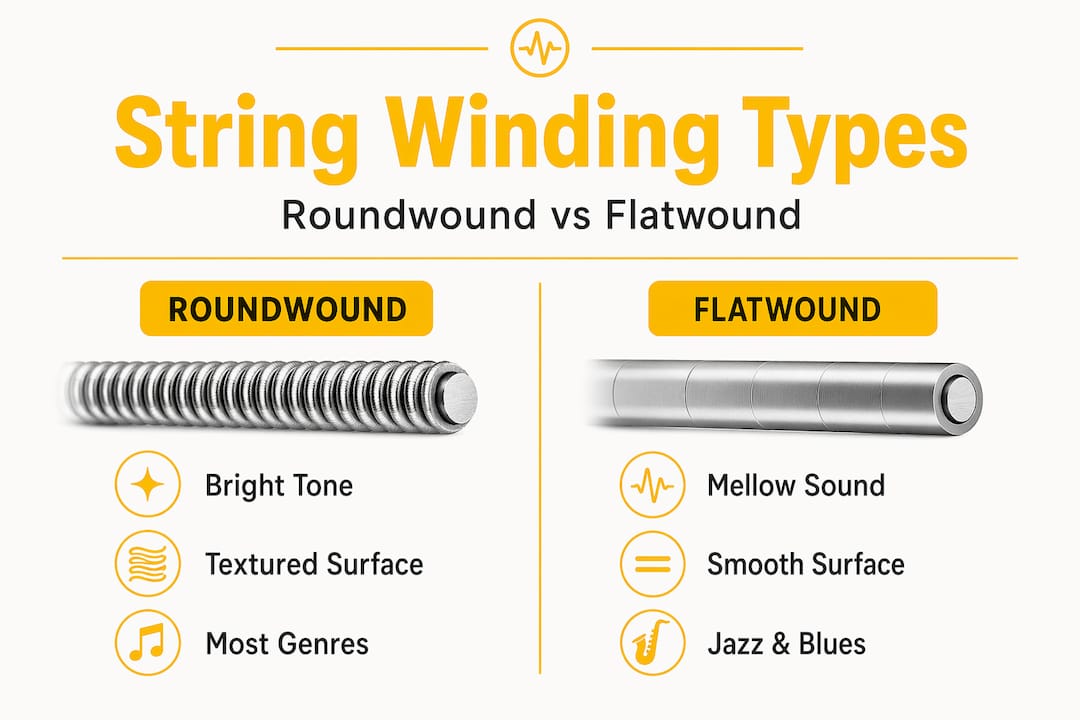
Roundwound strings have a textured, ridged surface produced by wrapping round wire around the core. They are bright, offer good grip for bending and vibrato, and are by far the most common type across genres. The trade-off is that the ridges catch on fingertips, generate finger squeak when sliding, and contribute to fret wear over time.
Flatwound strings use a flat ribbon of wire wound around the core, producing a smooth surface and a noticeably mellower, more subdued tone. They’re the preferred choice for jazz players who want that dark, warm sound without the treble edge. Changing string winding affects feel, tone, and playing technique, not just the sound coming out of the amp. Flatwounds genuinely change how you interact physically with the strings, which can alter your picking and fretting habits.
Halfwound strings (sometimes called groundwound or pressurewound) sit between the two. The outer wrap is partially flattened, giving a smoother feel than roundwound without the full tonal warmth of flatwound. They are a solid middle-ground choice for players who want roundwound versatility with reduced finger noise.
Here’s a quick breakdown of winding types by genre suitability:
- Roundwound: Rock, pop, country, metal, blues, most acoustic playing
- Flatwound: Jazz, R&B, some blues, vintage-style electric playing
- Halfwound: Soul, funk, studio work, players wanting roundwound tone with flatwound feel
Pro Tip: If you play jazz but find flatwounds too dark or stiff, try a halfwound string on your wound strings only. It’s a practical compromise that many session guitarists use without advertising it.
Guitar string gauges explained
String gauge refers to the diameter of the string measured in thousandths of an inch. It is the single biggest factor governing tension and playability, and gauge selection is primarily about tension, not just tone.
Common gauge ranges
- Extra light (acoustic: 10-47, electric: 8-38): Very low tension, easy bending, great for beginners and fingerstyle. More prone to intonation issues and breakage.
- Light (acoustic: 12-53, electric: 9-42): The most popular starting gauge for both acoustic and electric. Balances playability with tone.
- Medium (acoustic: 13-56, electric: 10-46): More volume and sustain on acoustic, fuller tone on electric. Requires more finger strength.
- Heavy (acoustic: 14-59, electric: 11-52 and above): Maximum tension, excellent tuning stability, preferred for drop tunings and heavier styles.
How gauge affects your guitar
Lighter gauge strings are easier to bend with less tension, making them beginner friendly and great for lead playing. Heavier gauges produce more tension and a fuller, louder tone but demand more effort from your fretting hand. There is also a structural dimension: gauge influences neck tension and overall guitar stability, meaning a significant gauge change can require a professional setup adjustment to the truss rod and saddle height.
| Gauge | Tension | Best for | Bending ease |
|---|---|---|---|
| Extra light | Very low | Beginners, fingerstyle | Very easy |
| Light | Low to moderate | All-rounders, lead | Easy |
| Medium | Moderate | Strummers, rhythm | Moderate |
| Heavy | High | Drop tuning, heavy styles | Difficult |
If you’re switching from 9s to 11s on an electric, budget for a setup at the same time. Your guitar will almost certainly need the neck relief and action adjusted to handle the extra tension correctly. Musicstreet’s guide to string gauge and playability walks through exactly what changes and why.
Coated vs uncoated strings
String coatings are polymer layers, typically applied to the outer wrap wire, that protect against sweat, oils, and environmental moisture. The practical benefit is significant. Coated strings can last three to five times longer than their uncoated equivalents, which matters considerably for players who gig regularly or whose hand chemistry corrodes strings quickly.
The benefits of coated strings in context:
- Longevity: Noticeably longer lifespan, particularly in humid climates or for players with acidic sweat
- Feel: Slightly slicker surface, which some players dislike but others find reduces fatigue on long sessions
- Tone: A small number of players argue coated strings sound marginally less bright than uncoated strings initially, though quality has improved significantly
- Cost efficiency: Higher upfront price but lower cost per hour of fresh-sounding strings
Coated strings make the most sense for gigging musicians, players who restring infrequently, and anyone who has noticed their strings going dull within a week or two of playing.
The terminology across brands varies considerably. “Coated”, “treated”, “protected”, and “extended life” can all refer to different levels of protection from different manufacturers. Some coat only the wound strings; others coat every string including the plain steel trebles. Reading the specific product description matters more than the marketing label.
Pro Tip: If you’re unsure about coated strings, buy one coated set and one uncoated set of the same gauge and brand. Play each for two weeks and compare feel and tone decay. Your own hands and ears are the only review that actually counts.
Special stringing options: Nashville tuning and beyond
Most guitarists stick to standard stringing configurations, but a few alternatives are worth knowing about, particularly if you record or want to add texture to your sound.
Nashville tuning is the most practical of these alternatives. Nashville tuning uses the higher-octave strings from a 12-string set, replacing the standard lower-octave wound strings on a six-string guitar. The result is a bright, jangly tone that sits differently in a mix than a standard guitar. The brightness comes from the string substitution itself, not from any processing, making it ideal for layering in sparse or mid-heavy mixes where you want shimmer without adding a second full guitar part.
Practical points to understand about Nashville tuning:
- You need a 12-string set and use only the octave strings for the lower four strings (E, A, D, G)
- Standard tuning is maintained; only the octave is raised on those four strings
- The guitar requires lower saddle action because the thinner strings sit at different tension
- It works particularly well for acoustic rhythm tracks recorded alongside a standard-tuned electric or acoustic
Beyond Nashville tuning, some players explore partial capos, alternate string materials on individual strings, or hybrid sets that combine light plain strings with heavier wound strings. These setups are niche, but they demonstrate that string configuration is a genuinely creative decision, not just a technical one.
My take on string experimentation
In my experience, most guitarists underestimate how much strings shape their sound and overestimate how much their pedals or amp do. I’ve watched players spend significant money on new gear when a string change would have addressed the actual problem: dull tone, poor intonation, or strings that fight their technique rather than supporting it.
What I’ve found after years of working with guitarists at all levels is that the winding type tends to be the most overlooked variable. Players research gauge obsessively but stick with roundwound strings by default, never realising that switching to halfwound would solve the finger fatigue they’ve been blaming on their technique.
The neck tension angle is another one that catches people out. Moving from light to medium gauge on a vintage-style neck without adjusting the truss rod creates tuning instability and string buzz, then players conclude the strings are bad rather than understanding it’s a setup issue.
My honest advice: buy two or three different sets, keep notes on how each feels and sounds after a week of regular playing, and trust what your hands and ears tell you over what any description claims. String choice evolves with your playing, and the set that suited you as a beginner will likely not be the right choice three years into serious practice.
— Musicstreet
Find your perfect strings at Musicstreet

Whether you’re restringing an acoustic for the first time or searching for the exact gauge that suits your drop-tuned electric, Musicstreet carries a curated selection of premium guitar strings across all materials, gauges, and winding types. From phosphor bronze acoustic sets to coated electric strings from trusted brands, you’ll find options suited to every style and budget.
Musicstreet also provides practical guides to help you get the most from your choice. If you want to go deeper on gauge selection, the choosing the right gauge guide covers everything from beginner setups to drop-tuning considerations. And when you’re ready to restring, the step-by-step restringing guide walks you through the process correctly. Explore the full range of guitars and accessories at Musicstreet and get the sound you’ve been working towards.
FAQ
What are the main types of guitar strings?
The main types are nylon, 80/20 bronze, phosphor bronze, nickel-plated steel, pure nickel, and stainless steel. Each material produces a distinct tone and suits specific guitar types and playing styles.
What is the difference between light and heavy gauge strings?
Light gauge strings have less tension, making them easier to bend and more comfortable for beginners. Heavy gauge strings have greater tension, fuller tone, and better tuning stability, but require more finger strength and may need a guitar setup adjustment.
Are coated strings worth it?
Coated strings last significantly longer than uncoated strings, with some manufacturers citing three to five times the lifespan. They are particularly worthwhile for gigging players or anyone whose strings go dull quickly after playing.
What is the difference between roundwound and flatwound strings?
Roundwound strings have a textured surface and a bright tone, making them the standard for most genres. Flatwound strings are smooth and produce a mellow, subdued sound preferred by jazz players.
What is Nashville tuning on guitar?
Nashville tuning replaces the standard lower-octave wound strings on a six-string guitar with the higher-octave strings from a 12-string set. The result is a bright, jangly tone that adds shimmer when layered with a normally tuned guitar in recordings.







Share:
What gauge strings are best for acoustic guitar
Acoustic electric guitar vs acoustic: which suits you?