


- Drop D tuning lowers the sixth string from E to D, creating a fuller bass sound.
- It simplifies power chords and enhances creative possibilities across genres.
- Proper tuning and handling techniques prevent damage and ensure accurate, versatile playing.
Drop D tuning is one of those deceptively simple adjustments that transforms what your guitar can do. Lower the 6th string from E down to D, and suddenly you’ve got a deeper, more resonant instrument that feels almost new beneath your fingers. Many players dismiss it as a rock or metal trick, but that misses the point entirely. Drop D opens doors for folk fingerpickers, acoustic songwriters, blues players, and complete beginners alike. This article breaks down everything you need to know: what Drop D is, how to achieve it reliably, why it changes your playing, and how to handle its quirks confidently.
Table of Contents
- Understanding Drop D tuning: The basics
- How to tune your guitar to Drop D
- Why Drop D tuning transforms your playing
- Common challenges and practical tips for Drop D tuning
- What most guides miss: Drop D tuning for lasting creativity
- Explore premium guitars and accessories for your Drop D journey
- Frequently asked questions
Key Takeaways
| Point | Details |
|---|---|
| Easy access for beginners | Drop D tuning unlocks simple power chords and creative riffs without advanced skills. |
| Wider musical possibilities | Drop D expands your guitar’s sonic range, making genres like rock, folk, and acoustic richer. |
| Mastering tuning technique | Using a tuner and tuning gradually prevents string issues and achieves precise Drop D tuning. |
| Creative growth tool | Changing tunings regularly builds new habits and boosts songwriting creativity for any guitarist. |
Understanding Drop D tuning: The basics
Drop D tuning is the most widely used alternative guitar tuning, and for good reason. It requires only one change from standard tuning: you lower the 6th string (the thickest, lowest-pitched string) from E down to D. Every other string stays exactly the same. That single adjustment gives you a lower, fuller bass note and unlocks a whole new landscape of chord shapes, riffs, and techniques.
Here’s a quick visual comparison so you can see at a glance what changes:
| String | Standard tuning | Drop D tuning |
|---|---|---|
| 6th (thickest) | E | D |
| 5th | A | A |
| 4th | D | D |
| 3rd | G | G |
| 2nd | B | B |
| 1st (thinnest) | E | E |
Only one note shifts. Yet the effect on your playing is dramatic.
When it comes to actually getting your guitar into Drop D, you have three reliable methods. The first is to use a clip-on or pedal tuner, which is the quickest and most accurate option. The second is to match the open 6th string to the open 4th string (D), though bear in mind the 6th string sounds an octave lower. The third is to match the open 6th string to the note at the 5th fret of the 5th string (A string), which also produces a D. As acoustic guitar experts advise, always tune down gradually to avoid placing sudden stress on the string or the nut.
Always tune down gradually to avoid string issues. Rushing through the process can cause strings to snap or affect your guitar’s intonation, which creates more problems than it solves.
A solid guitar tuning guide is invaluable here, especially if you’re new to alternative tunings. Learning the fundamentals of tuning by ear alongside using a tuner builds a stronger musical ear over time. You can also explore the practicalities of using guitar tuners for precise results, which is particularly helpful when you’re switching between tunings mid-session.
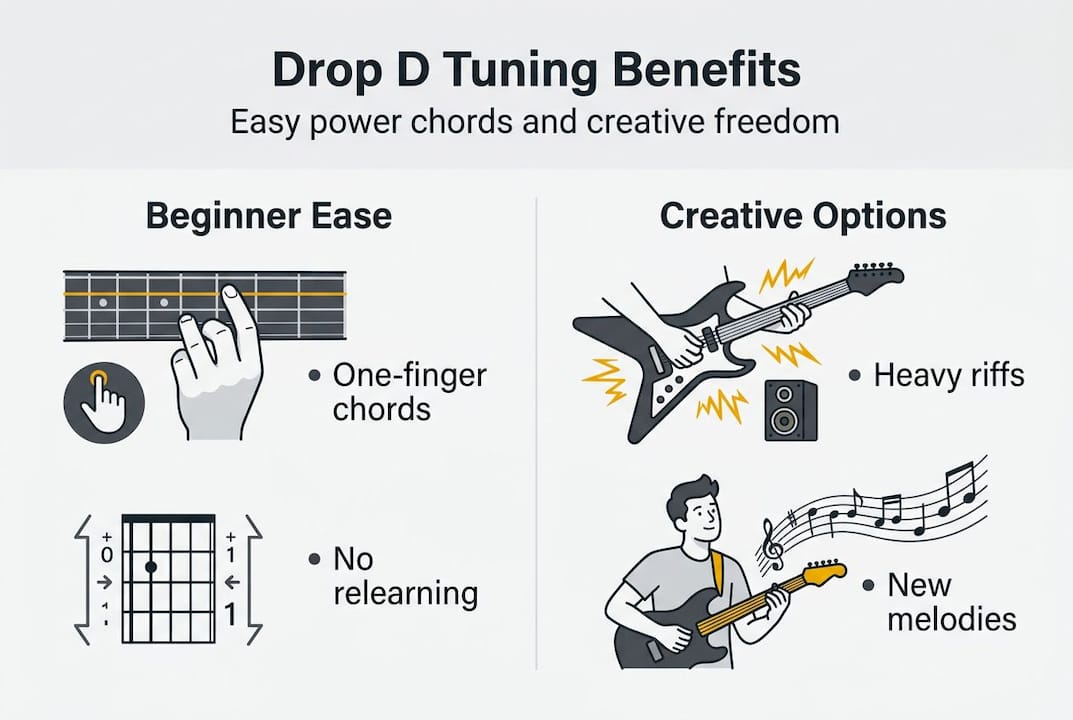
One reason Drop D is so accessible is that it demands zero relearning of the top five strings. Chords on strings 1 through 5 work exactly as they do in standard tuning. Your muscle memory stays intact. Beginners find it an encouraging first step into the world of alternative tunings because it’s low-risk and immediately rewarding. Experts, meanwhile, use it as a creative springboard that generates ideas they simply couldn’t access in standard tuning. Whether you’re picking up the guitar for the first time or you’ve been playing for twenty years, Drop D is worth knowing thoroughly.
Investing in a reliable tuner is one of those essential guitar accessories that pays dividends across your entire playing life, not just for Drop D but for every musical situation you encounter.
How to tune your guitar to Drop D
With the fundamentals clear, let’s walk through actually tuning your guitar to Drop D, supported by expert advice.
Follow these steps every time you switch to Drop D, and you’ll avoid the most common pitfalls:
- Start in standard tuning. Make sure all six strings are at their correct standard pitches (E, A, D, G, B, E) before you make any changes. Trying to tune to Drop D from an already out-of-tune guitar introduces compounding errors.
- Identify the 6th string. This is the thickest string, the one closest to the ceiling when you hold the guitar in playing position. You’re only touching this string.
- Loosen the 6th string gradually. Turn the tuning peg slowly to lower the pitch. Go in small increments rather than large sweeping turns.
- Match the pitch to D. Use a clip-on tuner, a phone tuning app, or your ear. If using your ear, tune down gradually and compare the open 6th string to the open 4th string (D), aiming for the same note one octave lower.
- Check intonation. Play a few chords and listen for anything that sounds slightly off. Intonation refers to how accurately the guitar plays in tune across the fretboard, not just on open strings.
- Re-check all other strings. Changing tension on one string can occasionally affect neighbouring strings, particularly on guitars with floating bridges. Give everything a quick check before you start playing.
- Play something you know. This is both a test and a reward. Run through a riff or chord progression you’re comfortable with to confirm everything sounds right.
Pro Tip: Always check intonation after tuning to Drop D, especially on acoustic guitars and guitars with tremolo systems. A few minutes checking intonation can save you from a whole session of playing in tune with yourself but out of tune with everyone else.
Common mistakes include forgetting to verify all strings after the change, tuning the wrong string entirely (it happens more than you’d think), and skipping the intonation check. These issues are easily avoided with a reliable tuner. Clip-on tuners, chromatic pedal tuners, and smartphone apps all work well. Browse the range of best guitar accessories to find a tuner that suits your setup and budget, and check out the essential guitar tools guide for broader recommendations that every guitarist benefits from owning.
Why Drop D tuning transforms your playing
Once you’ve tuned to Drop D, here’s how it opens up new and easier playing options you might not have considered.

The single most celebrated benefit of Drop D is the one-finger power chord. In standard tuning, playing a power chord on the low strings requires at least two fingers, often three. In Drop D, barring across the lowest three strings produces a full, heavy power chord with a single finger. That’s because the 6th, 5th, and 4th strings in Drop D are tuned to D, A, and D respectively, forming a perfect fifth interval that sounds powerful and complete. Rock and metal players have used this for decades, but the same efficiency benefits anyone who wants to move quickly between low chord positions.
Here’s how the shapes compare:
| Chord | Standard tuning shape | Drop D shape |
|---|---|---|
| D5 (power chord) | Two or three fingers on strings 5 and 6 | One finger barring strings 4, 5, 6 |
| D major open | Standard D shape (strings 1 to 4) | Standard D shape plus open 6th string |
| Low riff movement | Requires complex fingering | Single-finger slide up and down |
The efficiency gain is real and significant. Riffs that felt clunky at speed in standard tuning often become fluid and natural in Drop D.
Beyond power chords, Drop D tuning benefits a wide range of genres and techniques:
- Rock and metal: Fast, heavy riffing with minimal finger movement between positions.
- Folk and acoustic fingerpicking: The low D bass note adds warmth and depth to fingerstyle arrangements.
- Travis picking: The alternating bass note pattern (a staple of country and folk guitar) gains a satisfying resonance in Drop D.
- Hybrid picking: Combining pick and fingers with the low D string creates interesting textural contrasts.
- Blues: The low D allows for expressive, deep bass runs that complement slide guitar and pentatonic improvisation.
- Classical-influenced playing: Composers and arrangers often use Drop D to achieve bass notes not available in standard tuning.
For beginners, Drop D provides quick wins that build confidence fast. Songs that would otherwise require complex chord transitions suddenly become manageable. Check out easy guitar songs that use Drop D to get started immediately, or browse guitar lessons for beginners for structured guidance. For experienced players, Drop D’s value lies in creative flexibility. You can write in new keys, voice chords differently, and approach the instrument with fresh ears simply by making that one-string change.
Common challenges and practical tips for Drop D tuning
Even with its creative potential, Drop D tuning has unique challenges. Here’s how to handle them confidently.
The most immediate issue many players notice is that familiar chord shapes sound different. An open Em chord, for example, normally uses the 6th string as a root note. In Drop D, that string is now D rather than E, which means the chord sounds altered or wrong if you play it the same way. As fretello’s guidance explains, standard chords that use the 6th string need adjustment in Drop D, and switching carelessly between tunings can result in playing wrong notes without realising it.
Here are the most frequent challenges players encounter and how to address them:
- Altered chord sounds: Any open chord that uses the 6th string (Em, E major, Am with a low E bass) will sound different. Either mute the 6th string or learn the adjusted voicing for Drop D.
- Muting the 6th string: This requires deliberate technique. Use the underside of your fretting hand’s index finger to lightly touch the 6th string when you don’t want it ringing.
- Forgetting you’ve changed tuning: This is surprisingly common, especially in longer practice sessions. Keep a note on your music stand or use a coloured marker on your tuning peg as a reminder.
- Intonation drift: Particularly on cheaper guitars, lowering the 6th string can cause slight intonation issues higher up the neck. Always check by playing a few notes at the 12th fret.
- Switching back to standard mid-session: If you’re playing songs in both tunings, slow and deliberate re-tuning between each is essential. Rushing creates sloppy tuning that affects the whole performance.
Pro Tip: Build Drop D into a dedicated practice routine rather than switching on the fly. Spend a full session exclusively in Drop D, exploring the altered chord shapes and new bass possibilities. Treating it as its own tuning system, rather than a deviation from standard, accelerates your fluency dramatically.
Integrating Drop D into your regular practice also means equipping yourself properly. Browse the beginner guitarist essentials page for recommended starter gear and learn how to choose guitar accessories that support your tuning habits, from reliable clip-on tuners to capos designed for alternate tunings.
What most guides miss: Drop D tuning for lasting creativity
Most articles about Drop D spend all their time on power chords and rock riffs. That’s useful, but it’s only a fraction of what this tuning offers. The deeper value of Drop D lies in how it forces you to think differently about the instrument.
When your lowest string is in a new place, your familiar patterns break down. That breakdown, uncomfortable as it feels at first, is where genuine musical growth happens. Beginners expand rapidly because they’re not fighting years of ingrained standard-tuning habit. Experienced players, particularly those who’ve grown comfortable in standard tuning, often find that Drop D unlocks entirely new songwriting ideas. The tuning naturally suggests bass lines, open chord voicings, and harmonic combinations that simply don’t arise in standard tuning.
There’s also something to be said for intentionality. Switching to Drop D for a practice session or songwriting afternoon creates a mental shift, a signal to your brain that you’re exploring rather than executing. That shift invites experimentation. Some of the most interesting guitar work in folk, alternative rock, and acoustic music comes from players who use tuning changes as a creative prompt. If you’re looking for beginner guitar lessons that incorporate alternative tunings from the outset, starting with Drop D gives you a genuine creative advantage from day one.
Explore premium guitars and accessories for your Drop D journey
If Drop D tuning has sparked something in your playing, MusicStreet is the ideal place to take that enthusiasm further.

At MusicStreet, you’ll find an expertly curated selection of electric, acoustic, and bass guitars suited to every playing style, from beginner-friendly starter packs to professional-grade instruments from the world’s most respected brands. Whether you’re searching for a guitar that resonates beautifully in Drop D, a reliable clip-on tuner, quality string sets, or expert advice on alternative tunings, our team is here to help. Visit us online or in our Huntingdon, Cambridgeshire store for a hands-on experience, professional instrument setup, and the kind of honest, knowledgeable guidance that only a specialist retailer can offer. Browse MusicStreet’s full range and start your Drop D journey properly equipped.
Frequently asked questions
Can Drop D tuning be used on any guitar?
Yes, Drop D tuning works on electric, acoustic, and classical guitars. Simply lower the 6th string from E to D and check for any unusual string tension or buzzing before playing.
Which famous songs use Drop D tuning?
Many classics across genres use Drop D, including Everlong by Foo Fighters, Black Hole Sun by Soundgarden, and Dear Prudence by The Beatles, demonstrating its broad creative reach.
Do I need special strings or equipment for Drop D tuning?
No, standard strings work perfectly well for Drop D. Using a reliable tuner helps, and a quick intonation check after tuning ensures everything plays correctly across the fretboard.
Can Drop D tuning damage my guitar?
No, Drop D is completely safe provided you tune down gradually and avoid sudden, aggressive string changes. The reduced tension on one string is well within any standard guitar’s design tolerances.







Share:
The essential types of guitar tones for every style
7 Signs Your Guitar Needs a Professional Setup