


Choosing the right guitar strings involves matching string gauge, type, and coating to your instrument and playing style for optimal sound and comfort. Always verify individual string sizes before purchase and establish a consistent setup by replacing strings with the same brand and gauge to maintain tone. Patience and methodical experimentation help find your ideal strings, with coated options offering longer-lasting performance for regular players.
Walk into any music shop or browse online for guitar strings and the sheer variety can stop you in your tracks. You have roundwound, flatwound, coated, uncoated, phosphor bronze, nickel wound, light gauge, heavy gauge. Knowing how to buy guitar strings that actually suit your instrument and playing style is a skill that takes a little learning upfront but pays off every time you pick up your guitar. This guide covers string types, gauges, preparation, and the buying process itself so you can make a confident, informed choice.
Key takeaways
| Point | Details |
|---|---|
| Match your current setup first | Replacing strings with the same gauge and brand gives the most consistent tone and feel from the start. |
| String type shapes your sound | Roundwound strings suit bright, punchy genres; flatwound strings deliver warmer, smoother tones for jazz and blues. |
| Gauge affects playability directly | Lighter gauges are easier to bend; heavier gauges improve tuning stability, especially for lower tunings. |
| Coated strings last significantly longer | Coated strings typically last 3 to 6 months compared to 3 to 6 weeks for uncoated, but cost more upfront. |
| Check individual string sizes on the pack | Gauge labels vary between brands, so always verify the actual measurements printed on the packaging. |
Understanding guitar string types
Before you spend a penny, it helps to understand what separates one set of strings from another. The term “guitar string types” covers three main variables: the winding method, the core material, and whether the strings have a protective coating.

Winding methods
Roundwound and flatwound strings are the two most common winding styles, and they produce noticeably different playing experiences. Roundwound strings deliver bright, punchy tone with a textured feel that most rock, pop, and country players prefer. Flatwound strings have a smooth surface that reduces finger noise and produces a warmer, more mellow sound, making them a favourite for jazz and blues guitarists.
Core materials
The material the string is made from has a direct effect on tone and longevity. Here is a quick breakdown of the most common options:
- Steel and nickel wound strings are the standard choice for electric guitars, offering balanced brightness and warmth.
- Phosphor bronze strings are widely used on acoustic guitars for their rich, warm tone with a slight sparkle in the upper frequencies.
- Nylon strings are found on classical and flamenco guitars and produce a soft, mellow tone that is gentler on the fingers.
- 80/20 bronze strings (also called brass) give acoustics a very bright, crisp sound but tend to lose that brightness relatively quickly compared to phosphor bronze.
Coated vs uncoated
This is where budget meets longevity. Coated strings last approximately 3 to 5 times longer than uncoated alternatives, with a typical lifespan of 3 to 6 months compared to 3 to 6 weeks for uncoated strings. Players with sweaty hands or those living in humid climates benefit most from coated options since environmental factors like humidity significantly affect how quickly strings corrode and lose tone. The tradeoff is cost. Coated strings are more expensive per set, though the extended lifespan often balances out over time.
Pro Tip: Handle coated strings carefully. Avoid nicking or abrading the coating during installation, as even small areas of damage can reduce the lifespan benefit significantly.
Choosing the right string gauge
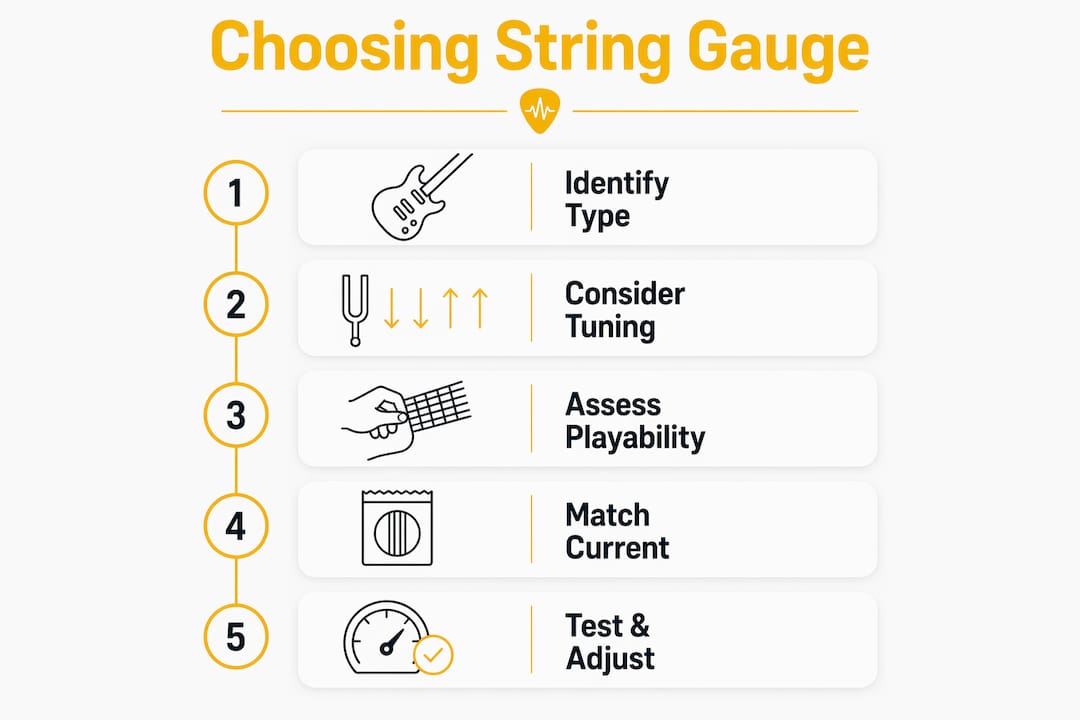
String gauge refers to the thickness of the strings, typically measured in thousandths of an inch. It has a bigger impact on feel and playability than most beginners expect.
What the numbers mean
| Guitar type | Common gauge set | Typical feel |
|---|---|---|
| Electric (super light) | .009–.042 | Very easy to bend, softer attack |
| Electric (regular/light) | .010–.046 | Balanced feel for most styles |
| Acoustic (custom light) | .011–.052 | Comfortable for beginners |
| Acoustic (light) | .012–.053 | Fuller tone, slightly more resistance |
| Bass (standard) | .045–.105 | Standard tension, versatile |
Lighter gauges are easier to bend and fret but can sacrifice tuning stability, especially in drop tunings. Heavier gauges provide stronger resistance and a fuller, louder tone, but they can fatigue your fretting hand more quickly. This makes lighter sets a sensible starting point for beginners and lead players, while heavier sets suit rhythm guitarists and those who tune below standard.
Tuning and gauge
If you play in standard tuning, most light or regular gauge sets work well. Drop tunings like Drop D or Drop C genuinely benefit from a heavier gauge because balanced string tension across all strings is what keeps the guitar sounding and feeling consistent. A very light string in a low tuning becomes floppy and difficult to control. The practical advice here is to step up one gauge at a time rather than jumping from a .009 set to a .013 set overnight. Your fingers and your guitar’s setup will thank you.
Pro Tip: When experimenting with a new gauge, give yourself at least two full playing sessions before deciding whether it suits you. First impressions after a change are often misleading.
For more detail on choosing thickness for acoustic guitars specifically, Musicstreet’s guide on acoustic string gauges is worth reading before you buy.
Preparing to buy guitar strings
Getting your preparation right before you purchase saves a wasted trip or a returned order. There are a few things to sort before you click “add to basket” or head to the shop.
Identify your current strings
The simplest approach is to look at the pack your current strings came in. If you still have it, note the brand, gauge designation, and material. Replacing strings with the same gauge and brand produces the most consistent tone and feel, which is exactly what you want if your current setup suits you.
If you do not have the original pack, use a pair of digital calipers to measure the strings currently on the guitar. Measuring your installed strings is the most reliable way to confirm what you have, particularly given that gauge labels are not consistent across brands.
Tools you will need
Before installing any new strings, gather these:
- A string winder (saves time and effort when removing old strings)
- Wire cutters or string snippers (to trim excess length after winding)
- A clip-on or pedal tuner (to tune up accurately after fitting)
- A clean cloth (to wipe down the fretboard while the strings are off)
Pro Tip: Use the string change as an opportunity to clean the fretboard and check for any fret wear. With the strings off, you have clear access to the whole neck.
The tools required are mostly the same whether you play acoustic or electric, though acoustic players should also check whether their guitar uses ball-end or tie-end strings at the bridge, as these require slightly different fitting techniques.
| Guitar type | Bridge style | String end type |
|---|---|---|
| Electric | Tremolo or hardtail | Ball-end |
| Acoustic (steel string) | Pin bridge | Ball-end |
| Classical/nylon | Tie block | Tie-end (no ball) |
The buying process: making the right choice
With your preparation done, the actual buying decision becomes much more straightforward. Whether you shop online or in person, the following steps apply.
-
Check the packaging carefully. Look beyond the gauge name (like “light” or “medium”) and read the actual individual string sizes printed on the pack. Different brands label the same thickness differently, so always check individual string gauges on the pack before purchasing.
-
Match strings to your guitar type. Electric strings on an acoustic guitar is a mistake that happens more often than you might think. Acoustic strings are generally heavier and produce better volume and tone on acoustic instruments. Putting nylon strings on a steel-string guitar is not possible, and using steel strings on a classical guitar can damage the instrument.
-
Consider your playing style honestly. If you spend most of your time playing rhythm parts and strumming hard, a medium gauge gives you the full, punchy tone you need. If you bend notes regularly and play lead lines high up the neck, a lighter gauge reduces hand strain significantly.
-
Weigh up coated versus uncoated. If you play daily, coated strings may cost more per set but save money and hassle over the course of several months. If you play occasionally or prefer the raw feel of uncoated strings, a standard set is perfectly fine.
-
Stick with reputable brands when starting out. Well-known string manufacturers maintain consistent quality and tension across their product lines. Once you know what you like, you can branch out and compare.
- Avoid buying the cheapest no-name sets you can find. Poor quality control means the gauges may be inconsistent, and the tone can be noticeably worse.
- Buying in multipacks often reduces the cost per set significantly without sacrificing quality.
- Online retailers often list full string-by-string gauge breakdowns, which makes comparison much easier than reading small print on a shop shelf.
Troubleshooting common mistakes
Even experienced players make errors when selecting or installing strings. Knowing the warning signs keeps you from being frustrated after a fresh change.
- Fret buzz after fitting: This is often a sign that you have gone too light in gauge. Lighter strings have less tension, and if your guitar’s action and truss rod were set up for heavier strings, buzz is the result. Step up one gauge or visit a guitar technician for a setup.
- Tuning instability: New strings keep moving initially, affecting tension and playability perception. Stretch each string gently after fitting and tune it repeatedly until it holds. Persistent instability beyond the first session suggests a gauge mismatch or a nut slot issue.
- Discomfort and hand fatigue: If your fretting hand aches more than usual after a string change, you have likely gone too heavy. Reduce the gauge gradually rather than dropping several sizes at once.
- Strings sound dull immediately: This usually points to low-quality strings or a coated set where the coating is too thick. It can also mean you touched the strings extensively during installation with oily hands. Wash your hands before fitting strings and wipe them down with a clean cloth afterwards.
Pro Tip: Do not judge a new set of strings mid-session on the day you fit them. Tune up properly after installation, play for 15 to 20 minutes to let the strings settle, retune, and then form your opinion.
For more detail on how gauge choices affect your tone and playing feel, read Musicstreet’s guide on string gauge and playability.
My honest take on buying guitar strings
I have changed enough strings over the years to have made every mistake in this guide at least once. The one I see most often, and the one that frustrates players the most, is the temptation to experiment wildly on the first replacement after reading about string gauges online.
My genuine recommendation is this: match your current setup exactly on your first purchase. Stick with the same brand, the same gauge, the same winding type. That way, if something feels off after the change, you know the strings are not the variable. You know it is either the installation or the guitar needing attention.
I have also found that the coating conversation gets distorted quite a bit. Players often assume coated strings feel artificial or dull. In my experience, the better coated sets today are almost indistinguishable from uncoated in terms of tone and feel, and the longevity advantage is real. If you play in a warm room or notice your hands sweat during longer sessions, coated strings are not a compromise. They are a practical choice.
String selection is one of those areas where patience pays off. Try one change at a time, give it a fair hearing over several sessions, and build up your personal reference point from there. It takes a few rounds, but eventually you will know exactly what you want without needing to second-guess the pack.
— Musicstreet
Find your perfect strings at Musicstreet
At Musicstreet, we stock strings for electric, acoustic, and bass guitars across a range of gauges, materials, and brands, so you can find exactly what matches your playing style and instrument.

Whether you are replacing a set for the first time or exploring a new gauge after reading this guide, our team is on hand to help you choose correctly. Browse our full guitar strings selection online, or visit us at our Huntingdon store for hands-on advice. We also offer expert guitar setup services, so if a string change reveals an underlying action or intonation issue, we have you covered there too. Free UK delivery is available on qualifying orders, making it easy to stock up on a multipack and keep spares ready.
FAQ
What string gauge should a beginner start with?
Most beginners do well with a light gauge set, such as .010 to .046 on electric or .011 to .052 on acoustic. These gauges are easier on the fingers whilst still providing a full enough tone to sound good.
Are coated guitar strings worth the extra cost?
Yes, for most players. Coated strings last 3 to 6 months compared to 3 to 6 weeks for uncoated, making the higher upfront cost offset by fewer replacements, especially for regular players.
Can I put any strings on my guitar?
No. You need to match the string type to your guitar. Steel strings are not suitable for classical guitars, and electric strings do not perform well on acoustic instruments. Always check your guitar type before purchasing.
How do I know what gauge strings I currently have?
Check the original pack if you still have it. If not, use digital calipers to measure the strings currently fitted. Measuring installed strings is more reliable than guessing, given that brand gauge labels are not always consistent.
Why do my new strings keep going out of tune?
New strings stretch significantly in the first few hours of use. Tune up, play for a while, retune, and repeat. New strings keep moving initially until the tension stabilises, which typically takes one to two playing sessions.









Share:
Fender Stratocaster Buyer's Guide: Which Model Is Right for You?
Best guitar string material: tone, feel and durability