


Most guitarists have been there: you nail a dramatic dive bomb, the crowd reacts, and then you strum a chord that sounds like a cat in distress. Standard tremolo systems rely on friction to hold string tension, and friction eventually loses. Locking tremolos changed that equation entirely. By physically clamping strings at the nut and bridge, they remove the slippage that sends vintage systems out of tune. This guide covers exactly what a locking tremolo is, how it works mechanically, where it excels, where it struggles, and how to decide whether one belongs on your guitar.
Table of Contents
- What is a locking tremolo?
- How does a locking tremolo improve tuning stability?
- Pros, cons and common misconceptions
- Is a locking tremolo right for your playing style?
- A fresh perspective on locking tremolos
- Explore the best guitar bridges to elevate your playing
- Frequently asked questions
Key Takeaways
| Point | Details |
|---|---|
| Superior tuning stability | Locking tremolos keep your guitar in tune—even during extreme tremolo use—by preventing string slippage. |
| Demanding setup and maintenance | Precise installation and adjustment are critical for enjoying the benefits of a locking system. |
| Trade-offs to consider | Locking tremolos offer great performance but can reduce sustain and be more complex to maintain. |
| Not for every player | Consider your genre, playing style and willingness to learn setup before choosing a locking tremolo. |
What is a locking tremolo?
A locking tremolo is a bridge system that clamps strings at two points, typically the nut and the bridge saddle, to prevent any movement during use. Where a standard tremolo relies on string tension returning to its original position after you release the arm, a locking system removes that variable entirely. The strings are physically fixed, so there is nothing to slip.
The most recognised name in this space is the Floyd Rose, introduced in 1977 and still the benchmark for locking tremolo systems that prevent string slippage at the nut and offer superior stability for dive bombs compared to vintage tremolos. Other respected systems include the Ibanez Edge, found on many of their prestige models, and the Gotoh GE1996T. Each follows the same core principle with slight engineering differences.
The main components of a locking tremolo are:
- Locking nut: Replaces the standard nut and uses small clamp blocks to fix the strings in place
- Double-locking bridge: Saddles that grip each string individually at the bridge end
- Fine tuners: Small adjustment screws on the bridge that allow micro-tuning after the nut is locked
- Tremolo arm (whammy bar): The lever that pivots the bridge to raise or lower pitch
- Spring cavity: A routed section in the body housing springs that counterbalance string tension
Understanding how these parts interact is much easier when you already have a solid grasp of types of guitar bridges and how they differ in function and feel.
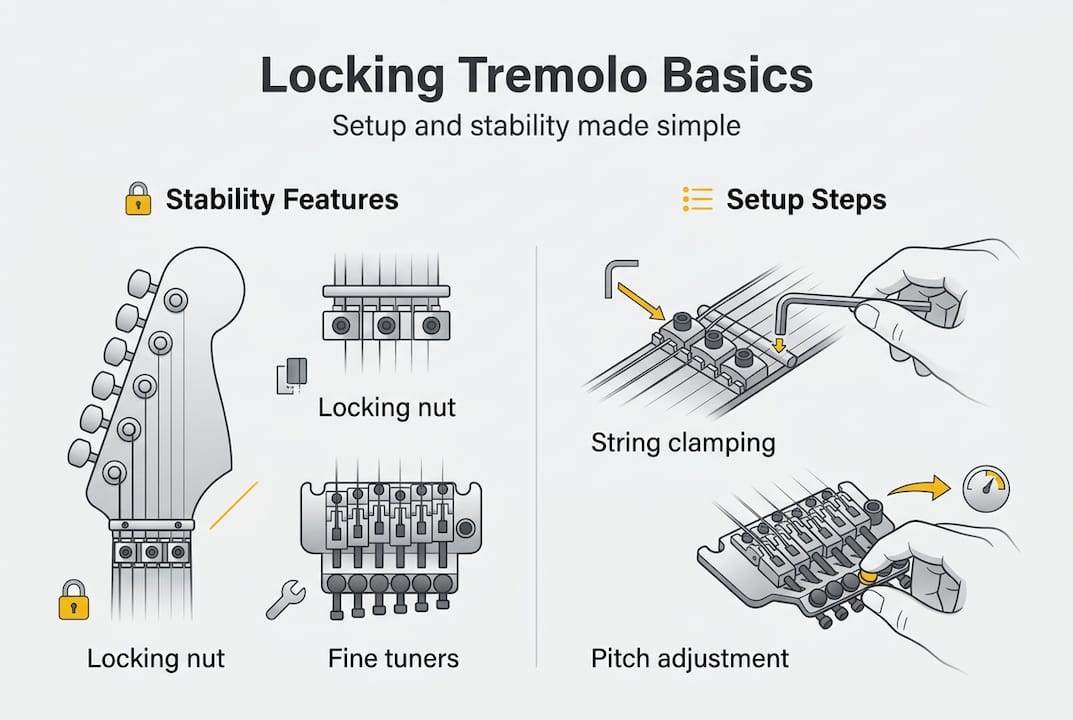
The typical player drawn to a locking tremolo is performing metal, hard rock, or shred, where extreme pitch effects like dive bombs, flutter, and screaming bends are part of the vocabulary. That said, the system has appeared on everything from fusion guitars to signature models used in genres you would not immediately associate with a Floyd Rose.
Pro Tip: When you lock the nut, you can no longer use the standard tuning pegs to adjust pitch. Always tune up before locking the nut, then use the fine tuners for any small corrections.
How does a locking tremolo improve tuning stability?
To appreciate what a locking tremolo does, it helps to understand why vintage systems fail under pressure. A Fender-style tremolo, for example, relies on the string passing over a nut slot and returning to the same position after the arm is released. Every point of contact is a friction point. String trees, the nut, the saddle, even the tuning peg: all of these can cause the string to catch slightly and return to a marginally different tension. Do that ten times in a set and your guitar drifts noticeably flat.

A locking tremolo eliminates those friction points by clamping the string at the nut and bridge. The string has nowhere to go. When you push the arm down for a dive bomb and release it, the string returns to exactly the same tension because it was never free to move in the first place. Locking systems offer dramatically better tuning stability for extreme tremolo use, maintaining pitch better than vintage tremolos across repeated heavy use.
This is why experienced players can execute drops of five to seven semitones and return to perfect pitch. That range is simply not achievable with a vintage system without significant retuning.
| Feature | Vintage tremolo | Locking tremolo |
|---|---|---|
| Tuning stability | Moderate | Excellent |
| Pitch range | 2 to 3 semitones | 5 to 7 semitones |
| Restringing ease | Simple | More involved |
| Maintenance frequency | Low | Moderate to high |
| Fine-tuning method | Tuning pegs | Fine tuners on bridge |
| Tone character | Warm, resonant | Bright, articulate |
The fine tuners on a locking bridge deserve special mention. Because the nut is locked, you cannot use the headstock tuners for small corrections mid-performance. The fine tuners compensate for this, giving you precise micro-adjustment without unlocking the nut. If you are browsing best guitars under £1000 that include locking systems, pay attention to the quality of the fine tuners as much as the bridge itself.
Pros, cons and common misconceptions
Locking tremolos have a devoted following for good reason, but they are not without trade-offs. Understanding both sides helps you make a genuinely informed choice rather than following hype.
Advantages:
- Exceptional tuning stability under heavy use
- Ability to perform extreme pitch effects reliably
- Consistent performance across long live sets
- Works well with high-output pickups and aggressive playing styles
- Trusted by professional touring musicians for decades
Compromises:
- Restringing takes significantly longer than a standard bridge
- Setup requires patience and precision, especially balancing spring tension
- String changes mid-gig are genuinely difficult
- The mechanical construction can affect sustain and low-end resonance
On the topic of sustain, locking trems demand precise setup discipline, and shortcuts cause drift. While they excel in pitch range, they may affect sustain compared to fixed bridges due to the additional mechanical components between string and body.
“The locking tremolo is not a shortcut to better tone. It is a precision tool for a specific job. Treat it that way and it rewards you. Neglect the setup and it punishes you.”
Now for the myths. The most persistent misconception is that locking tremolos ruin your tone. In reality, tone is shaped by dozens of variables: tonewoods, pickups, amp settings, playing technique. A well-set-up Floyd Rose on a quality guitar can sound extraordinary. The second myth is that these systems are only for metal. Look at the catalogue of players like Alex Lifeson, who used Floyd Rose-equipped guitars across a wide range of musical textures, and that argument falls apart quickly.
For players exploring guitar bridge types for the first time, or those reading up on shred guitar insights to understand how technique and gear interact, the locking tremolo sits at the intersection of engineering and expression.
Is a locking tremolo right for your playing style?
The honest answer is: it depends entirely on what you play and how you play it. A locking tremolo is a remarkable tool in the right context and an unnecessary complication in the wrong one.
| Bridge type | Best genre fit | Tuning stability | Maintenance level |
|---|---|---|---|
| Locking tremolo (Floyd Rose) | Metal, shred, hard rock | Excellent | High |
| Vintage tremolo (Fender-style) | Blues, classic rock, pop | Moderate | Low |
| Hardtail fixed bridge | Jazz, blues, heavy rhythm | Excellent | Very low |
| Tune-o-matic (Gibson-style) | Rock, jazz, country | Good | Low |
| Modern vintage with locking tuners | Rock, pop, mild vibrato | Good to very good | Low to moderate |
Floyd Rose systems excel in extremes but are harder to restring, while modern vintage-style bridges with locking tuners are now close in stability for milder use. That is a significant point. If you rarely use the tremolo arm for more than gentle vibrato, a well-maintained vintage bridge with locking tuners may give you 90% of the stability with none of the restringing headache.
If you are considering making the switch, here is what to expect:
- Setup time increases. Your first full setup with a locking tremolo will take longer than you expect. Budget an afternoon.
- String changes require new tools. You will need small Allen keys and ideally a locking nut wrench.
- Spring tension needs balancing. Changing string gauge means re-balancing the bridge, which affects tuning and feel.
- Fine tuners become your best friend. Learn to use them confidently before your first gig.
- The payoff is real. Once set up correctly, the stability is genuinely impressive.
Pro Tip: Before committing to a guitar with a locking tremolo, try one in person. MusicStreet’s Huntingdon store lets you play instruments before purchasing, which is invaluable for a decision like this.
For players exploring specific genres, articles on PRS guitars for metal and modding your Strat offer useful context on how bridge choice intersects with the wider instrument.
A fresh perspective on locking tremolos
Here is something most gear guides will not tell you: the best tremolo system is the one that makes you want to play more, not the one with the most impressive specification sheet.
We have seen experienced players abandon their Floyd Rose-equipped guitars after years of faithful use, not because the system failed them, but because they wanted simplicity. They wanted to grab a guitar, tune it in thirty seconds, and play. That is a completely valid priority.
Conversely, we have seen beginners take to locking tremolos with remarkable ease because the discipline required to set one up properly taught them more about guitar mechanics than years of casual playing. The process itself became educational.
The conversation around locking tremolos is often framed as a binary choice, but the reality is more nuanced. Examples of high-end guitars show that manufacturers are increasingly offering hybrid solutions: bridges with locking elements that do not require a full nut lock, giving players stability without the full commitment. The technology is evolving, and the gap between systems is narrowing. What matters most is listening to what inspires you to play.
Explore the best guitar bridges to elevate your playing
If this guide has sparked your curiosity about locking tremolos or bridge upgrades in general, MusicStreet is the ideal next step.

At MusicStreet, we stock a carefully chosen range of guitars featuring locking tremolo systems from leading brands, alongside expert advice to match the right setup to your genre and budget. Our team in Huntingdon is available to walk you through the differences in person, and our guitar shopping tips guide helps you ask the right questions before you buy. Whether you are upgrading an existing guitar or choosing your first instrument with a locking bridge, we offer the knowledge and the stock to help you make a confident, informed decision.
Frequently asked questions
What does a locking tremolo do?
A locking tremolo clamps the strings at the nut and bridge, dramatically improving tuning stability during heavy vibrato or dive bombs. Locking systems prevent string slippage at the nut and offer superior stability compared to vintage tremolos.
Are locking tremolos worth it for beginners?
Locking tremolos offer great tuning reliability, but restringing and setup can be more demanding for beginners, so trying one before committing is wise. Precise setup discipline is essential because shortcuts lead to tuning drift rather than stability.
Do locking tremolos reduce sustain or impact tone?
Some players notice a change in sustain or tone due to the mechanical design, though this varies considerably by model and is largely subjective. Locking tremolos may reduce sustain and bass response versus fixed bridges because of their additional moving parts.
Can modern vintage-style tremolos be as stable as locking systems?
With locking tuners and proper maintenance, some vintage-style tremolos now rival locking systems for moderate playing. Modern vintage trems with locking tuners and lubricant can match stability for subtle vibrato use.







Share:
Key benefits of custom guitars for every player in 2026
Locking tuners: boost your guitar's tuning stability