


- Tuning a guitar requires proper tools, techniques, and musical verification beyond just turning pegs.
- Exploring alternate tunings expands musical possibilities and can simplify chord shapes and sonorities.
- Continuous maintenance and ear-based adjustments help achieve accurate, stable, and lively guitar sound.
You tune up carefully, hit your first chord, and something still sounds wrong. It is one of the most frustrating experiences for any guitarist, beginner or seasoned player alike. The truth is, tuning a guitar well goes far beyond spinning a peg until a needle hits centre. It involves the right tools, a reliable method, an understanding of intonation, and a habit of checking your work musically rather than just mechanically. This article walks you through everything you need, from essential equipment and step-by-step standard tuning to alternate tunings and long-term maintenance strategies, so your guitar sounds as good as it possibly can.
Table of Contents
- Essential tools and prerequisites for guitar tuning
- Step-by-step guide to standard tuning methods
- Exploring alternate tunings and their applications
- Verifying, adjusting and maintaining your tuning
- The hidden truth about guitar tuning: what experts know
- Enhance your tuning experience with MusicStreet
- Frequently asked questions
Key Takeaways
| Point | Details |
|---|---|
| Tool selection matters | Choosing the right tuner or tuning method makes the process easier and more accurate. |
| Alternate tunings unlock versatility | Exploring tunings like Drop D or Open G can expand your musical possibilities and playing style. |
| Maintenance is essential | Regular care, string changes, and hardware upgrades help keep your guitar tuned and sounding its best. |
| Intonation limits exist | Perfect guitar intonation is impossible but checking chords and harmonics brings you closer. |
Essential tools and prerequisites for guitar tuning
With an understanding of tuning’s importance, let’s look at what you’ll need for effective tuning. Having the right equipment is not a luxury. It is the foundation of everything else.
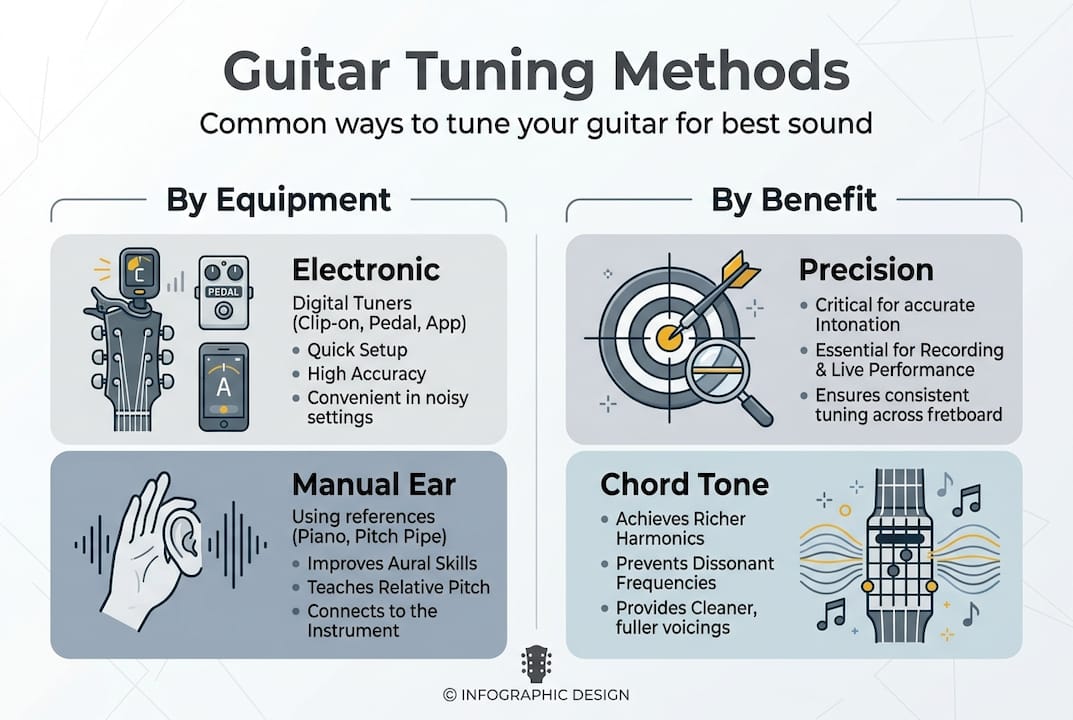
The three main tools guitarists rely on are electronic tuners, tuning forks, and smartphone apps. Each has its place, but they are not equal in every situation. Here is a quick overview of what each does well:
- Electronic clip-on tuners: Attach to your headstock and read vibration directly. Accurate, fast, and unaffected by background noise.
- Pedal tuners: Ideal for live performance. They mute your signal while tuning, which is a huge advantage on stage.
- Tuning forks: Give you a single reference pitch, usually A440. Reliable but require a trained ear to use effectively.
- Smartphone apps: Convenient and free, though microphone quality and ambient noise can affect accuracy.
- Strobe tuners: The most precise option available, used by luthiers and professional setup technicians.
For most players, a clip-on electronic tuner or a pedal tuner will serve you brilliantly day to day. Before you even think about turning a tuning peg, though, check your strings. Old, corroded strings stretch unevenly and will never hold pitch reliably. Wipe them down after every session using appropriate guitar care products to extend their life and preserve their tone.
| Tool | Accuracy | Best use | Noise sensitivity |
|---|---|---|---|
| Clip-on tuner | High | Practice and studio | Low |
| Pedal tuner | High | Live performance | None |
| Smartphone app | Moderate | Casual practice | High |
| Tuning fork | Moderate | Reference pitch | Moderate |
| Strobe tuner | Very high | Professional setup | Low |
Also worth knowing is that relative tuning using your ear or harmonics can actually produce better chord consonance than relying on a tuner alone, because a tuner measures absolute pitch rather than how notes interact musically. Always check your chords after tuning, not just individual open strings.
Browsing the full list of essential guitar tools is a great starting point if you are building your kit from scratch.
Pro Tip: Upgrading to locking tuners for stability is one of the single most effective hardware changes you can make. They grip the string at the post, reducing slippage and dramatically improving how long your guitar stays in tune.
Step-by-step guide to standard tuning methods
Armed with the right gear, it is time to explore how to tune your guitar accurately. Standard tuning, EADGBE from the thickest string to the thinnest, is where every guitarist begins.
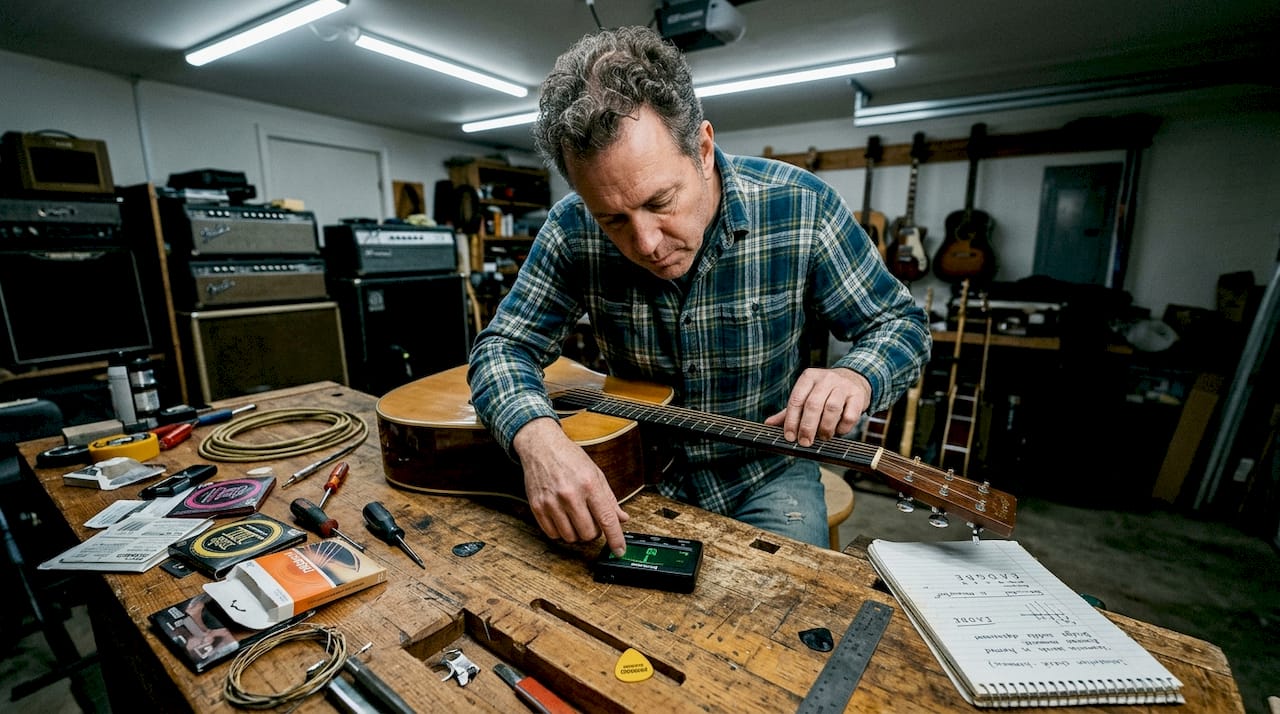
Here is a straightforward numbered process using an electronic tuner:
- Clip your tuner to the headstock or plug into a pedal tuner.
- Pluck the low E string (6th string) and watch the display. Tune up slowly if flat, or down if sharp.
- Move to the A string (5th string) and repeat the process.
- Tune the D string (4th), then the G string (3rd).
- The B string (2nd) is the one most players find tricky. It sits a major third above G rather than a perfect fourth, so expect a bigger gap.
- Finish with the high E (1st string) and double-check the low E again, as stretching one string can slightly affect the neck tension across the others.
For a more detailed walkthrough with diagrams and audio examples, the step-by-step tuning guide on the MusicStreet blog is an excellent resource.
| Method | Equipment needed | Accuracy | Suitable for |
|---|---|---|---|
| Electronic tuner | Clip-on or pedal tuner | High | All levels |
| Tuning fork | Fork plus trained ear | Moderate | Intermediate |
| Relative ear tuning | No equipment | Variable | Advanced |
| App-based tuning | Smartphone | Moderate | Beginners |
Once you are in tune, do not assume the job is done. Intonation adjustment is essential after tuning. Compare the harmonic at the 12th fret with the fretted note at the same position. If they differ, your saddle position needs adjusting. Perfect intonation is actually physically impossible due to the mathematics of equal temperament, but you can get very close. Understanding the types of guitar tuners overview available will also help you choose the right tool for different playing situations.
Exploring alternate tunings and their applications
Once you are comfortable with standard tuning, exploring alternate tunings opens up new musical possibilities. They are not just for advanced players either. Some alternate tunings actually make certain chord shapes far easier.
Alternate tunings such as Drop D (DADGBE), Open G (DGDGBD), DADGAD, and Open D (DADF#AD) each serve a distinct musical purpose. Here is a quick breakdown:
- Drop D: Lower the 6th string from E to D. Instantly unlocks heavier power chords and is widely used in rock and metal.
- Open G: Tune to DGDGBD. Strum all strings open and you get a G major chord. Brilliant for slide guitar and blues.
- DADGAD: A modal tuning used extensively in Celtic and folk music. Rich, ambiguous, and incredibly atmospheric.
- Open D: Tune to DADF#AD. Another slide favourite, producing a warm, resonant major chord across all open strings.
“Alternate tunings offer a heavier sound, easier chord shapes, and modal possibilities that standard tuning simply cannot replicate.”
| Tuning | String notes | Common genre | Key benefit |
|---|---|---|---|
| Standard | EADGBE | All styles | Universal reference |
| Drop D | DADGBE | Rock, metal | Easy power chords |
| Open G | DGDGBD | Blues, slide | Open major chord |
| DADGAD | DADGAD | Folk, Celtic | Modal atmosphere |
| Open D | DADF#AD | Blues, slide | Warm resonance |
Moving between alternate tunings does put additional stress on the neck and bridge. If you switch tunings frequently, check out the bridge comparison for alternate tunings to understand which bridge designs handle retuning most reliably. Tremolo bridges in particular can be problematic when shifting pitch significantly.
Pro Tip: If you use a tremolo bridge, consider blocking it or switching to a hardtail configuration before experimenting with alternate tunings regularly. A locked or fixed bridge holds pitch far more dependably under tension changes. The setup guide for playability covers this in useful detail.
For players who regularly switch tunings, investing in a second guitar set up specifically for your alternate tuning of choice is not extravagant. It is genuinely practical. The guitar maintenance guide is worth reading alongside any tuning experiments to keep your instrument in good shape throughout.
Verifying, adjusting and maintaining your tuning
Alternate tunings and methods have their benefits, but it is vital to check your results and maintain your guitar’s tuning health. Tuning is not a one-time task. It is an ongoing practice.
Follow these steps to verify your tuning is working musically, not just technically:
- Tune all strings using your preferred method.
- Play an open E major chord and listen critically. Does it sound balanced and clean?
- Check the 12th fret harmonic on each string against the fretted note. They should match. A significant difference means your intonation needs attention.
- Play a few chord progressions in the key you intend to use. If something sounds consistently sour, recheck the relevant string.
- Retune if needed after playing for ten minutes. New strings in particular stretch and settle, so a second tuning pass is often necessary.
As intonation research confirms, perfect intonation is physically impossible due to equal temperament. The goal is tonal balance, not mathematical perfection.
“Perfect intonation is physically impossible. Aim for tonal balance across the most common chord positions you use.”
For ongoing tuning stability, keep these maintenance habits in place:
- Change your strings regularly: Every four to six weeks for active players, or when they lose brightness.
- Clean the fretboard and strings after each session to remove sweat and oils.
- Lubricate the nut slots with a small amount of graphite to reduce friction and binding during tuning.
- Check neck relief every few months, particularly when the weather changes, as wood expands and contracts with humidity.
- Store your guitar in a stable environment, away from radiators and direct sunlight.
Remember that relative tuning using harmonics may give you slightly different results than an electronic tuner, and that difference can sometimes be musically preferable. The essential guitar maintenance guide expands on all of these points with practical instructions.
Pro Tip: Always verify your tuning by playing actual chords, not just individual open strings. A single note may read perfectly on a tuner whilst sounding slightly wrong in context. Your ears are the final judge.
The hidden truth about guitar tuning: what experts know
Most tuning guides tell you to get the needle centred and move on. That is fine advice as far as it goes, but it misses something important. Tuning is ultimately a musical act, not a mechanical one.
Here is the nuance most players discover only after years of playing. A guitar tuned to perfect mathematical pitch on every string can still sound subtly wrong when you play actual music. This is because relative tuning based on ear and harmonics produces a slightly different result than absolute tuner-based tuning, and in many musical contexts, the relative approach sounds more consonant.
Professional guitarists and recording engineers often nudge certain strings fractionally sharp or flat to make specific chord voicings sing more beautifully. This is not imprecision. It is intention. Understanding this principle transforms how you think about optimising playability and tone across your whole instrument. The tuner gets you close. Your ears get you there.
Enhance your tuning experience with MusicStreet
Getting your tuning right becomes significantly easier when you are working with a well-set-up instrument and the right accessories.

At MusicStreet, we stock a carefully chosen range of guitars, tuners, and accessories to support players at every stage. Whether you are looking to upgrade to a better-spec instrument that holds its tuning more reliably, or you need guidance on setting up your guitar for alternate tunings, our team is here to help. Visit our premium guitar shop to browse new and pre-loved instruments, or read our guitar setup for optimal playability guide to ensure your guitar is performing at its best before you even pick up a tuner.
Frequently asked questions
What is the best method for tuning a guitar for beginners?
Electronic clip-on tuners or smartphone apps are the most accessible starting point, offering reliable pitch accuracy without requiring a trained ear. Once you are confident with these, ear-based tuning using harmonics can refine your results further.
Why does my guitar sound out of tune even after using a tuner?
The most common cause is poor intonation. Check whether your 12th fret harmonic matches the fretted note at the same position. If they differ noticeably, your saddle needs adjustment.
What are the most popular alternate guitar tunings?
Drop D, Open G, DADGAD, and Open D are among the most widely used. These tunings serve different musical genres and offer unique chord voicings that standard EADGBE cannot replicate.
How can I keep my guitar tuned for longer?
Installing locking tuners, changing strings regularly, lubricating nut slots, and storing your guitar in a stable environment all contribute to improved tuning stability over time.
Recommended
- How to Use Guitar Tuners for Perfect Sound | MusicStreet
- Guitar Tuning Guide: Step-by-Step to Perfect Tuning – MusicStreet
- Guitar upgrades: 5 essential changes for better sound – MusicStreet
- How to improve guitar tone: essential tips for every player – MusicStreet
- Guitar Bridge Tremolo vs Tele Tremolo Bridge: A Comparison – Stevie The Manager aka Stangr The Man







Share:
Piezo pickups explained: enhance your guitar's acoustic sound
Multiscale guitars: superior playability and tone explained