


- Most guitar learners progress through clear stages, from beginner to advanced, with consistent practice. Focusing on meaningful music and skill integration enhances motivation and long-term mastery. Proper instrument setup and balanced practice phases prevent burnout and support sustained growth.
Most people who pick up a guitar for the first time have no idea what the journey actually looks like. They know they want to play, but the stages of learning guitar between “complete beginner” and “confident player” feel like a mystery. That uncertainty leads to frustration, unrealistic expectations, and often, a guitar that ends up gathering dust in the corner. This guide maps out every stage clearly, from your first chord to advanced technique, so you always know where you are, what to work on next, and how long things genuinely take.
Table of Contents
- Key takeaways
- 1. The foundational stage: your first chords and posture
- 2. Early beginner progress: building your first song repertoire
- 3. Reaching early intermediate: barre chords and basic theory
- 4. Intermediate stage: connecting everything you know
- 5. Advanced skills: solos, genre fluency, and creative expression
- 6. The maintenance phase: keeping skills sharp without burning out
- 7. Realistic timelines: what to expect and when
- My honest take on learning guitar the right way
- Find the right guitar for where you are right now
- FAQ
Key takeaways
| Point | Details |
|---|---|
| Progress has clear stages | Guitar learning follows recognisable phases: beginner, early intermediate, intermediate, and advanced. |
| Consistency beats intensity | Short, consistent practice sessions build muscle memory faster than occasional long sessions. |
| Milestones are predictable | Most learners can play simple songs within weeks and reach intermediate level within one to two years. |
| Practice must evolve | Your routine should shift between learning, improvement, and maintenance phases to avoid burnout. |
| The right instrument matters | Having a guitar that suits your current stage makes practising more enjoyable and progress more likely. |
1. The foundational stage: your first chords and posture
Every guitarist starts here, and there are no shortcuts through it. Before you play a single note, how you hold the guitar shapes everything that follows. Posture affects tone, comfort, and injury risk. Whether you’re sitting with the guitar resting on your leg or standing with a strap, the neck should be angled slightly upward and your fretting hand should be relaxed, not gripping the neck like a tennis racket.
The first practical skills to focus on are:
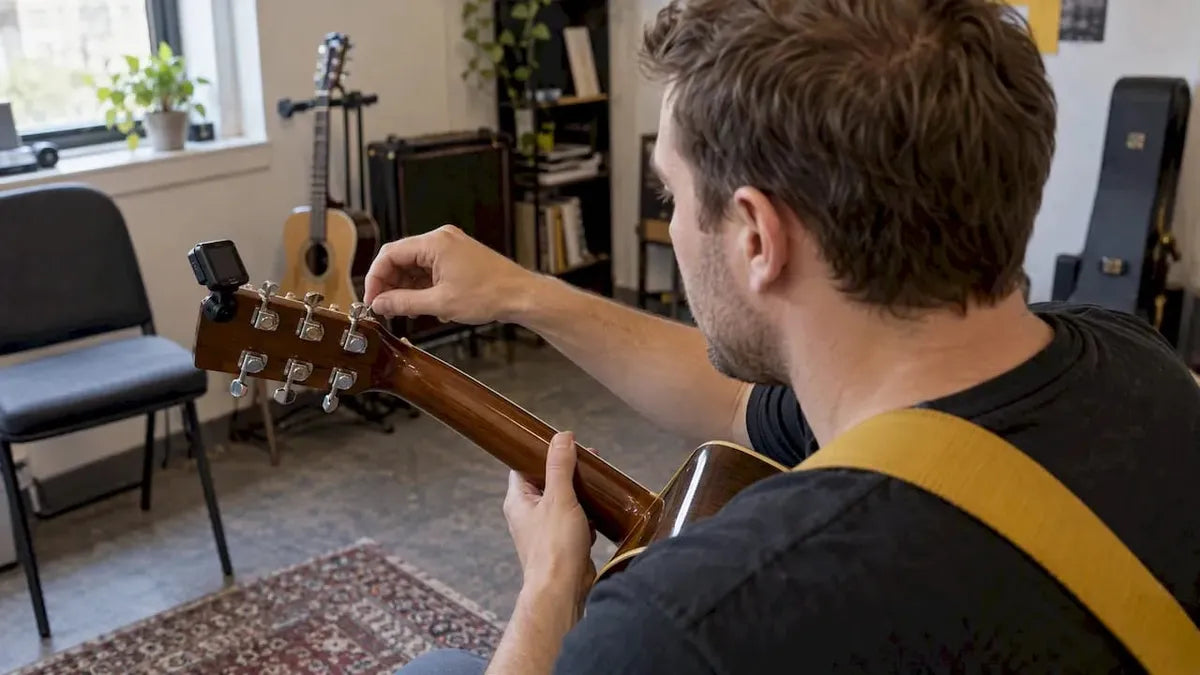
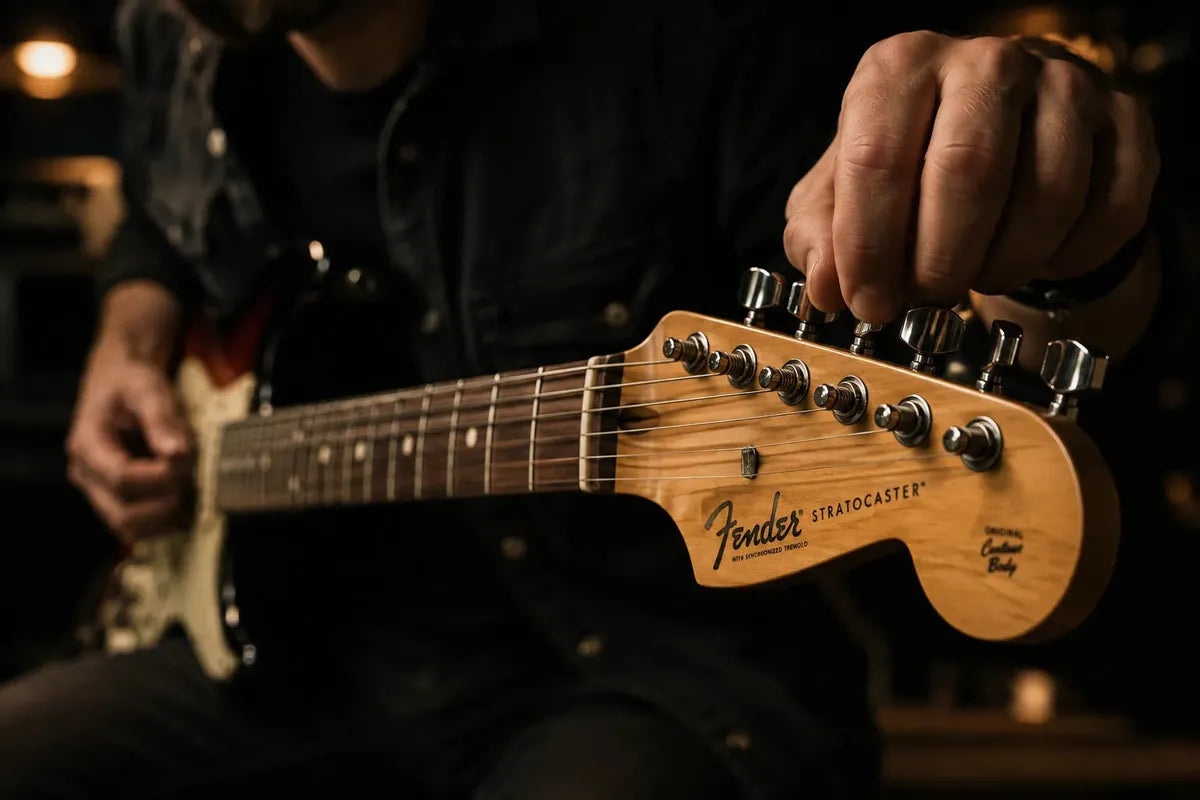
- Tuning your guitar before every single session. Standard tuning (E A D G B e) should become second nature quickly.
- Learning the string names so you can follow tabs and instructions without confusion.
- Practising open chords starting with G, C, D, and Em. These four chords alone unlock dozens of songs.
- Developing a basic strumming pattern. The Down, Down, Up, Up, Down, Up universal strumming pattern is the standard starting point and gives you a rhythmic foundation you will use for years.
- Working on clean chord changes. Buzzing or muted strings are normal at first, but clean transitions between chords should be your primary goal.
The anchor finger technique is one of the most underrated beginner tools. It means keeping one finger planted on the fretboard when you switch between related chords. Switching between G and D, for instance, you keep your third finger on the third fret. This small habit reduces transition errors significantly and builds fluency faster than brute-force switching alone.
A practical four-week beginner plan recommends 15 minutes of daily practice focusing on tuning, clean fretting, and strumming, with the goal of playing one or two songs by the end of the month. That is achievable. Stick to it.
Pro Tip: Try “air chord” practice away from the guitar. Form chord shapes in the air without the instrument and your fingers will build muscle memory without the frustration of muted strings.
2. Early beginner progress: building your first song repertoire
Once you can move between a handful of open chords without stopping to think, you have crossed a meaningful threshold. This is where beginner guitar progression starts to feel genuinely musical rather than purely mechanical.
Your goal in this phase is to build a repertoire of five to ten songs you can play from start to finish. Do not skip this. It matters more than learning new chords at this point because it trains your brain to treat guitar as music rather than an exercise.
A good approach here:
- Choose songs that use chords you already know. There are hundreds of popular tracks built on G, C, D, and Em.
- Play along with recordings. This trains your ear and your timing simultaneously.
- Use a metronome. Even at slow speeds, keeping time is a skill that will pay dividends at every future stage.
- Vary your strumming patterns slightly across songs. This builds rhythmic flexibility without overwhelming you.
- Practise the transitions that trip you up in isolation, not just by playing through the whole song and hoping for the best.
Emotional engagement is worth taking seriously here. Playing music you love keeps motivation high in a way that learning exercises simply cannot replicate. If your goal is acoustic covers, learn acoustic covers. If you love a particular genre, focus there. The learners who progress fastest are almost always the ones who are playing music they actually care about.
Pro Tip: Use the one-minute chord change drill: set a timer and count how many clean changes you can make between two chords. Aim to increase that number by two or three per session. It turns a monotonous exercise into a trackable game.
3. Reaching early intermediate: barre chords and basic theory
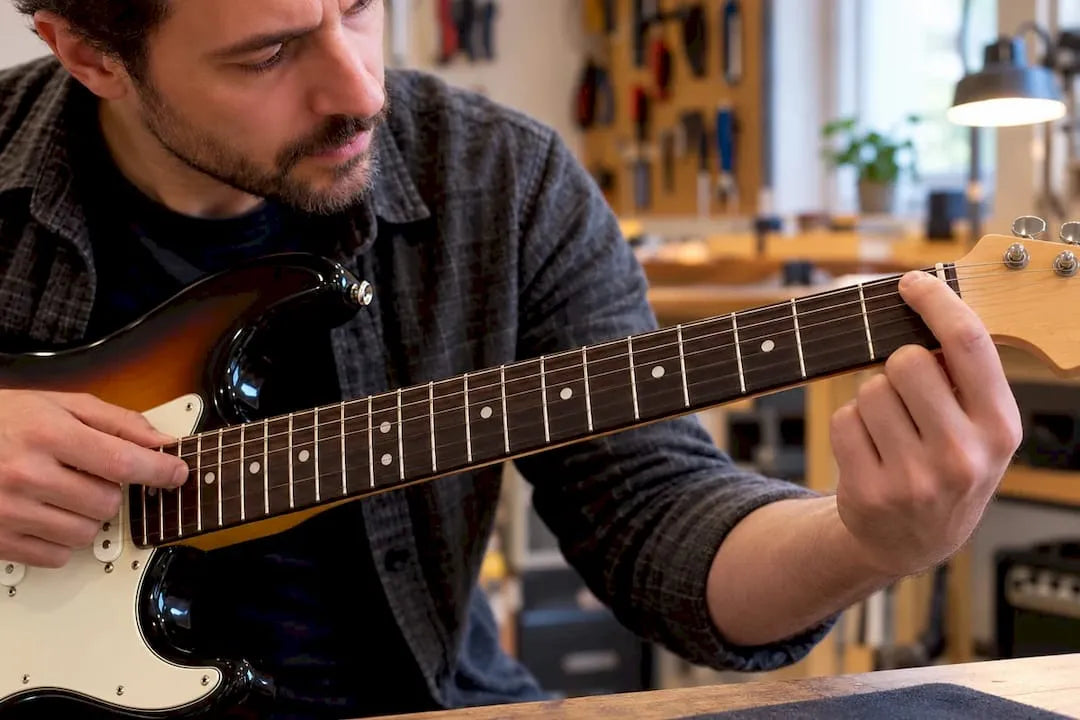
This is the stage where many learners stall. The early intermediate phase introduces barre chords, and barre chords are genuinely hard at first. Your index finger needs to press down all six strings cleanly across a single fret, which requires hand strength you simply have not built yet. Expect buzzing, aching fingers, and frustration. It is completely normal, and it passes.
The intermediate guitar stages begin when you can move beyond open chord shapes and start applying what you know up and down the neck. Key skills at this point include:
- F major and B minor barre chords as your first two barre chord targets
- Fingerpicking basics, starting with simple patterns like alternating thumb and fingers on separate strings
- Chord families and basic key understanding, so you know which chords work together and why
- Smoother chord transitions between barre chords and open chords in the same song
- Consistent metronome use to tighten up your timing before you progress to faster tempos
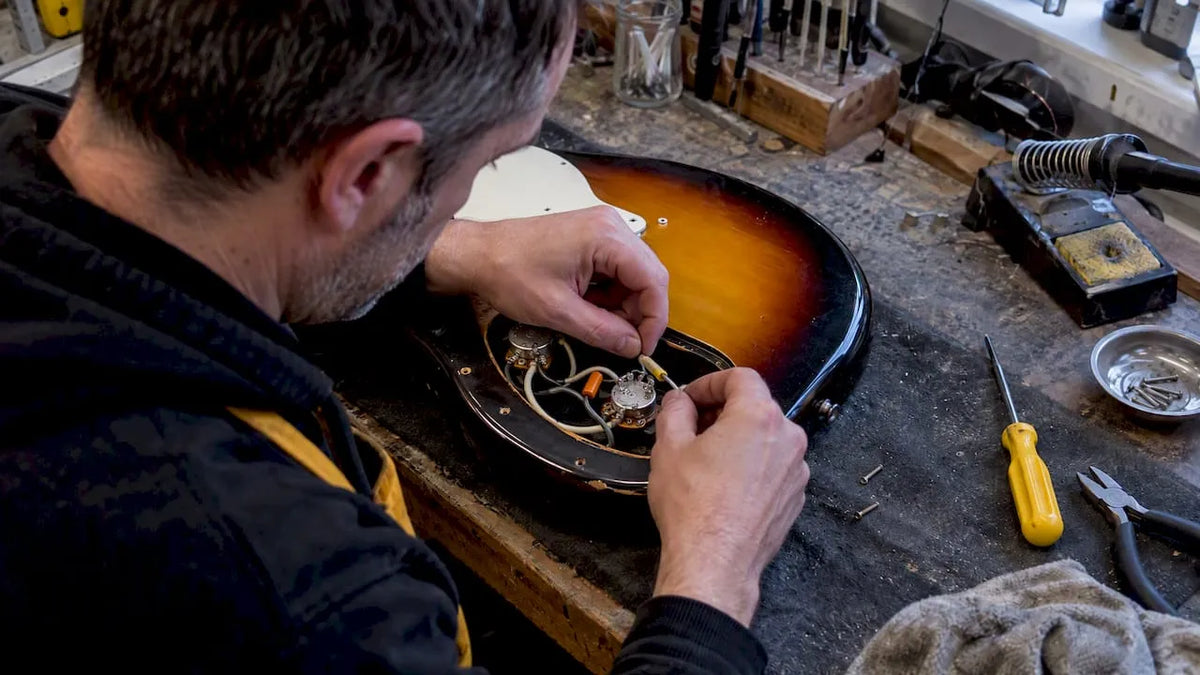
Understanding how to choose your first guitar wisely becomes more relevant here too, because a poorly set up instrument makes barre chords considerably harder than they need to be. High action on a cheap guitar can make this stage feel almost impossible.
4. Intermediate stage: connecting everything you know
By this point, you have a real toolkit. The intermediate stage is about joining your skills together rather than learning them separately. This is where playing starts to feel genuinely expressive rather than just technically correct.
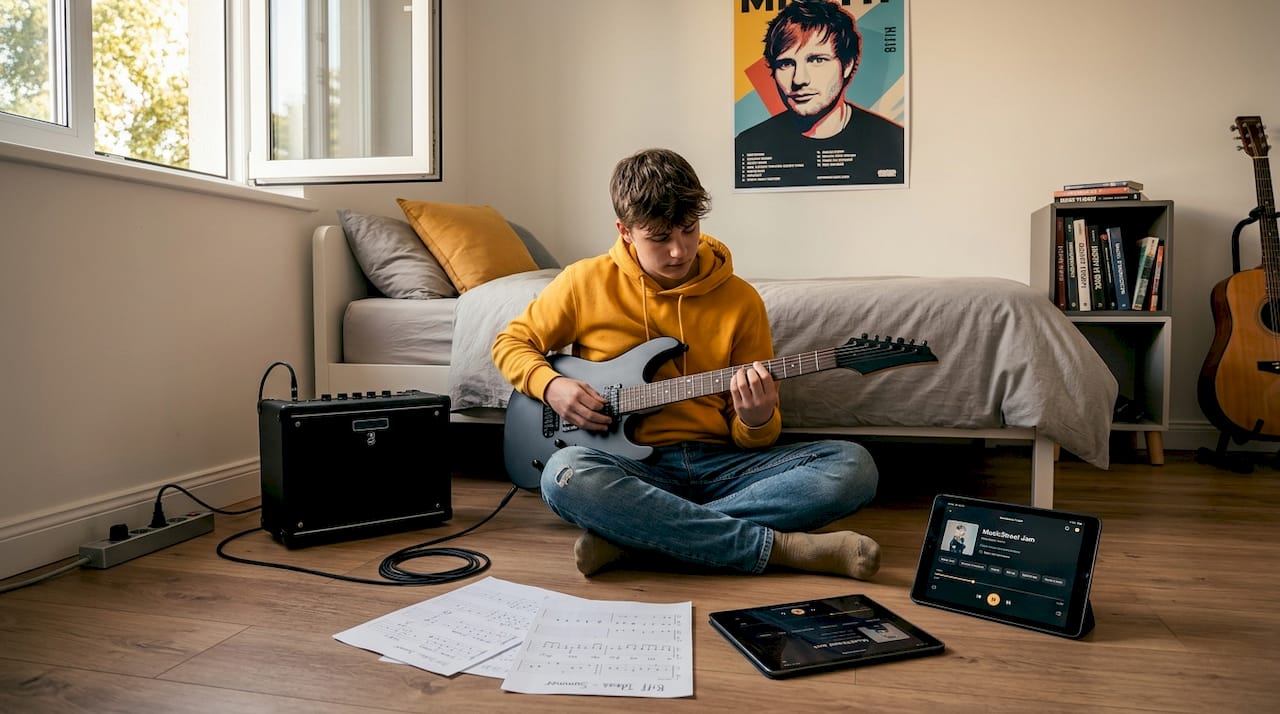
Core skills to develop at intermediate level
Barre chord fluency. You should be able to move barre chord shapes across the neck without hesitation. Power chords, which are simplified two-note versions, give you a fast entry point into rock and heavier styles.
Scales and soloing. The minor pentatonic scale is where almost every guitarist begins with lead playing. It is forgiving, versatile, and immediately usable across blues, rock, and pop. Learning the five positions of this scale gives you a map for improvisation.
Ear training and tab reading. Reading guitar tablature is not hard to learn and opens up a vast library of songs immediately. Ear training, meaning the ability to recognise chords and intervals by sound alone, takes longer but transforms how you interact with music.
Here is how practice time typically shifts at this stage:
| Focus area | Beginner (% of practice time) | Intermediate (% of practice time) |
|---|---|---|
| Chord changes and open chords | 60% | 20% |
| Scales and lead technique | 5% | 30% |
| Songs and repertoire | 30% | 35% |
| Theory and ear training | 5% | 15% |
Practise with backing tracks and jam tracks rather than always playing to a metronome. It is far more musically engaging, and it teaches you to respond to other instruments. You can also begin exploring structured practice guidance to organise your sessions more deliberately at this level.
5. Advanced skills: solos, genre fluency, and creative expression
Advanced guitar is not a destination. It is a direction. The most experienced players are still learning, still finding gaps, still pushing into new territory. What separates advanced players from intermediates is not just technical ability but musical instinct, the sense of what to play and what to leave out.
At the advanced stage, your focus shifts to:
- Complex solos and techniques such as legato playing, string bending, vibrato, and tapping
- Genre fluency, meaning the ability to recognise and reproduce the stylistic vocabulary of different musical styles, from blues phrasing to classical fingerstyle
- Songwriting and arrangement, using your technical knowledge to create original music
- Self-assessment, regularly recording yourself and listening back critically to identify specific weaknesses
- Jam sessions and collaboration, which develop musical communication and responsiveness in real time
Pro Tip: Deconstruct songs you admire rather than just learning them note-for-note. Ask why a guitarist chose a particular phrase, what scale they were using, and how it fits the chord progression. This builds musical thinking, not just technique.
Burnout is a genuine risk at this stage. Years of intensive practice can erode motivation, and many advanced players hit a wall where progress feels invisible. The solution is not to practise more. It is to practise differently.
6. The maintenance phase: keeping skills sharp without burning out
One of the most useful frameworks for any guitarist is the three-phase model: the learning phase, the improvement phase, and the maintenance phase. Guitar learning divided into three phases shows that burnout is not caused by too much playing. It is caused by treating every session as intense learning rather than varying your focus.
The maintenance phase is where you keep already-mastered skills alive with minimal effort. Maintenance practice should last just one to two minutes per skill, which frees up mental energy for genuine new learning. A guitarist who spends forty minutes repeating songs they already know perfectly is wasting the cognitive bandwidth they need for actual progress.
Efficient maintenance looks like this:
- Run through mastered chord progressions for sixty to ninety seconds each
- Play a familiar scale pattern once or twice, cleanly and in time
- Play a song you know well at the start of a session as a warm-up, then move on
The learning phase, by contrast, demands full attention and accepts mistakes. You are deliberately working at the edge of your ability. Blending all three phases into a weekly routine is what sustains long-term progress without grinding you down.
7. Realistic timelines: what to expect and when
How long does each stage take? The honest answer is that it depends heavily on how often and how deliberately you practise. That said, there are consistent benchmarks that most players hit at similar points.
| Practice level | Playing simple songs | 10-song repertoire | Barre chords | Intermediate level |
|---|---|---|---|---|
| Casual (2-3x per week) | 2-3 months | 12-18 months | 12-18 months | 3-4 years |
| Steady (4-5x per week) | 4-6 weeks | 8-12 months | 6-12 months | 1.5-2 years |
| Intensive (daily, structured) | 2-4 weeks | 3-6 months | 3-6 months | 1-1.5 years |
Most learners can play recognisable songs within weeks, and reaching intermediate level typically takes one to two years. Advanced skill, the kind that comes with genuine fluency and musical creativity, requires sustained effort measured in years, with some estimates placing mastery in the range of thousands of hours of deliberate practice.
Project-based goals consistently outperform vague ambitions like “get better at guitar.” Deciding to learn three specific songs this month, or to record a short video of yourself playing by a certain date, gives practice sessions a purpose that keeps motivation intact through the inevitable slow patches.
My honest take on learning guitar the right way
I have spent a long time watching people learn guitar, and the pattern I keep seeing is this: technical progress without emotional engagement does not stick. Players who focus entirely on exercises, scales, and technique drills often plateau or quit, while players who spend most of their time playing music they actually love tend to stay curious, stay consistent, and end up more technically proficient in the long run anyway.
The stages of learning guitar are real, and knowing them matters. But they are not a strict ladder. You do not have to fully master one rung before touching the next. In my experience, the healthiest approach is to spend roughly seventy percent of your practice time playing music you enjoy and thirty percent pushing into new technical territory. It keeps the joy intact.
The other thing I would tell anyone at any stage: the plateau is not a sign you are failing. It is a sign your nervous system is consolidating what it has learned. The progress is happening below the surface. Keep showing up.
— Music
Find the right guitar for where you are right now

The guitar you play on genuinely affects your experience at every stage. A poorly set up instrument makes barre chords harder, makes open chords sound worse, and quietly erodes your motivation in ways that are hard to trace back to the source. At Musicstreet, you will find guitars from trusted names like Gibson, Fender, PRS, and Martin, spanning every budget and playing level, with expert setup included and real advice from people who play themselves.
Whether you are still deciding on your first guitar or ready to step up to a serious intermediate or advanced instrument, Musicstreet’s premium guitar shop has the stock and the knowledge to point you in the right direction. You can browse online or visit the store in Huntingdon, Cambridgeshire, and try before you buy.
FAQ
How long does it take to get through the beginner stage?
Most learners can play a handful of simple songs within one to three months of regular practice. Reaching the early intermediate stage, where barre chords and basic theory feel manageable, typically takes six to twelve months with consistent effort.
What is the hardest stage of learning guitar?
The transition from beginner to intermediate is widely considered the most difficult phase, largely because of barre chords. Building the hand strength and finger independence required takes time, but it is a temporary challenge that resolves with regular, patient practice.
How often should I practise at each stage?
At the beginner stage, even fifteen minutes daily produces real results. As you progress, three to five sessions per week of thirty to forty-five minutes each is more productive than occasional long sessions, because consistent short sessions build muscle memory more reliably.
Do I need to learn music theory to progress?
Not in depth, and not immediately. A basic understanding of chord families and keys is useful at the early intermediate stage, but many accomplished guitarists have progressed through all the main stages of learning guitar with minimal formal theory. Practical playing comes first.
What should I focus on at the intermediate stage?
Intermediate guitar stages are about joining your existing skills: moving barre chords fluidly across the neck, learning the minor pentatonic scale for soloing, developing your ear, and playing full songs with confidence. Structure your sessions across multiple focus areas rather than drilling just one thing each time.


Share:
How to sell guitars online and maximise your return
Fender Stratocaster vs Telecaster: Which Is Right for You?