


- A semi-hollow guitar features a design with a hollow wings and solid center block that balances acoustic warmth with feedback resistance. It produces warm, resonant tones suitable for jazz, blues, and rock, with amplified sound maintaining clarity at moderate volumes. Choosing the right semi-hollow depends on personal feel, genre, and performance environment, with hands-on assessment being essential.
If you’ve ever assumed a semi-hollow guitar is just a hollow guitar with a different name, you’re not alone. Many players dismiss them as feedback-prone or pigeonhole them into jazz. Both assumptions miss the mark. A semi-hollow body guitar occupies genuinely distinct territory, built around a clever design that blends acoustic warmth with amplified control. This guide covers what makes a guitar semi-hollow, how it sounds, how it compares to solid and fully hollow alternatives, and how to choose one that actually suits your playing.
Table of Contents
- Understanding semi-hollow guitar construction
- How semi-hollow guitars sound and perform
- Comparing semi-hollow with solid and hollow body guitars
- Choosing and using a semi-hollow guitar effectively
- A musician’s perspective: why semi-hollow guitars matter beyond specs
- Explore premium semi-hollow guitars at MusicStreet
- Frequently asked questions
Key Takeaways
| Point | Details |
|---|---|
| Unique construction | A semi-hollow guitar blends hollow chambers with a solid centre block to balance tone and feedback control. |
| Versatile tone | The semi-hollow offers warm, resonant sounds suitable for jazz, blues, rock, and more. |
| Feedback management | Though more resistant than hollow guitars, semi-hollows still need careful volume and amp positioning to reduce feedback. |
| Feel over brand | Playability and personal connection often matter more than brand differences in semi-hollow guitars. |
| Balanced choice | Semi-hollow guitars bridge the gap between solid and hollow body types, providing a versatile option for many players. |
Understanding semi-hollow guitar construction
To grasp the tonal character of semi-hollow guitars, it’s essential first to understand their distinctive body structure. The name itself is the clue: semi-hollow means partially hollow, not fully hollow. And that distinction matters more than most players realise.
A semi-hollow guitar has a hollow body with a solid centre block running through the middle, which reduces feedback and contributes to its warm tone. That centre block, typically made from maple or mahogany, runs the full length of the body and is often where the pickups, bridge, and tailpiece are anchored. The hollow chambers sit on either side of that block, known as the wings.
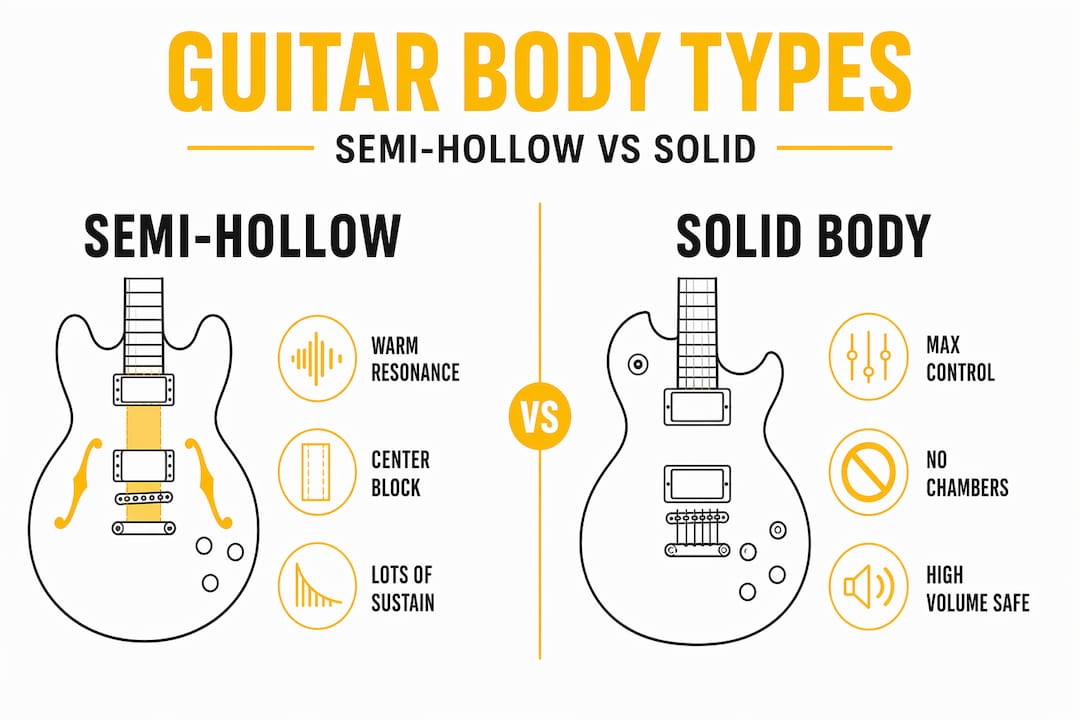
These hollow wings are what give semi-hollow guitars their acoustic resonance and woody character. The centre block is what keeps them playable at band volume without the guitar turning into a feedback machine. It’s a genuinely elegant solution to a real problem.
Key construction features you’ll notice on most semi-hollow body guitars include:
- Solid centre block running lengthwise through the body, usually maple or mahogany
- Hollow wing chambers on either side that create acoustic resonance
- F-holes cut into the top, similar to a violin, allowing sound to project outward
- Full-depth or thinline body depending on the model (thinlines are more common in modern designs)
- Bound edges on higher-end models, adding both aesthetics and structural integrity
If you want to understand how this compares to a fully acoustic electric, the hollow body guitar explained in detail gives a useful frame of reference for seeing where semi-hollows diverge.
How semi-hollow guitars sound and perform
Beyond construction, understanding sound and performance characteristics helps clarify why players choose semi-hollow guitars over other types.
Semi-hollow guitars produce warm, resonant tones with good sustain and are versatile across jazz, blues, rock, and pop. Acoustically, they’re louder than a solid body when unplugged, with a fuller and more complex tone. But they’re not a replacement for an acoustic guitar. The resonance is more of a subtle bloom on the notes than a full acoustic projection.

Amplified is where they really come into their own. The hollow chambers add warmth and complexity to the amplified signal, while the centre block keeps feedback under control at moderate volumes. The centre block provides feedback resistance, making semi-hollow guitars suitable for higher volume play unlike fully hollow guitars.
Here’s how they stack up in real playing situations:
- Jazz and blues: Exceptional. The warm, rounded tone suits fingerpicking and chord melody playing.
- Classic rock: Very capable. Think early British Invasion sounds or the tone behind early Foo Fighters recordings.
- Indie and alternative: A natural fit. The character and expressiveness suit melodic, dynamic playing.
- High-gain metal: Generally not the best choice. At high gain, feedback becomes harder to manage without noise gates.
- Funk and soul: Brilliant. Clean tones with a bit of snap and warmth are exactly what the genre needs.
The one genuine limitation is live performance at loud volumes without proper management. Feedback can creep in, particularly if you’re standing close to your amp.
Pro Tip: Position your amplifier behind you and use in-ear monitors during live gigs. This single change dramatically reduces onstage feedback with a semi-hollow at high volumes. If you’re playing a hollow body guitar live, the same principle applies, but you’ll need to be even more deliberate about it.
Comparing semi-hollow with solid and hollow body guitars
To deepen your grasp, a direct comparison highlights where semi-hollow guitars fit in the broader family of electric guitars.
Semi-hollow guitars strike a “Goldilocks zone” between solid and hollow body guitars, balancing resonance and feedback control. That framing is useful, but it can oversimplify. Each type has genuine strengths, not just compromises.
| Feature | Solid body | Semi-hollow body | Hollow body |
|---|---|---|---|
| Feedback resistance | Excellent | Good | Limited |
| Acoustic resonance | Minimal | Moderate | High |
| Sustain | High | Medium to high | Medium |
| Weight | Heavier | Moderate | Light |
| Best genres | Rock, metal, country | Jazz, blues, rock, indie | Jazz, country, acoustic-electric |
| Live performance at loud volumes | No issues | Manageable | Requires care |
| Tonal character | Bright, direct | Warm, complex | Rich, woody |
The difference between a semi-hollow and a fully hollow body is more significant than many players expect. A hollow body guitar, which has no centre block at all, responds more like an acoustic in terms of resonance and feedback sensitivity. Beautiful instruments, but they demand more discipline onstage.
Solid bodies are the most controllable tools in the set. No surprises, no acoustic colouring. That predictability is a feature, not a limitation. The semi-hollow sits between these two poles, offering something genuinely different rather than simply splitting the difference.
If you’re still weighing up which direction to go, choosing electric guitars with a clear sense of your genre and playing environment will save you a lot of second-guessing later.
Choosing and using a semi-hollow guitar effectively
With an understanding of characteristics and differences, practical tips help you make confident choices and use semi-hollow guitars effectively.
Playability, neck feel, and personal vibe often matter more than brand or price when choosing semi-hollow guitars. That sounds obvious until you’re standing in a shop comparing two guitars with very similar specs and a significant price gap. The more expensive one won’t always win.
Here’s a practical process for selecting your semi-hollow:
- Define your primary genre and volume needs. A jazz player gigging in small venues has very different requirements to an indie rock player performing on larger stages.
- Try multiple body depths. Thinline designs are easier to manage feedback-wise and sit more comfortably for rock players. Deeper bodies resonate more and suit jazz contexts.
- Assess the neck profile carefully. Semi-hollows from different manufacturers vary considerably in neck shape. What feels fast to one player feels awkward to another.
- Play it both clean and with gain. A guitar that sounds warm clean but becomes muddy with overdrive won’t serve you well in a rock context.
- Check the balance when standing. Some semi-hollow designs neck-dive. You’ll notice this immediately with a strap.
For managing feedback when considering a new guitar of this type, keep your amp volume at around 70 to 80% of where it would cause issues, and use your guitar’s volume control actively. Many experienced players use the guitar’s volume knob far more dynamically with a semi-hollow than they ever would with a solid body.
Pro Tip: If you experience feedback at high amp volumes with a semi-hollow, try a subtle high-frequency cut on your amp’s EQ before reaching for a noise gate. Often it’s the high-end content that feeds back first, and a small treble reduction solves it without affecting your core tone.
A musician’s perspective: why semi-hollow guitars matter beyond specs
Here’s something worth saying plainly: the spec sheet for a semi-hollow guitar will not tell you whether you’ll love playing it.
Jens Larsen found that despite differences in brand and specs, the subtle feel and vibe of the guitar are what truly influence satisfaction and playability. This is a professional jazz guitarist who has played and compared more semi-hollows than most of us will ever touch. His conclusion was essentially that the differences he expected to matter didn’t, and the differences he hadn’t accounted for, feel, responsiveness, how the guitar sits, did.
That matters for how you approach buying one. The tone differences between a mid-range semi-hollow and a premium one are often smaller than you’d imagine in a full band context. The mix swallows nuance. What doesn’t get swallowed is whether the guitar inspires you to pick it up and play, whether the neck feels like an extension of your hand, whether the weight sits right after two hours of playing.
This isn’t anti-spec thinking. Understanding construction and tonal character, as covered above, helps you narrow the field significantly. But once you’re down to two or three realistic options, trust your hands more than the product descriptions.
The players who get most frustrated buying guitars are those who over-research and under-play. No forum thread or review video can replace 20 minutes with the instrument. If you can, always try before you buy, or buy from somewhere with a sensible return policy that allows you to make that assessment properly. The best semi-hollow guitar is the one you reach for every time you sit down to play.
Explore premium semi-hollow guitars at MusicStreet
Having understood the unique qualities and how to choose a semi-hollow guitar, MusicStreet is ready to support your next purchase.

At our guitar shop, we stock a curated range of premium semi-hollow guitars from respected brands, covering everything from entry-level models for players making their first move into this territory, to professional instruments for serious performers. Our team brings genuine playing experience to every conversation, so you get honest guidance rather than a sales pitch. Every guitar we sell is professionally inspected and set up before it reaches you, whether you’re buying new or pre-loved. We offer free UK delivery on qualifying orders and in-store try-outs at our Huntingdon showroom if you’d prefer to play before you commit.
Frequently asked questions
What is the main difference between a semi-hollow and a hollow body guitar?
A semi-hollow guitar has a solid centre block that reduces feedback and adds sustain, while a hollow body lacks this block, offering warmer tones but higher feedback risk at loud volumes.
Can semi-hollow guitars be used for rock music?
Yes, semi-hollow guitars are versatile and can deliver warm, punchy tones for many rock styles. They are particularly well suited to rockabilly, indie rock, and cleaner rock tones due to their tonal balance.
How can I manage feedback when playing a semi-hollow guitar live?
Manage feedback by keeping your amp volume at around 70 to 80%, positioning your amplifier behind you, and using EQ to cut high frequencies slightly. In-ear monitors during gigs also help considerably.
Does the brand of a semi-hollow guitar greatly affect its sound?
Tone differences between brands can be surprisingly subtle in practice. Feel and playability typically matter more than brand name when choosing between comparable models.
What genres benefit most from using a semi-hollow guitar?
Semi-hollow guitars adapt across jazz, blues, classic rock, indie, and pop thanks to their tonal versatility, warm character, and good sustain.






Share:
What is Fender Custom Shop: a guide for guitar enthusiasts
Acoustic guitar shop guide for UK guitar enthusiasts