


Effects loops position delay and reverb effects after the preamp for clearer sound.
Using an effects loop improves tone clarity and control over modulation, delay, and reverb effects.
Proper setup of effects loops prevents muddiness and enhances the overall musical quality of your rig.
Many guitarists spend hours obsessing over pedal order, chasing the perfect tone, yet overlook one of the most powerful features built right into their amplifier. The effects loop is frequently misunderstood, often ignored, or simply left unused because its purpose isn’t immediately obvious. Whether you’re running a modest pedalboard or a sprawling rig, knowing how to use your amp’s effects loop correctly can be the difference between a muddy, cluttered sound and one that’s clear, defined, and genuinely musical. This guide covers everything: what an effects loop is, why it matters, which pedals belong there, and how to set it up without making the most common mistakes.
Table of Contents
Key Takeaways
| Point | Details |
|---|---|
| Better sound clarity | Using an effects loop ensures your time-based effects are clear, even with high-gain amps. |
| Pedal placement matters | Knowing which pedals go in the loop or in front maximises their tone and effectiveness. |
| Simple setup steps | Setting up an effects loop is straightforward with the right accessories and guidance. |
| Amp compatibility | Not all amps have effects loops, so check your gear before planning your setup. |
Understanding effects loops: The basics
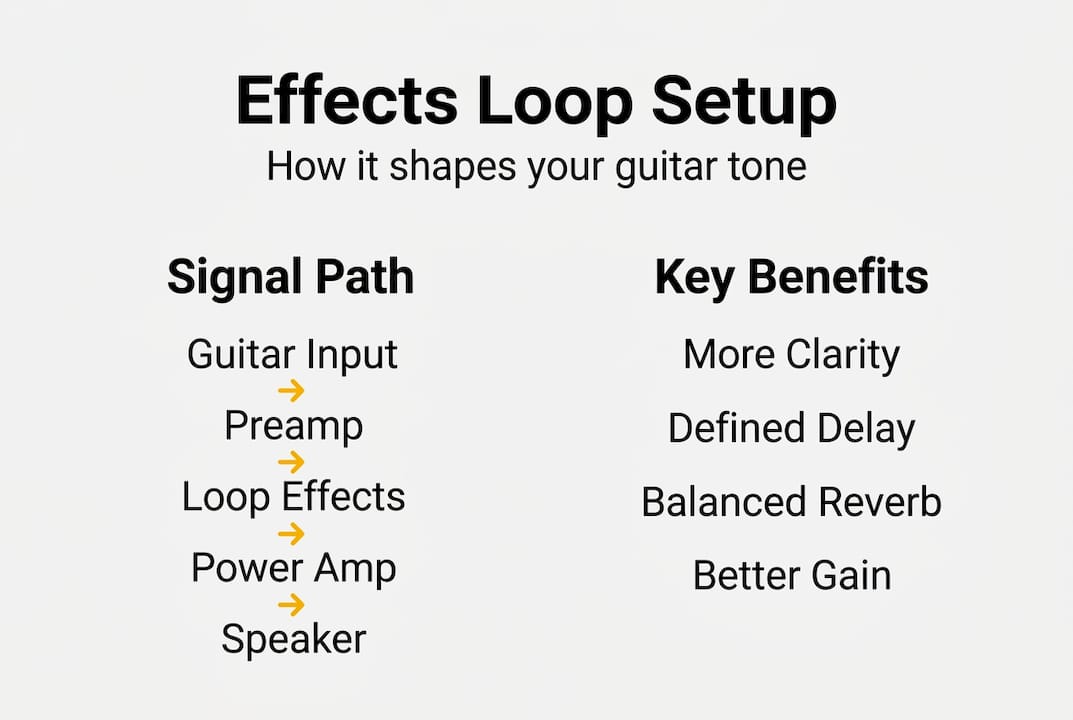
Before anything else, it helps to understand where an effects loop actually sits in your signal chain. A guitar signal travels a long way before it becomes sound. It goes from your guitar, through any pedals placed in front of your amp, into the amp’s preamp section, then through the power amp, and finally out through the speaker cabinet. The preamp is where your amp shapes its core character, adding gain, EQ colouring, and the fundamental voice of the amplifier.
An effects loop is a circuit that lets you insert effects between the preamp and power amp sections of an amplifier. This is a crucial distinction. Instead of your delay or reverb pedal running through the preamp and being coloured by it, those effects are placed after the preamp has already done its job. The result is a much cleaner interaction between your effects and your amp’s tone.
There are two main types of effects loops you’ll encounter:
-
Series effects loop: The entire signal passes through your connected pedals. This is the most common type and works well for most setups.
-
Parallel effects loop: The signal is split, with one path going through your pedals and one staying dry. The two signals are then blended together, giving you control over how much of the effect you hear.
Here’s a simple breakdown of how the signal flows with and without an effects loop:
| Signal path | Route |
|---|---|
| Without effects loop | Guitar > Pedals > Preamp > Power amp > Speaker |
| With effects loop | Guitar > Preamp > Effects loop pedals > Power amp > Speaker |
Amplifier manufacturers include effects loops because certain effects simply behave better after the preamp. High-gain amps in particular benefit enormously from this feature, as running delay or reverb through a heavily saturated preamp creates a chaotic, indistinct wash of sound rather than a musical effect. Understanding guitar effects explained in the context of your amp’s architecture is the first step to genuinely better tone.
Why use an effects loop? Key benefits for your guitar sound
Now that the basics are clear, it’s important to ask: what do you actually gain from using an effects loop?
The most significant benefit is clarity. Delay and reverb sound clearer and more defined when placed in the effects loop rather than before the amp’s preamp section. When you place a delay pedal in front of a high-gain amp, every repeat gets pushed through the preamp’s distortion circuit. The result is a smeared, indistinct mess. Place that same pedal in the loop, and each repeat rings out cleanly, sitting beautifully in the mix.

Here’s a comparison of how common effects perform in each position:
| Effect type | In front of amp | In effects loop |
|---|---|---|
| Delay | Repeats distort, loses clarity | Repeats stay clean and defined |
| Reverb | Washes out with gain | Natural, spacious, controlled |
| Modulation (chorus, flange) | Can sound thin or harsh | Full, lush, sits well in mix |
| Overdrive/distortion | Ideal position | Not recommended |
| Wah | Ideal position | Not recommended |
Here’s a logical order for your pedals when using an effects loop on amplifiers with effects loops:
-
Tuner (before the amp)
-
Wah (before the amp)
-
Compressor (before the amp)
-
Overdrive and distortion (before the amp)
-
Modulation pedals (in the effects loop)
-
Delay (in the effects loop)
-
Reverb (in the effects loop)
Pro Tip: If you’re using a clean amp with light overdrive, placing modulation in front can sometimes sound great. The effects loop rule matters most when you’re using significant preamp gain.
The effects loop also helps with gain staging, which means managing the volume and signal level at each point in your chain. When you understand building effects chains properly, you’ll notice that keeping your drive and dirt pedals before the preamp and your time-based effects in the loop creates a more professional, studio-quality sound from your live rig.
Pedals and gear: What works best in an effects loop
Knowing why you might want to use an effects loop naturally leads to which pedals and effects benefit most from this setup.
Specific types of pedals greatly benefit from being placed in the effects loop, including modulation pedals, time-based effects, and EQ. Here’s a clear breakdown:
Effects that work well in the loop:
-
Chorus and flanger pedals
-
Phaser and tremolo
-
Delay and echo pedals
-
Reverb pedals
-
Parametric or graphic EQ pedals
-
Volume pedals (for swells and fades)
-
Noise gates (when used to tame amp noise)
Effects that should stay in front of the amp:
-
Overdrive and distortion pedals
-
Fuzz pedals
-
Wah and auto-wah
-
Compressors
-
Octave pedals
-
Boost pedals
For beginners, a straightforward delay pedal like the Boss DD-8 or MXR Carbon Copy placed in the loop will immediately reveal the difference in clarity. For more advanced players, a multi-effects unit such as the Line 6 HX Effects can be configured to run certain blocks in the loop while others stay in front, giving you enormous flexibility.
It’s worth noting that delay is consistently rated among the most popular pedal types for electric guitarists, and its effectiveness increases significantly when looped correctly. Exploring the full range of guitar pedal examples will help you identify which additions would most benefit your specific rig.
For those building a more considered setup, checking out the best guitar pedals available in 2025 and 2026 gives a solid overview of what’s currently performing well across different styles. And if you’re still deciding which effects suit your playing, reading about effects pedals for tone can help you narrow down your choices with confidence.
How to set up and use an effects loop
Having covered which pedals work best, let’s walk through setting up your own effects loop.
Most amplifiers with an effects loop have two quarter-inch jacks on the back panel, labelled Send and Return. The Send carries the signal out of the preamp, and the Return feeds it back into the power amp. Setting up is straightforward:
-
Connect a patch cable from the amp’s Send jack to the input of your first loop pedal.
-
Connect the output of your last loop pedal to the amp’s Return jack.
-
If you have multiple pedals in the loop, chain them together as you would a normal pedalboard.
-
Power your loop pedals as usual, ensuring stable, clean power supply.
-
Set your pedal output levels carefully to avoid signal mismatches with the amp.
Pro Tip: Some amps run their effects loops at a higher signal level (known as line level) rather than instrument level. If your pedals sound distorted or too quiet in the loop, check whether your amp has a level switch or trim control on the back panel.
“A well-configured effects loop can prevent muddy sound and unwanted noise by optimally placing pedals based on their signal needs.”
For accessories, quality patch cables are essential. Cheap cables introduce noise and signal loss, which defeats the purpose of using the loop in the first place. A reliable power supply, a looper switch for bypassing the entire loop quickly, and a noise gate can all make your setup more robust. The right guitar accessories for effects loops make a genuine difference to your live performance reliability.
If you encounter issues, the most common problems are level mismatches (solved by adjusting the output level on your pedals or using the amp’s loop level control) and unwanted noise (often caused by ground loops, which a quality isolated power supply will resolve). Investing in best accessories for guitarists from the outset saves a lot of troubleshooting time later.
A fresh take: Why the right effects loop setup is more important than you think
Here’s something most articles won’t tell you: the majority of guitarists who own amps with effects loops never use them properly, not because they lack knowledge, but because they copied someone else’s pedalboard without considering their own amp’s architecture.
We see this constantly. A player buys a boutique reverb pedal, places it in front of a high-gain amp because their favourite guitarist does it, and wonders why it sounds nothing like the recordings they love. The answer is almost always the effects loop. Those recordings were made with the reverb placed post-preamp, either in the loop or in the studio mix.
The real lesson here is that your effects loop is a creative tool, not just a technical best practice. Try running your EQ pedal in the loop to shape your overall amp voice rather than just your guitar’s output. Experiment with running a clean boost in the Return jack only, effectively bypassing your preamp entirely for a different character. These aren’t standard approaches, but they can yield genuinely surprising results. Treat your loop as a laboratory. The players who develop truly distinctive tones are rarely the ones who follow the rulebook most closely.
Find your ideal guitar setup with MusicStreet
If you’re looking to take the next step in optimising your sound, MusicStreet is here to help you do exactly that.

As a premium guitar shop with both an online store and a physical location in Huntingdon, Cambridgeshire, we stock a carefully chosen range of guitars, amplifiers, and pedals to suit every style and budget. Our team understands the nuances of effects loops, signal chains, and tone-shaping, so you’ll get genuine, practical advice rather than a generic sales pitch. Whether you need help choosing the right amp with a quality effects loop or want to explore the top guitar accessories to complete your rig, we’re ready to guide you every step of the way.
Frequently asked questions
What is the difference between an effects loop and putting pedals in front of the amp?
An effects loop places effects after the preamp for greater clarity, while pedals placed in front run through the preamp and are coloured by its gain and tone shaping.
Do all amplifiers have an effects loop?
Effects loops are found on many but not all amps, and they are most commonly a feature of mid-to-high-end or feature-rich models rather than entry-level practice amps.
Which pedals should go in an effects loop?
Modulation, delay, and reverb pedals benefit most from placement in an effects loop, as they interact more cleanly with the signal after the preamp has shaped the core tone.
Will using an effects loop affect my amplifier’s tone?
A properly set up effects loop should preserve and often improve your core tone, particularly when using time-based effects that would otherwise be muddied by running through the preamp.



Share:
Understanding flanger effects: add depth and drama to your sound
Understanding neck joints: the guitarist's guide to construction