


You can fit nylon strings on a steel-string acoustic. The short answer is yes, but the result will sound noticeably different and the setup will need attention. Before you touch a nut file or order a full classical set, try ball-end nylon strings or a silk-and-steel set first. These seat under bridge pins without any bridge modification, which keeps the experiment reversible.
A few things to know before you start:
- Ball-end nylon strings (such as the Ernie Ball 2403 Clear & Silver Nylon) drop straight into a pin bridge with no tie-block work needed
- Silk-and-steel sets offer a softer feel while keeping tension and nut fit compatible with steel-string setups
- Truss rod adjustment is almost always necessary because nylon runs at roughly half the total tension of a steel set
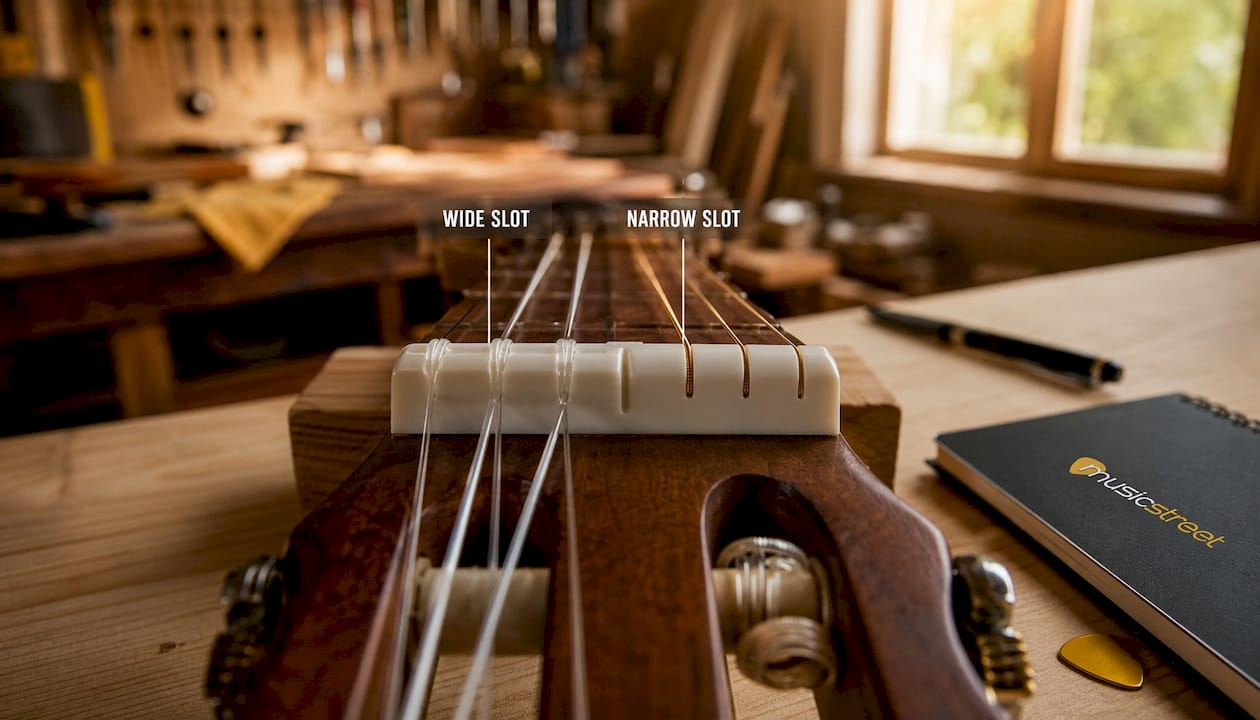
- Nut slots on steel-string guitars are cut for thinner metal strings; thicker nylon trebles may bind or raise action
- The D’Addario NYXL 11-49 and NYXL 9-42 are steel electric sets worth knowing as reference points for tension comparison, though they are not nylon options
Musicstreet stocks ball-end nylon and silk-and-steel sets and can handle the setup work if you would rather not do it yourself.
Table of Contents
- How do nylon strings change tone and feel on a steel-string guitar?
- What should you check on the guitar before fitting nylon strings?
- How do you install nylon strings on a steel-string acoustic safely?
- What are the lower-risk alternatives worth trying first?
- What does a luthier actually think about this swap?
- Key takeaways
- Is the swap actually worth it?
- Musicstreet can sort the strings and the setup
- Further reading and useful links
- FAQ
How do nylon strings change tone and feel on a steel-string guitar?
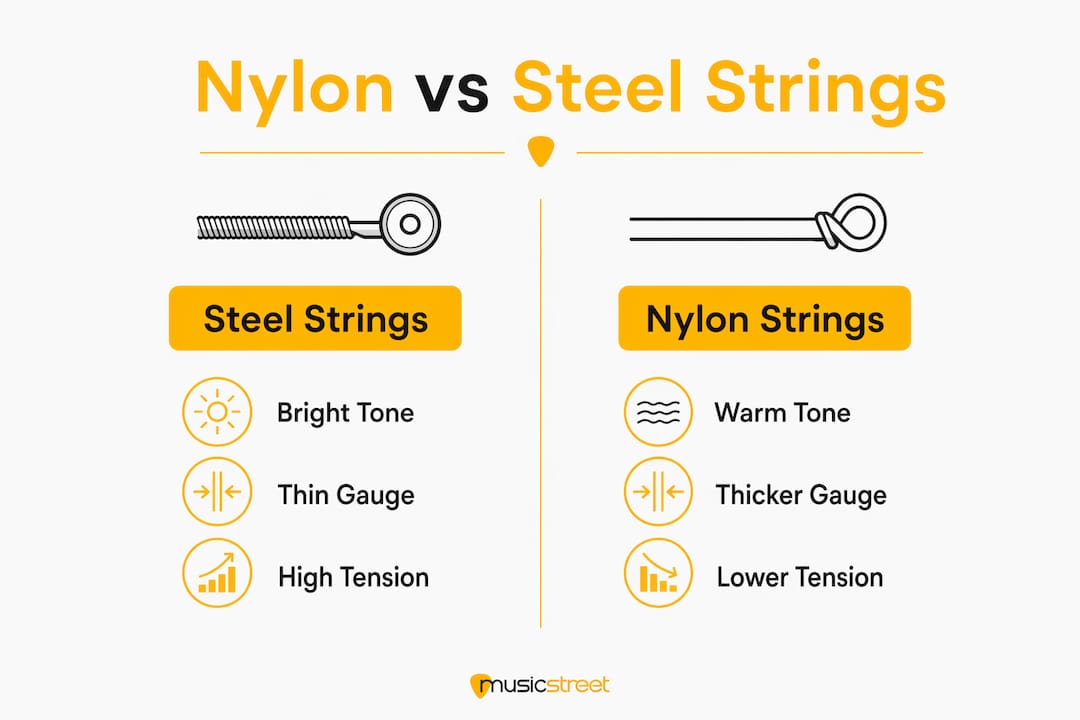
The tonal shift is significant. Steel strings produce bright, projecting sound because the metal windings vibrate with high energy against a stiff, heavily braced top. Nylon strings are softer in every sense: the attack is gentler, the overtones are warmer, and the volume drops noticeably. On a guitar built for steel, that drop can tip into sounding flat or lifeless rather than classically mellow, because the heavy X-bracing and stiff spruce top are tuned to respond to higher tension and simply are not excited enough by nylon.
| Feature | Steel strings | Nylon strings on steel guitar |
|---|---|---|
| Tone character | Bright, projecting | Warm, softer, reduced overtones |
| Volume | Higher | Noticeably lower |
| Sustain | Long | Shorter, can sound muted |
| Finger feel | Firm, can cause soreness | Softer surface, wider treble gauges |
| Tuning stability | Settles quickly | Extended stretch-in period, frequent retuning |
| Lifespan | Months (coated sets longer) | Similar, but stretch behaviour differs |
Playability changes too. Nylon treble strings are physically thicker than their steel equivalents, so they feel different under the fingers. The softer surface is gentler on fingertips, which is one reason beginners sometimes ask about the swap. The trade-off is that nylon stretches considerably when new, meaning you will retune repeatedly over the first few days before the strings settle.
Pro Tip: Stretch each string manually after fitting by pulling it gently away from the fretboard at the 12th fret, then retune. Repeat three or four times per string and you will cut the settling period from days to hours.
What should you check on the guitar before fitting nylon strings?
Run through this checklist before you commit to anything permanent.
Bridge type. Most steel-string acoustics use bridge pins. Standard classical strings are tie-on, designed for a slotted tie-block. Forcing a tie-on string under a bridge pin rarely works cleanly. Ball-end nylon strings solve this directly because they seat exactly as a steel string would.
Nut slots. Steel-string nut slots are cut for thinner metal strings. Nylon treble strings are wider in diameter, so they may bind in the slot, raise the action at the first fret, or simply not seat properly. Do not force them. If the string will not drop into the slot without pressure, the nut needs attention before you proceed.
Truss rod. A steel-string neck is set up to balance the pull of a high-tension string set. Drop that tension significantly and the truss rod can pull the neck into a back-bow, raising action in the middle of the neck and causing buzzing. Check that your guitar has an adjustable truss rod before you start.
Saddle height. Thicker strings may alter how the string sits at the saddle, affecting both action and intonation. Check for buzzing and check that the intonation is still reasonable after fitting.
Tuning machines. Small capstan holes and sharp slot edges can abrade nylon, which is softer than steel. Wind carefully and avoid sharp bends at the capstan.
How do you install nylon strings on a steel-string acoustic safely?
The sequence matters. Do not remove all six steel strings at once and immediately fit nylon; the sudden tension change is harder on the neck than a gradual swap.
- Choose the right strings. Ball-end nylon or silk-and-steel are the lowest-risk starting points. Low-tension nylon variants reduce the setup adjustment needed.
- Clean the fretboard while strings are off. It is the easiest opportunity you will get.
- Fit one string at a time, bringing each up to pitch before moving to the next. This keeps neck tension relatively stable throughout the process.
- Bring strings up slowly. Do not yank a nylon string to pitch in one go. Wind gradually, check for binding at the nut, and listen for any creaking from the bridge.
- Check neck relief. Once all strings are at pitch, sight down the neck. If it has back-bowed, the truss rod needs loosening. Turn it no more than a quarter-turn at a time, wait a few minutes, and recheck. If you are not confident doing this, stop and book a setup with a technician.
- Recheck action and intonation after 24 hours, once the neck has settled.
Nut slot modification is permanent: filing a slot wider to accept a thicker nylon string will usually ruin the nut for future steel sets. If the nut needs work, have a luthier fit a new nut rather than filing the existing one. That way, reverting to steel strings later means replacing the nut again rather than working around a ruined slot.
Community experience confirms that tuning instability is the most common frustration in the first week. Budget time for repeated retuning and do not judge the result until the strings have fully settled.

What are the lower-risk alternatives worth trying first?
If the full nylon swap sounds like too much hassle, these options get you closer to a softer feel without the compatibility headaches.
- Ball-end nylon strings are the pragmatic first experiment. They fit pin bridges without modification and give you a genuine nylon tone, even if the steel top limits how far that tone develops.
- Silk-and-steel sets are the most practical compromise. A silk core wrapped in steel keeps tension compatible with your existing setup, the nut fits without filing, and the feel is noticeably softer than a standard phosphor-bronze set. Silk-and-steel strings reduce finger harshness while keeping ball ends and core tension compatible with steel-string setups.
- Light-gauge or coated steel sets reduce finger soreness while preserving projection and keeping your setup stable. A good starting point if your main complaint is sore fingertips rather than tone.
- Buy a dedicated classical guitar. If you genuinely want the tone and feel of nylon strings, a purpose-built classical instrument will deliver it properly. A steel-string top will always limit how far the nylon tone can develop, no matter how well the setup is done. Browse Musicstreet’s acoustic guitar string guide for a fuller picture of what different materials actually do.
What does a luthier actually think about this swap?
The structural risk is asymmetric. Fitting nylon strings to a steel-string guitar is unlikely to cause immediate catastrophic damage because you are reducing tension, not increasing it. Martin Guitar’s guidance confirms this: the dangerous direction is fitting steel strings to a classical guitar, where the tension increase can split the top or pull the bridge. Going the other way is safer, but not without consequences.
The real risk with nylon on a steel guitar is not a cracked top. It is a back-bowed neck left unchecked, a nut filed permanently wide, and a guitar that no longer plays well with either string type. The instrument’s heavy X-bracing and stiff top are optimised for high tension; nylon often under-excites them and the result can sound dead rather than warm. A luthier’s job is to make sure the setup changes are controlled and reversible where possible.
Permanent modifications a workshop might carry out include nut slot filing or full nut replacement, saddle reshaping, and in some cases bridge hole work if tie-on strings are being used. Each of these changes the guitar’s compatibility with steel strings going forward. If the instrument has any collector or resale value, discuss this with a luthier before touching anything. Older guitars with more flexible tops sometimes respond more favourably to nylon tone than heavily braced modern acoustics, so the result is not always predictable without trying.
Key takeaways
Fitting nylon strings on a steel-string acoustic is possible and low-risk structurally, but the tonal result is often disappointing without a proper setup, and some modifications are permanent.
| Point | Details |
|---|---|
| Start with ball-end nylon | These seat under bridge pins without bridge modification, keeping the swap reversible. |
| Expect lower volume and warmth | Heavy X-bracing under-responds to nylon tension; the tone may sound muted rather than classical. |
| Adjust the truss rod carefully | Lower tension can back-bow the neck; loosen gradually, a quarter-turn at a time, and recheck. |
| Nut filing is permanent | Have a luthier fit a new nut rather than filing the existing slots if wider clearance is needed. |
| Musicstreet can help | Musicstreet stocks ball-end nylon sets and offers professional setup and inspection in Huntingdon. |
Is the swap actually worth it?
The honest answer is: rarely, unless you are experimenting for fun on a guitar you are not precious about. The steel-string top is the limiting factor. No matter how well the setup is done, the bracing and stiffness that make a steel-string guitar project and sustain are the same properties that prevent it from producing a convincing classical tone. You will get warmth, yes. You will get a softer feel. But you will not get the bloom and sustain of a proper classical instrument, and you will likely lose the volume and presence that made the steel-string worth playing in the first place.
Where the swap does make sense: low-volume home playing, a tonal experiment on a beater guitar, or a temporary fix while waiting for a new instrument. Where it does not: a gigged guitar you rely on for projection, an instrument with resale value, or any situation where you genuinely want classical tone rather than just a softer feel.
Musicstreet can sort the strings and the setup
Fitting nylon strings to a steel-string acoustic is one of those jobs where the strings themselves are cheap and the setup work is where things get complicated. Musicstreet stocks the Ernie Ball 2403 Clear & Silver Nylon set, one of the most practical ball-end nylon options for pin-bridge guitars, alongside silk-and-steel alternatives and a full range of acoustic sets for UK players.

The workshop at Musicstreet’s Huntingdon store handles truss rod adjustments, nut replacements, saddle work, and full setup inspections. If you want the swap done properly without risking a permanent mistake on a guitar you care about, book a setup inspection or browse compatible string sets at musicstreet.co.uk.
Further reading and useful links
- Ernie Ball 2403 Clear & Silver Nylon Classical Guitar String at Musicstreet
- Different types of guitar strings: a complete guide at Musicstreet
- How to replace guitar strings: a step-by-step guide at Musicstreet
- Best guitar strings 2025 for UK players at Musicstreet
- Martin Guitar: Steel vs. nylon guitars (manufacturer guidance on compatibility)
- Music StackExchange: Can I use nylon with a steel-string guitar? (community experience)
When booking a setup, ask your technician: “Can you check neck relief after the string change, and advise whether the nut needs replacing rather than filing?”
FAQ
Can you put nylon strings on a standard acoustic guitar?
Yes, but the result depends on bridge type, nut slot width, and whether the truss rod is adjustable. Ball-end nylon strings are the safest starting point because they seat under bridge pins without modification.
Do nylon strings hurt less than steel strings?
Nylon strings are softer on the fingertips than steel, which is why beginners often find them more comfortable. The trade-off on a steel-string guitar is lower volume and a longer tuning-in period as the strings stretch.
Do steel strings sound better than nylon?
Neither is objectively better. Steel strings produce a brighter, louder, more projecting sound suited to folk, country, and pop. Nylon strings produce a warmer, softer tone suited to classical and fingerstyle. On a steel-string guitar, nylon strings will typically sound quieter and less defined than on a purpose-built classical instrument.
Will nylon strings damage my steel-string guitar?
Structural damage is unlikely because nylon strings run at lower tension than steel. The real risks are a back-bowed neck if the truss rod is not adjusted, and permanent nut damage if slots are filed rather than the nut replaced.
How long do nylon strings take to settle on a steel-string guitar?
Nylon stretches considerably when new. Expect repeated retuning over the first two to four days. Manually stretching each string at the 12th fret after fitting speeds up the process significantly.






Share:
The Best Guitar Shop Cambridgeshire Has in Huntingdon, Cambridgeshire
Bass and electric guitar difference: which should you learn?