


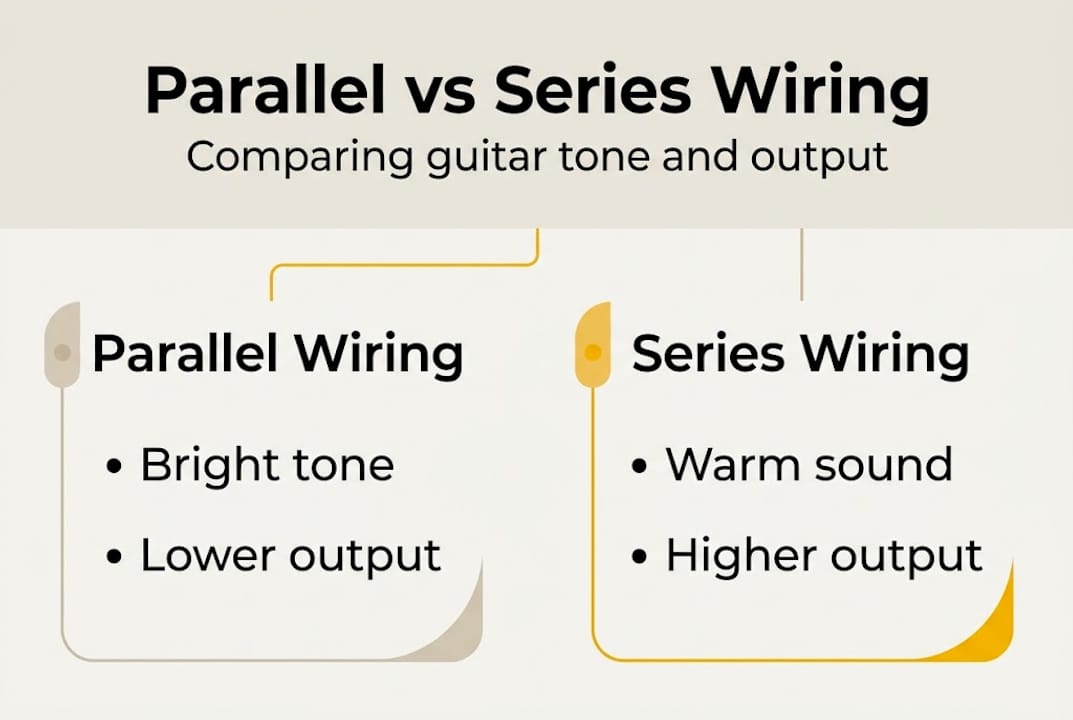
- Parallel wiring delivers brighter, more articulate tones with better note separation.
- It reduces output volume, making your guitar sound cleaner and more responsive on clean settings.
- Ideal for genres like funk, jazz, and pop, but less suitable for heavy rock or blues.
Most guitarists assume more output means better tone. It’s a reasonable assumption, but it misses something important. Parallel wiring flips that logic entirely, trading raw volume for something far more expressive: clarity, brightness, and note separation that series wiring simply cannot replicate. If you’ve ever wondered why your humbucker sounds muddy on clean settings, or why certain Stratocaster tones have that distinctive ‘quack,’ the answer often lives in how the pickups are wired. This guide covers exactly what parallel wiring is, how it shapes your sound, when to use it, and how to try it yourself.
Table of Contents
- What is parallel wiring?
- How does parallel wiring affect your guitar’s tone?
- When and why should you choose parallel wiring?
- How to rewire your guitar for parallel pickups
- A guitarist’s perspective: Why parallel wiring is more than just brighter tone
- Upgrade your tone with expert help
- Frequently asked questions
Key Takeaways
| Point | Details |
|---|---|
| Parallel wiring definition | Connects pickups side-by-side for a brighter, clearer guitar tone. |
| Sound characteristics | Delivers higher treble, enhanced note separation, and reduced output. |
| Best use cases | Favoured for clean, funk, and pop styles needing clarity and articulation. |
| DIY friendly | Many hobbyists can modify their guitar for parallel wiring with basic skills. |
What is parallel wiring?
Parallel wiring is a method of connecting your guitar’s pickups so that each one runs on its own independent signal path, side by side, before joining at the output. Think of it like two lanes of traffic moving simultaneously rather than one car following another. In contrast, series wiring connects pickups end to end, so the full signal from one pickup feeds directly into the next, stacking output and often adding warmth and thickness.
The difference matters enormously for tone. Understanding how your electric guitar pickups guide interact with wiring choices is the foundation of shaping your sound. In parallel, each pickup contributes its own character independently, which results in a brighter, more articulate tone with lower overall output compared to series.
Here’s a quick comparison to make it clear:
| Feature | Parallel wiring | Series wiring |
|---|---|---|
| Output level | Lower | Higher |
| Tone character | Bright, clear, articulate | Warm, thick, powerful |
| Note separation | Excellent | Moderate |
| Best genre fit | Funk, pop, clean work | Rock, blues, metal |
| Hum rejection | Moderate | Better |
The role of guitar pickups in determining your final sound cannot be overstated, and wiring configuration is one of the most influential variables in that equation.
Why do guitarists choose parallel? Several reasons:
- Clarity on complex chords: Individual notes ring out more distinctly.
- Preserving treble response: High-end shimmer is not absorbed by stacked coils.
- Taming overpowering humbuckers: Reduces the mud that can come with high-output pickups.
- Achieving vintage single-coil character: Humbuckers wired in parallel can approximate that classic snap.
Parallel wiring is not a new concept. It’s used in nearly every Fender Stratocaster from the factory. Those iconic in-between pickup positions you get on a Strat? That’s parallel wiring at work, and it’s responsible for some of the most beloved tones in guitar history.
How does parallel wiring affect your guitar’s tone?
The tonal shift from series to parallel is immediately noticeable. You lose some grunt, but you gain something more nuanced: definition. Each string speaks more clearly, and chords sound more open and crystalline. This is especially valuable when playing through a clean amplifier channel, where muddiness can ruin an otherwise good performance.
The physics behind it are straightforward. When coils run in parallel, the combined inductance drops, which pushes the resonant frequency higher. A higher resonant frequency of around 9 to 10kHz means more treble content reaches your amp. Series wiring sits below that range, accentuating midrange and bass instead.
Output voltage is also affected. Parallel wiring produces roughly half the output voltage of series, which changes how your amp responds. Lower input gain means the amp stays cleaner at higher volumes, which is a genuine advantage for studio recording and clean-tone players.
| Characteristic | Parallel | Series |
|---|---|---|
| Resonant frequency | 9 to 10kHz | Lower (midrange focus) |
| Output voltage | ~50% of series | Full output |
| Clean headroom | High | Lower |
| Midrange body | Leaner | Full |
Understanding how your guitar pots and wiring interact with these tonal changes helps you fine-tune the result. A lower-value tone pot, for instance, can warm up a parallel-wired guitar without losing its brightness.
Pro Tip: When switching to parallel wiring, turn your amp’s treble down slightly and boost the mids a touch. This balances the brighter signal and keeps your tone full rather than thin.
Genres where parallel wiring genuinely shines include funk, where that snappy, percussive attack is everything. It also suits pop production, where clarity in a dense mix is critical, and jazz, where clean articulation across complex chord voicings is non-negotiable. Even country players prize that bright, twangy cut that parallel wiring delivers naturally.

When and why should you choose parallel wiring?
Knowing what parallel wiring does is useful. Knowing when it serves you is what transforms a hobbyist into a thoughtful player. The answer depends on your style, your instrument, and honestly, the music you love to make.
Parallel wiring is the right call when you spend most of your time on clean or lightly overdriven tones. It also suits players who feel their humbucker sounds too thick and compressed for the music they play. If you’ve ever played a Stratocaster and loved its clarity, then found your Les Paul too dark by comparison, parallel wiring for the Les Paul’s humbuckers can bridge that gap.
Thinking about whether you need a pickup upgrade before rewiring is worth doing. Sometimes the pickup itself is fine, and the wiring configuration is the only thing holding back the sound you want.
Player profiles that benefit most from parallel wiring:
- Funk and rhythm guitarists who need percussive, snappy attack.
- Studio session players recording in dense arrangements where clarity is essential.
- Jazz guitarists who want articulate voicings without excessive warmth.
- Indie and pop players who blend clean and light drive tones regularly.
- Humbucker users who love the vintage single-coil character, as parallel preserves single-coil ‘quack’ in humbuckers.
Pro Tip: Before committing to a permanent rewire, use a push-pull pot or a mini toggle switch to create a series/parallel switching option. Many guitarists end up preferring the flexibility of both rather than locking into one configuration. Exploring different guitar and amp combinations helps you hear the wiring change in context before you commit.
The honest drawback? If you play hard rock or heavy blues, parallel wiring may feel too thin. Series wiring’s warmth and power suit those styles far better. Knowing your genre keeps you from chasing a tone that doesn’t match your music.
How to rewire your guitar for parallel pickups
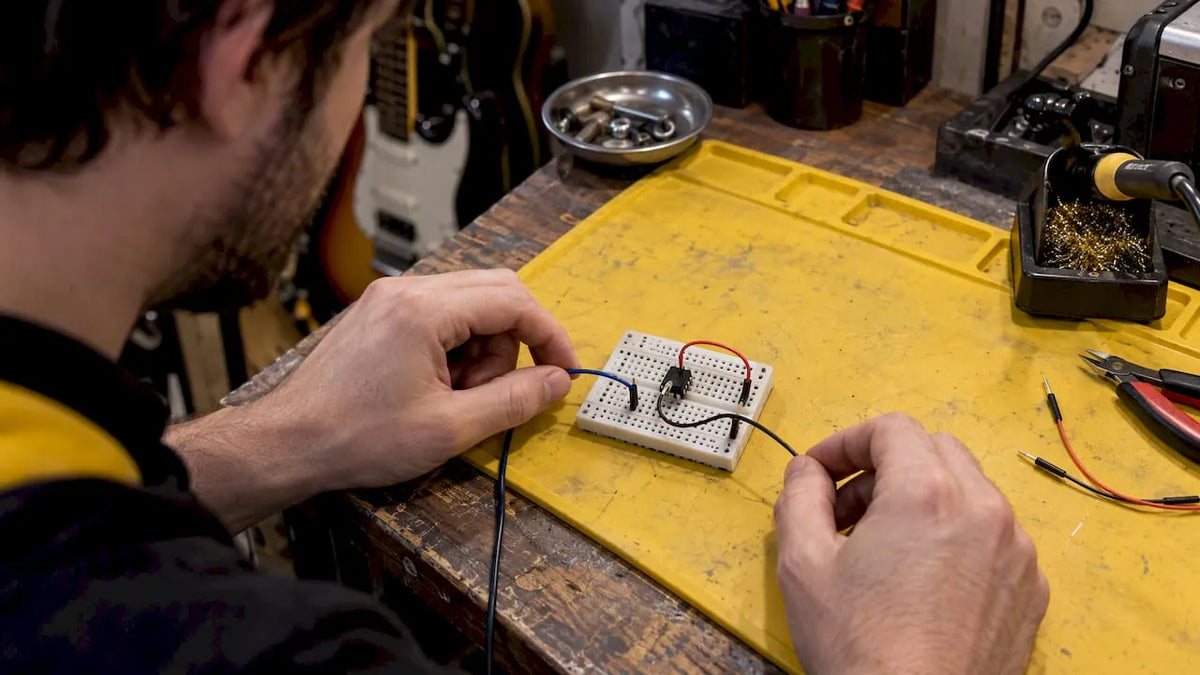
Ready to try it? The good news is that parallel wiring is one of the more accessible guitar modifications. You don’t need years of experience, but you do need patience, a steady hand, and the right tools.
Tools you’ll need:
- Soldering iron (25 to 40 watts)
- Rosin-core solder
- Wire strippers
- Small screwdrivers
- Wiring diagram specific to your guitar model
- Multimeter (optional but very useful)
Always work with the guitar unplugged from any amplifier. Heat dissipates quickly in electronics, so work methodically and do not rush joints.
Step-by-step process:
- Remove the guitar’s back plate or scratchplate to access the wiring cavity.
- Photograph the existing wiring before touching anything. This is your safety net.
- Identify the hot and ground wires from each pickup coil.
- In a standard series humbucker, the finish wire of the first coil connects to the start wire of the second. For parallel, connect both start wires together and both finish wires together instead.
- Run the combined hot signal to your volume pot and the combined ground to the pot casing.
- Reassemble, plug in, and test with a clean amp signal.
- If using a push-pull pot, wire so that pulled-up gives parallel and pushed-down gives series.
“A reversible mod is always the smartest first step. Add a switch before committing to a full rewire, and you’ll never have to unsolder regret.”
The guitar upgrades guide covers additional modifications worth pairing with a wiring change, particularly if you’re upgrading other components at the same time. Parallel wiring delivers clear note separation most noticeably through a clean amp, so test it that way first.
Watch for solder bridges and cold joints. A cold joint looks dull rather than shiny and can cause signal loss or intermittent crackling. If your tone sounds odd after rewiring, the joint is usually the first thing to check.
A guitarist’s perspective: Why parallel wiring is more than just brighter tone
There’s a temptation to view parallel wiring as a purely technical fix, a way to get a bit more treble from a muddy humbucker. But that framing misses the real value. Parallel wiring changes how you play, not just what you hear.
When your guitar sounds more articulate and responsive, you tend to play more deliberately. You hear every note in a chord, which makes you more conscious of voicings. You listen differently. Players who switch to parallel often report that their technique tightens up without them consciously trying, because the guitar rewards precision.
Most DIYers focus entirely on the wiring diagram and forget to account for how the change interacts with their amp’s gain structure and their actual playing dynamics. Understanding why to upgrade guitar pickups alongside wiring choices gives you a fuller picture of your instrument’s potential. Parallel wiring is not just a tone mod. It’s a creative tool that can shift your musical direction entirely.
Upgrade your tone with expert help
Exploring parallel wiring is genuinely exciting, and you don’t have to navigate it alone. At MusicStreet, we work with guitarists at every level, whether you’re just starting to experiment with wiring or planning a full instrument overhaul.

Our team in Huntingdon, Cambridgeshire is on hand for setup advice, component recommendations, and guitar repairs. If you want a solid grounding in how pickups shape your tone before modifying anything, our guitar pickups guide is a great place to start. We stock guitars from top brands and offer expert post-sale support, so whether you’re buying new, pre-loved, or upgrading your current instrument, we’re here to help you get the tone you’re after.
Frequently asked questions
Does parallel wiring reduce hum in guitars?
Parallel wiring does reduce some hum, but not as effectively as running a full humbucker in series mode. Its primary benefit is tonal clarity rather than noise cancellation.
Can you install parallel wiring on any guitar?
Most guitars fitted with humbuckers can be rewired for parallel operation. Single-coil pickups, such as those found in Stratocasters, are typically already wired in parallel by design.
Is parallel wiring better than coil-splitting?
Neither is universally better. Parallel wiring keeps both coils active for a brighter, fuller sound, while coil-splitting deactivates one coil entirely for a true single-coil character. They serve different creative purposes.
Are there drawbacks to parallel wiring?
Yes. The lower output and thinner sound compared to series wiring can be a disadvantage for heavier playing styles that rely on thick, powerful midrange tones.




Share:
Solid Top vs Laminate: Which Guitar Construction Is Right for You?
Noise gates explained: cleaner sound for every musician