


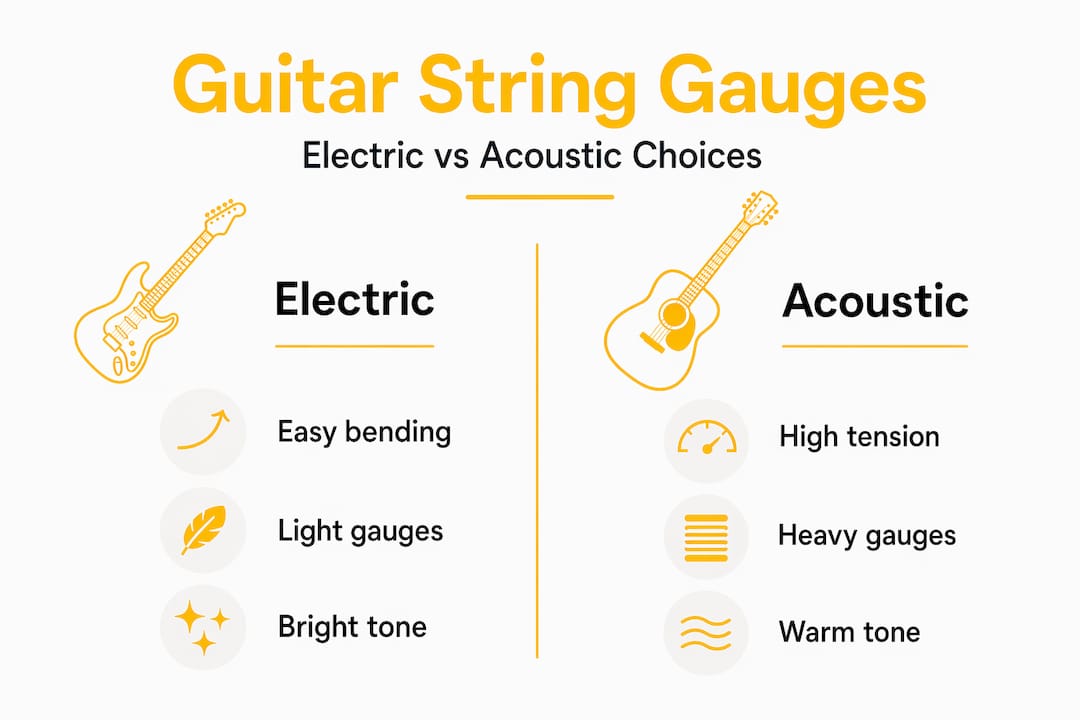
- Choosing the right string gauge influences both your guitar’s tone and playability, affecting tension, bending ease, and fatigue. Electric guitars typically use lighter gauges like 9s or 10s for versatility, while acoustics require heavier strings to drive the top and produce volume. Selecting the appropriate gauge depends on your playing style, tuning, and instrument, with gradual changes and professional setups recommended for significant shifts.
Choosing the right string gauge is one of those decisions that quietly shapes everything about how your guitar feels and sounds, yet it trips up players at every level. If you’ve ever stood in a shop staring at a wall of string packets wondering what gauge guitar string should I use, you’re not alone. The common assumption is that heavier strings equal better tone. That’s only half the story. Gauge affects playability and tone directly, influencing how long you can play before your fingers give up. This guide cuts through the confusion so you can make a confident, informed choice.
Table of Contents
- Key takeaways
- What is string gauge and why does it matter?
- Electric vs acoustic: choosing the right gauge
- Matching gauge to your playing style
- Practical steps for choosing and maintaining your gauge
- My honest take on string gauge selection
- Find your perfect strings at Musicstreet
- FAQ
Key takeaways
| Point | Details |
|---|---|
| Gauge affects more than tone | String thickness shapes tension, bending ease, sustain, and how long you can play before fatigue sets in. |
| Electric and acoustic differ significantly | Electric guitars suit lighter gauges; acoustics need heavier strings to drive the top and project volume. |
| Tuning and style drive gauge choice | Drop tunings and heavier genres need thicker strings; faster, bendy styles favour lighter gauges. |
| Changing gauge needs care | Moving up or down significantly may require a professional setup to keep your neck and action correct. |
| Stick with what works | If your tone is dialled in, replace with same gauge and brand to avoid unwanted surprises. |
What is string gauge and why does it matter?
String gauge refers to the diameter of a guitar string, measured in thousandths of an inch. A set described as “9s” has a plain first string measuring .009 inches across. That might sound tiny, but this measurement has a profound effect on how the string behaves under your fingers and how it sounds through your instrument.
Thinner strings sit under less tension. That makes them easier to press down, bend, and hold for extended periods. Thicker strings demand more force but reward you with more volume, warmth, and tuning stability, particularly at lower pitches. Neither is objectively superior. The right choice depends on you, your guitar, and the music you play.
Here is what gauge directly influences:
- Tension: Heavier gauges create higher tension across the neck, which affects how the guitar feels and how it must be set up.
- Tone: Lighter gauges are brighter and easier to bend, while heavier gauges produce a warmer, fuller sound with better sustain.
- Tuning stability: Thicker strings hold pitch more reliably, especially when you are using vibrato or drop tunings.
- Fatigue: Lighter strings let you play longer before your fretting hand tires, which matters hugely for beginners and players with smaller hands.
Pro Tip: If you are new to playing and wondering what string gauge for beginners makes sense, start with lighter gauges. They make learning far less physically demanding and let you focus on technique rather than fighting the strings.
Most standard guitar string gauge guides use common shorthand. On electric guitar you will see sets labelled 8s, 9s, 10s, 11s, and 12s, referring to the thinnest string in the set. Acoustic sets are typically labelled by the full range, such as 11 to 52 or 12 to 53.
Electric vs acoustic: choosing the right gauge
The guitar type you play is the single biggest factor in narrowing down your gauge options. Electric and acoustic guitars are built differently, strung differently, and respond to tension in very different ways.
Electric guitar gauges
Electric guitars rely on pickups rather than acoustic resonance to produce volume, so they tolerate lighter strings without losing fullness. The most popular electric string gauges break down like this:
| Gauge label | Typical measurements | Best suited for |
|---|---|---|
| Super light (8s) | .008–.038 | Shredders, fast lead players |
| Light (9s) | .009–.042 | Balanced playability, most genres |
| Regular (10s) | .010–.046 | Versatile, most popular choice |
| Medium (11s) | .011–.049 | Blues, jazz, lower tunings |
| Heavy (12s) | .012–.054 | Drop tunings, warm rhythm playing |
D’Addario’s gauge categories reflect this progression clearly: super lights are the easiest to bend and suit beginners or lead guitarists, while mediums are preferred for lower tunings and heavier styles. The 10s occupy a sweet spot that serves most players well, which is why they are the default factory choice on countless instruments.
Pro Tip: Famous players offer a telling contrast here. Stevie Ray Vaughan used notoriously heavy gauges for tone, while Tony Iommi of Black Sabbath used light strings tuned down to achieve his signature heaviness. Gauge and tuning work together. Neither tells the full story alone.
Acoustic guitar gauges
Acoustics work differently. The strings drive the guitar’s soundboard to create volume, so they need more tension to do their job properly. Going too light on an acoustic can leave the sound thin and lifeless. Typical acoustic gauge categories include:
- Extra light: .010–.047. Easiest to play, suits parlour guitars and fingerpickers.
- Light: .012–.053. A standard choice offering good balance of playability and projection. D’Addario’s light acoustic set at 12 to 53 in nickel bronze is a popular benchmark for clarity and tonal balance.
- Medium: .013–.056. Fuller sound, better suited to strumming on larger-bodied guitars such as dreadnoughts.
- Heavy: .014+. Maximum volume and sustain, but demanding on the fingers and the guitar’s structure.
Body shape matters too. A parlour guitar with a smaller, more delicate top can be damaged by heavy strings over time. A large-bodied dreadnought can handle and benefit from medium gauges. If you are exploring acoustic string gauge choices in more depth, body size is a key variable to factor in.
Matching gauge to your playing style
Once you know your guitar type, the next filter is your playing style. This is where personal preference and physical reality both come into the picture.
Bending and vibrato: If you bend strings frequently, lighter gauges are your friend. A .009 set bends with ease; an .011 set on the same guitar will feel like pulling wire. Blues players who rely on expressive vibrato and vocal bends almost always gravitate toward 9s or 10s on electric.

Genre and tuning: Drop D and other lower tunings need heavier strings to maintain adequate tension and avoid floppy, indistinct notes. Metal and heavy rock players tuning to C or B standard often move to 11s or 12s. Conversely, country and pop styles that favour bright, clean tones suit lighter gauges well.
Finger strength and comfort: This is under-discussed. If your fingertips are sore after twenty minutes of playing, the gauge may be too heavy for your current strength and callus development. There is no shame in using lighter strings. Many professional players do. Comfort directly affects how much you practise, and practise is what actually builds skill.
Jazz and classical-influenced playing: These styles tend to favour heavier gauges on electric because the emphasis is on warm, round tone with minimal string noise rather than bright attack or extreme bending. Jazz guitarists often use 11s or 12s with a flatwound construction for that smooth, dark sound.
The best gauge for guitar strings in any situation is the one that lets you play the music you love without fighting the instrument. There is no universal answer.
Practical steps for choosing and maintaining your gauge
Knowing what gauge suits you is one thing. Making sure your guitar responds well to it is another. Follow these steps to get the most from your string selection.
-
Check your guitar’s factory spec. Most manufacturers ship instruments with a specific gauge. This is the gauge the guitar was set up for. Staying close to this spec will keep your setup stable without any professional intervention.
-
Change strings like for like. MusicNomad advises replacing with the same gauge and brand if your tone and setup are already where you want them. Two sets with the same nominal gauge from different brands can feel distinctly different due to winding style, core shape, and material choices.
-
Move in small steps. If you want to experiment with gauge, shift by one step at a time. Going from 9s to 10s is manageable with minor adjustments. Going from 9s to 13s will likely require neck and action adjustments that need professional attention.
-
Know when to visit a technician. Large gauge changes need professional setup due to the increased tension affecting neck relief and bridge action. This is not an optional extra. Done wrong, it can damage the instrument over time.
-
Use manufacturer tools. D’Addario’s String Finder and String Tension Pro let you input your tuning, scale length, and preferred feel to generate a precisely matched string recommendation. These tools remove much of the guesswork.
Pro Tip: If you play multiple guitars in different tunings, consider labelling each guitar with the string gauge and brand currently fitted. This removes the temptation to grab whatever is to hand and maintains the tonal consistency you have worked to achieve.
For a deeper look at how gauge interacts with your instrument’s setup and long-term tone, Musicstreet’s guide on string gauge is a solid starting point before you commit to a change.
My honest take on string gauge selection
In my experience, the biggest mistake guitarists make is treating gauge as a fixed identity rather than a working variable. I have seen players stick rigidly to the strings that came on their guitar for years, assuming any change would be a step backwards. And I have seen the opposite: beginners reaching straight for heavy strings because a favourite guitarist uses them, then wondering why playing feels like hard work.
What I have found actually useful is this: start lighter than you think you need to, and move up only when the tone or tuning stability demands it. A small gauge shift often delivers more difference than people expect. Moving from 9s to 10s on an electric changes the feel under your fingers noticeably while adding warmth and body to the tone.
The point that rarely gets made is that gauge is not a one-size-fits-all decision. Your comfort, your instrument, your genre, and your current technique all feed into the right answer. Personal comfort should guide your experimentation far more than received wisdom about what “serious” players use. The strings that keep you playing longer and enjoying it more are, without question, the right ones for you.
— Musicstreet
Find your perfect strings at Musicstreet
Whether you are just starting out or reassessing your setup after years of playing, having access to the right strings makes a real difference.

At Musicstreet, you will find a carefully selected range of premium guitar strings across all gauges, materials, and brands, suited to electric, acoustic, and bass players alike. Our team understands that string selection is personal, and we are here to help you match gauge and construction to your playing style with confidence. From trusted manufacturers to niche options for specialist tunings, the best electric guitar strings in a range of gauges are available to browse online or in our Huntingdon store. Free UK delivery on qualifying orders makes trying something new that much easier.
FAQ
What gauge electric guitar strings should a beginner use?
Most beginners do well with 9s (.009–.042) on electric guitar. They are easier to press and bend, which lets you focus on developing technique without unnecessary finger fatigue.
Does changing string gauge require a guitar setup?
Moving one step in gauge, such as from 9s to 10s, usually requires only minor adjustments. A large change, such as moving from 9s to 12s, will require a professional setup to adjust neck relief and action correctly.
Are heavier strings always better for tone?
Not at all. Heavier gauges offer warmth and better tuning stability, but lighter gauges provide brightness and ease of bending. The best tone comes from the gauge that suits your guitar, tuning, and playing style.
Can two string sets with the same gauge feel different?
Yes. Two sets at the same gauge can behave quite differently depending on their core shape, winding style, and material. This is why sticking with the same brand as well as gauge is recommended when you are happy with your current tone.
What string gauge should I use for drop tunings?
Drop D and lower tunings suit medium to heavy gauges, typically 11s or 12s on electric. The extra tension keeps strings taught at lower pitches and prevents the floppy, undefined feel that lighter strings produce when tuned down.










Share:
Fender Jazzmaster vs Jaguar: Which Offset Guitar Should You Choose?
Electric guitar wood: how tonewoods shape your sound