

Many beginner guitarists feel stuck because they practise without a clear plan, leading to slow progress and frustration. An efficient workflow transforms scattered efforts into focused sessions that build skills faster and keep you motivated. This guide provides a structured daily practice routine designed to help you master chords, rhythm, and scales while enjoying consistent improvement every week.
Table of Contents
- Introduction To Beginner Guitar Workflow
- Prerequisites: What You Need Before Starting
- Daily Practice Routine And Time Management
- Warm-Up Exercises To Prepare Your Hands
- Chord Practice Strategies For Beginners
- Strumming And Rhythm Development
- Introduction To Scale Practice
- Common Mistakes And How To Fix Them
- Expected Outcomes And Progress Benchmarks
- Discover The Perfect Guitar And Accessories For Beginners
- FAQ
Key takeaways
| Point | Details |
|---|---|
| Structured daily practice builds skill faster | Beginners who adopt a structured routine improve 2-3 times faster than those practising without clear plans. |
| Warm-up exercises prepare your hands | Spending 5 to 10 minutes on stretches and chromatic drills reduces injury risk and improves dexterity. |
| Focused chord and strumming practice improves technique | Deliberate chord transitions and simple strumming patterns develop muscle memory and rhythm skills. |
| Introducing scales boosts fretboard familiarity | Major and pentatonic scales expand musical vocabulary and prepare you for soloing. |
| Consistent routines lead to steady progress | Following a daily plan for 3 to 6 months produces measurable improvements in timing, transitions, and confidence. |
Introduction to beginner guitar workflow
A clear, step-by-step workflow prevents you from feeling overwhelmed and directs your energy toward activities that produce real results. Without structure, beginners often struggle with irregular practice, slow skill acquisition, and mounting frustration that can lead to giving up entirely.
Beginners who adopt a structured routine improve their skills 2-3 times faster than those practising without clear plans. This difference stems from focused repetition of foundational techniques rather than aimless noodling.
Key benefits of a structured workflow include:
- Faster skill acquisition through targeted exercises that address specific weaknesses
- Better retention of techniques because consistent repetition strengthens muscle memory
- More enjoyable sessions since you can track tangible progress each week
- Reduced frustration from knowing exactly what to practise and when
Think of your practice routine as a recipe. Just as baking requires specific steps in the right order, guitar progress demands deliberate exercises performed consistently. Daily practice tips for electric guitar players emphasise this systematic approach.
Pro Tip: Keep a practice journal to record which exercises you completed and areas that felt challenging. This habit helps you identify patterns and adjust your routine for maximum efficiency.
Prerequisites: what you need before starting
Before diving into practice, gather the essential tools and create an environment that supports focused learning. Your guitar should feel comfortable and be properly set up with low action to make fretting easier on your fingers.
Essential equipment includes:
- A beginner-friendly acoustic or electric guitar with proper setup
- Electronic tuner or smartphone tuning app for accurate pitch
- Replacement picks in various thicknesses to find your preference
- Metronome or rhythm backing tracks for timing practice
- Comfortable chair or strap for proper playing posture
Choosing your first guitar wisely ensures you start with an instrument that fits your body size and musical preferences. Consider visiting a shop for professional setup advice, as proper string height dramatically affects playability.

Create a dedicated practise area free from distractions like television or social media notifications. Even a quiet corner works if it allows you to focus completely on the task at hand.
| Setup element | Recommendation | Why it matters |
|---|---|---|
| Guitar setup | Low action, fresh strings | Easier fretting reduces finger fatigue |
| Lighting | Bright, adjustable lamp | Helps you see fret positions clearly |
| Seating | Firm chair or standing strap | Maintains proper posture and prevents back strain |
| Accessories storage | Small basket or case pocket | Keeps picks and tuner within reach |
Mindset readiness involves setting realistic goals and committing to consistent practice. Expect gradual progress rather than overnight mastery. Beginner guitarist essentials for a strong start covers mental preparation alongside physical tools.
Pro Tip: Schedule practice at the same time each day to build a habit. Morning sessions often work best because your mind is fresh and distractions are minimal.
Daily practice routine and time management
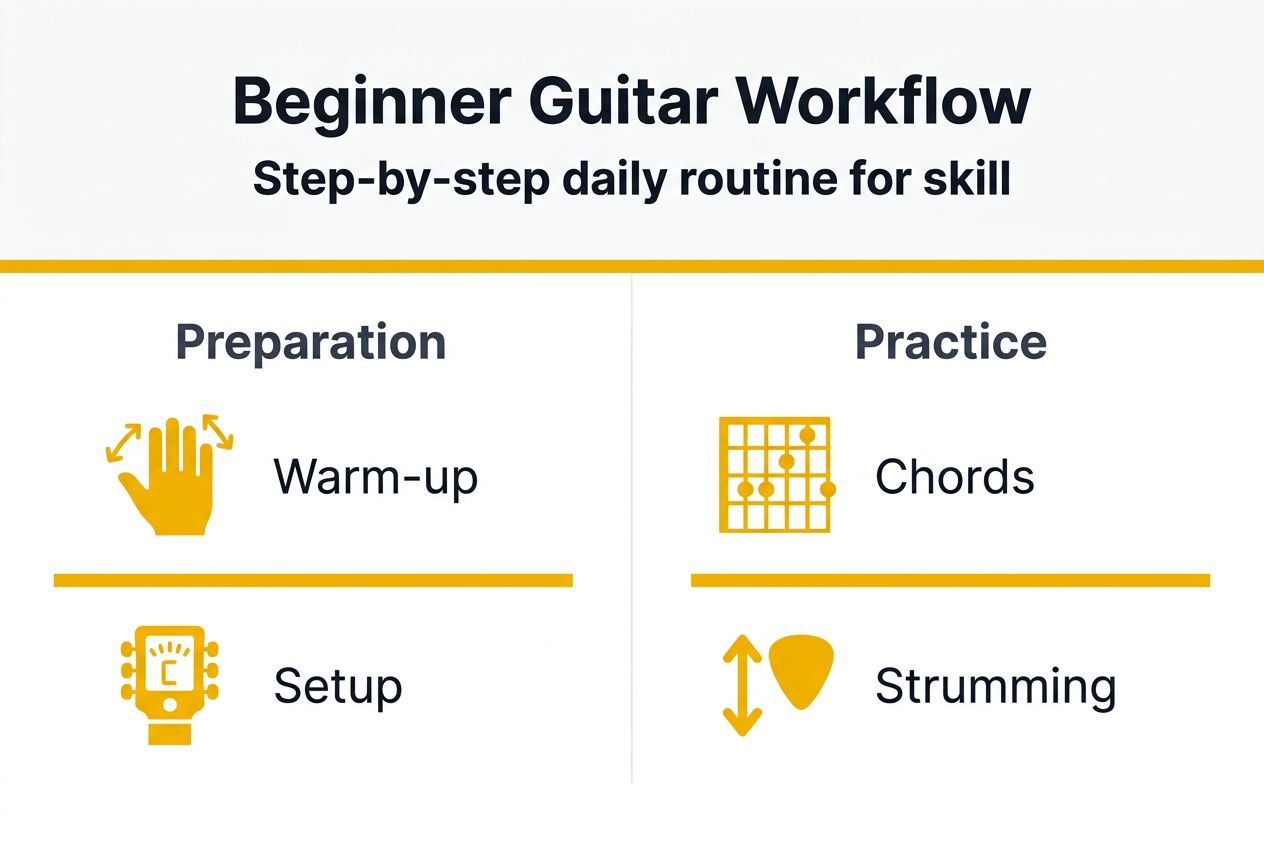
Establishing a consistent daily schedule creates the foundation for rapid skill development. Consistent daily practice sessions of 20-30 minutes for beginners lead to faster skill acquisition and better retention compared to irregular longer sessions.
Aim for four to six days per week rather than seven to allow recovery time and prevent burnout. Quality trumps quantity, so a focused 25-minute session delivers better results than an hour of distracted playing.
Implement this time management approach:
- Choose specific days and times that fit your schedule realistically
- Set phone reminders 10 minutes before each session to mentally prepare
- Use a timer during practice to stay on track with each exercise segment
- Track completed sessions on a calendar to visualise your consistency streak
- Adjust timing if needed, but never skip more than two consecutive days
Consistency builds neural pathways that make techniques feel automatic over time. Missing occasional sessions is normal, but maintaining a regular pattern ensures steady progress.
Daily practice tips for electric guitar players suggest breaking your 20 to 30 minutes into focused segments: warm-up, chords, rhythm, and scales. This structure prevents boredom and addresses multiple skill areas each session.
Pro Tip: If you miss a planned session, practise for just 10 minutes that day instead of skipping entirely. Short practice maintains your habit streak and keeps skills fresh.
Warm-up exercises to prepare your hands
Starting a practice session with 5-10 minutes of warm-up exercises enhances finger dexterity and reduces injury risk. Cold muscles and tendons are prone to strain, especially when attempting fast or complex techniques.
Chromatic exercises move through all four frets using one finger per fret. Start on the low E string at the first fret with your index finger, then play the second fret with your middle finger, third fret with your ring finger, and fourth fret with your pinky. Move to the A string and repeat the pattern up through all six strings.
Spider exercises involve playing non-sequential fret combinations to improve finger independence. Try playing frets 1, 3, 2, 4 on each string, or experiment with patterns like 1, 4, 2, 3. These unusual sequences force your brain to coordinate fingers that don’t naturally work together.
Hammer-on drills strengthen your fretting hand by building finger power without picking assistance. Place your index finger on the fifth fret of the G string and pick once, then hammer your middle finger onto the sixth fret without picking again. The force of your finger hitting the fretboard should produce a clear note.
Key warm-up benefits include:
- Increased blood flow to fingers, improving coordination and speed
- Reduced risk of tendonitis or repetitive strain injuries
- Mental preparation that shifts your focus entirely to guitar playing
- Gradual difficulty increase that prepares hands for complex chord shapes
Perform each warm-up exercise slowly at first, focusing on clean notes and even timing. Speed develops naturally as your fingers gain strength and muscle memory.
Chord practice strategies for beginners
Focusing chord practice on common open chords like C, G, D, Am, and Em improves beginner proficiency effectively because these shapes appear in thousands of popular songs. Mastering these five chords unlocks the ability to play recognisable music quickly.
Practice slow, deliberate chord changes to build muscle memory. Your brain needs time to encode the finger positions and movements required for smooth transitions. Rushing this process creates sloppy habits that become difficult to correct later.
Follow this structured approach:
- Form the C chord shape and strum slowly, ensuring each string rings clearly
- Lift your fingers completely off the fretboard and relax your hand
- Reform the C chord without looking at your fingers if possible
- Repeat this lift-and-reform process 10 times to strengthen muscle memory
- Move to the G chord and repeat the entire process
- Practice transitioning between C and G, pausing between each change
- Gradually reduce pause time as transitions become smoother
Focus on common chord pairs that appear frequently in songs: G to C, D to A, Em to C, and Am to G. These transitions deserve extra repetition because they form the backbone of countless chord progressions.
Best advice for new guitar players emphasises patience during this stage. Expect transitions to feel awkward for several weeks before they start feeling natural.
Visualise your finger movements away from the guitar. Mental rehearsal strengthens the same neural pathways as physical practice and can be done anywhere.
Strumming and rhythm development
Practising strumming with simple patterns such as downstrokes and down-up alternating strokes improves rhythm skills and timing significantly in beginners. Solid rhythm makes even simple chord progressions sound musical and engaging.
Start with all downstrokes on each beat using a metronome set to 60 beats per minute. Strum once per click, focusing on hitting all strings evenly with consistent force. This foundational pattern teaches you to lock into steady time.
Progress to down-up patterns by strumming down on the beat and up on the offbeat. Count “one and two and three and four and” while playing, with downstrokes on numbers and upstrokes on “ands.” This alternating motion feels more natural and enables faster rhythm playing.
Key strumming practice elements:
- Metronome use to develop internal timing and prevent rushing or dragging
- Wrist motion rather than arm motion for smoother, more controlled strumming
- Dynamic variation between loud and soft strums to add musical expression
- Muting techniques using your palm to create rhythmic accents
Backing tracks provide more engaging rhythm practice than a bare metronome. Search for simple chord progression backing tracks that match the chords you know, then practise maintaining steady strumming throughout the entire track.
Rhythm training improves every aspect of your playing because timing issues undermine even perfectly formed chords. A slightly sloppy chord played with solid rhythm sounds better than a perfect chord with inconsistent timing.
Pro Tip: Record yourself strumming along with a metronome, then play back the recording to identify where your timing drifts. This objective feedback reveals timing issues you might not notice while playing.
Introduction to scale practice
Integration of scale practice, especially minor pentatonic and major scales in multiple positions, builds fretboard knowledge vital for soloing and improvisation. Scales feel abstract at first but become essential tools for creating melodies and understanding music theory.
The major scale in open position uses open strings combined with fretted notes. Start on the open G string and play through the pattern: open, 2nd fret, 4th fret, then move to the B string. This pattern teaches you how notes connect across strings.
The major scale in 5th position begins on the 5th fret and uses a moveable pattern that works at any fret. Learning one moveable shape gives you access to all 12 major scales simply by starting at different frets.
Minor pentatonic box shape on the 5th fret provides your first soloing framework. This five-note scale sounds good over blues and rock backing tracks, making practice immediately rewarding. Play the pattern ascending and descending until your fingers memorise the shape completely.
| Scale type | Position | Primary benefit |
|---|---|---|
| Major scale | Open position | Teaches note relationships and open string integration |
| Major scale | 5th fret | Introduces moveable patterns usable anywhere |
| Minor pentatonic | 5th fret box | Enables immediate soloing over backing tracks |
| Minor pentatonic | 12th fret box | Expands range and connects scale patterns |
Practise scales with a metronome, playing one note per click. This methodical approach builds accuracy and timing simultaneously. As the pattern becomes familiar, increase the tempo gradually.
Scales expand your musical vocabulary by showing you which notes work together. This knowledge helps you create original melodies rather than relying solely on memorised songs.
Common mistakes and how to fix them
Common mistakes like skipping warm-ups, inconsistent practice, and neglecting rhythm occur frequently and stunt progress, but remedial measures including scheduled routines and metronome use address these issues effectively.
Skipping warm-ups can slow progress by up to 50% because cold fingers lack the coordination needed for complex techniques. This mistake also increases injury risk, potentially forcing you to stop playing for weeks. Fix this by scheduling warm-ups as non-negotiable parts of every session.
Inconsistent practice leads to stagnated skill development because your brain needs regular repetition to form lasting neural connections. Missing multiple days erases the progress from previous sessions. Maintain consistency by treating practice appointments as seriously as work meetings.
Neglecting rhythm training causes timing issues that make you sound amateurish even when playing correct notes. Many beginners focus exclusively on chords and scales while ignoring the metronome. Integrate rhythmic exercises into every practice segment to develop steady internal timing.
Practising chord changes too quickly creates sloppy habits. Speed comes naturally from accurate slow practice, but accuracy never develops from rushed sloppy practice. Slow down, pause between changes, and prioritise clean execution over impressive tempo.
Key fixes for common pitfalls:
- Schedule warm-ups as the mandatory first activity of each session
- Set calendar reminders to maintain consistent practice days
- Use a metronome during every exercise, even basic chord changes
- Record practice sessions weekly to objectively assess your technique
- Focus on small improvements rather than comparing yourself to advanced players
Practising slowly with full attention builds skills faster than mindlessly rushing through exercises. Quality repetition creates muscle memory, while careless repetition reinforces mistakes.
Address mistakes immediately when you notice them rather than hoping they’ll resolve on their own. Bad habits become progressively harder to fix the longer you ignore them.
Expected outcomes and progress benchmarks
Effective beginner practice routines see measurable progress in muscle memory, rhythm timing, and fretboard navigation within 3 to 6 months of consistent practice. Setting realistic expectations helps you stay motivated during the inevitable plateaus.
Smooth chord changes between common open chords typically develop within three months. Your fingers will find positions automatically without conscious thought, and transitions will flow without noticeable pauses. This milestone enables you to play simple songs from start to finish.
Steady strumming patterns accompanied by a metronome usually solidify after two months. You’ll maintain consistent tempo without drifting faster or slower, and your strumming hand will move with relaxed confidence.
Fretboard scale patterns become playable and memorised within four to six months. You’ll navigate the major scale and minor pentatonic shapes without looking at your fingers, opening the door to improvisation and melody creation.
| Timeframe | Skill milestone | Confidence indicator |
|---|---|---|
| 1 month | Basic open chords formed clearly | Can play simple one-chord songs |
| 2 months | Steady rhythm with metronome | Comfortable playing along to backing tracks |
| 3 months | Smooth chord transitions | Can play 3-4 chord songs without stopping |
| 4-6 months | Scale patterns memorised | Beginning to create simple melodies |
| 6 months | Multiple skills integrated | Playing complete songs with confidence |
Overall confidence and musical independence improve steadily with consistent effort. You’ll find yourself picking up the guitar spontaneously to explore ideas rather than viewing practice as obligatory work.
Track progress through recordings rather than memory. Record yourself playing the same chord progression monthly to hear concrete improvements that daily practice makes difficult to notice.
Expect occasional plateaus where progress seems to stall. These periods often precede breakthroughs as your brain consolidates multiple skills simultaneously. Maintain your routine through plateaus rather than changing everything out of frustration.
Discover the perfect guitar and accessories for beginners
Starting your guitar journey with quality equipment tailored to beginner needs makes practice more enjoyable and accelerates your progress. Finding a guitar with proper setup and comfortable playability removes unnecessary obstacles that can discourage new players.

Explore beginner-friendly guitars from trusted brands like PRS, Gibson, Fender, and Martin at MusicStreet’s premium guitar shop, where expert advice helps you choose instruments designed to support your learning workflow. Quality guitars with professional setup ensure low action and proper intonation, making chord formation and fretting significantly easier on developing fingers. Browse essential accessories including reliable tuners, comfortable straps, and replacement strings that complement your structured practice routine and keep you playing consistently.
FAQ
How long should I practise guitar daily as a beginner?
Aim for 20 to 30 minutes daily, four to six days per week. Consistency matters far more than long sessions because regular repetition builds muscle memory effectively. Short focused practice beats irregular marathon sessions every time.
What are the best warm-up exercises for guitar beginners?
Chromatic finger exercises, spider drills, and hammer-ons performed for 5 to 10 minutes prepare your hands optimally. These exercises increase blood flow, improve finger independence, and reduce injury risk. Start every session with deliberate warm-ups rather than jumping straight into songs.
How can I improve chord transitions quickly?
Practise slowly and deliberately, focusing on accuracy rather than speed. Use common open chords like C, G, D, Am, and Em, then repeat frequent transitions between pairs like G to C repeatedly. Muscle memory develops through patient repetition, not rushed attempts.
Why is rhythm training important for beginners?
Good rhythm underpins all musical skills and makes even simple playing sound professional. Metronomes and backing tracks help develop steady internal timing that makes you sound musical. Neglecting rhythm creates timing issues that undermine otherwise solid technique.


Share:
Discover the advantages of custom guitars in 2026
Why Is The P Bass So Popular With Bass Players?