


The five scale families every 5-string player needs are the major scale, natural minor, harmonic minor, melodic minor, and both pentatonic variants plus the blues box. Learn those seven shapes and you cover harmony, groove, soloing, and cross-genre utility in one go. Start by picking C major, find the root on the 3rd fret of your low A string (4th string in BEADG), and play the shape up two octaves. Then shift that same shape up two frets to another key. That single transposition is the whole game on a 5-string.
Two immediate next steps:
- Play a C major shape from the A string root, ascending and descending, at 60 BPM with a metronome.
- Shift the root to D (5th fret, A string) and repeat the identical fingering. Notice nothing changes except position.
Key takeaways
Mastering 5-string bass guitar scales requires learning movable shapes for major, minor, pentatonic, and blues patterns in both BEADG and EADGC tunings, paired with interval knowledge that lets you apply those shapes musically across all 12 keys.
| Point | Details |
|---|---|
| Learn seven core shapes | Major, natural minor, harmonic minor, melodic minor, major pentatonic, minor pentatonic, and blues box cover all essential musical contexts. |
| Use movable shapes across 12 keys | Shift the root on the A or B string to transpose any shape to a new key without relearning the fingering. |
| Know your tuning’s root logic | BEADG roots sit on the B or A string; EADGC roots sit on the E or A string — map this before practising. |
| Practise applied, not isolated | Play scales over chord progressions and backing tracks; interval knowledge built this way transfers to improvisation. |
| Musicstreet setup and instruments | The Yamaha TRBX305 and TRB1005J, available from Musicstreet, offer stable platforms for serious scale practice. |
Table of Contents
- Major and minor scale patterns on a 5-string: interval formulas and fingering
- Pentatonic and blues box patterns for 5-string bass
- How BEADG and EADGC change your whole-neck scale maps
- Practice routines that build real fluency on a 5-string
- How to find and build printable 5-string scale charts
- Why intervals matter more than shapes on a 5-string
- The right 5-string bass makes scale practice click
- Sources
- FAQ
Major and minor scale patterns on a 5-string: interval formulas and fingering
The major scale interval formula is 2-2-1-2-2-2-1 (whole, whole, half, whole, whole, whole, half steps). On a 5-string in BEADG, a C major shape with the root on the 3rd fret of the A string looks like this:
String:  B    E    A    D    G
Fret:    —    —    3    5    2
         —    —    5    7    3
         —    —    —    —    5
The root sits on the A string (4th string). You can also anchor the root on the low B string (5th string) for a lower-octave start, which is one of the key advantages of 5-string bass guitar scales in BEADG tuning.
Natural minor (Aeolian) uses the formula 2-1-2-2-1-2-2. C natural minor: C D Eb F G Ab Bb. The lowered 3rd, 6th, and 7th give it that darker, more settled feel you hear in rock and funk.
Harmonic minor raises the 7th degree back up: 2-1-2-2-1-3-1. That augmented 2nd interval (3 semitones) between the 6th and 7th degrees is the sound of flamenco, metal, and classical bass lines. The stretch in your fretting hand is real — keep your thumb centred behind the neck.
Melodic minor (ascending form) uses 2-1-2-2-2-2-1, smoothing out the awkward augmented 2nd of harmonic minor. Many jazz bassists use this scale almost exclusively over minor-major 7th chords.
For fingering, the guiding principle is one finger per fret in the lower positions, shifting to a stretch approach above the 7th fret where the frets narrow. Avoid anchoring your thumb over the top of the neck — it locks your hand and kills lateral movement across five strings.
Pro Tip: Think in scale degrees (1, 2, 3, 4, 5, 6, 7) rather than memorising shapes alone. When you know that the harmonic minor’s raised 7th is degree 7, you can find it instantly in any key without relearning the shape from scratch. Practitioners who rely on shapes alone tend to stall at the edge of a memorised pattern — interval thinking keeps you moving. This is a point Bassline Publishing’s scale guide makes explicitly: interval knowledge, not shape memory, is what gives you musical flexibility.
Pentatonic and blues box patterns for 5-string bass
Pentatonic scales strip the major or minor scale down to five notes, removing the two most harmonically tense intervals. The result is a shape that sits comfortably over almost any chord in its key.
C minor pentatonic (formula: 3-2-2-3-2): C Eb F G Bb. Root on the 3rd fret of the A string.
String:  B    E    A    D    G
Fret:    —    —    3    5    3
         —    —    6    8    6
C major pentatonic (formula: 2-2-3-2-3): C D E G A. Root again on the 3rd fret of the A string, but the shape shifts up — the major pentatonic sits a minor 3rd above its relative minor pentatonic shape.
The blues box adds one note to the minor pentatonic: the flat 5th (the “blue note”). In C, that’s Gb. It sits between the 4th (F) and 5th (G) and creates the tension that defines blues, funk, and soul bass lines. On the fretboard, it appears as a single extra fret between two notes you already know. Once you can transpose pentatonic shapes across all 12 keys by shifting the root on the A or B string, the blues box moves with it automatically.
Three short practice drills to lock these in:
- Boxed licks: Play the C minor pentatonic shape, then improvise a 4-bar phrase using only those five notes. Restrict yourself to the box — no position shifts. Record it and listen back.
- Octave displacement: Play each note of the pentatonic scale, then immediately play it an octave higher on the next string set. This forces you to map the shape across the full 5-string neck rather than staying in one position.
- Call and response: Play a 2-bar phrase (the “call”), leave 2 bars of silence, then answer with a different phrase using the same scale. This builds musical phrasing rather than mechanical scale running.
How BEADG and EADGC change your whole-neck scale maps
The two common 5-string tunings serve different musical purposes, and understanding that difference changes how you map scales across the neck.
BEADG (standard low B) is the factory tuning on most 5-string basses, including the Yamaha TRBX305. The low B string extends your range down a perfect 4th below the standard E, giving you five extra low notes (B, C, C#, D, D#) that are invaluable for drop-tuned grooves, orchestral bass lines, and heavy music. Root positions for scales typically sit on the B string (5th string) or the A string (4th string). Movable diagrams for BEADG tuning show how a C major shape anchored on the B string at the 3rd fret gives you a full two-octave run without shifting position.
EADGC (high C) keeps the familiar 4-string EADG layout and adds a high C above the G string. This tuning is preferred by players who want upper-register access for chordal work, melodic soloing, and chord-melody arrangements. The interval relationships between strings remain identical to a 4-string, which makes the transition from 4-string intuitive. Movable diagrams for EADGC tuning demonstrate how the same C major shape from the E string root now extends up to the high C string for a wider melodic range.
| Feature | BEADG (low B) | EADGC (high C) |
|---|---|---|
| Extra range | 5 lower notes (B to D#) | Upper register (C above G) |
| Root start | B string or A string | E string or A string |
| Best for | Groove, drop tunings, heavy music | Chordal work, soloing, jazz |
| 4-string familiarity | Requires adjustment | Familiar interval layout |
| Scale shape shift | New shapes on B string | Familiar shapes, new high string |
Switching between tunings mid-practice is where players get into trouble. The spatial logic of BEADG puts your lowest root on the 5th string; EADGC puts it on the 4th. That one-string shift scrambles your muscle memory until you consciously remap it.
Pro Tip: If you are converting a bass from BEADG to EADGC, do not just swap strings and play. TalkBass community experience consistently shows that truss rod adjustment, bridge action changes, and sometimes a new nut are needed for stable playability. A professional setup from a qualified technician is worth the cost — a poorly set-up neck will fight your scale practice at every turn.
Practice routines that build real fluency on a 5-string
Shape memorisation gets you started. Fluency requires applying those shapes over real music, across all 12 keys, with your hands relaxed and your ears engaged. Cross-string arpeggio and whole-neck exercises are among the most effective tools for developing spatial awareness on the wider 5-string fingerboard.
A repeatable weekly structure:
- Warm-up (10 minutes): Chromatic runs across all five strings, one finger per fret, starting on the low B. Keep the tempo slow (50–60 BPM) and focus on even pressure and clean release. Follow with a single major scale shape, ascending and descending, in two keys.
- Focused pattern work (20 minutes): Take one scale (e.g. natural minor) and play it in all 12 keys by moving the root up in semitones along the A string. Use a metronome. Start at 70 BPM; when you can play all 12 keys cleanly, add 5 BPM. Record a short clip each session so you can track progress week to week.
- Applied groove and improvisation (15 minutes): Play a simple chord progression (e.g. i-iv-v in A minor) on a loop pedal or backing track, and improvise bass lines using only the scale you practised that day. The goal is musical application, not technical display.
Additional exercises worth building into your routine:
- Arpeggio cross-string drills: Play a minor 7th arpeggio (root, b3, 5, b7) that deliberately crosses from the B string to the G string. This develops the spatial awareness the wider neck demands and reduces string-skipping errors.
- Low-B anchor grooves (BEADG): Write a 4-bar groove that uses the low B string as a pedal tone while the upper strings carry the scale movement. This is idiomatic 5-string writing.
- High-C chordal voicings (EADGC): Practise two-note intervals (6ths, 10ths) using the G and C strings. Scale knowledge makes these voicings systematic rather than guesswork.
Pro Tip: The wider neck of a 5-string puts more demand on your fretting hand, particularly in the lower positions where fret spacing is widest. Keep your thumb behind the middle finger, not gripping over the top. If your hand fatigues within 10 minutes, slow down and check your wrist angle — tension is the enemy of progress, and on a 5-string it compounds faster than on a 4.
Instructor Simon Goulding’s approach, outlined in his scale and mode etudes, reinforces this: fluency on a 5-string comes from understanding the intervallic relationships between notes, not from memorising more shapes. Shapes are the map; intervals are the language.
How to find and build printable 5-string scale charts
The most useful printable resources fall into three types: single-shape charts (one scale, one key, full fingering), whole-neck diagrams (all positions for one scale across the entire fretboard), and practice-sheet templates (blank fretboard grids with timed drill blocks).
Single-shape charts are best for beginners and for learning a new scale quickly. Whole-neck diagrams suit intermediate players connecting positions. Practice sheets are for structured daily sessions.
To build your own printable PDF, open a fretboard diagram tool online, set it to 5-string with your tuning (BEADG or EADGC), mark the root and scale tones, then export or screenshot and paste into a document. Print at A4 with landscape orientation for the clearest fret spacing.
A one-page practice sheet template you can copy:
- Scale name and tuning (e.g. C natural minor, BEADG)
- Root positions (which fret, which string)
- Interval formula (e.g. 2-1-2-2-1-2-2)
- Timed drill block 1: ascending/descending, 5 minutes, target BPM
- Timed drill block 2: all 12 keys, 10 minutes
- Timed drill block 3: applied improvisation over backing track, 10 minutes
The Scales and Modes for the 5-String Bass book from Hal Leonard covers modes, minor/major variants, and arpeggios with audio examples — a solid physical reference to sit alongside your printed charts.
The standard fretboard diagram is often too small to read at a glance during practice. A slightly enlarged version on the music stand saves you squinting mid-session.
Why intervals matter more than shapes on a 5-string
Most players who plateau on a 5-string have the same problem: they know the shapes but not what the shapes mean. They can play a C minor pentatonic box from memory, but ask them to find the b7 of that scale on the high C string and they are lost. The extra string does not just add range — it exposes the limits of shape-only learning faster than a 4-string does, because there are simply more positions to get lost in.
The instructors worth listening to on this are consistent. Practise scales over chord progressions, not in isolation. When you play a natural minor scale over a i-iv-v progression and hear how the 6th degree clashes over the iv chord, you learn something no diagram can teach. Play arpeggios that deliberately cross the B or C string — that is where your spatial map of the neck gets built, note by note, rather than shape by shape.
Musicstreet’s setup and inspection service exists precisely for this reason: a well-set-up 5-string with correct action and intonation lets you focus on the music rather than fighting the instrument. If your bass buzzes on the B string or goes sharp above the 12th fret, your scale practice is teaching you bad habits.
The right 5-string bass makes scale practice click

Practising 5-string bass guitar scales on an instrument that is properly set up and well-built is not a luxury — it is the baseline. A bass with poor intonation teaches your ears the wrong pitches; one with high action makes the wider neck feel punishing rather than expansive.
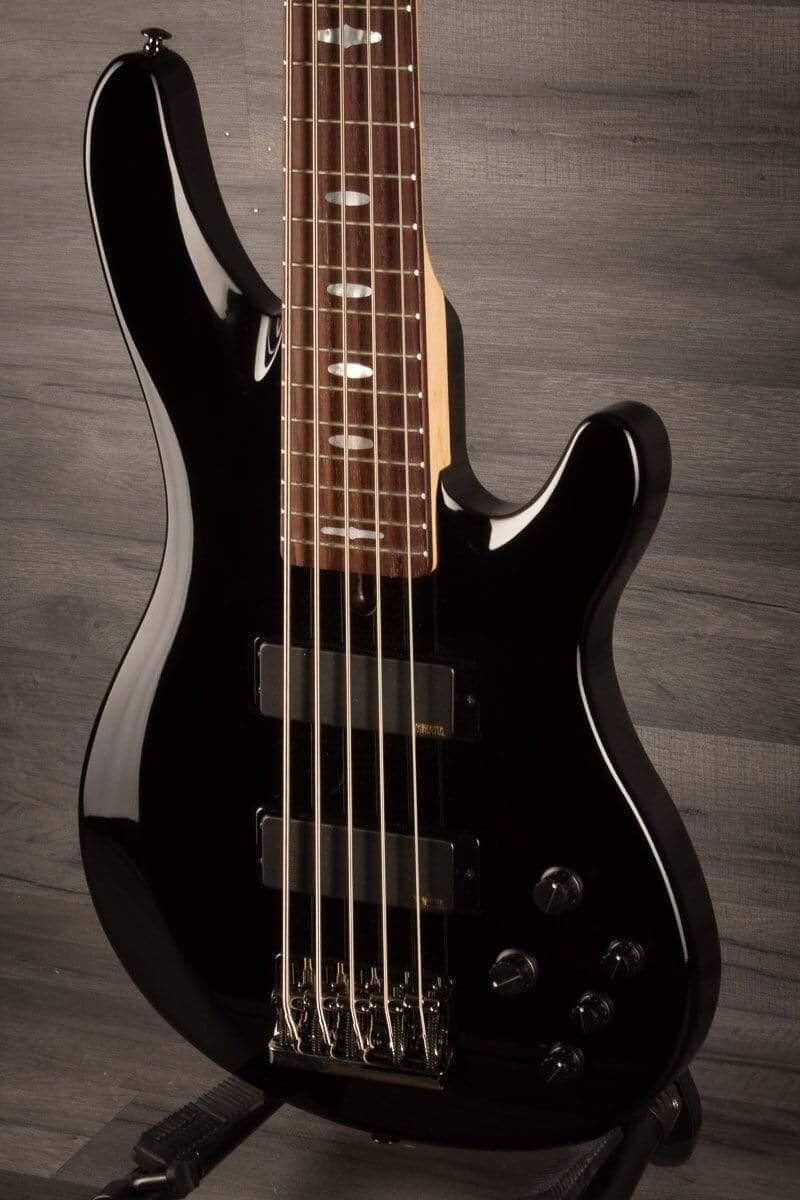
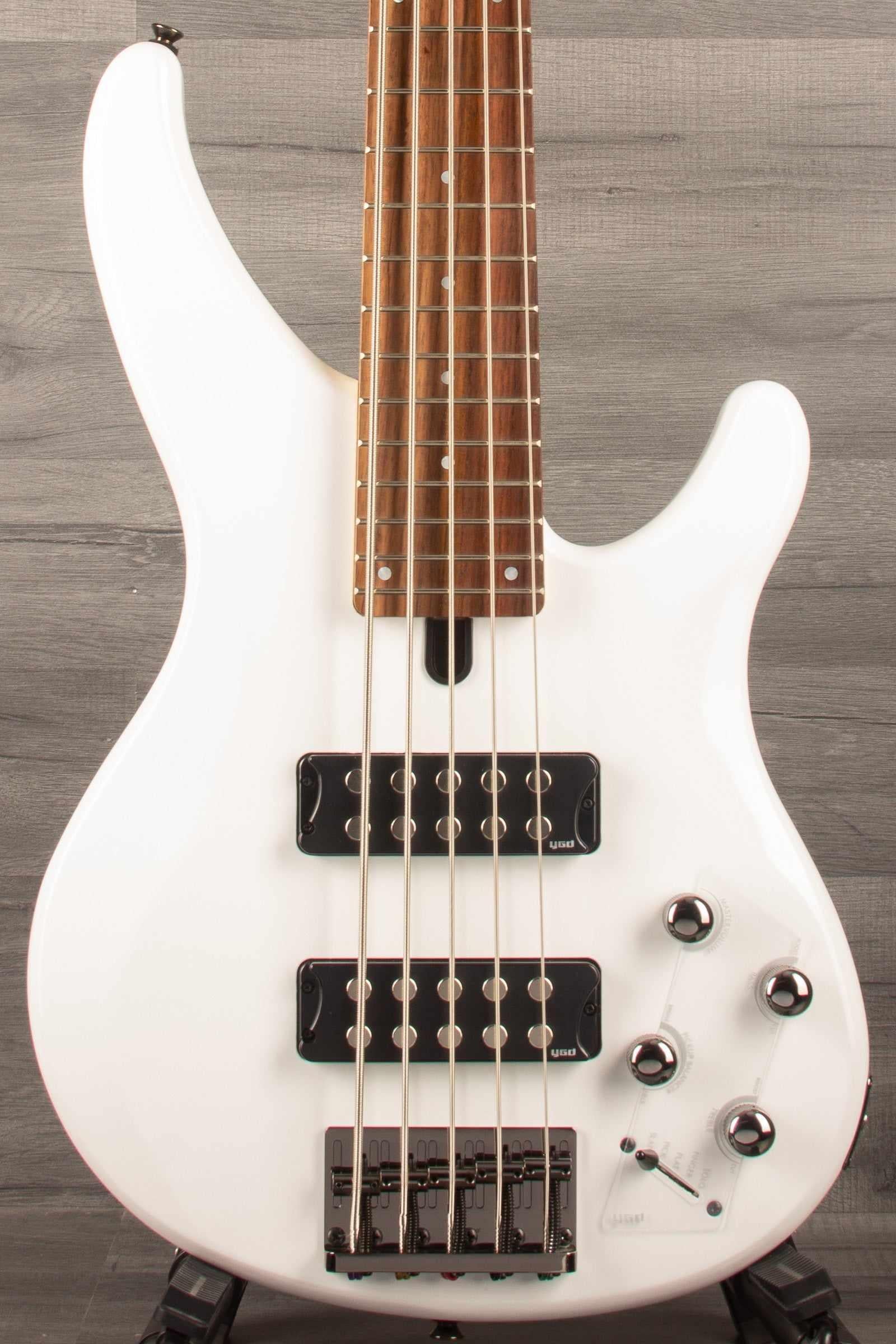
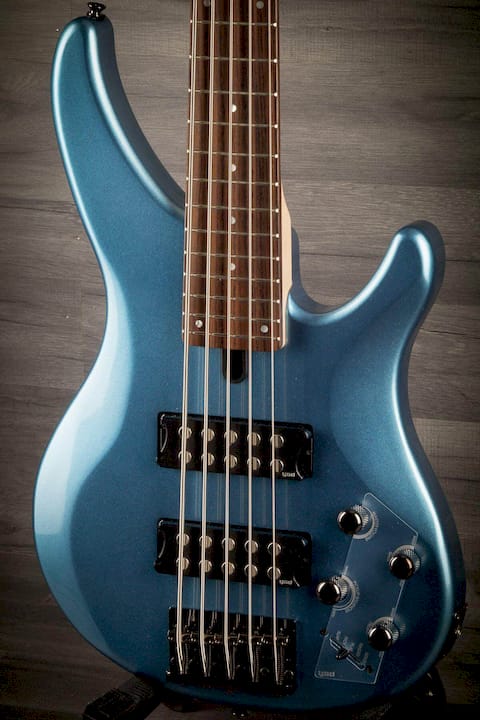
Musicstreet stocks two Yamaha 5-string models that suit different stages of this journey. The Yamaha TRBX305 in White and the TRBX305 in Factory Blue are reliable, well-balanced instruments with a comfortable neck profile that makes scale practice across all five strings genuinely enjoyable rather than a workout. For players ready to step up, the Yamaha TRB1005J offers a higher-spec build with extended tonal options and a neck stability that suits players working through advanced scale work across multiple tunings.
Every instrument sold through Musicstreet comes with professional inspection and setup support. Visit the Musicstreet website to view these models and enquire about setup services.
Sources
- 5 String Bass Pentatonic scale — Play Electric Bass
- 5-String Bass Exercises – Johnny Cox Music
- Talkbass
For a broader foundation, Musicstreet’s guide to essential bass guitar scales for beginners covers the core shapes before you tackle the full 5-string system. If you are still deciding between a 4-string and 5-string, the Musicstreet 4-string vs 5-string comparison is worth reading first.
FAQ
What are the best scales to learn first on a 5-string bass?
Start with the major scale and natural minor, then add the minor pentatonic and blues box. These four shapes cover the vast majority of bass lines across rock, funk, pop, and jazz.
How do movable shapes work on a 5-string bass?
A movable shape uses the same fingering pattern in every key. Shift the root note to a different fret on the A or B string and the entire scale moves with it, with no change to the fingering.
What is the difference between BEADG and EADGC tuning for scales?
BEADG adds five lower notes below the standard E, making it ideal for groove and heavy music. EADGC adds a high C above the G string, suiting chordal work and upper-register soloing. Root positions and scale shapes differ between the two tunings.
Do I need a professional setup when switching from BEADG to EADGC?
In most cases, yes. Changing string gauges for a tuning switch typically requires truss rod and bridge adjustments, and sometimes a new nut, to maintain stable action and intonation.
Which Yamaha 5-string bass suits scale practice for beginners?
The Yamaha TRBX305 is a well-balanced, accessible 5-string with a comfortable neck profile that suits players learning scale patterns across all five strings. Musicstreet stocks it in White and Factory Blue.








Share:
Top boutique guitars for UK players: a buyer's guide
Best guitar cases 2025: what UK players need