


Start with closed-position major and natural minor shapes, using Segovia’s fingerings as your default. Prioritise tone and evenness over speed: slow metronome work, rhythmic variation, and both rest and free stroke will fix more faults than any amount of fast, sloppy repetition. Classical guitar scales are not a warm-up chore. They are the fastest diagnostic tool you have for exposing exactly where your technique breaks down.
If you only have twenty-five minutes a day, spend it like this:
- 10 minutes: closed-position scales with rhythmic variation (straight quavers, then dotted rhythms, then triplets)
- 10 minutes: slur scales (hammer-ons and pull-offs built into the scale pattern) to isolate left-hand strength and independence
- 5 minutes: targeted work on whatever felt worst in the first fifteen minutes
That last five minutes matters more than people expect. It is where actual progress happens.
Key Takeaways
Consistent, rhythmically varied scale practice at a controlled tempo builds tone, coordination, and repertoire-ready technique faster than speed-focused drilling ever will.
| Point | Details |
|---|---|
| Start with closed-position shapes | Segovia fingerings give one pattern that transfers across all twelve major keys. |
| Practise diagnostically, not for speed | Slow, rhythmically varied scales expose timing and tone faults that fast playing hides. |
| Use both rest and free stroke | Alternate apoyando and tirando across your routine to build full tonal versatility. |
| Fix left-hand tension at the source | Lift from the back knuckle joint, not the fingertip, to cut strain and speed recovery. |
| Match your instrument to your technique | Musicstreet’s expert setup and Yamaha acoustic and electro-acoustic models support cleaner, more even scale tone. |
Table of Contents
- What are the essential classical guitar scale patterns?
- Why practise scales beyond just getting faster
- How to practise classical guitar scales properly
- Practice routines that actually fit your level
- Solving the advanced problems: shifts, tension, and tone colour
- Books, lessons, and instruments worth adding to your practice
- How proper setup changes what your scales sound like
- The modes hiding inside your major scales
- Where scales actually show up in real repertoire
- Editorial take: scales are diagnosis, not decoration
- Get your instrument set up to match your technique
- Sources
- FAQ
What are the essential classical guitar scale patterns?
Every classical guitarist eventually settles on a mental map of shapes rather than memorised individual notes. Closed-position scales, patterns that use no open strings, are the backbone of that map because the fingering stays identical wherever you move it on the neck. Learn one closed-position major scale shape and you effectively know twelve, just shifted to a different starting fret.
Closed-position shapes work well because:
- The same left-hand fingering pattern repeats in every key, so muscle memory transfers directly
- They mirror the fretboard patterns you will meet constantly in repertoire, particularly in Bach, Sor, and Tárrega
- They force disciplined position work, which pays off the moment you tackle barre chords or higher positions
Open-position scales, by contrast, bring open strings into the pattern and sit almost exclusively in first position. They are musically useful for a different reason: much of the standard beginner and intermediate repertoire is written to exploit those ringing open strings, so you need the open-position fingering fluent even after you have “graduated” to closed shapes further up the neck.
The Segovia scale system remains the default reference most teachers hand out first, and for good reason: it is systematic, covers all twelve major keys through the circle of fifths, and pairs naturally with rest and free stroke work. That said, it is not the only serious option. Abel Carlevaro’s fingerings spread shifts out more evenly across a scale, which can ease tension for players whose hands struggle with Segovia’s more clustered position changes, and Andrés Segovia’s own students later refined variants, alongside Aaron Shearer’s more pedagogically graduated system, aimed at different technical priorities. If a Segovia fingering keeps producing an audible bump or a strained stretch, try the Carlevaro alternative for that scale before assuming the problem is you.
Why practise scales beyond just getting faster
Scales are the clearest diagnostic tool available to a classical guitarist. Play one slowly and every weakness shows up immediately: uneven tone between fingers, a rushed beat, a left hand that tenses on shifts. Repertoire hides these problems inside phrasing and dynamics; a bare scale has nowhere to hide them.
The physical case for scales is just as strong. Practised mindfully rather than purely for speed, scale work functions as a genuine warm-up that reduces injury risk by preparing tendons and building the muscle memory needed for confident fretboard navigation. Rushing straight into fast repertoire without that preparation is one of the more common ways players develop tendon strain.
Musically, consistent scale practice pays off in ways that are easy to underrate:
- Faster, more confident sight-reading because key signatures stop feeling abstract
- Better phrasing, since you internalise where a scale naturally wants to breathe
- Real comfort in unfamiliar key centres instead of just pattern-matching a handful of favourite keys
How to practise classical guitar scales properly
The method matters more than the minutes. A metronome, used deliberately, turns scale practice from a mechanical chore into a genuinely effective diagnostic session.
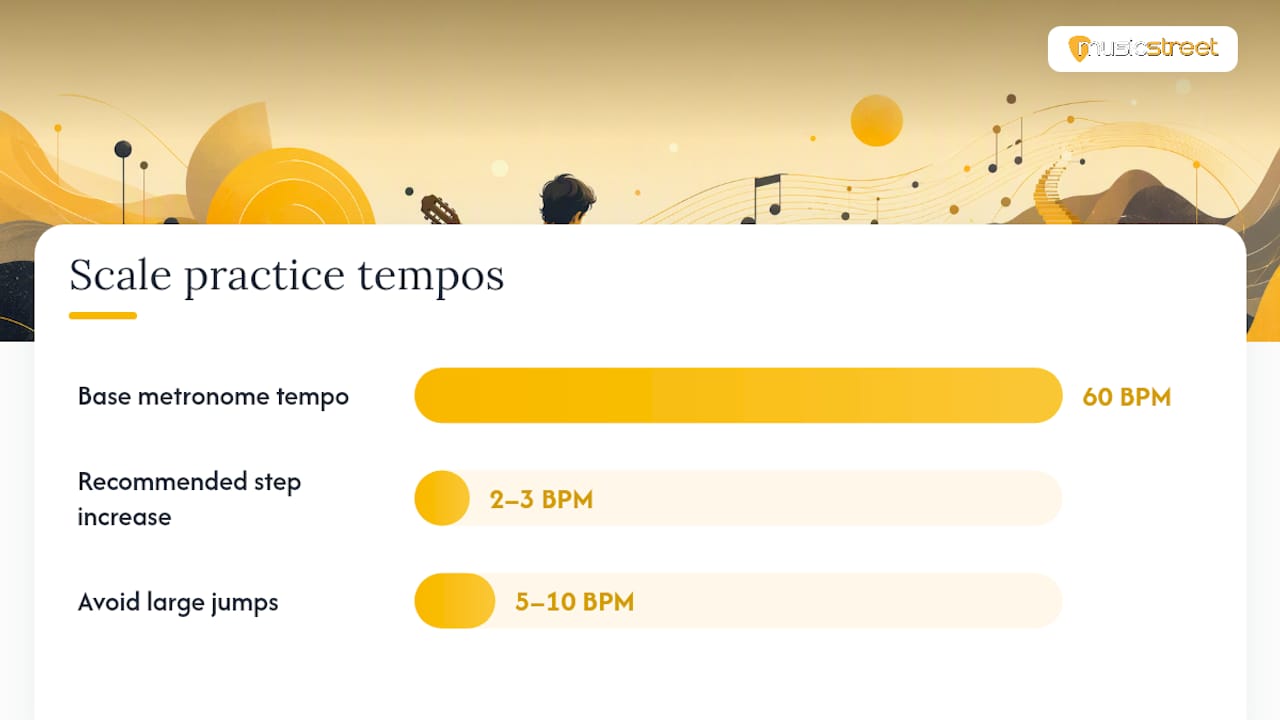
- Start slow and subdivided. Set the metronome around 60 BPM and play in strict subdivisions rather than drifting. Slow, rhythmically precise repetition exposes faults that fast playing conceals.
- Introduce rhythmic variation once the base tempo is clean. Run the same scale in dotted rhythms, then triplets, then irregular groupings of five or seven notes. Each pattern stresses your fingers differently, and problems that survive triplets often only surface under five-groupings.
- Increase tempo in small increments. Move up by two or three BPM at a time, not five or ten. The moment accuracy slips, drop back to the last clean tempo rather than pushing through.
- Alternate right-hand strokes deliberately. Practise rest stroke (apoyando), where the finger comes to rest against the next string, for a fuller, more even tone, and free stroke (tirando) for lighter, faster passages. Most experienced players rotate between both rather than committing to one exclusively.
- Test both concentrated and spread-out left-hand fingerings. If a Segovia-style shift feels cramped, try spacing the shift across a different finger combination and compare tone and comfort directly.
Most players default to alternating i-m (index-middle) in the right hand, though a-m-i patterns show up often in faster passages and three-note groupings.
Pro Tip: Record yourself at a “comfortable” tempo before you touch the metronome. Most players are shocked to hear how uneven their rhythm actually is once they compare it against a fixed pulse.
Practice routines that actually fit your level
A routine only works if it matches where your hands actually are today, not where you wish they were.
- Beginner (20 minutes): Warm up with a closed-position major scale using rhythmic variations (straight, then dotted). Follow with five minutes of single-hand tone drills, right hand only, focusing on evenness between fingers. Close with a simple two-string slur scale to introduce hammer-ons and pull-offs.
- Intermediate (30 to 40 minutes): Run two-octave scales across at least two positions on the neck. Add slur scales at a slightly faster tempo, then string-crossing exercises that move the right hand across three or more strings in sequence. Finish with a short passage from current repertoire, isolating any scale-like run within it.
- Advanced (40 minutes plus): Three-octave scales across the full fretboard, chromatic scale segments for finger independence, and short tempo bursts (ten seconds at a noticeably faster tempo, then back to baseline). Integrate scale patterns directly from repertoire, passages from Rodrigo’s guitar writing are a favourite testing ground given how scale-driven his lines often are.
Track your progress against four checkpoints rather than tempo alone: evenness across all fingers, shifts that stay inaudible, tone that holds steady from the first note to the last, and the ability to drop a practised pattern straight into a real piece without relearning it.
Solving the advanced problems: shifts, tension, and tone colour
The difference between a good scale and a great one usually comes down to details nobody points out in a beginner lesson.
Inaudible shifts happen when the destination finger lands on the string a fraction before the right hand attacks the next note. Practise shifts in isolation, slowly, until the landing finger is already in place and silent before you pluck.
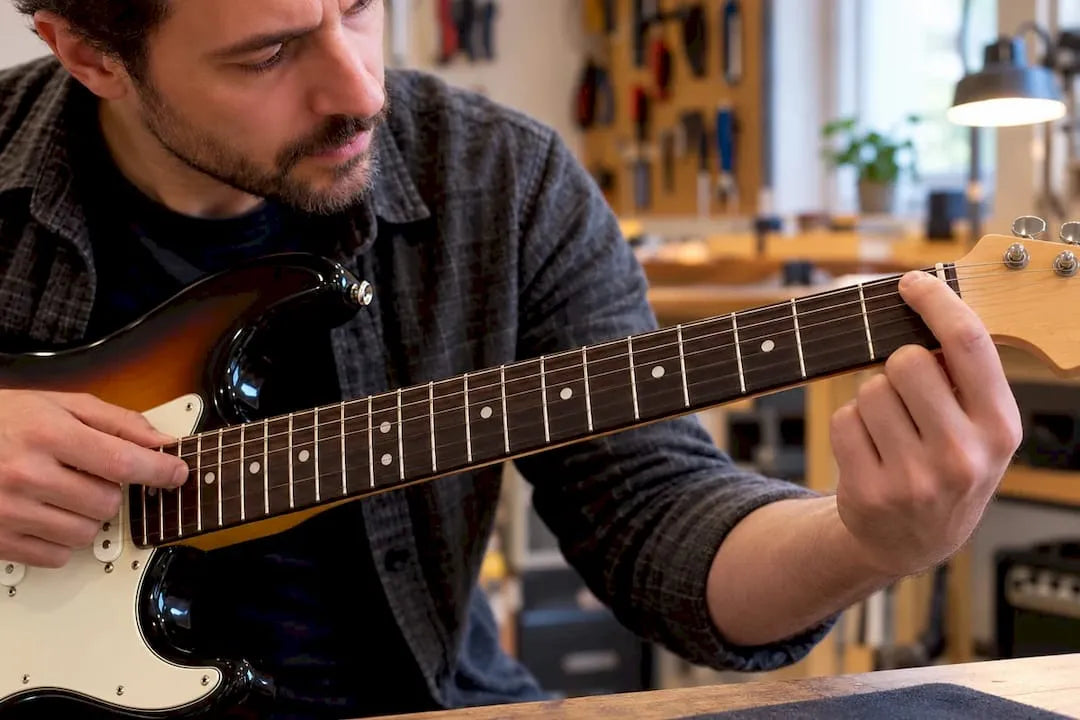
Tension creeps in through the left hand far more often than the right. Keep fingers close to the frets rather than lifting them high, and lift from the back knuckle joint rather than the fingertip. This single adjustment to lifting mechanics is one of the most commonly missed fixes for self-taught players, and it is usually solved within a single guided session once someone points it out.
Tone colour deserves its own slot in scale practice. Run the same scale twice: once with the right hand near the bridge (ponticello) for a brighter, more metallic sound, then near the fretboard (tasto) for something warmer and rounder. Applying these positions to plain scales builds the kind of timbre control that transfers directly into expressive repertoire playing.
- Only chase speed bursts once accuracy is consistent at the slower tempo, not before
- A brief physical “reset” (drop the shoulders, unclench the jaw) after each scale phrase prevents tension becoming a learned habit
Books, lessons, and instruments worth adding to your practice
The right resources shortcut a lot of trial and error. Beyond the Segovia system already mentioned, Mel Bay’s “The Essential Classical Guitar Scale Book” is a genuinely comprehensive graded resource, covering two and three-octave scales, modal patterns, and structured weekly schedules that suit self-teaching as much as formal lessons. Aaron Shearer’s technical method books remain a strong alternative if Segovia’s fingerings do not suit your hand shape.
For video demonstration, Classical Guitar Corner and Douglas Niedt’s own lesson archive are the two most consistently cited references among teachers, and they pair well with MusicStreet’s own practical guidance on scale technique.
If your instrument is fighting you, the practice suffers regardless of method:
- Check your string material if tone feels dull or inconsistent across strings
- A guitar with poor action makes every fingering exercise harder than it needs to be, worth reviewing MusicStreet’s guide to classical guitar types if you are unsure whether your instrument is holding you back
How proper setup changes what your scales sound like
No amount of metronome discipline fixes a guitar with uneven action or dead strings. Musicstreet’s expert setup and professional inspection exist precisely because a fraction of a millimetre in string height can turn a clean scale into a buzzing mess, and most players never realise that is the actual cause.
A few practical points worth knowing:
- Musicstreet inspects every instrument before it leaves the shop, catching action and intonation issues that would otherwise sabotage tone work
- The site’s buying guides and technique articles complement structured scale practice rather than duplicating it, covering the instrument side of the equation this article does not
- Fresh, well-matched strings noticeably change how evenly a scale rings across the fretboard, something worth revisiting before blaming your fingers
Good technique deserves an instrument that responds honestly to it.
The modes hiding inside your major scales
Every major scale contains seven modes, and classical repertoire uses several of them constantly without ever announcing the fact. A mode is simply the same set of notes as a major scale, started from a different degree, which shifts where the semitones fall and changes the entire character of the sound.
Dorian, built from the second degree of the major scale, has a minor quality with a slightly brighter sixth degree than natural minor. It turns up in Renaissance and early Baroque guitar transcriptions constantly, giving pieces a modal, slightly ambiguous colour that pure minor scales lack.
Phrygian, from the third degree, carries a distinctive flattened second that gives it an unmistakably Spanish, almost flamenco-adjacent flavour. Anyone who has played through Spanish repertoire has used Phrygian shapes without necessarily naming them, since the sound is baked into so much of that tradition.
Lydian, from the fourth degree, raises the fourth degree of the major scale, producing a brighter, slightly unresolved character that composers use for tension without moving into minor territory.
Mixolydian, from the fifth degree, flattens the seventh degree, giving major-scale brightness a bluesy, less final-sounding quality often used to prolong tension before a resolution.
Learning modal scale shapes is not an academic exercise. Recognising a Phrygian passage the instant you see it on the page, rather than puzzling through the accidentals, is the difference between reading music and merely decoding it.
Where scales actually show up in real repertoire
Open any piece by Fernando Sor, Francisco Tárrega, or Joaquín Rodrigo and scale fragments are everywhere, they just rarely look like the tidy exercises in a scale book. A study by Sor might disguise a straight major scale inside a broken-chord texture, spreading the same seven notes across two strings instead of running them in a neat line.
Rodrigo’s guitar writing leans particularly hard on scale-like runs to build momentum between thematic statements, which is exactly why practising three-octave scales at performance tempo pays off directly rather than staying an abstract drill.
Improvisation, less common in classical training than in jazz or flamenco but present in cadenza-style passages, relies on the same shape knowledge. A performer working out a cadenza is essentially recombining scale fragments and arpeggios they already know cold, in real time, over a harmonic outline. That only works if the scale shapes are so automatic that thinking about fingering never interrupts the musical decision.
The practical takeaway: every time you drill a closed-position scale with rhythmic variation, you are rehearsing a movement your hands will need the very next time that pattern appears inside an actual piece, and it will appear, usually sooner than you expect.
Editorial take: scales are diagnosis, not decoration
Most guitar advice treats scales as a speed test, a box to tick before “real” playing begins. That framing is backwards, and it produces players who can rattle off a fast scale but fall apart the moment a piece demands the same pattern with expression attached.
The more useful mindset treats every scale as a diagnostic session. Slow it down, vary the rhythm, alternate rest and free stroke, and you will find the actual weak point within minutes rather than guessing at it for months. Segovia’s fingering system deserves its status as the default starting point, but treating it as gospel rather than a testable option does some players a disservice, particularly those whose hands genuinely suit Carlevaro’s spread-out shifts better.
What gets underestimated most is tone colour work. Players will spend hours chasing speed and almost none chasing the ponticello-to-tasto control that actually makes a scale sound musical rather than mechanical. Prioritise that, alongside honest instrument setup, before chasing another five BPM on the metronome.
— Music
Get your instrument set up to match your technique
Scales expose weak technique fast, but they also expose a poorly set-up guitar just as fast, and no metronome discipline fixes uneven action or dull strings. Musicstreet’s expert setup and professional inspection catch exactly the issues that turn a clean scale into a frustrating one, string height, intonation, action, before they cost you weeks of practice blaming your own fingers.
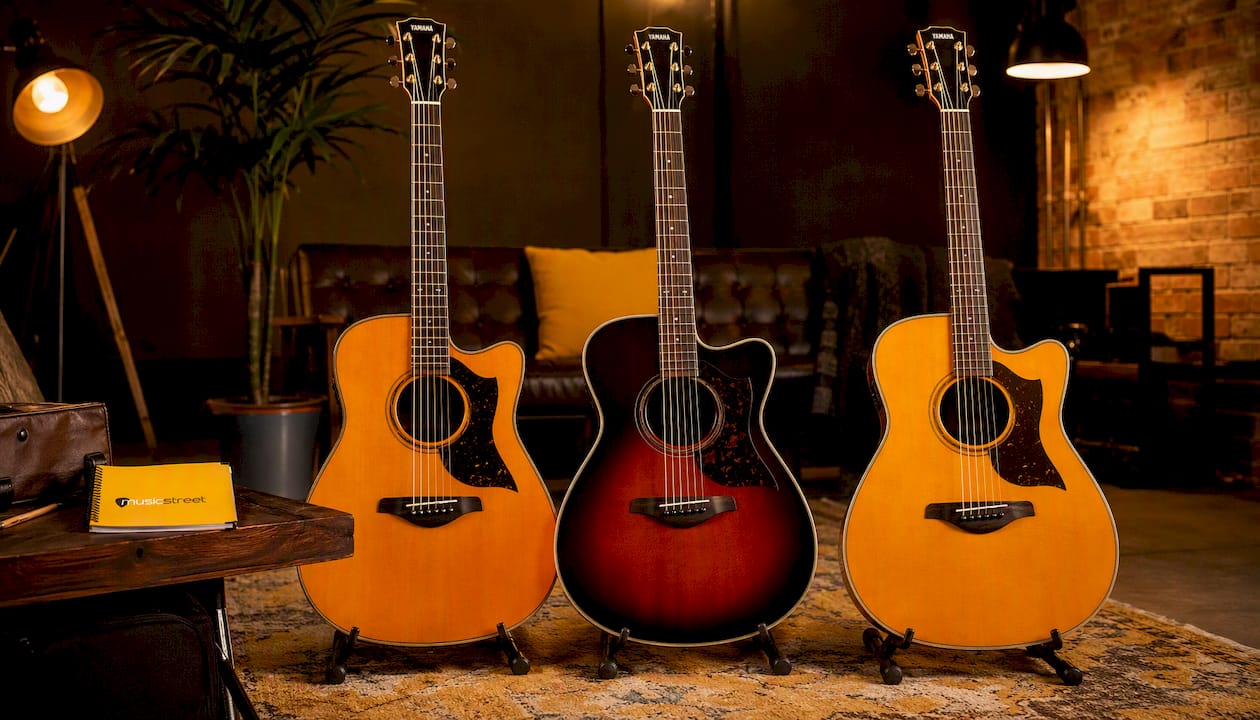
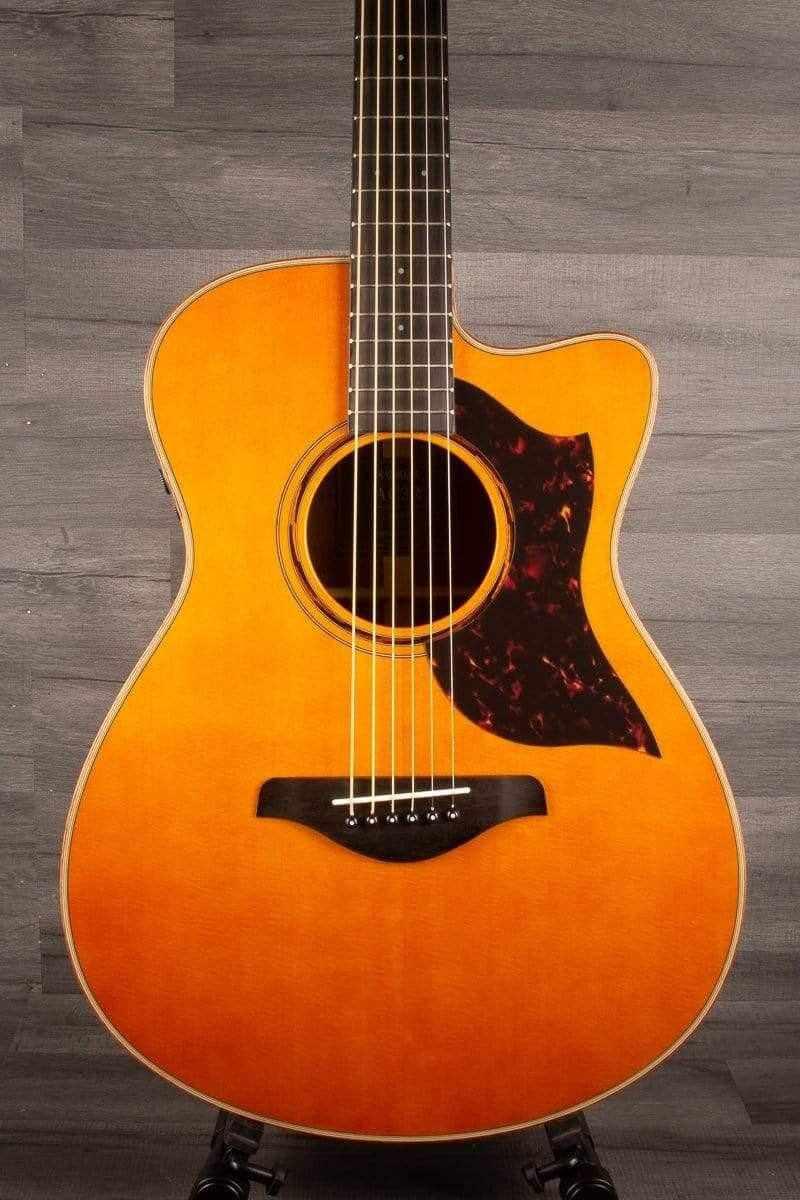
If your current guitar is fighting you, it might be time to try something built for the job. The Yamaha A5M Acoustic Guitar offers the even, responsive tone that makes tone-colour drills worth doing in the first place, while the Yamaha AC3R ARE Electro Acoustic in Tobacco Brown Sunburst or the Vintage Natural finish give you the same reliability with amplification built in for small performances. Book an in-store tryout or check current stock directly with Musicstreet before your next practice session.
Sources
- CLASSICAL GUITAR SCALES-How to Practice
- Classical Guitar Scales: Shapes Explained
- Scale practice on the classical guitar
FAQ
What are the seven major scale modes?
The major scale produces seven modes: Ionian, Dorian, Phrygian, Lydian, Mixolydian, Aeolian, and Locrian, each starting from a different degree of the same seven notes. Classical repertoire leans most heavily on Dorian and Phrygian for their distinctive minor and Spanish-tinged colours.
What is the most unsettling-sounding guitar scale?
Among classical players, the Locrian mode and the harmonic minor scale are usually singled out for their tense, unresolved character, driven by the flattened second in Locrian and the raised seventh in harmonic minor. Neither is common in standard repertoire precisely because of how unstable they sound.
What are the twelve guitar scales beginners should know?
Most teachers mean the twelve major scales, one for each key in the chromatic scale, which the Segovia system organises systematically through the circle of fifths. Learning the closed-position shape once and shifting it to each starting fret covers all twelve without relearning fingerings.
What are the five essential scales for beginners?
A practical beginner set covers the major scale, natural minor, harmonic minor, one closed-position two-octave shape, and a simple slur scale for left-hand independence. That combination, practised with rhythmic variation and a metronome, builds the core technique needed for most early repertoire.



Share:
How to tune my guitar: a step-by-step method that works
How to tune your guitar: a step-by-step routine that sticks