


The fastest way to get in tune is a chromatic clip-on or app tuner set to standard tuning: E–A–D–G–B–E, from the thickest string (6th) to the thinnest (1st). Tune each string up to pitch rather than down, and run through all six strings twice, since the first pass almost always pulls the others slightly out.
- Standard tuning, low to high: E, A, D, G, B, E
- Use a clip-on or app-based chromatic tuner for the most reliable readings
- Tune up to the note, then re-check every string after the full pass
Key Takeaways
Getting a guitar in tune reliably comes down to using a chromatic tuner correctly, tuning up to pitch, and knowing when the problem is hardware rather than technique.
| Point | Details |
|---|---|
| Standard tuning target | Set strings to E–A–D–G–B–E from the 6th string to the 1st, checked with a chromatic tuner. |
| Tune up, not down | Approach each note from slightly flat and tune upward for a more stable result. |
| Expect two passes | Tightening higher strings pulls lower ones flat, so retune the full set twice. |
| New strings need settling | Stretch and retune new strings three or four times before they hold steady. |
| Persistent problems need a setup | Musicstreet’s professional setup and inspection service fixes intonation and hardware faults tuning alone can’t touch. |
Table of Contents
- How to tune my guitar step by step with a tuner
- Which tuner should you actually use?
- Can you tune a guitar without a tuner?
- New strings won’t stay in tune. Is that normal?
- Why won’t my guitar stay in tune?
- How MusicStreet helps when tuning alone won’t fix it
- A simple habit that saves you the hassle
- Get set up properly with Musicstreet
- Sources
- FAQ
How to tune my guitar step by step with a tuner
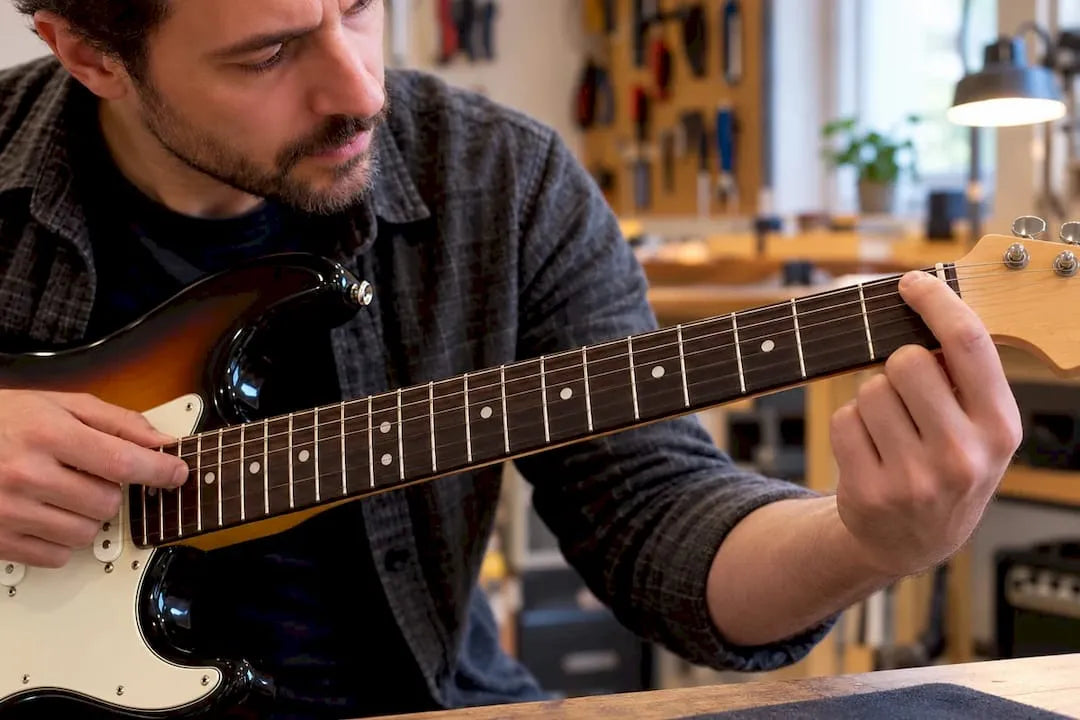
Get comfortable before you touch a peg. Sit or stand with the headstock at a natural angle, mute the strings you’re not tuning with your palm, and if you’re using a clip-on model, fit it firmly to the headstock so it picks up vibration rather than room noise.
Work through the strings in this order, checking the display or needle after each turn rather than cranking blindly.
- Low E (6th string) — pluck it, watch the tuner, and turn the peg slowly until it settles on E.
- A (5th string) — same process. Small turns matter more than you’d think; a quarter turn can shift pitch a surprising amount on a fresh string.
- D (4th string) — tune it in.
- G (3rd string) — tune it in.
- B (2nd string) — tune it in.
- High E (1st string) — finish the pass here.
Once you’ve been through all six, go back to the low E and start again. Tightening the high strings pulls slightly on the neck and drags the lower strings flat, so a second pass is standard practice rather than a sign you did something wrong. JustinGuitar’s beginner tuning guide makes the same point: tune up to the note, not down into it, because approaching pitch from below keeps the string under even tension as it settles.
Pro Tip: If a string keeps drifting flat within seconds of tuning it, pluck a little harder and check your tuner is reading the fundamental note, not an overtone. Cheap or worn strings can trick a tuner into displaying the wrong pitch entirely.

Check your tuning again after five or ten minutes of playing, especially with new strings, and once more before anything that matters, like a rehearsal or a take.
Which tuner should you actually use?
Not every tuner suits every situation, and the one that works at home might be useless on a noisy stage.
- Clip-on tuners read vibration through the headstock rather than sound through a microphone, which makes them the best choice in loud rehearsal rooms or busy households. They typically sit in an affordable price band, clip on in seconds, and need no cables.
- Phone apps and browser tuners work well in quiet spaces and cost nothing beyond the phone you already own, but background noise, other instruments, or a barking dog will throw the reading off fast.
- Pedal and rack tuners are the electric player’s answer to silent, instant tuning on stage, since they sit in the signal chain and read the electrical signal directly rather than any sound at all.
If you want a proper breakdown of which type suits your setup, MusicStreet’s guide to types of guitar tuners covers the buying decision in more depth. For the mechanics of actually using one well, the piece on using guitar tuners for perfect sound is worth a read too.
Can you tune a guitar without a tuner?
Yes, and it’s a genuinely useful skill even if you own three tuners already. Relative tuning uses one string as a reference and tunes the rest against it by ear.
- Get your low E close to pitch (a piano note, a tuning fork, or memory of A=440 all work).
- Press the 5th fret of the low E. That note is A. Match the open A string to it.
- Press the 5th fret of the A string to get D, and match the open D string.
- Press the 5th fret of D to get G, and match the open G string.
- Press the 4th fret of G (not the 5th) to get B, and match the open B string.
- Press the 5th fret of B to get high E, and match it to your low E an octave up.
Harmonics offer a more precise version of the same idea: play the harmonic at the 5th fret of one string against the harmonic at the 7th fret of the next, and listen for the beating to disappear as they lock together. Relative tuning gets your guitar in tune with itself, but it won’t necessarily sit at concert pitch unless your reference string was accurate to begin with, so treat it as a solid emergency method or ear-training exercise rather than your main routine.
New strings won’t stay in tune. Is that normal?
Completely normal. Fresh strings stretch as they bed into the nut, saddle, and tuning post, and they’ll drift flat for the first few hours of playing until that stretching settles down.
- Tune each string up to pitch, then gently pull it away from the fretboard with your fingers.
- Retune, pull again, repeat three or four times per string.
- Check the nut slots and tuning post windings aren’t binding or catching, since a rough slot will fight you every time you tune.
Pro Tip: A drop of graphite or nut lubricant in the slots stops binding on guitars that go flat unevenly after restringing. If one string won’t hold no matter what you try, that’s a hardware issue, not a technique problem. MusicStreet’s restringing guide walks through proper winding technique in more detail.
Why won’t my guitar stay in tune?
Sometimes the problem isn’t your technique, it’s the instrument. Worn strings, temperature and humidity swings, faulty tuning machines, a binding nut slot, and excessive tremolo movement are the most common reasons a guitar won’t hold pitch, and no amount of careful tuning fixes a mechanical fault.
There’s a separate issue that gets mistaken for a tuning problem constantly: intonation. If your open strings read perfectly on the tuner but fretted notes sound sharp or flat, particularly higher up the neck, that’s an intonation issue, and it needs a bridge saddle or nut adjustment, not more retuning.
Quick checks before you book a setup:
- Do open strings and 12th-fret harmonics match? If not, it’s intonation.
- Do tuning pegs feel loose or slip under string tension? That’s a hardware fix.
- Has the guitar just come in from a cold car or a humid gig venue? Give it 20 to 30 minutes to acclimatise before you judge the tuning at all.
Climate matters more than most players expect. Wood expands and contracts with humidity, and a guitar that was perfectly in tune indoors can genuinely drift within an hour of a temperature change, which is why touring musicians retune constantly and don’t treat it as a fault.
How MusicStreet helps when tuning alone won’t fix it
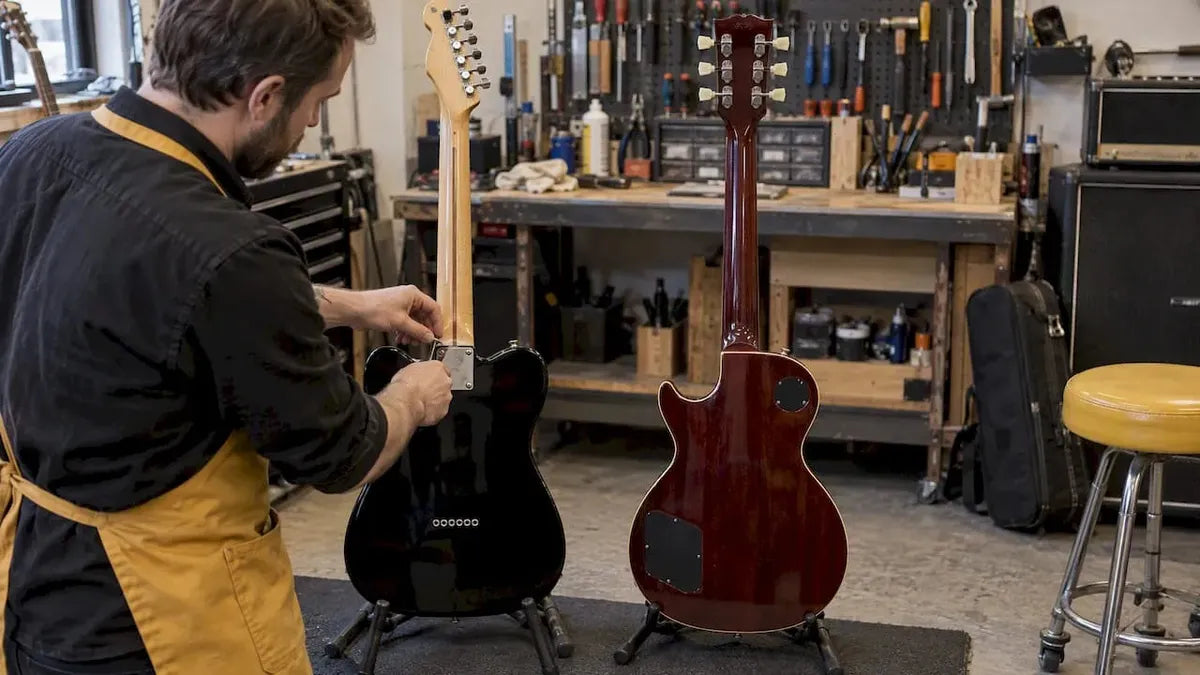
If you’ve worked through every check above and something still won’t sit still, that’s a job for a proper setup rather than another five minutes with a tuner. Musicstreet offers professional guitar setup and instrument inspection to sort out intonation, worn nut slots, and tired tuning machines that no amount of patience will cure.
- Book a full setup and inspection for hardware, intonation, and action issues.
- Pick up a CruzTools Groovetech Guitar Player Tech Kit for at-home adjustments between visits.
- Grab a Groovetech Mini Multi-Tool for quick string changes and minor tweaks on the road.
Musicstreet’s team inspects every trade-in and setup by hand before it reaches a customer, which is the same standard applied to walk-in repairs.
A simple habit that saves you the hassle
Tuning stops being a chore once it’s a two-minute ritual: tune before you play, glance at the tuner again mid-session, and don’t fight a guitar that keeps drifting, that’s a hardware conversation, not a technique failing. Learn relative tuning gradually for the ear training, but lean on a proper tuner for anything that matters. If a guitar won’t hold pitch no matter what you try, Musicstreet’s setup service exists precisely for that moment.
— Music
Get set up properly with Musicstreet
A tuner sorts out pitch. It won’t fix a nut slot that’s binding, a saddle that’s killing your intonation, or pegs that slip halfway through a set. Musicstreet’s approach is simple: sort the instrument properly once, in-store or by post, so you’re not fighting the same tuning problem every single week.

For everyday maintenance, the CruzTools Groovetech Guitar Player Tech Kit covers most electric and acoustic adjustment jobs in one compact case, while the CruzTools Groovetech Acoustic Guitar Player Tech Kit is built specifically for acoustic setups. If you just need something small enough for a gig bag, the Groovetech Mini Multi-Tool handles string changes and quick truss rod checks without fuss. And if the guitar itself is the problem rather than the strings, browse instruments like the Yamaha FGX5 or the Yamaha FGC-TA TransAcoustic, both built with hardware that holds tuning far better than a budget instrument struggling to stay put. Book a setup and inspection through Musicstreet and get the hardware side sorted properly, so every tuning session afterwards actually sticks.
Sources
- Guitartuner
- JustinGuitar — How to tune a guitar for beginners
- Fender — Why do guitars go out of tune?
- DiscMakers — guitar intonation
FAQ
How do I know if my guitar is in tune?
A chromatic tuner will show each open string matching E, A, D, G, B, E exactly. If fretted notes sound off despite the open strings reading correctly, that’s an intonation issue rather than a tuning one.
How often should I tune my guitar?
Tune before every practice session and check again midway through, especially with new strings or after any change in temperature or humidity.
Why does my guitar go out of tune after restringing?
New strings stretch during their first hours of use, which pulls them flat until the winding and stretching settle down. Tuning up, gently stretching each string, and retuning three or four times speeds this up.
Can I tune my guitar without an app or tuner?
Yes, using the 5th-fret relative tuning method or harmonics at the 5th and 7th frets, though this tunes the guitar to itself rather than to concert pitch.
What’s the difference between a tuning problem and an intonation problem?
Tuning affects open strings; intonation affects fretted notes further up the neck. If open strings check out but fretted chords sound wrong, book a setup rather than retuning again, which is a service Musicstreet offers alongside instrument inspection.






Share:
How do you string an acoustic guitar yourself?
The classical guitar scales that build technique fastest