

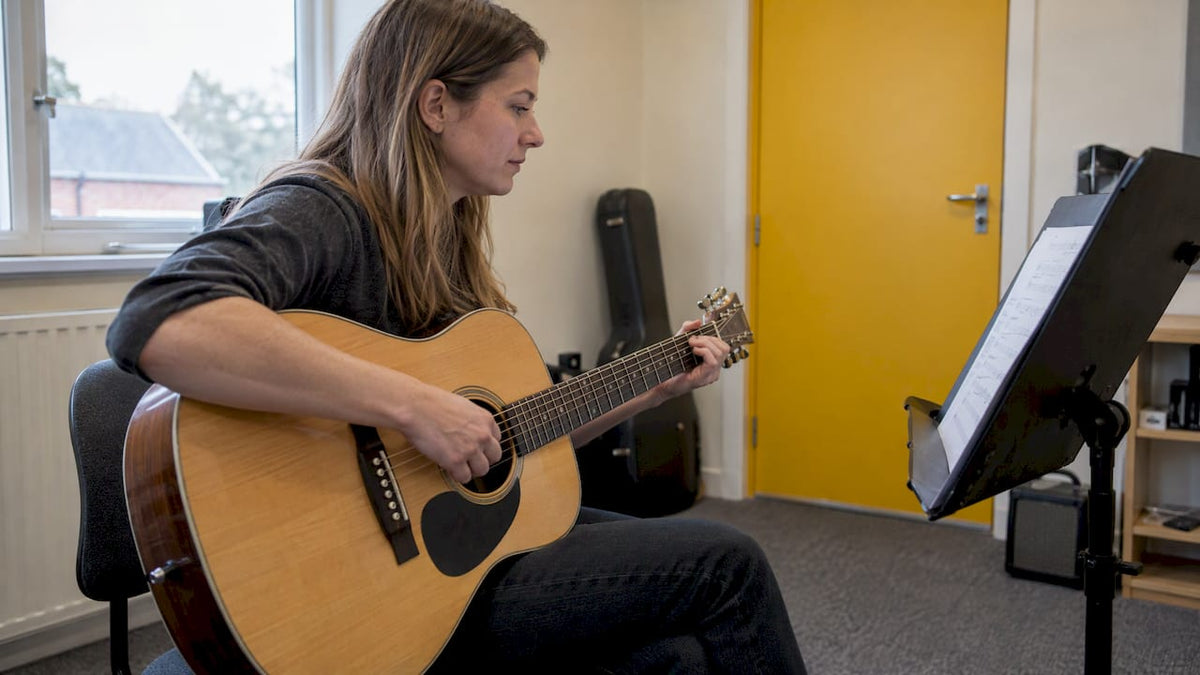
Guitar tab is a picture of your fretboard: six horizontal lines stand for the six strings, and the numbers on them tell you which fret to press. Read it left to right, like a sentence, with the thin high E string on the top line and the thick low E on the bottom. That is the whole core of it. Everything else, from hammer-ons to rhythm, is detail you can add one piece at a time, and this guide takes you through it in the order you will meet it.
If you have just bought your first guitar, or you are about to, the good news is that tab is the quickest notation to learn. You can usually play your first recognisable riff within a practice session or two.
Table of Contents
- What guitar tab actually is
- The six lines: which string is which
- Reading the numbers: frets and open strings
- Reading chords: numbers stacked in a column
- Your first bar, step by step
- Tab symbols decoded: h, p, slides, bends and x
- Rhythm: the part tab often leaves out
- When the tuning or the instrument is different
- Is tab hard to read? How to practise
- Make sure the guitar lets you play what the tab says
- Your next guitar, ready for the tab on your music stand
- Our view on learning tab
- Frequently asked questions
- Sources
What guitar tab actually is
Tablature, usually shortened to tab, is a system that shows where to put your fingers rather than which musical note you are playing. Alfred Music describes it as a picture of the guitar neck turned on its side. Standard notation, the five-line stave with note heads that orchestras and piano players use, tells you the pitch and leaves you to work out where on the neck to play it. Tab skips that step and names the string and fret directly.
That precision is why guitarists love it. The same note can often be played in several places on a guitar neck, and tab removes the guesswork about which one the arranger meant. Many published guitar books therefore print tab beneath standard notation, so you get the pitch and rhythm from the stave and the finger positions from the tab.
The six lines: which string is which
Tab has six horizontal lines, one for each string. The layout matches what you see when you look down at the guitar in your lap: the thickest, lowest string at the bottom and the thinnest at the top. It feels upside down to some beginners, because the “top” line is the string closest to the floor when you hold the guitar, but it is the shape of the page that matches your view, not the shape of the strings in the air.
In standard tuning the lines read, from top to bottom:
| Tab line (top to bottom) | String name | String number | Note |
|---|---|---|---|
| 1st line | Thinnest | 1st string | High E |
| 2nd line | 2nd string | B | |
| 3rd line | 3rd string | G | |
| 4th line | 4th string | D | |
| 5th line | 5th string | A | |
| 6th line | Thickest | 6th string | Low E |
If you struggle to remember the names from thick to thin, a classic mnemonic is Elephants And Donkeys Grow Big Ears, giving E A D G B E. Many tab beginners find that the slowest part is not the numbers but quickly deciding which line is which string, so it is worth memorising this table before anything else. A guitar that is out of tune will make even correct tab sound wrong, so tune up first. Our guide to tuning your guitar by ear or with a tuner takes a couple of minutes.
Reading the numbers: frets and open strings
The numbers sitting on the lines are fret numbers. A fret is the metal strip across the neck, and the numbering starts at the nut, the piece nearest the headstock. Frets run along the entire neck from there, so a higher number means you move your fretting hand towards the body of the guitar.
Two rules cover almost everything:
- A 0 means an open string. You pluck that string without pressing any fret.
- Any other number is the fret to press on that string. A 3 on the A line (fifth line down) means press the A string at the third fret. MusicRadar gives the same logic with a D note: it sits on the second string at the third fret, so you see a 3 on the second line down.
Press just behind the fret wire with the tip of a finger, not in the middle of the gap, and the note will ring cleanly. If your fingers buzz or the strings feel a long way from the neck, that is often an instrument problem rather than a technique one, which we come back to below.
Reading chords: numbers stacked in a column
When numbers are stacked vertically on the same spot across several lines, you play them together. Alfred Music gives an open C major as an example: reading from the top line down, 0, 1, 0, 2, 3, with an x on the bottom line.
That x means do not play that string, or mute it. So for C major you strum the five thinnest strings and leave the low E alone. In the tab it looks like this:
e|--0--|
B|--1--|
G|--0--|
D|--2--|
A|--3--|
E|--x--|
The same numbers spread out one after another, left to right, mean an arpeggio: you hold the chord shape but pick the strings one at a time. School of Rock points out that an arpeggiated chord appears as single notes even though you are fretting a full chord shape, so look at the neighbouring notes to spot the shape.
Your first bar, step by step
Pick a short, familiar riff and work through it slowly.
- Tune up. Tab assumes a tuned guitar. If the tab says nothing about tuning, assume standard tuning.
- Check the tuning and time signature at the start. Letters at the left of the lines can tell you the tuning, and a fraction such as 4/4 sits near the start of the bar.
- Find the first number. Note which line it is on, then name that string aloud: “second line, B string”.
- Place the finger. Press the fret the number gives, just behind the fret wire.
- Pluck only that string. Use a pick or your thumb and keep the other strings quiet.
- Move left to right. Take the next number in the same way. Numbers lined up in one column are played together.
- Slow down and repeat. Play the bar at half speed until your eyes find the string without thinking, then lift the speed.
The common failure is to read the number correctly and put it on the wrong string. Saying the string name out loud for the first week cures it quickly. For a structured week-by-week approach, our practice plan for beginners learning tablature shows how to build the habit.
Tab symbols decoded: h, p, slides, bends and x
Once the numbers feel natural, you will see letters and marks between them. These describe how to play a note, not which note it is. The most common ones, as Rocksmith’s tab guide and Simple Notation’s symbol reference define them, are:
| Symbol | Example | What it means |
|---|---|---|
| h | 2h3 | Hammer-on: play the 2nd fret, then bring a finger down hard on the 3rd without plucking again |
| p | 3p2 | Pull-off: the reverse, pulling the finger away so the lower note sounds |
| / or \ | 2/3 | Slide up (/) or down (\) from one fret to the other along the same string |
| b | 7b9 | Bend the note at the 7th fret until it sounds like the 9th, a whole step. 7b8 is a half step |
| r | 7b9r7 | Bend up, then release back down |
| ~ | ~~~ | Vibrato: more tildes mean wider or longer vibrato |
| x | x | Dead or muted note, a pitchless click. A column of x’s is a percussive strum |
| (5) | (5) | Ghost note, played quietly |
| P.M. | P.M.---- | Palm muting, with dashes showing how long to keep it going |
| <12> | <12> | A harmonic at the 12th fret |
So the people-also-ask question “what does 2h3 mean in tabs?” has a short answer: pluck the second fret once, then hammer your finger onto the third fret so the second note sounds without a second pluck. Older printed tab uses curved slur marks and triangle-shaped bend symbols for the same ideas, as Adrian Legg explained in a 1987 Melody Maker feature, so if you buy a vintage songbook the symbols may look different but the meaning carries over.
Do not try to learn the whole table at once. Learn h, p, slides and x first, because they appear in nearly every rock, blues and pop riff, and look up the rest as they arrive.
Rhythm: the part tab often leaves out
This is the real limit of tab, and the reason beginners sometimes play the right notes in the wrong shape. Alfred Music notes that on its own, tab usually does not show rhythm. Songsterr’s guide says the same: basic tab carries pitch information but no note lengths.
There are three practical ways round it.
Use the stems. Better tab borrows the markings from standard notation. Skipton music teacher Damian Oxborough lays them out: a fret number with a vertical stem lasts one beat (a crotchet), a number in a circle with a stem lasts two beats (a minim), a circled number alone lasts four (a semibreve), and beamed stems or flags mark half-beat quavers. A dot to the right lengthens a note by half, and rests and barlines appear just as in standard notation.
Read the time signature. The fraction at the start of a piece tells you how the bar is counted. As Songsterr explains, the top number is how many beats are in a bar and the bottom number is the type of note that gets one beat, so 4/4 means four quarter-note beats per bar. A 3/4 piece is a waltz feel, 4/4 is the standard rock count.
Use your ears. Where the tab has no stems, listen to the recording. The spacing between numbers sometimes hints at how close together the notes fall, and some tabs add a tempo in beats per minute, but the song itself is the best guide. If you are building your sense of time, our guide to strumming and rhythm development gives you a way to practise it, and our four exercises for reading tab faster pair note-finding with counting.
Software that adds stems and plays the tab back is another option; Steve McWilliam recommends TablEdit for that, since without stems or a recording the correct timing is hard to work out.

When the tuning or the instrument is different
Standard tab assumes six strings tuned E A D G B E. Other situations show up quickly:
- Alternative tuning. Letters at the left end of the lines tell you which note each open string should produce. If a tab opens with D A D G B E, your low string is dropped to D, and the numbers are then read exactly as normal.
- Bass guitar. The number of lines shows the number of strings: six for guitar, four for bass. Bass tab uses four lines, with the thickest string on the bottom as before.
- Left-handed players. The tab is read the same way; you simply fret with your right hand, so the picture is a mirror of what a right-hander sees on the neck.
If a piece does not mention tuning at all, assume standard tuning. If you are not sure the tab matches the guitar in your hands, count the lines first.
Is tab hard to read? How to practise
No. MusicRadar’s beginner guide calls tab a simpler way to explain which notes to play and where to put your fingers, and it advises practising the basics on songs you already know before moving to more complex tab. Hearing the tune in your head gives your hands a reference for the rhythm that the page does not supply.
A realistic routine for the first fortnight:
- Days 1 to 3: learn the string-to-line table and play single open strings and the first three frets on each.
- Days 4 to 7: play a simple one-string melody from tab, naming each string aloud.
- Week 2: add a column chord such as C major, then a four-bar riff with one hammer-on and one slide.
Ten to fifteen minutes a day is plenty. Our beginner practice routine and time management guide fits that into a normal week, and the chord practice strategies help with the stacked-number shapes. If you want to go further than tab, the Vaieology music theory book for guitar players explains the theory behind the notes you are playing.
Make sure the guitar lets you play what the tab says
Tab can be read perfectly and still sound poor if the instrument fights you. High strings, fret buzz, old strings and poor intonation all make clean fretting harder, and beginners often blame themselves. A guitar that has been properly set up, with the action and neck adjusted to the player, is easier to fret and holds its tuning better. Fresh strings matter too, since worn ones sound dull and tune badly.
This is why we inspect and set up every instrument we sell, and why you can bring your own in for guitar setups, servicing and repairs or the in-store restring service. If you are choosing a first guitar, you can try the instruments in our Huntingdon store before you commit, or browse online.
Your next guitar, ready for the tab on your music stand
Whether you are learning from tab on an electric, an acoustic or a bass guitar, we stock new and pre-owned instruments from well-known brands, each inspected and set up by our team, with insurance-backed warranties and post-sale support.

For everything around the guitar, from strings and accessories to cases and gig bags and amps and combos, start at Musicstreet. We offer free UK delivery on orders over a minimum amount, and our guitar lessons guide for beginners is a good next read.
Our view on learning tab
Tab is the friendliest doorway into playing real songs, and we think every beginner should walk through it early. But the page is only half of the picture. The other half is a guitar that is in tune, comfortable to fret and set up so a three on the second line sounds like a three on the second line.
That is why we put so much weight on inspection and setup before an instrument leaves us, and on being here afterwards when a player has questions. Reading tab is a skill you build with a routine, a recording to listen to and an instrument that cooperates.
Come and try a few guitars in our Huntingdon shop, or order online, and learn the first riff on a guitar that was made ready for you.
Music
Frequently asked questions
What does 2h3 mean in tabs?
It is a hammer-on. You play the second fret, then press a finger firmly onto the third fret of the same string without plucking again. The reverse, 3p2, is a pull-off, where you pull the finger away so the lower note sounds.
Are tabs hard to read?
Not for most beginners. The system is six lines and fret numbers, and you can play simple riffs within days. The usual snag is quickly telling which line is which string, which memorising the string order fixes.
Which line is the thick string in guitar tab?
The bottom line is the thickest, lowest string, the low E. The top line is the thinnest, the high E. The page matches the view you have when you look down at the guitar in your lap.
Does tab show rhythm?
Basic tab does not; it shows which string and fret, not how long to hold each note. Better tab adds stems, beams and a time signature borrowed from standard notation. Otherwise, listen to the song and let the recording set the timing.
What does an x mean in guitar tab?
An x means a muted or dead note, a short click with no pitch. In a chord, an x on a line means do not play that string. A column of x’s usually asks for a percussive muted strum.
Sources
- How to Read Guitar Sheet Music and Tab, Alfred Music
- How to Read Guitar Tabs and Standard Notation, MusicRadar
- Tabs and Techniques Every Beginner Guitarist Needs to Know, School of Rock
- How To Read Guitar Tabs, Rocksmith
- Guitar Tab Symbols Explained, Simple Notation
- Guitar Times Table, Melody Maker 1987
- How to read tab, Songsterr
- Rhythm in Guitar TAB Notation, Damian Oxborough
- Reading Guitar Tablature, Steve McWilliam
- How to read tablature, toFret
- Reading Tab and Rhythm, Dave Jones


Share:
Patch Leads: What They Are and How Guitarists Use Them