


Reverb creates a sense of space in audio by blending sound reflections within 50 milliseconds. It shapes the perception of size and atmosphere, with different types suited for specific instruments and environments. Proper control of reverb parameters enhances mix clarity and emotional impact.
Reverb is defined as the persistence of sound reflections within an enclosed space, creating the sensation of depth, size, and atmosphere in audio recordings. Every time you hear a guitar chord ring out in a vast hall, or a vocal that feels warm and intimate, reverb is shaping that perception. Understanding what reverb does gives you direct control over how listeners experience your music. The effect works through rapid sound reflections arriving within approximately 50ms, blending into a continuous tail that tells the ear where a sound exists in space.
What does reverb do acoustically?
Reverberation is acoustically defined as a series of sound reflections arriving at a listener in less than approximately 50ms. Anything longer than that becomes a distinct echo. This distinction matters enormously in production because reverb creates a sense of continuous space, whilst echo creates a rhythmic repetition.
When sound leaves a source, it bounces off walls, floors, ceilings, and surfaces before reaching your ears. These reflections arrive in two stages. The first stage, known as early reflections, reaches you within the first 50ms and tells your brain the size and shape of the room. The second stage, the late diffuse tail, is the wash of sound that follows and gives a space its character.
The measurement engineers use to quantify this is RT60, which describes the time it takes for a sound to decay by 60 decibels after the source stops. A small, carpeted room might have an RT60 of under 0.5 seconds. A cathedral can sustain reverb for 8 seconds or more. That single number explains why the same guitar sounds completely different in a bedroom versus a stone church.
Artificial reverb in studios and digital audio workstations simulates these reflections using algorithms or recordings of real spaces. The goal is identical to the natural phenomenon: convince the listener’s ear that a sound exists within a believable environment.
Key acoustic characteristics of reverb include:
- Early reflections define the perceived size and shape of a space
- Late diffuse tail creates the characteristic wash and sustain
- RT60 measures decay time and determines how “live” a space sounds
- Surface materials affect absorption, with hard surfaces producing longer reverb and soft materials shortening it
- Room volume directly influences the density and length of reflections
What are the main types of reverb?
Five primary categories of artificial reverb are used in music production: Room, Hall, Plate, Spring, and Convolution. Each has a distinct character, and choosing the right type is as important as setting the parameters correctly.
Room reverb
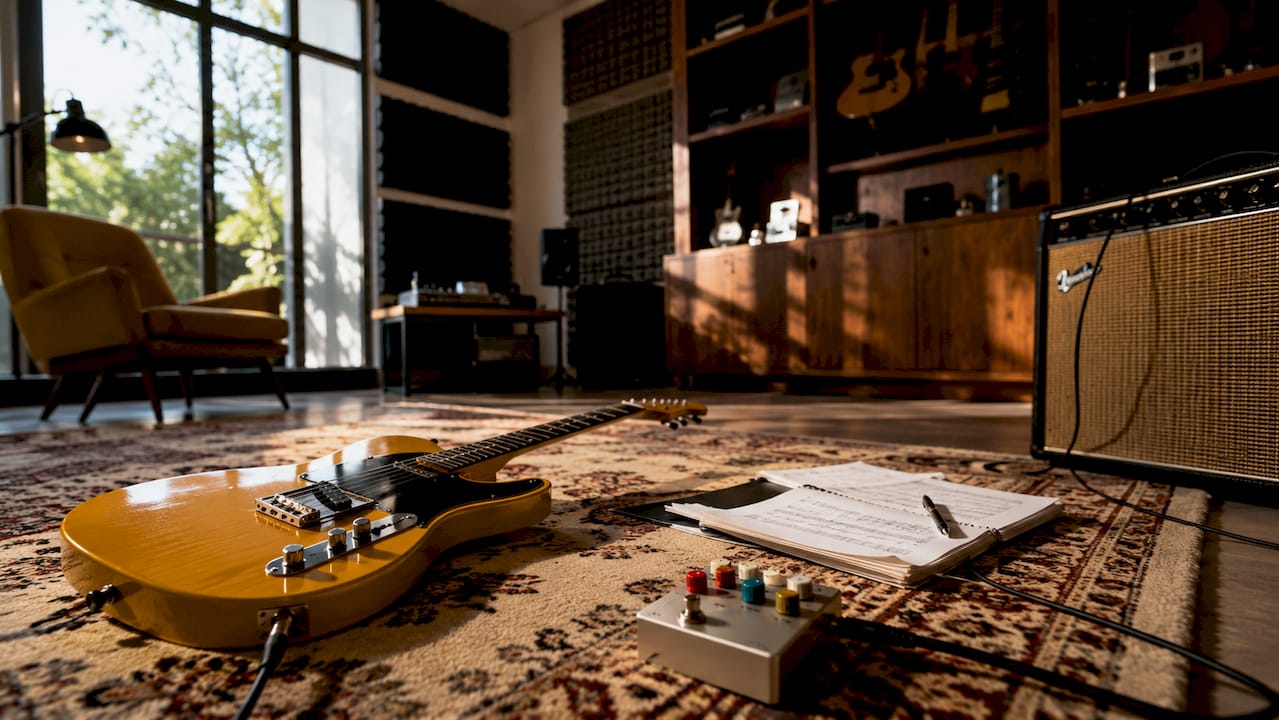
Room reverb simulates small to medium enclosed spaces. It adds subtle ambience without pushing a sound far back in the mix. Drummers and guitarists use room reverb to add life to a dry recording without making it sound like it was recorded in a concert hall. The decay times are short, typically under one second, and the density is moderate.
Hall reverb
Hall reverb creates the impression of a large performance space. Decay times extend from two to four seconds, and the tail is smooth and diffuse. Orchestral recordings and lead vocals on ballads benefit most from hall reverb because it adds grandeur and emotional scale without cluttering the mid-range.
Plate reverb
Plate reverb was originally created by suspending a large metal plate and vibrating it with a transducer. The result is bright, dense, and smooth. It became the standard choice for vocals and snare drums in the 1960s and 1970s, and that preference holds today. Plate reverb sits well in a mix because its brightness complements rather than competes with the dry signal.
Spring reverb
Spring reverb uses a physical spring mechanism to create its characteristic metallic, bouncy sound. Guitar amplifiers have used spring reverb since the 1950s, and the effect is inseparable from surf rock, country, and blues tones. It has a shorter, more pronounced tail than plate reverb and a distinctly analogue character.
Convolution reverb
Convolution reverb uses impulse responses, which are recordings of real spaces, to recreate acoustic environments with exceptional realism. You can place a guitar in the acoustic signature of Abbey Road Studio Two or a Viennese concert hall. The trade-off is that convolution reverb is less flexible than algorithmic types because the character of the space is fixed within the impulse response.
Pro Tip: Use plate reverb on vocals and snare drums as your default starting point. Its brightness cuts through a mix cleanly, and you can always roll off the high frequencies with an EQ on the return channel if the effect feels too present.
| Type | Typical decay | Character | Common use |
|---|---|---|---|
| Room | 0.3–0.8s | Natural, subtle | Drums, guitars, ambience |
| Hall | 2–4s | Smooth, expansive | Vocals, strings, pads |
| Plate | 1–3s | Bright, dense | Vocals, snare, lead instruments |
| Spring | 0.5–2s | Metallic, bouncy | Guitar amps, vintage sounds |
| Convolution | Variable | Highly realistic | Film scoring, acoustic realism |
How do reverb parameters shape a mix?
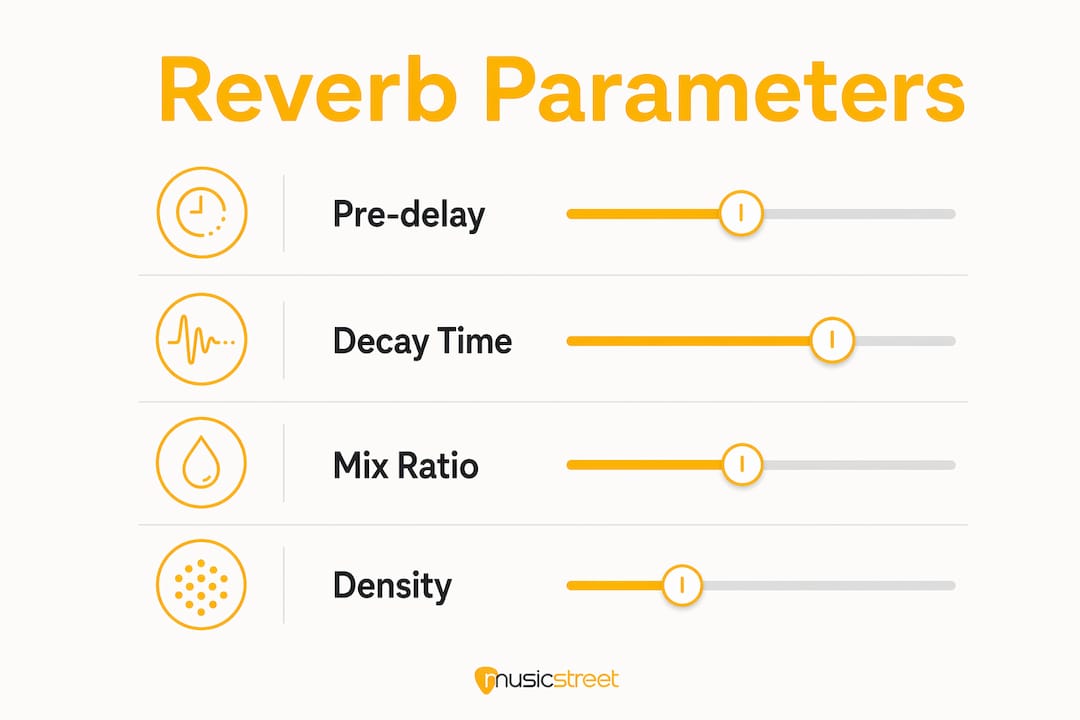
Standard reverb control panels feature four primary parameters: Pre-delay, Decay Time, Mix, and Density. Mastering these four controls gives you the ability to simulate any acoustic environment from a small studio booth to a vast cathedral.
1. Pre-delay
Pre-delay sets the gap between the dry signal and the onset of the reverb tail. A pre-delay of 10–30ms is critical for maintaining transient clarity and keeping the original sound distinct from the reverb. Without pre-delay, the reverb starts immediately and smears the attack of the note or word. With it, the listener hears the dry signal first, then the space opens up behind it. This is the single most important reverb control for maintaining clarity in a busy mix.
2. Decay time
Decay time controls how long the reverb tail sustains before fading to silence. Short decay times create intimate, close spaces. Long decay times suggest large, open environments. For up-tempo tracks, keep decay times short so the reverb tail does not bleed into the next beat. For slow, atmospheric pieces, longer decay times add emotional weight.
3. Mix (wet/dry ratio)
The mix control sets the balance between the dry signal and the reverb effect. A low mix setting, around 10–20%, adds subtle spatial glue. A high mix setting pushes the sound further back in the perceived space and makes the effect more obvious. Most professional mixes use reverb at lower mix levels than beginners expect.
4. Density
Density controls how tightly the reflections cluster together. High density produces a smooth, lush tail. Low density creates a more sparse, grainy texture with audible individual reflections. Snare drums often benefit from high density for a full, controlled sound. Ambient guitar parts can use lower density for a more textured, interesting decay.
Pro Tip: Route reverb to a dedicated auxiliary return track rather than inserting it directly on the source channel. Parallel processing of reverb lets you apply EQ and compression exclusively to the reverb signal, preserving the dry sound’s integrity and preventing a washed-out mix.
How to use reverb effectively in mixing and sound design
Reverb functions as a positioning tool in a mix, helping to place sounds spatially and create emotional scale. Professional engineers think about reverb in terms of where they want the listener to sit relative to each sound source, not simply how much effect to add.
The direct-to-reverberant ratio is the core technique for creating depth without changing volume. A high ratio of dry to wet signal places an instrument in the foreground. A low ratio pushes it to the background. This is how a lead vocal sits in front of a lush string arrangement even when both are at similar volume levels.
Common mistakes to avoid:
- Over-reverb on vocals: Heavy reverb pushes vocals back in the mix and reduces intelligibility. Use subtle settings and rely on pre-delay to keep the voice present.
- Smearing transients: Applying reverb without pre-delay blurs the attack of drums and plucked strings. Always set pre-delay before adjusting decay.
- Same reverb on every track: Using identical reverb settings across all instruments flattens the mix. Vary the type, decay, and mix level to create a three-dimensional sonic field.
- Ignoring the tempo: Long reverb tails on fast tracks create rhythmic clutter. Match your decay time to the tempo of the track, or use a tempo-synced reverb setting.
- Skipping EQ on the reverb return: Reverb accumulates low-frequency mud quickly. High-pass the reverb return at around 200Hz to keep the low end clean.
Subtle reverb acts as glue integrating tracks rather than overwhelming them. The most effective mixes use reverb so naturally that the listener does not consciously notice it. They simply feel that the music exists in a believable, cohesive space.
For creative sound design, non-linear reverbs, which fade in rather than decay naturally, create dramatic, otherworldly textures on drums and percussion. Reverse reverb, where the tail precedes the dry signal, is a classic studio technique for building tension before a vocal entry.
Pro Tip: Automate your reverb mix level throughout a track. Increase it slightly during quieter, more atmospheric sections and pull it back during dense, rhythmically active passages. This keeps the mix clear without sacrificing the sense of space.
Key takeaways
Reverb is the most powerful spatial tool in audio production, and controlling its four core parameters determines whether a mix sounds professional or cluttered.
| Point | Details |
|---|---|
| Reverb vs echo | Reverb consists of reflections arriving within 50ms; anything longer becomes a distinct echo. |
| Five reverb types | Room, Hall, Plate, Spring, and Convolution each suit different instruments and applications. |
| Pre-delay is critical | A pre-delay of 10–30ms preserves transient clarity and prevents the reverb from smearing the dry signal. |
| Use parallel processing | Route reverb to an auxiliary return track to apply EQ and compression without affecting the dry signal. |
| Direct-to-reverberant ratio | Adjusting this ratio positions instruments in the foreground or background without changing volume levels. |
Why reverb is the most misunderstood tool in your mix
Most musicians treat reverb as decoration. They reach for it when a track feels dry or lifeless, dial up the decay, and move on. That approach produces the muddy, washed-out mixes that separate amateur recordings from professional ones.
Reverb is spatial storytelling. Every decision you make with it tells the listener something about where a sound exists. A dry, close vocal says intimacy. A long hall reverb on a guitar says scale and drama. A tight room reverb on a snare says a live, energetic performance. None of these are accidents in a well-produced record.
The producers I most respect think about reverb before they reach for it. They ask: where does this instrument live in the physical world of this song? Is it close to the listener, or far away? Is it in a small, warm space or a large, cold one? Those questions lead to intentional choices rather than default settings.
The other thing worth understanding is that less reverb than you think you need is almost always the right answer. Your ears adjust to the wet signal quickly, and what sounds dry in isolation sounds natural in context. Commit to subtle settings, use your pre-delay, and process the reverb return with a high-pass filter. The result will be a mix that breathes without losing clarity.
Experiment with types you have not used before. Spring reverb on a piano is unusual but can be extraordinary. Plate reverb on an acoustic guitar adds a vintage warmth that room reverb cannot replicate. The types of reverb available in modern production are genuinely different tools, not just variations of the same effect.
— Music
Gear that gives you real control over reverb
Reverb is only as good as the tool delivering it. A quality effects pedal with dedicated reverb controls lets you dial in pre-delay, decay, and mix with precision, whether you are recording at home or performing live.

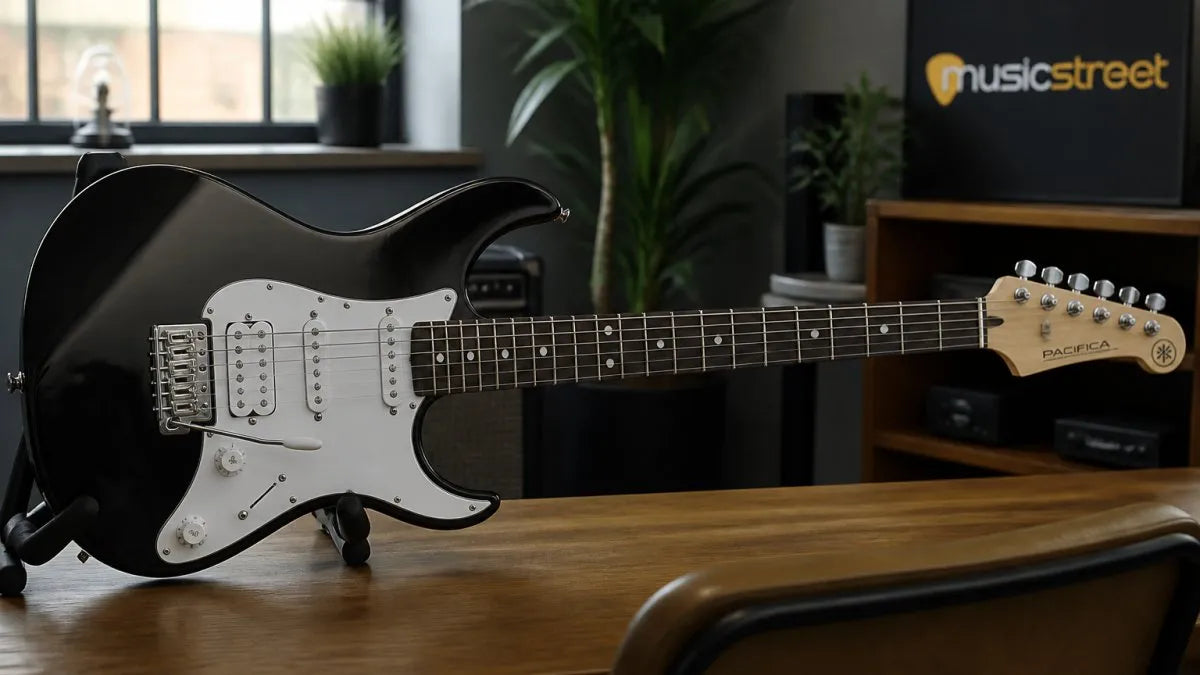
Musicstreet stocks a carefully selected range of effects pedals and guitars built for musicians who take their tone seriously. The Strymon Big Sky reverb pedal is one of the most respected reverb units available, offering twelve reverb types with deep parameter control. If you want to explore guitar effects in depth, Musicstreet’s expert team in Huntingdon, Cambridgeshire is available for in-store advice and demonstrations. Browse the full range online or visit the shop to find the right gear for your sound.
FAQ
What does reverb do to a guitar sound?
Reverb adds spatial depth and atmosphere to a guitar signal, simulating the reflections of a physical space. It makes a dry guitar recording sound as though it was played in a room, hall, or other acoustic environment.
What is the difference between reverb and echo?
Reverb consists of sound reflections arriving within approximately 50ms, blending into a continuous tail. Echo involves longer delays that produce distinct, audible repetitions of the original sound.
What reverb type works best on vocals?
Plate reverb is the standard choice for vocals because its bright, dense character complements the voice without pushing it back in the mix. A pre-delay of 10–30ms keeps the vocal present and clear.
How do I stop reverb making my mix sound muddy?
Route reverb to an auxiliary return track and apply a high-pass filter at around 200Hz to remove low-frequency build-up. Keep mix levels subtle and use pre-delay to separate the dry signal from the reverb tail.
What is convolution reverb?
Convolution reverb uses impulse responses, which are recordings of real acoustic spaces, to recreate those environments with high realism. It is the most accurate type of reverb for placing instruments within a specific physical location.


Share:
Wood for electric guitar body: the builder's guide
Acoustic vs semi-acoustic guitar: key differences explained