


- The choice of wood for electric guitar bodies significantly influences tone, weight, and feel. Variations within the same species and construction methods affect the instrument’s resonance and sound. Builders improve tone consistency by carefully selecting and testing each wood blank beyond species labels.
The wood for electric guitar body is the single most consequential material decision a builder or luthier makes. It shapes tone, sustain, weight, and the way a finished instrument feels under a player’s arm. The industry term for these materials is “tonewoods,” and understanding how each species behaves is the foundation of good guitar design. Common choices include alder, mahogany, basswood, and ash, each with distinct density profiles and sonic characters. Musicstreet works with instruments built from all of these species, and the differences between them are audible, measurable, and worth knowing before you cut a single blank.
What are the most common woods used for electric guitar bodies?
Alder is the most versatile and widely used electric guitar body wood. Its density ranges between 0.4 and 0.7 g/cm³, which places it firmly in the lightweight to medium category. That density produces a balanced tone with clear highs, responsive mids, and a tight low end. Builders favour it because it machines cleanly, takes paint well, and delivers consistent results across pieces.
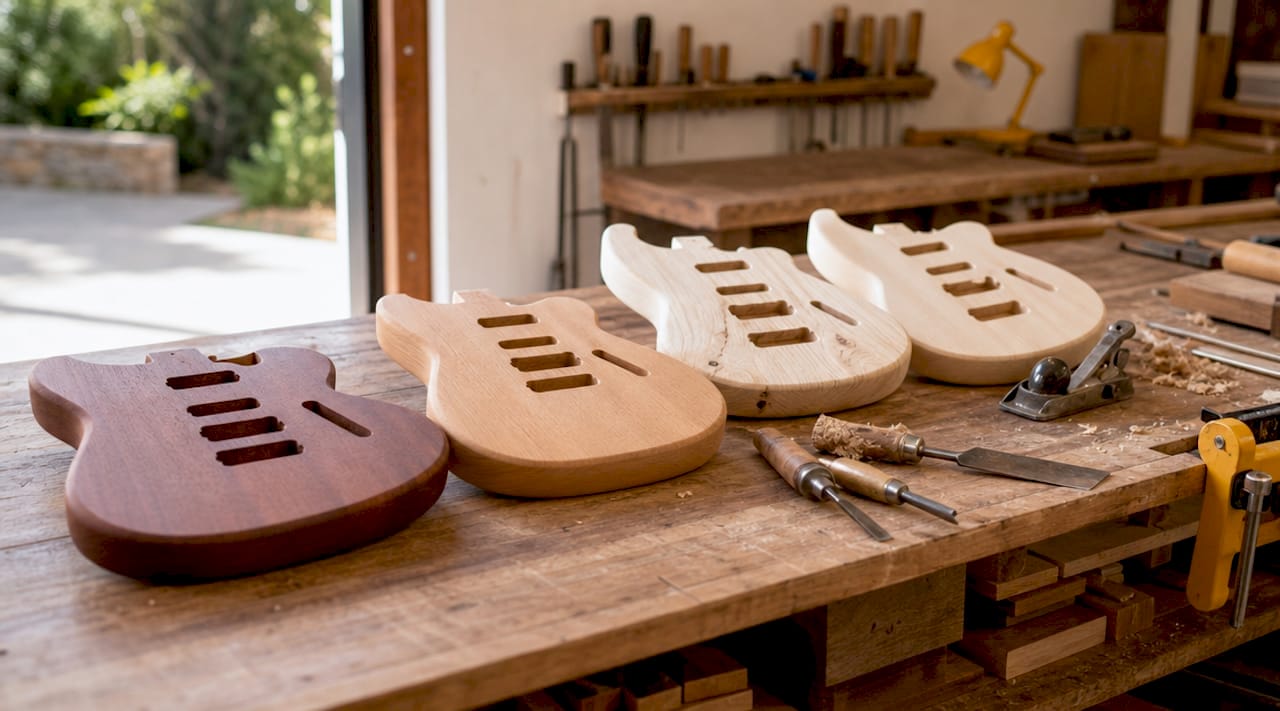
Mahogany sits at the warmer end of the tonal spectrum. Its density of 0.5–0.6 g/cm³ and Janka hardness of 800–860 lbf give it a dense, resonant character that emphasises the midrange and extends sustain. That sustain profile makes mahogany the standard choice for set-neck guitar designs, where the neck-to-body joint already encourages long note decay. The trade-off is weight: a full mahogany body can feel substantial after a long set.
Basswood is the builder’s choice when weight is a priority. Its Janka hardness of 410 lbf makes it one of the softest commonly used body woods, which means it carves and routes with minimal effort. Tonally, it leans into the mids with a warm, slightly compressed character. Many ergonomically shaped electric guitars use basswood precisely because the low density keeps the finished instrument comfortable to wear.
Ash divides into two distinct categories: Swamp Ash and Hard Ash. Swamp Ash offers a lively, airy tone with shimmering highs, but displays notable inconsistency between individual pieces. Hard Ash is denser, heavier, and produces a brighter, more aggressive sound. The open grain of both ash varieties creates a striking visual character, which is why many builders choose it as much for aesthetics as for tone.
| Wood | Density (g/cm³) | Janka hardness (lbf) | Tonal character |
|---|---|---|---|
| Alder | 0.4–0.7 | Moderate | Balanced, clear highs, tight bass |
| Mahogany | 0.5–0.6 | 800–860 | Warm mids, strong sustain |
| Basswood | Low | 410 | Warm mids, compressed, lightweight |
| Swamp Ash | Low to medium | Variable | Airy, bright, lively |
| Hard Ash | Medium to high | High | Bright, aggressive, heavy |
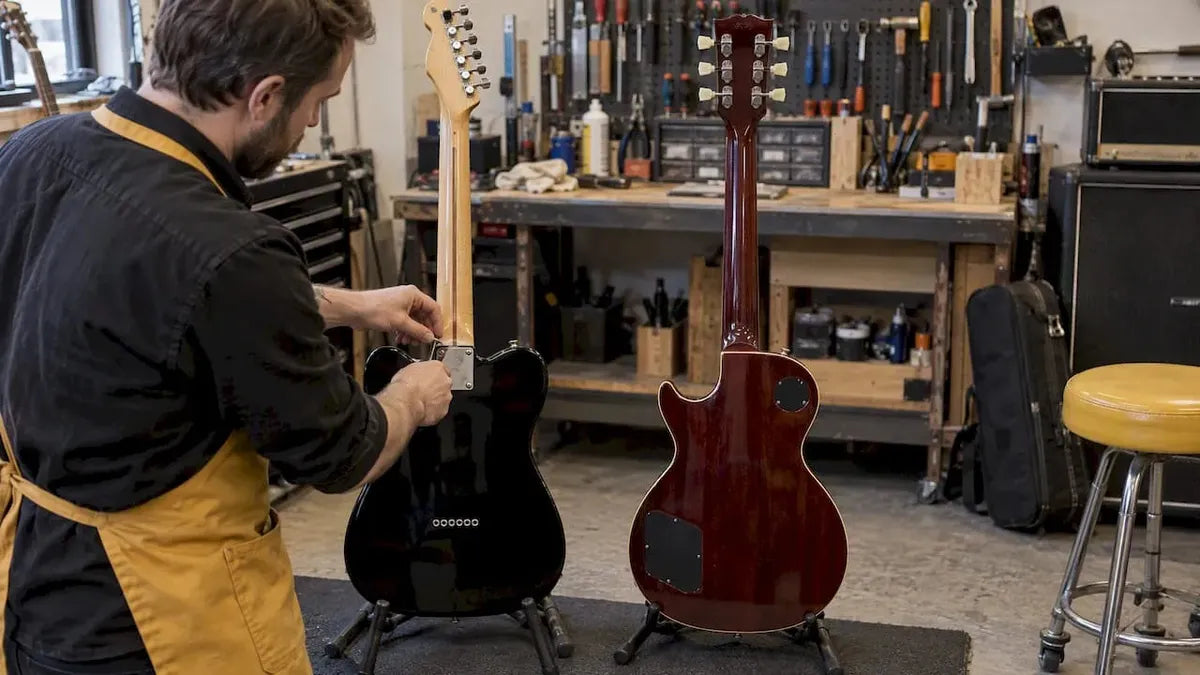
Pro Tip: When comparing wood blanks in a workshop, hold each piece at its centre point and tap it sharply with a knuckle. A clear, bell-like ring indicates good resonance. A dull thud suggests internal inconsistencies that will limit the finished guitar’s sustain.
How does wood actually affect an electric guitar’s sound?
Wood is part of a mechanical system, and its density and properties influence string vibration, which in turn shapes the signal a pickup captures. The string vibrates, the body absorbs and reflects that energy, and the pickup reads the result. A denser body returns more energy to the string, which extends sustain. A lighter, more porous body absorbs energy faster, which can produce a warmer, more compressed character.
Peer-reviewed research confirms that wood species measurably influence the frequency response and output of electric guitars through this mechanical energy transfer. That finding matters because it moves the tonewood debate away from subjectivity and into physics. The body wood does not work alone, though. Neck construction, pickup design, and hardware all contribute to the final sound.
“Wood’s influence on tone is not absolute but works in concert with neck construction, pickup design, and hardware for the final sound. Treating the body wood as the only variable misrepresents how guitars actually work.”
The unplugged resonance of a guitar body does carry through to the amplified tone, though the relationship is not linear. A body that rings clearly when tapped tends to produce a more open, responsive amplified sound. This is why experienced builders test blanks before committing to a design, not after.
Pro Tip: Builders use tap-testing and weighing to assess resonance and stability of wood blanks. Properties vary significantly within species, so two pieces of alder from the same supplier can behave quite differently once shaped and strung.
What practical factors should builders consider when choosing body wood?
Selecting electric guitar body materials involves more than matching a wood species to a tonal description. Builders must weigh availability, workability, weight, finishing behaviour, and how the wood interacts with the rest of the instrument’s construction.
-
Assess weight and ergonomics first. Heavier woods like mahogany deliver specific sustain profiles but affect player comfort over long periods. If the instrument is intended for stage use, a lighter wood like alder or basswood may serve the player better than a tonally superior but physically demanding alternative.
-
Check moisture content before purchase. Wood that has not been properly kiln-dried will move after shaping, causing joints to open, finishes to crack, and necks to shift. A moisture content of around 6–8% is the accepted target for guitar body blanks in a temperate workshop environment.
-
Evaluate grain consistency. Straight, even grain produces more predictable tonal and structural results than wild or figured grain. Figured wood is visually striking, but the interlocked fibres can complicate routing and increase the risk of tearout.
-
Consider finishing requirements. Open-grained woods like ash require grain filling before a smooth finish can be applied. Alder and basswood accept paint directly with minimal preparation. If the build calls for a natural or translucent finish, the wood’s figure and colour become part of the design brief.
-
Match the wood to the construction method. A bolt-on neck design transfers less energy through the joint than a set-neck or neck-through design. This means the body wood’s resonant properties have a slightly smaller influence in bolt-on builds, which gives builders more flexibility to prioritise weight or workability over pure tonal character.
Pro Tip: For builders working with figured or exotic woods, always route test pieces before committing to the actual blank. Grain direction changes unpredictably in highly figured material, and a single misaligned router pass can ruin an expensive piece.
How do body construction methods interact with wood choice?
Construction style directly influences resonance and tone in combination with wood density and properties. Understanding the three main construction types helps builders make wood choices that support, rather than fight, the intended design.
Solid body construction
A solid body transmits string energy through the full mass of the wood. This maximises sustain and keeps feedback under control at high volumes. Dense woods like mahogany work particularly well in solid bodies because the mass supports long note decay. Lighter woods like alder also perform well, producing a slightly more open, articulate response. The solid body format is the most common in electric guitar design precisely because it gives builders the most predictable tonal outcomes.
Chambered and weight-relieved bodies
Chambering removes material from the interior of a solid body blank, reducing weight without changing the external dimensions. Weight-relieved bodies use a similar approach but with smaller, more numerous cavities. Both methods shift the resonant character of the instrument toward a slightly more acoustic quality. A chambered mahogany body, for example, loses some of the density-driven sustain but gains a warmer, more open midrange. This approach suits builders who want the tonal warmth of a heavy wood without the physical burden.
| Construction type | Effect on tone | Best wood pairing |
|---|---|---|
| Solid | Maximum sustain, controlled feedback | Mahogany, alder, Hard Ash |
| Chambered | Warmer, more open midrange | Mahogany, walnut |
| Weight-relieved | Balanced sustain, reduced weight | Mahogany, alder |
The interaction between wood density and body construction is not a simple formula. A chambered basswood body will behave very differently from a chambered mahogany body, even if the chamber dimensions are identical. The starting density of the wood determines how much the chambering changes the resonant character. Builders who understand this relationship can use construction method as a tonal tool, not just a weight management strategy.
Key takeaways
The body wood of an electric guitar works within a mechanical system alongside the neck, pickups, and hardware, and no single species delivers a fixed tonal outcome independent of those other components.
| Point | Details |
|---|---|
| Alder is the most versatile choice | Balanced tone, lightweight, and easy to finish make it the most widely used body wood. |
| Mahogany prioritises warmth and sustain | Its density extends note decay but adds weight, so consider chambering for comfort. |
| Individual pieces vary more than species | Select blanks by tap-testing and weighing, not by species name alone. |
| Construction method shapes tonal outcome | Solid, chambered, and weight-relieved builds each alter how wood density affects resonance. |
| Weight affects playability as much as tone | Matching wood weight to the player’s physical comfort is as important as matching tonal character. |
Why I think builders obsess over the wrong thing
Most discussions about guitar tonewoods for body selection focus on species comparisons, as if choosing mahogany over alder is a decision you make once and then forget. The reality is more interesting and more demanding than that. Variation within the same wood species can cause greater tonal differences than differences between species entirely. Two alder blanks from the same batch can produce instruments that feel and sound noticeably different. That is the fact the species comparison charts never tell you.
What I have found, working with instruments across a wide range of builds, is that the builders who produce consistently great guitars are the ones who treat wood selection as an ongoing skill rather than a lookup exercise. They handle blanks, tap them, weigh them, and reject pieces that do not meet their standard, regardless of the species label. That discipline separates a good build from a great one.
The other thing worth saying plainly: wood choice matters less than most builders fear and more than most players realise. The body wood sets the tonal foundation, but the neck joint, pickup height, and string gauge all sit on top of that foundation and shape the final result. If you are agonising over alder versus basswood while using mismatched pickups and a poorly cut nut, you are solving the wrong problem first. Get the fundamentals right, then refine with wood selection.
For builders exploring how tonewoods shape your sound, the most useful thing you can do is handle as many different instruments as possible and listen critically. Theory is a starting point. The wood in your hands is the real teacher.
— Music
Musicstreet’s electric guitar range: wood in practice
Musicstreet stocks a carefully selected range of electric guitars that put these tonal principles into practice across real instruments.

Whether you are drawn to the warm sustain of a mahogany body or the balanced clarity of an alder build, the Musicstreet collection includes both new and pre-loved instruments built from the species discussed here. The used Ibanez GSA60 in Walnut is a strong example of how alternative body woods translate into a finished instrument, while the used Gretsch G5422G-12 demonstrates how tonewoods interact with semi-hollow construction. Every instrument at Musicstreet is professionally inspected before sale, so the wood quality you read about here is the wood quality you receive. Browse the full range at Musicstreet and hear the difference that considered wood selection makes.
FAQ
What is the best wood for an electric guitar body?
Alder is the most widely used and versatile body wood for electric guitars, offering balanced tone and light weight. Mahogany suits players who want warmth and sustain, while basswood works well for ergonomic designs where weight is a priority.
Does the body wood of an electric guitar actually affect the sound?
Research confirms that wood species measurably influence frequency response through mechanical energy transfer between the string and body. The effect works alongside pickup design and neck construction rather than in isolation.
Is mahogany too heavy for a guitar body?
Mahogany is denser than alder or basswood, which can make a solid mahogany body feel substantial. Builders address this with chambered or weight-relieved construction, which reduces mass while preserving much of the wood’s tonal warmth.
How do I choose between solid wood guitar bodies and chambered designs?
Solid bodies maximise sustain and feedback resistance, making them the standard choice for high-volume playing. Chambered bodies reduce weight and add a slightly more open, resonant quality, which suits players who want a lighter instrument without switching to a less dense wood species.
Why do two guitars with the same body wood sound different?
Variation within species means individual blanks differ in density, grain structure, and resonant character. Experienced builders use tap-testing and weighing to select pieces that meet their tonal targets, rather than relying on species classification alone.





Share:
Best type of acoustic guitar strings: your 2026 guide
What does reverb do to your sound?