

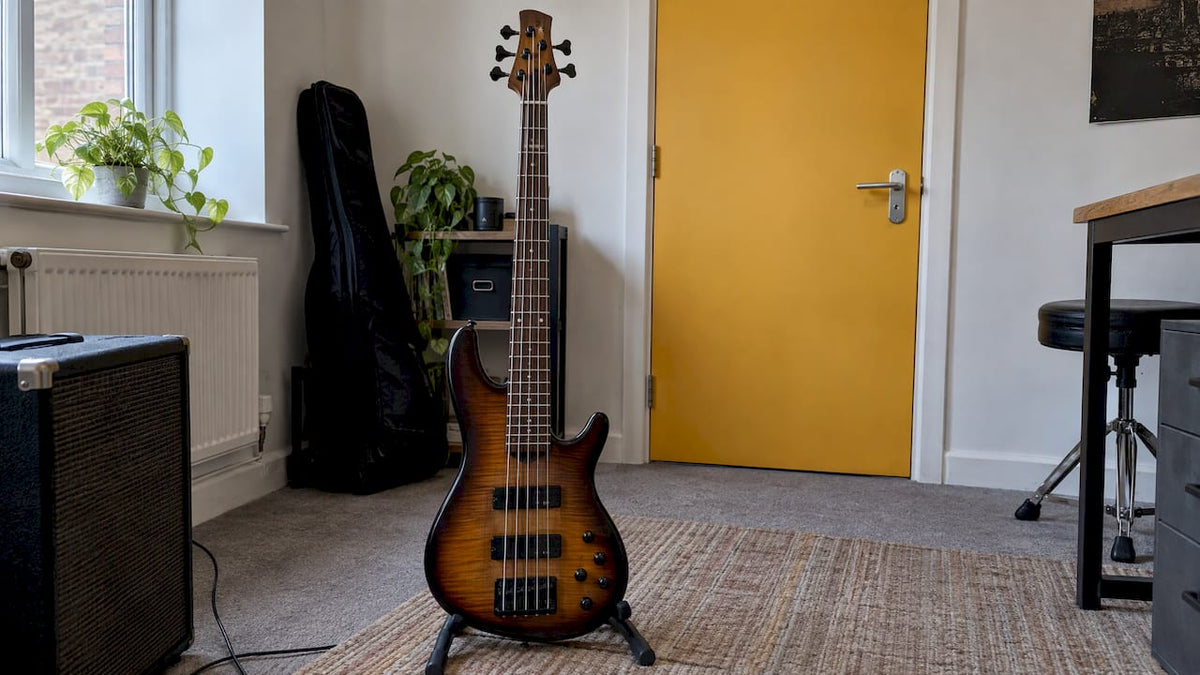
A 5-string bass needs a set made for five strings: four familiar strings plus a low B, usually gauged between about .125 and .135, and cut to the scale length of your bass. Get those three things right (tuning, gauge, scale) and the rest is a matter of taste: nickel for warmth, stainless steel for bite. This guide takes you through each decision in the order you will meet it in a shop, so you order the right set first time.
We sell new and pre-owned basses and strings at our shop in Huntingdon and online, and the questions below are the ones that come up whenever someone moves up from four strings to five.
Table of Contents
- The names and tuning of a 5-string bass
- Why a 5-string set is not a 4-string set with a spare B
- Gauge: what the numbers mean for feel and sound
- Winding and material: nickel, stainless steel and coated
- Scale length: the check that stops a wrong order
- Changing a 5-string set
- Putting it together: a simple way to choose
- Strings, setup and advice from one shop
- Our view: set up the string to suit the bass
- FAQ
- Sources
The names and tuning of a 5-string bass
Most 5-string basses are tuned B E A D G, from lowest to highest. The strings are numbered from the thinnest, so the G is the 1st string, then D (2nd), A (3rd), E (4th) and the low B is the 5th. The upper four are tuned exactly as on a standard four-string bass, so nothing you already know about the top of the neck changes. Bass guitar tuning is summarised on Wikipedia, which also notes that the low-B five-string dates from 1975, when Jimmy Johnson built the first one, and that Yamaha’s first production model, the BB5000, appeared in 1984.

There is an older alternative. Fender’s 1965 Bass V was tuned E A D G C, adding a high C on top instead of a low B, and was discontinued in 1970, according to the same page. A handful of players still prefer a high-C layout. If your bass is set up that way, you need a set built for E A D G C, not B E A D G, so check the configuration before you order.
What the low B actually gives you
The fifth string extends your range downwards without altering the other four. On a four-string the lowest note is the open E; the B string puts five extra semitones beneath it. Yamaha’s guide to the benefits of a five-string bass points out that this lets you play the root of a song in keys such as D or C without fighting other instruments, and that a low F played at the sixth fret of the B string is richer in harmonics than the same note at the first fret of the E string.
It also changes how you move around the neck. The same line can sit in one position instead of stretching across the E string. If you want to see how the extra string reshapes fingerings, our guide to how B E A D G and E A D G C change your scale maps shows the patterns, and the page on why intervals matter more than shapes on a 5-string helps you read the neck.
Why a 5-string set is not a 4-string set with a spare B
The low B sits a fourth below the E, so at the same scale length it holds less tension at pitch. That is why it is wound heavier than the other strings. A set designed for five strings balances the whole pack: the B is thick enough to stay firm, and the other four are chosen so that the feel across the neck is even.
Mixing and matching is possible, and some players do add a single heavy B to a four-string set, but a complete five-string set saves you guessing. Whenever you jump to a noticeably different gauge, expect to adjust the truss rod, string height and intonation. The neck and bridge were set for the old tension, and a heavier string pulls differently.
Gauge: what the numbers mean for feel and sound
Bass string gauges are quoted in thousandths of an inch, from the thinnest string to the thickest. A set labelled 45-125 has a .045 G string and a .125 B. Five-string sets commonly come in these patterns:
| Set | Typical use | What you notice |
|---|---|---|
| 45-125 | All-round light five-string set | Easier on the fingers, quicker response, good for slap and fingerstyle |
| 45-130 | Light-medium, firmer B | A tighter low B on a 34-inch scale |
| 50-130 | Medium | Fuller bottom end, a little more finger strength needed |
MusicRadar’s best bass strings review, last updated in September 2024, lists five-string D’Addario NYXL sets in 45-125 and 45-130 and XT Nickel Plated in 45-130, which gives you a feel for the range the major makers cover. Other makers use similar ranges, with the B string anywhere between roughly .125 and .135.
Choosing a heavier or lighter set
The principle is simple. Heavier strings give a richer, fuller low end and more tension, which many players like for sustained, driving playing. They ask more of your fretting hand. Lighter strings bend and move more easily and suit fast, percussive styles, but the B can feel looser. Neither is better; they are different tools.
If your low B has always felt floppy, step up a size on the B before changing anything else. The other common answer is a longer 35-inch scale, which adds tension without a thicker string. That is a feature of the bass itself, so it is something to consider when buying the instrument. Our bass guitar range includes five-strings, and you can try them in the shop.
Winding and material: nickel, stainless steel and coated
The metal wrapped around the core is the biggest influence on tone. MusicRadar’s explanation of material choice breaks it down plainly:
- Stainless steel adds top-end bite and a slight mid scoop. It suits modern rock, punk, pop and metal.
- Pure nickel is much warmer and mellower, the classic choice for vintage tones.
- Nickel-plated steel sits between the two and covers a wide range of styles from one bass.
Stainless strings also feel slicker and tend to be brighter out of the packet, while nickel feels softer under the fingers. Round-wound strings, the usual choice, have a ridged surface and a bright, clear attack. Flatwounds are smoother, darker and more muted. The question “does Paul McCartney use flatwounds?” comes up a lot; he is a famous example of the rounded, mellow sound that flats give, but you can reach that sort of tone only if your bass and amp suit it, and many players keep a flatwound set for one bass and rounds on another.
Coated strings carry a thin polymer layer that is designed to slow corrosion and keep the tone consistent for longer. They cost more per set, which is worth it if your strings go dull quickly.
Scale length: the check that stops a wrong order
Strings are made to fit a particular scale length, the distance from nut to bridge saddle. Most basses, including Fender Precision and Jazz-style instruments, are 34-inch. Short-scale basses are around 30 inches, and many five-string basses are 35 inches. A set cut for the wrong scale will be too short to reach the tuner, or leave you with a long, awkward tail.
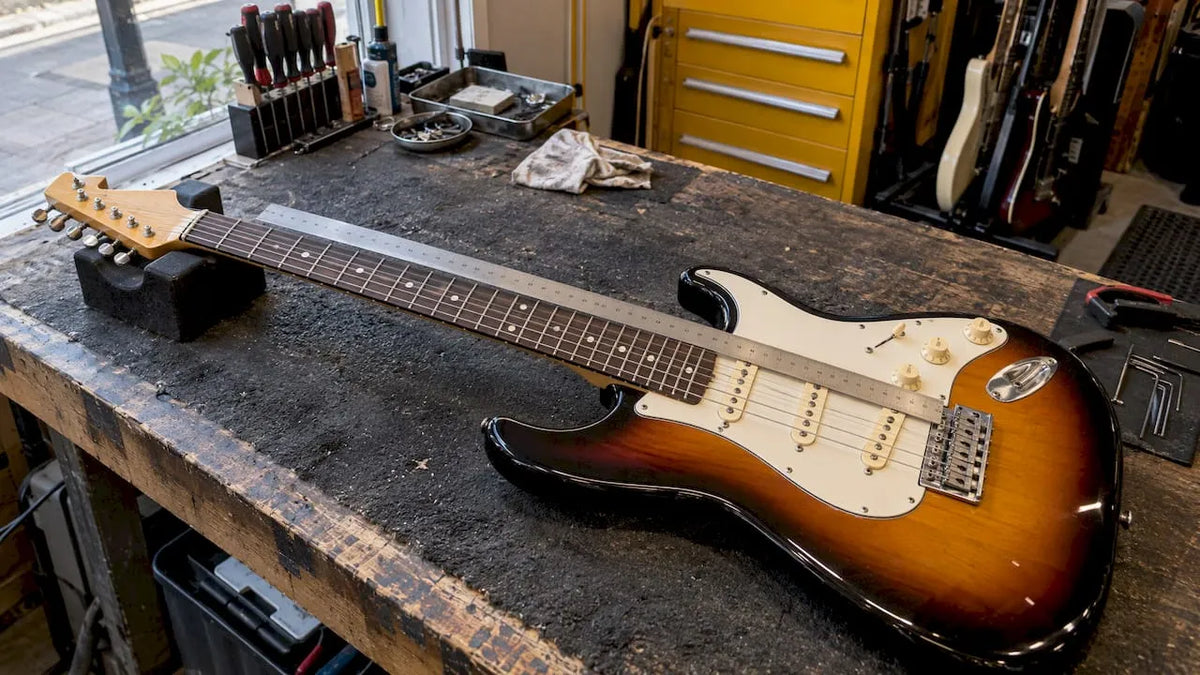
Look for “long scale” on the pack for a 34-inch bass, “extra long” for 35 inches, and “short scale” for 30 inches. If you are unsure which your bass is, measure from the nut to the bridge saddle and double the distance from the nut to the twelfth fret as a check.
Changing a 5-string set
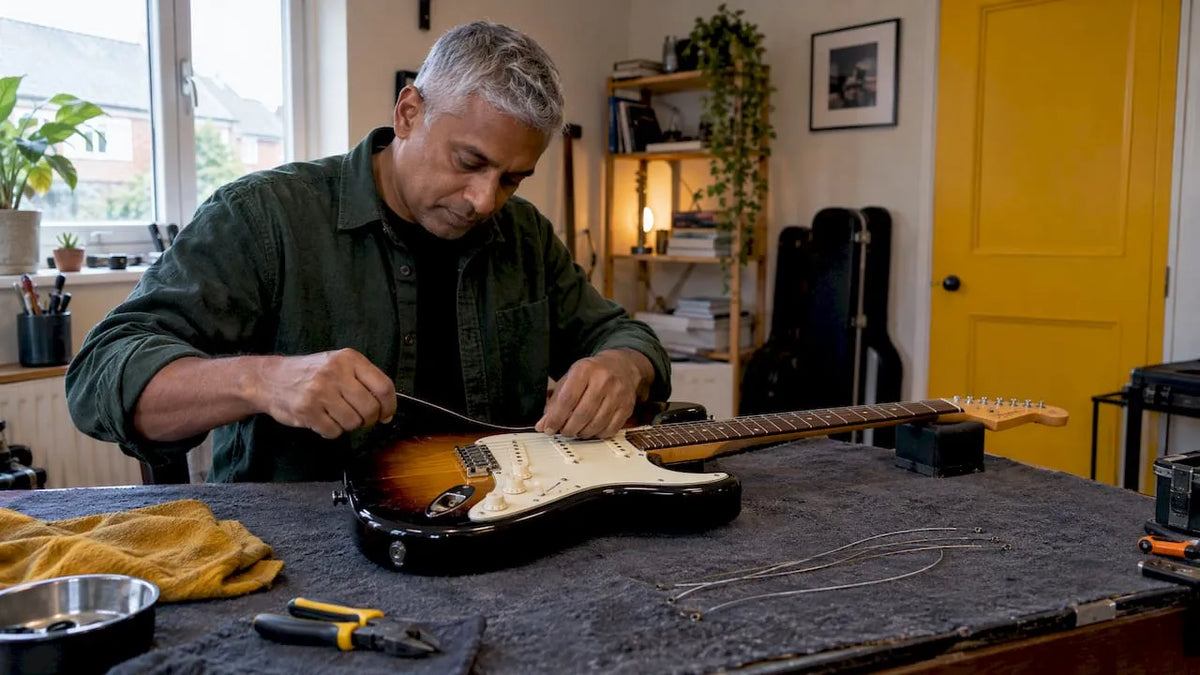
Change the strings one at a time if you can: it keeps tension on the neck and keeps the bridge in position. Wind each string onto the tuner with two or three neat turns, tune up, stretch gently along the length, and retune until it holds. A new B string stretches more than the others, so expect to retune it several times on the first day.

Bass strings last longer than guitar strings, but they do lose their brightness. The signs are a dull, thuddy tone, notes that will not stay in tune, strings that feel gritty, and an intonation that drifts higher up the neck. If you play every day, you will notice that sooner than a weekend player. If you would rather not do it yourself, our in-store restring service handles it, and our setup and repair team can adjust the truss rod, action and intonation after a gauge change so the bass plays as it should.
Putting it together: a simple way to choose
- Confirm the tuning. B E A D G for almost every modern five-string; E A D G C only if yours is set up that way.
- Confirm the scale length. 34, 35 or 30 inches, and buy strings made for it.
- Pick a gauge for how you play. 45-125 for lighter, faster playing; 45-130 or 50-130 for a firmer, fuller low end.
- Pick a material for the tone you want. Nickel for warmth, stainless for brightness, nickel-plated steel as the middle ground.
- Allow for a quick check-up if you change gauge. A different tension can call for a small adjustment to the neck and bridge.
If you also want to upgrade the sound beyond strings, five-string pickup sets are another route; we stock Aguilar 60s series 5-string Precision Bass pickups and Aguilar 70s series 5-string Jazz Bass pickups, among others.
Strings, setup and advice from one shop
Buy your strings where someone can look at the bass they are going on. Our guitar strings collection covers sets for bass, and our in-store restring service means you can have them fitted at our shop in Huntingdon, Cambridgeshire. Every instrument we sell is inspected and set up by our team, and we offer free UK delivery on orders over a minimum amount if you would rather order online.

If you are moving from four strings to five, come and try a few basses in person. Browse the bass guitar range or get in touch through our shop and we will match a set to your instrument.
Our view: set up the string to suit the bass
A five-string bass works best when the strings, the scale length and the setup agree with each other. We see the low B as the string that shows it fastest: if it sounds slack, the answer is usually a considered change of gauge and a quick adjustment, not a different instrument.
That is why we inspect and set up every instrument we sell, and why we offer restringing in store. A set chosen for your bass, fitted properly and checked for action and intonation will feel better than a good set simply dropped on.
Our advice is to decide what you want from the low end, whether that is a tight, modern punch or a deep, warm foundation, and choose the gauge and material to match. Then let us help you get it onto the neck, and support you afterwards.
Music
FAQ
What are the string names on a 5-string bass?
From lowest to highest they are B, E, A, D and G. The G is the 1st string and the low B is the 5th. If your bass is the rarer high-C type, the order is E, A, D, G, C.
Can I put a 4-string set on a 5-string bass?
Not as a complete set, because it has only four strings and none of them is a low B. Some players add a single heavy B to a four-string set, but a set made for five strings is balanced across all five, which makes choosing simpler.
What gauge should the low B be?
Most five-string sets put the B between about .125 and .135. A .125 B feels lighter and easier to play; a .130 or .135 is firmer and tighter, especially on a 34-inch scale. If you change gauge noticeably, have the action and intonation checked.
Is a 5-string bass tuned to E1 or E2?
The open E on a bass is E1, at about 41 Hz, with the low B of a five-string a fourth below at about 31 Hz. Bass music is usually written an octave higher than it sounds, which is why you sometimes see E2 quoted.
Sources
- Bass guitar tuning, Wikipedia
- Benefits of a Five-String Bass, Yamaha Hub
- Best bass strings: Electric and acoustic options, MusicRadar



Share:
What Is Scale Length on a Guitar? A Plain Guide