


TL;DR:
- Building correct habits early by tuning, proper hand placement, and mastering simple chords is essential for guitar beginners. Consistent short daily practice sessions with focused drills and metronome use develop muscle memory, rhythm, and smooth transitions faster than infrequent, longer sessions. Choosing a comfortable, appropriately priced guitar and reliable tools supports motivation and steady progress over time.
Learning guitar is defined by one non-negotiable truth: the habits you build in your first few weeks will shape everything that follows. The best guitar tips for beginners are not about playing fast or sounding impressive. They are about tuning correctly every single time, placing your hands properly, and mastering a handful of clean chords before anything else. Get those three things right and progress becomes almost automatic. Skip them and you will spend months unlearning bad habits.
What are the essential techniques every beginner should master?
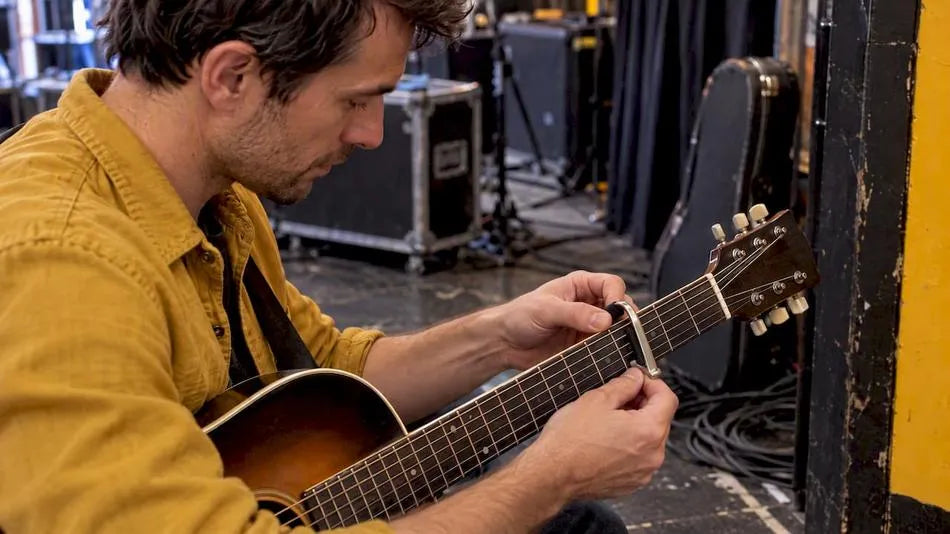
The foundation of how to play guitar starts with standard tuning: E, A, D, G, B, E from the lowest string to the highest. Tuning before every session is not optional. An out-of-tune guitar trains your ear incorrectly and makes chord shapes sound wrong even when your fingers are in exactly the right position.
Posture comes next. Sit with the guitar resting on your strumming-hand thigh, back straight, and the neck angled slightly upward. Your fretting hand should curve naturally so your fingertips press just behind the fret, not on top of it. Tension in the wrist or shoulder is a warning sign. If something aches after five minutes, adjust before continuing.
Once you are sitting correctly and in tune, learn the string names and the basic layout of the fretboard. You do not need to memorise every note immediately. Knowing that the thinnest string is high E and the thickest is low E gives you enough orientation to follow any lesson or tab.
The beginner sequence recommended by the United Conservatory is clear: play one clean single note first, then attempt two or three open chords such as Em, G, and D, before adding any strumming or rhythm. This order matters because it builds confidence through small, audible wins rather than overwhelming you with multiple skills at once.
- Tune to E-A-D-G-B-E before every session without exception
- Press fingertips just behind the fret to produce clean, buzz-free notes
- Start with Em, G, and D as your first three basic guitar chords
- Play single notes cleanly before attempting full chord shapes
- Check posture regularly to prevent wrist and shoulder tension
Pro Tip: Place your fretting finger as close to the metal fret as possible without sitting on top of it. This single adjustment eliminates most of the buzzing that frustrates new players in the first week.
How should beginners structure their practice sessions?
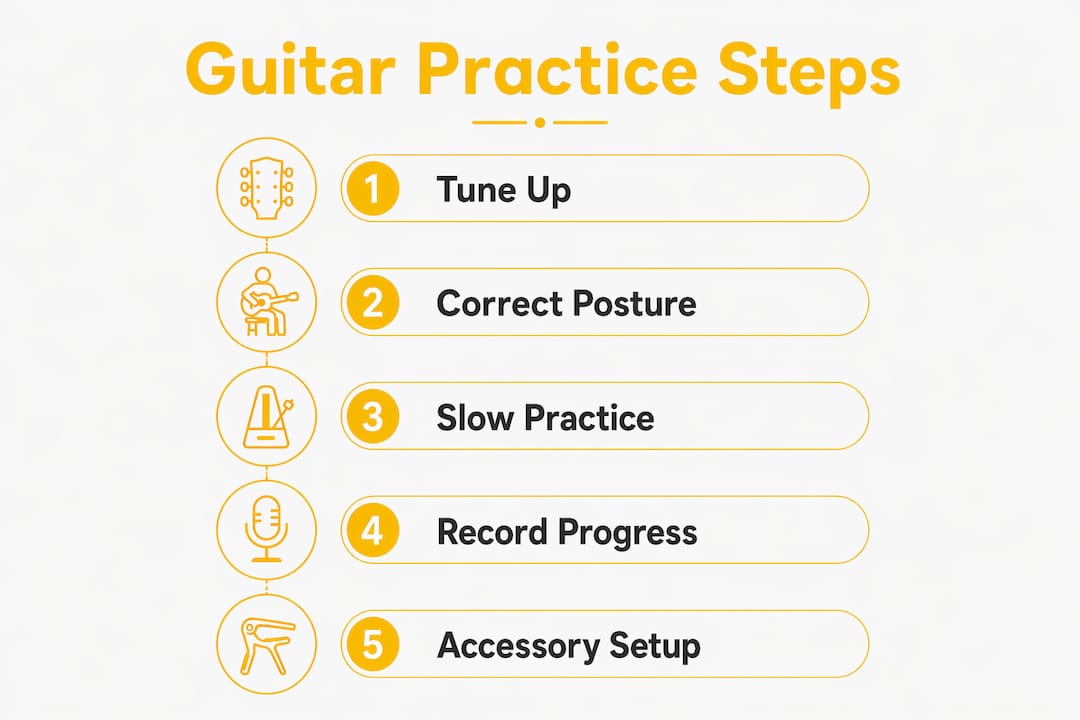
Short daily sessions of 10 to 15 minutes produce faster results than a two-hour session once a week. The reason is neurological. Repetition across multiple days builds muscle memory far more efficiently than cramming. Consistency is the mechanism, not duration.
Structure each session so it has three distinct phases. TrueFire’s daily practice template offers a practical model: three minutes of chromatic warm-up exercises, five minutes of scale or technique work, five minutes of chord changes with a metronome, and two minutes of playing an actual piece of music. That last two minutes is not a reward. It is the application phase that makes everything else feel purposeful.
- Warm up your hands with a chromatic walk up and down the fretboard for two to three minutes
- Work on one specific technique such as a chord transition or a picking pattern for five minutes
- Practise chord changes with a metronome at a slow, controlled tempo for five minutes
- Apply your skills by playing a short song or progression for two minutes
- Review what felt difficult and note it as the focus for your next session
Deliberate, slow practice with clear goals outperforms unfocused playing every time. This means setting a specific target before you pick up the guitar. “I will practise the G to D chord change at 60 beats per minute until it is clean” is a useful goal. “I will play for 20 minutes” is not.
Pro Tip: Record yourself on your phone at the end of each session. You will hear things your fingers cannot feel, and reviewing a week of recordings shows you exactly how much progress you are making, which is one of the most powerful motivators available.
Which accessories actually help beginners learn and maintain their guitar?
The right tools remove friction from learning. The wrong ones create it. Here is what genuinely matters for beginners, along with a comparison of the most common choices.
A clip-on tuner such as a Snark or a D’Addario NS Micro is faster and more reliable than a phone app in a noisy room. Apps like GuitarTuna work well for quiet practice at home. Either option is acceptable, but the habit of tuning is more important than the tool you use to do it.
Picks are often overlooked in beginner guidance. A thin pick around 0.5mm is recommended for most beginners because it flexes slightly on contact with the string, which makes downstroke strumming feel more natural and forgiving. Thicker picks give more control for single-note playing but require more precision. Start thin and experiment as your technique develops.
You can find a full breakdown of essential guitar accessories that covers tuners, picks, capos, and more in detail.
| Accessory | Beginner recommendation | Why it matters |
|---|---|---|
| Tuner | Clip-on (Snark, D’Addario) or GuitarTuna app | Accurate tuning before every session is non-negotiable |
| Pick | 0.5mm thin pick | Easier for strumming; forgiving on contact |
| Metronome | Free app (Metronome Beats, Pro Metronome) | Builds timing from the very first session |
| Strings | Nylon for classical; light-gauge steel for acoustic or electric | Nylon is gentler on fingertips; steel gives brighter tone |
| String winder | Any basic model | Speeds up string changes and reduces hand fatigue |
For guitar maintenance, wipe down your strings with a dry cloth after every session. Sweat accelerates corrosion and dulls tone within days. Store your guitar in a case or on a wall hanger away from radiators and direct sunlight. Temperature and humidity fluctuations cause the wood to warp over time, which affects both playability and intonation.
How do you develop rhythm and smooth chord transitions?
Rhythm is the skill most beginners underestimate. Timing and rhythm are first-class priorities according to Yamaha’s beginner guidance, because even perfectly shaped chords sound amateur without a steady beat. The metronome is your most important practice partner, not an optional extra.

Start strumming with downstrokes only. Count “one, two, three, four” aloud as you strum, one downstroke per beat. When that feels natural, add upstrokes on the “and” between beats. This is the foundation of most beginner strumming patterns and it underpins songs across every genre from folk to pop to rock.
Chord transitions are where most beginners stall. The one-minute chord changes drill is one of the most effective exercises available. Set a timer for 60 seconds and switch between two chords repeatedly, aiming for 15 to 20 clean changes. The target is not speed. It is cleanliness. One clean change per five seconds is far more valuable than 30 sloppy ones. This drill isolates the transition itself rather than burying it inside a full song where you can fudge the timing.
- Practise with a metronome from day one, even at very slow tempos like 50 to 60 beats per minute
- Start with downstrokes only before adding upstrokes to your strumming patterns
- Use the one-minute drill to isolate and improve specific chord transitions
- Prioritise accuracy over speed at every stage of development
- Fix buzzing strings by adjusting finger placement closer to the fret and pressing more firmly with your fingertip
Pro Tip: When a chord change keeps breaking down, slow the metronome to a tempo where you can make the change cleanly every single time. That tempo, however slow, is your actual starting point. Build from there.
Learning correct chord fingering techniques alongside these drills will accelerate your transitions significantly.
How do you choose your first guitar and stay motivated?
Choosing the right first guitar is one of the most practical guitar tips for beginners, and it is simpler than most people think. The single most important factor is comfort. A guitar that is physically uncomfortable to hold will reduce your practice time without you even realising it. Visit a shop where you can hold several instruments before buying. Musicstreet’s beginner guitar guide covers the key considerations for UK buyers in detail.
For style, acoustic guitars with steel strings are the most common starting point because they require no amplifier and build finger strength quickly. Classical guitars with nylon strings are gentler on fingertips and suit fingerpicking styles. Electric guitars are a legitimate first choice if rock or blues is your goal. The idea that you must start acoustic is a myth.
- Choose based on comfort first, then style and budget
- Avoid over-investing early on a premium instrument before you know your preferences
- Set weekly goals such as learning one new chord or one new song section
- Manage finger soreness by keeping sessions short initially and allowing calluses to build naturally over two to three weeks
- Learn easy guitar songs like “Knockin’ on Heaven’s Door” by Bob Dylan or “Horse With No Name” by America, which use only two or three chords
Motivation follows progress. The most reliable way to stay engaged is to track what you can do now versus what you could do two weeks ago. A short recording on your phone, a practice journal, or even a simple checklist of chords you have mastered all serve this purpose. Progress that is visible is progress that keeps you practising.
Key takeaways
Consistent, structured practice built on correct fundamentals is the single most reliable path from beginner to confident guitarist.
| Point | Details |
|---|---|
| Tune before every session | Use standard E-A-D-G-B-E tuning with a clip-on tuner or app every time you pick up the guitar. |
| Prioritise short daily practice | Ten to fifteen minutes daily builds muscle memory faster than long, infrequent sessions. |
| Master a few chords cleanly | Em, G, and D are enough to play dozens of songs; clean transitions matter more than quantity. |
| Use a metronome from the start | Steady timing is the foundation of musicality and cannot be retrofitted once bad habits form. |
| Choose gear that fits your goals | A comfortable guitar, a thin pick, and a reliable tuner are all you need to begin effectively. |
What I have learned from watching beginners progress
The most common mistake I see is the rush to sound musical before the mechanics are solid. A beginner will spend 20 minutes strumming through a song badly when five minutes of focused chord-change drills would have produced more genuine improvement. Speed and fluency are outputs of correct mechanics, not goals in themselves.
The second thing worth saying plainly is that finger soreness in the first two to three weeks is not a sign that something is wrong. It is the process of building calluses. Short sessions and patience resolve it. Stopping entirely because it hurts is the only wrong response.
What actually separates beginners who progress quickly from those who plateau is not talent. It is whether they practise at their limit rather than within their comfort zone. Playing what you already know feels good but teaches you nothing new. The structured beginner practice guide on the Musicstreet blog explains how to build this kind of targeted routine in practical terms.
Enjoy the process. The guitar rewards patience with compound returns. Every clean chord you build today makes the next one easier to learn.
— Music
Start your guitar journey with Musicstreet
Whether you are buying your first guitar or filling out your practice kit, Musicstreet stocks a carefully selected range of acoustic, electric, and bass guitars from trusted brands, alongside all the accessories a new player needs.

From clip-on tuners and picks to starter guitars set up by professionals before they leave the shop, every product is chosen with playability and value in mind. Musicstreet also offers expert post-sale support, so if you have questions about your instrument after purchase, help is available. Browse the full range at Musicstreet and find the right instrument to match your goals, your budget, and your playing style.
FAQ
What is the first thing a beginner should learn on guitar?
Tune your guitar to standard E-A-D-G-B-E and learn to play a single clean note before attempting chords. The United Conservatory recommends this sequence because it builds correct technique and ear training from the very first session.
How long should a beginner practise each day?
Ten to fifteen minutes of focused daily practice is more effective than longer, infrequent sessions. Consistency across multiple days builds muscle memory faster than any single extended session.
Which chords should a beginner learn first?
Em, G, and D are the most practical starting chords because they are open shapes, appear in hundreds of songs, and introduce the core hand positions used across the fretboard.
How do I stop my chords from buzzing?
Press your fingertip just behind the metal fret rather than on top of it, and apply firm downward pressure. Most buzzing is caused by insufficient finger pressure or a finger accidentally touching an adjacent string.
Do I need an expensive guitar to start learning?
No. A comfortable, properly set-up mid-range guitar is far more useful than an expensive instrument that does not suit your hand size or playing style. Focus on playability and comfort over price when making your first purchase.





Share:
Best electric guitar wood: a player's guide for 2026
Acoustic guitar string differences: your 2026 guide