

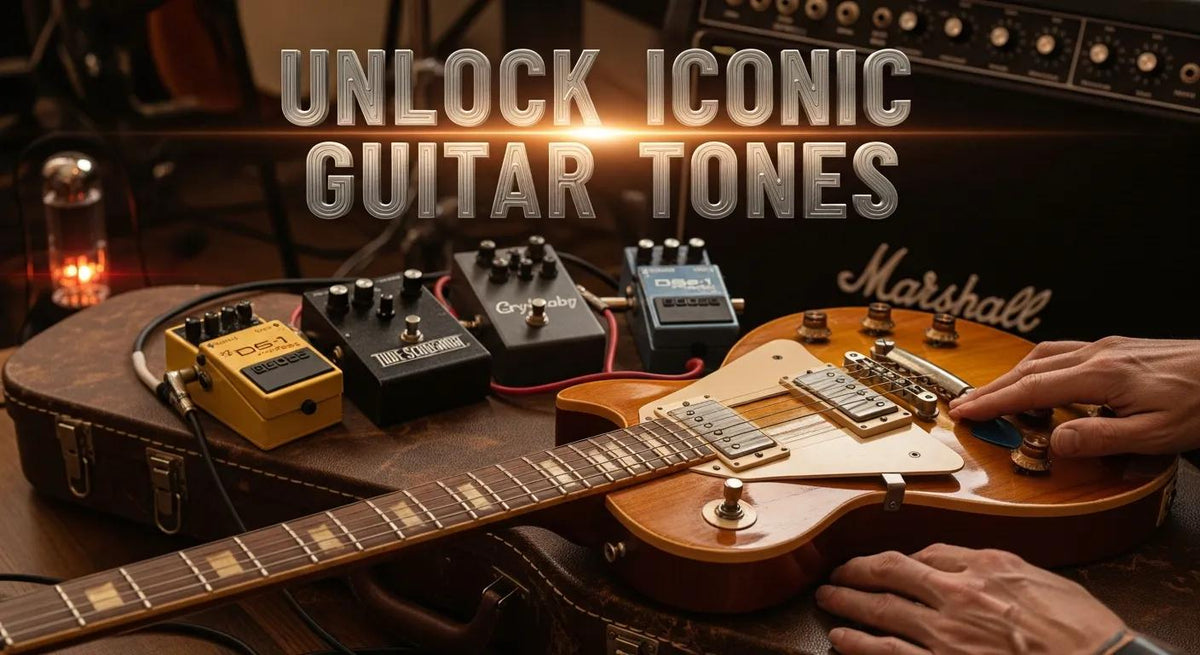
Dial in Iconic Guitar Tones: A Technical and Historical Masterclass
Getting close to the tones your heroes made isn't about buying what they bought. It's about understanding how the instrument, the amp, the pedals and your own hands work together to make a sound. This guide walks through the gear, the settings and the playing habits behind some of the most recognisable guitar tones ever recorded, with real model numbers, dial positions and pickup specs so you can put the theory into practice. Whether you're chasing Jimi Hendrix's psychedelic shimmer or Eddie Van Halen's "Brown Sound," you'll come away with a clear, practical path to building a tone you can call your own.
Which Legendary Guitarists Set the Benchmark for Iconic Tones?
A handful of players didn't just write great songs, they changed what guitarists reach for and how they play. Looking closely at the gear and technique behind their tones is a great way to sharpen your own ear, whether you want to recreate a classic sound or simply understand it well enough to build something new.
What Gear and Settings Gave Jimi Hendrix His Psychedelic Voice?
Hendrix's tone came together through a carefully chosen rig and a touch that few players have matched. At the heart of it was a Fender Stratocaster, a 1968 model with single-coil pickups prized for their bright, bell-like clarity and that distinctive midrange scoop. He typically rolled the tone control back slightly, around 6-7 on a 10-point scale, taking the edge off and adding warmth.
His amp of choice was the Marshall Super Lead 100-watt head, model 1959, loved for the way its EL34 power tubes produce a rich, mid-focused overdrive once the volume is pushed to 7-8. He usually set presence between 5 and 6 for clarity without harshness, keeping bass and treble balanced around 5.
Hendrix's pedals mattered just as much. The Dallas Arbiter Fuzz Face, built around germanium transistors, gave him a smooth, saturated distortion with a mid-hump around 800 Hz that added sustain and harmonic depth. His Uni-Vibe recreated the swirl of a rotary speaker by modulating phase and amplitude at roughly 4-7 Hz. Combine that gear with his dynamic pick attack and his feel for feedback and volume, and you get a tone that still stands as one of the richest and most expressive in electric guitar history.
How Did Eddie Van Halen Craft the Famous "Brown Sound"?
Eddie Van Halen's "Brown Sound" grew out of a guitar he built himself and a playing style nobody else quite had. His Frankenstrat carried a single Seymour Duncan SH-1 '59 humbucker in the bridge position, wired in series for maximum output and midrange punch. The alder body and maple neck gave it a bright attack with a tight low end, which suited his articulate style perfectly.
His amp setup was built around a Marshall Plexi 1959 Super Lead, modified with a variac so he could drop the voltage and get that saturated, compressed distortion even at lower volumes. He pushed gain to 8-9, pulled bass back to around 4 to avoid muddiness, boosted mids to 7, and kept treble around 6 for clarity. A custom MXR Phase 90 added gentle modulation at roughly 0.5-1 Hz, adding colour without burying the core tone.
His two-hand tapping opened up harmonic possibilities few guitarists had explored, while his palm muting and controlled harmonics gave the sound a percussive yet fluid feel. A Boss DD-2 Digital Delay, set to a short 300 ms with low feedback, added just enough depth without cluttering the mix. Put it all together and you get a warm, saturated tone that's still the benchmark rock guitarists measure themselves against.
Looking at technique alongside gear, things like tapping and wah-wah pedal work, shows just how much control these players had over frequency and dynamics, and how deliberately they shaped every note.
Electric Guitar Performance Techniques & Technologies Analysis This thesis presents an in-depth discourse analysis of electric guitar techniques and technologies, including power chords, wah-wah effects, and finger tapping. It identifies recurring themes in the evolution of electric guitar practice and technology, emphasizing the interplay between player identity and technological innovation. Electric Guitar Performance Techniques: Meaning and Identity in Written Discourse, 2015
What Essential Gear Actually Shapes a Signature Sound?
The character of a rig comes down to how its parts interact: the guitar itself, the pickups, the amp circuitry and whatever effects sit in the chain. Getting familiar with how each piece contributes makes it much easier to shape the tone you're actually after, rather than guessing.
How Do Different Guitars and Pickups Change the Tone?
Pickups and guitar construction have the biggest say in how a guitar responds. Single-coils, like the Fender Custom Shop '69 Stratocaster pickups, sit around 6.5 kΩ resistance and peak between 2-5 kHz, giving you the clarity and articulation that suits clean and lightly overdriven tones so well. Humbuckers such as the Gibson Burstbucker 3 run hotter, around 13 kΩ, and lean into midrange warmth while cancelling 60 Hz hum, which is what gives them that thicker, more saturated character.
The wood matters too. Mahogany bodies are denser and more damped, which brings out midrange warmth and sustain, while alder and ash tend to sound brighter and more resonant, with more presence in the upper mids and treble. Neck profile and scale length, Fender's 25.5" versus Gibson's 24.75" being the classic comparison, change string tension and harmonic content, adding yet another layer to how an instrument speaks.
Wiring options open things up further. Coil-splitting, series/parallel switching and phase reversal all let one guitar cover more ground. Split a humbucker into single-coil mode, for instance, and you get a brighter, cleaner voice that works nicely for funk or country.
Which Amplifiers and Pedals Are Fundamental for Classic Rock Tones?
Classic rock tone still lives mostly in valve amplifiers, loved for how they distort, compress and respond to your playing. The Marshall JCM800 2203, Fender '65 Deluxe Reverb and Vox AC30 each have their own voicing and gain character, and each has shaped entire genres.
The JCM800's EL34 tubes give you that familiar midrange-forward crunch when gain sits between 6-8, bass around 5, mids at 7 and treble at 6, with presence around 5 adding sparkle without turning harsh. The Deluxe Reverb, running 6V6 tubes, stays cleaner and glassier, breaking up smoothly at higher volumes, which is why it's such a favourite for blues and country players.
Pedals push things further. Overdrives like the Ibanez Tube Screamer TS808 boost the midrange around 720 Hz, nudging a tube amp into natural-sounding overdrive rather than outright distortion. Something like the Pro Co Rat, by contrast, offers a more aggressive clipping circuit with a wider frequency spread, better suited to heavier styles.
Delay and reverb usually sit at the end of the chain to keep things clear. Analog delays like the Electro-Harmonix Memory Man give you warm, modulated repeats, while digital delays stay cleaner and more precise. Chorus and phaser add movement, typically with a slow rate (0.5-1 Hz) and modest depth so they colour the tone without taking it over.
How Do Playing Techniques Affect Iconic Guitar Sounds?
Technique shapes tone just as much as gear does. How you strike the string, how you control dynamics, it all feeds directly into the harmonic content, sustain and articulation of every note.
What Vibrato and Bending Approaches Do Famous Players Use?
Vibrato is really about controlled, deliberate pitch movement. B.B. King's vibrato was wide and slow, around 5 Hz, with steady amplitude that gave his playing an almost vocal quality. Eric Clapton leans toward a faster, narrower vibrato, closer to 7-8 Hz, which brings a bit more tension and emotion to a phrase.
Bending takes real finger strength and precise timing, especially when you're reaching for the subtler quarter-tone intervals. Getting comfortable with these techniques adds sustain and harmonic richness, since you're increasing string tension and effectively changing how the string vibrates.
How Do Picking Dynamics and Volume Control Shape the Sound?
How hard you pick changes everything about the note that follows. A lighter touch keeps things clean and fundamental-heavy, while digging in harder brings out more harmonics and pushes the amp's input into saturation, adding distortion and sustain.
The volume knob on your guitar is a tone tool in its own right. Rolling it back cleans up the signal without touching the amp at all, so you can move between clean and overdriven sounds mid-song. This works because of the logarithmic taper built into most volume pots, usually 250kΩ or 500kΩ, which gives a smooth, musical sweep rather than an abrupt jump.
How Do You Build and Customise an Effective Guitar Rig?
Building a rig you can rely on takes a bit of planning, both in what you choose and in how you connect it, so you get flexibility without sacrificing tone.
What's an Effective Signal Chain for Classic Tones?
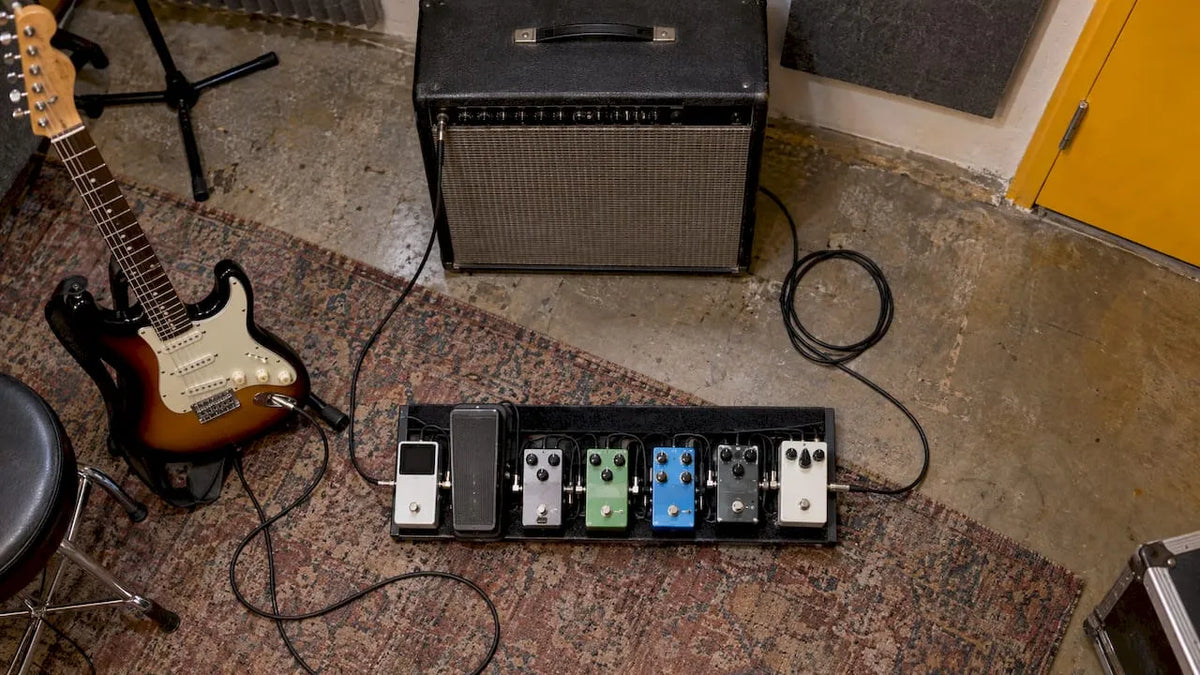
Most classic rock tones follow a simple, tried-and-tested order:
- Guitar output (with volume and tone controls)
- Gain-based pedals (overdrive, distortion, fuzz)
- Modulation effects (chorus, phaser, flanger)
- Time-based effects (delay, reverb)
- Amplifier input
Keeping this order means your distortion pedals shape the core tone before any modulation or spatial effects get added on top. Put an Ibanez Tube Screamer TS808 ahead of a Boss DD-7 Digital Delay, for example, and the repeats stay clear while the underlying tone stays full and saturated.
How Can Modding Guitars and Pedals Improve Tone?
A few well-chosen modifications can make a real difference to clarity, response and reliability. Popular guitar mods include:
- Pickup upgrades: Installing high-output pickups like Seymour Duncan JB or DiMarzio Super Distortion increases output voltage and harmonic complexity.
- Wiring refinements: Using high-quality shielded cables and upgrading potentiometers to audio-taper 500kΩ pots reduces noise and improves control smoothness.
- Capacitor swaps: Replacing tone capacitors with premium polypropylene types (e.g., 0.022 µF) refines high-frequency roll-off characteristics.
On the pedal side, swapping in low-noise, high-bandwidth op-amps (TL072 to OPA2134, for example) or improving power supply filtering can cut hum and interference noticeably. These small tweaks often do more for the sound than buying a brand-new pedal, and they let you fine-tune gear to suit exactly how you play.
What Are the Best Practices for Maintaining and Setting Up a Guitar?
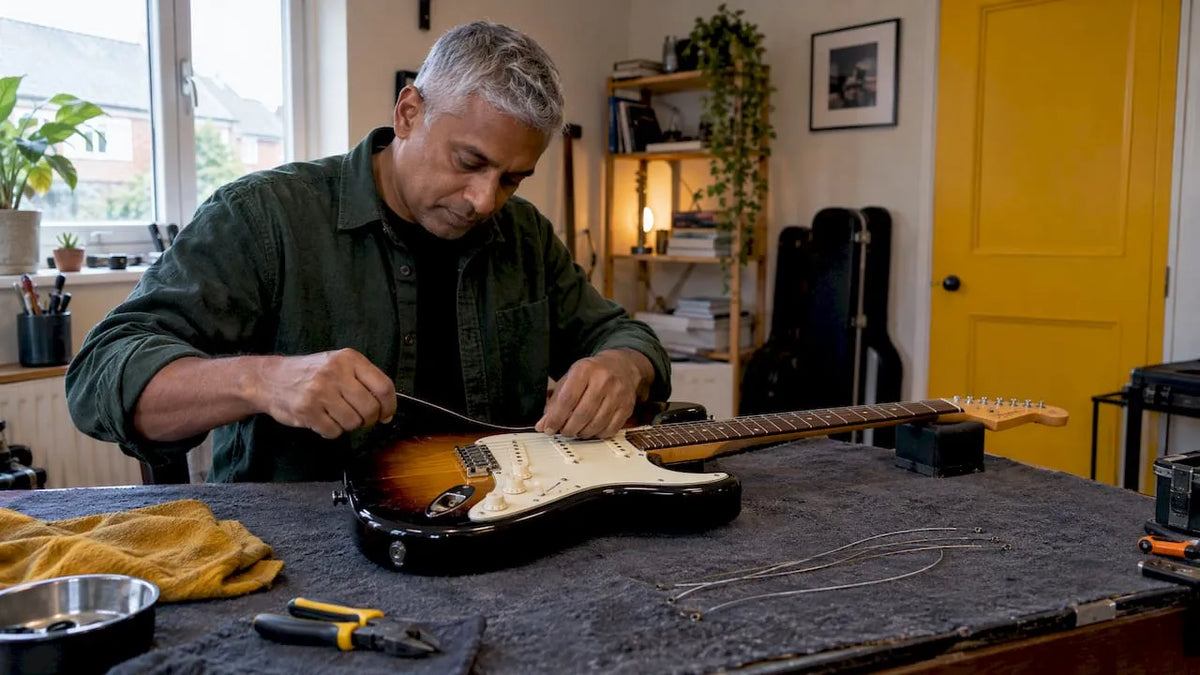
Regular maintenance and a proper setup are what keep a guitar sounding and playing its best over time.
Why Is a Professional Setup Important for Tone and Playability?
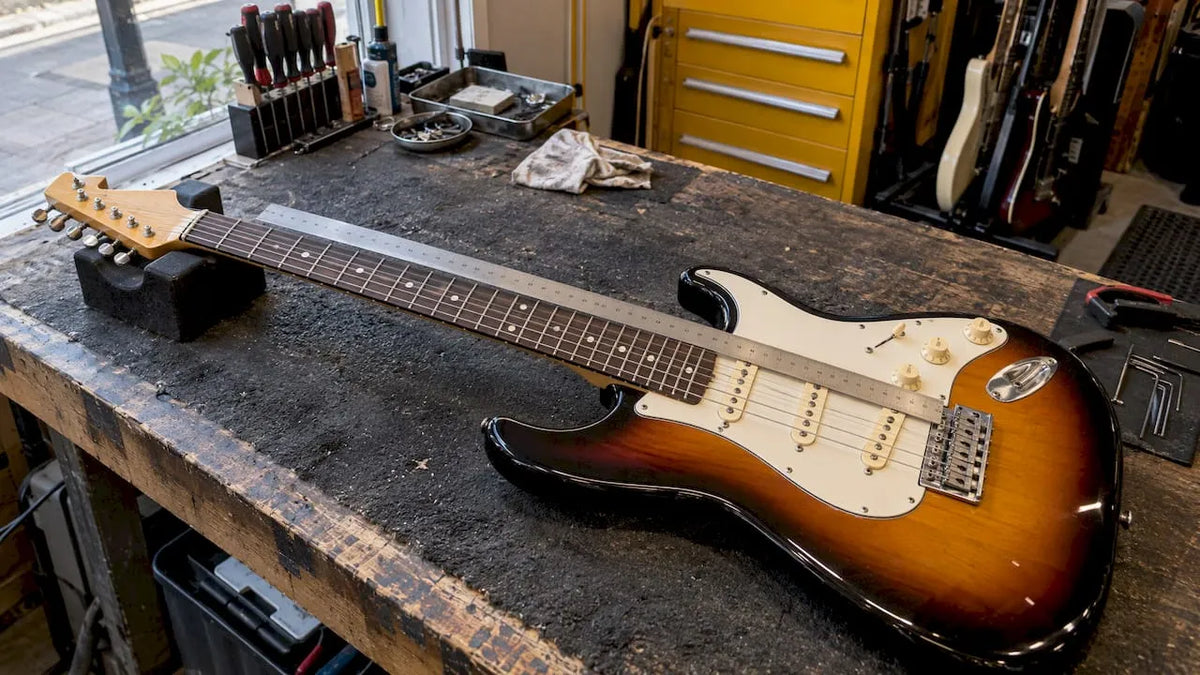
A good setup covers neck relief (adjusted via the truss rod), string action height and intonation. Neck relief typically sits around 0.25-0.5 mm at the 7th fret, striking the right balance between buzz-free playing and comfortable action. Action height usually runs between 1.5-2.5 mm at the 12th fret on electrics, though it comes down to personal preference and style. Intonation work makes sure the pitch stays accurate all the way up the neck.
Get these right and the string vibrates more efficiently, with better sustain and harmonic balance, which translates directly into better tone and easier playing.
How Do String Choice and Tuning Influence Signature Sounds?
String gauge and material have a real say in tension, brightness and sustain. Nickel-plated steel strings, Ernie Ball Regular Slinky .010-.046 being a classic example, give a balanced tone with moderate brightness, while pure nickel strings sound warmer and more vintage. Heavier gauges add tension and sustain but ask more of your fretting hand, so they're worth considering alongside your playing style.
Alternate tunings such as Drop D (D-A-D-G-B-E) or Open G (D-G-D-G-B-D) change string tension and resonance, opening up chord voicings and textures you simply can't get in standard tuning. They're well worth exploring if you're after a fresh creative direction.
How Can You Find Your Own Voice Beyond Copying the Greats?
Studying the greats teaches you an enormous amount, but your own sound comes from experimenting and bringing gear, technique and personal taste together in your own way.
What Role Does Experimentation Play in Developing a Personal Tone?
Finding your own tone means trying things out: different gear combinations, different techniques, different influences, and really listening back to what you record. Some of it won't work, and that's fine. Treating those misses as part of the process is often exactly what leads to the combinations that feel genuinely yours.
How Do You Balance Gear and Technique to Create Original Sounds?
Gear gives you options, but technique is what makes a sound feel like you. Focus on your touch, your dynamics and your phrasing first, then choose equipment that brings those strengths forward. A player with strong fingerstyle technique, for instance, might lean toward a fast neck profile and low action, paired with a clean, responsive amp like the Fender '65 Deluxe Reverb. Get that balance right and you end up with a sound that's distinctive without losing musical versatility.
| Gear Type | Example | Impact on Tone |
|---|---|---|
| Guitars | Fender Stratocaster '68, single-coil pickups (6.5 kΩ) | Bright, clear tone with pronounced midrange scoop |
| Amplifiers | Marshall 1959 Super Lead, EL34 tubes, gain 7-8 | Warm, saturated distortion with harmonic richness |
| Effects | Dallas Arbiter Fuzz Face (germanium transistors) | Smooth, saturated fuzz with mid-hump around 800 Hz |
This table sums up how a handful of specific, well-chosen components come together to build a tone. It's a good reminder that thoughtful choices, not simply the most expensive gear, are what really shape a professional sound.
Master the interplay between gear, technique and your own taste, and you'll be able to build tones that last while still sounding like you. Study the classics closely, experiment with your own setup, and keep refining both your equipment and your playing as you work toward a sound that's technically solid and genuinely your own.
Frequently Asked Questions
What Are Common Mistakes to Avoid When Trying to Replicate Iconic Guitar Tones?
The most common mistakes are chasing gear before technique, skipping a proper setup (which causes intonation and action problems), and piling on too many effects until the tone turns muddy. Start with the fundamentals: make sure your instrument is properly set up, get to know your amp's gain structure, and use effects to support your core tone rather than cover it up.
How Can I Use Effects Pedals Effectively to Shape My Tone?
Build your chain deliberately, gain-based pedals like overdrive and distortion before modulation such as chorus and phaser, with time-based effects like delay and reverb at the end. Set each pedal's level, tone and gain to work with your amp's natural voicing, and use a pedalboard with buffered true-bypass switching to keep your signal and settings consistent. Small, careful adjustments usually sound better than extreme settings.
What Should I Consider When Choosing a Guitar for My Style?
Think about pickup type (single-coil vs. humbucker), body wood, neck profile and scale length, since each one shapes tone and playability differently. Single-coils suit clarity-focused styles like blues and funk, while humbuckers bring the output and warmth that rock and metal players often want. It's worth trying a few neck shapes (C, V, U profiles) and scale lengths to see what feels right in your hands and suits how you play.
How Can I Maintain My Guitar to Ensure the Best Sound?
Change your strings regularly so the tone doesn't dull over time, clean the fretboard with a proper conditioner, and check that hardware stays tight. A periodic professional setup to adjust the truss rod, action and intonation goes a long way, and storing your guitar somewhere with stable humidity helps protect it from warping or finish damage.
What Are Effective Ways to Develop My Unique Guitar Sound?
Listen widely across styles, experiment with different gear and techniques, and record yourself so you can hear what's actually working. Pulling influences from a few different genres and refining your approach through regular practice is one of the most reliable ways to end up with a sound that feels genuinely your own.
How Does String Choice Affect My Guitar Tone?
String gauge and material affect tension, brightness, warmth and sustain. Heavier gauges (.011-.049) add sustain and fullness but need more finger strength, while lighter gauges (.009-.042) make bending and fast playing easier. Nickel-plated steel strings give a balanced brightness and warmth, while stainless steel strings sound brighter and tend to last longer. It's worth trying a few sets to see what suits your instrument and your playing best.
Conclusion
Getting to an iconic guitar tone takes a mix of technical understanding, thoughtful gear choices, solid technique and a willingness to keep experimenting. Once you understand how string vibration, tube saturation and signal processing actually work, you can shape your sound with real confidence rather than guesswork. Look after your instrument, treat tone-crafting as an ongoing process rather than a finished project, and use everything in this guide as a starting point for digging deeper into the gear and techniques that interest you most, on your way to a tone that's unmistakably yours.


Share:
How to Personalise Guitars for Optimal Playability
How to Get a Great Guitar Tone: Complete Guide for Beginners and Pros