


- Proper storage and environmental control are crucial to prevent warping and cracking in guitars. Using cases with humidifiers, monitoring micro-climates, and avoiding extreme locations can significantly extend an instrument’s lifespan. Detuning slightly and storing guitars upright in appropriate conditions help maintain their structural integrity over time.
Improper storage is one of the most common reasons a perfectly good guitar ends up warped, cracked, or simply unplayable. Temperature swings, humidity fluctuations, and careless positioning all take a toll on wood, hardware, and finish, often before you even notice. Whether you own one acoustic or a collection of electrics, applying the right guitar storage tips can be the difference between a guitar that plays beautifully for decades and one that needs expensive repairs. This article covers everything from environmental control to storage method comparisons, so your instrument stays in top condition.
Table of Contents
- Key takeaways
- 1. Understand the ideal storage environment
- 2. Know the difference between room and case humidity
- 3. Choose the right storage method for your situation
- 4. Clean your guitar before putting it away
- 5. Detune strings slightly, but never remove them
- 6. Position the guitar correctly in storage
- 7. Use humidifiers inside cases for long-term guitar care and storage
- 8. Comparison of storage solutions at a glance
- My honest take on guitar storage
- Protect your guitar with the right gear from Musicstreet
- FAQ
Key takeaways
| Point | Details |
|---|---|
| Control humidity and temperature | Keep storage conditions between 45–55% RH and 18–24°C to prevent warping and cracking. |
| Choose the right storage method | Hardshell cases offer the best protection for long-term storage; stands suit daily-use guitars. |
| Detune slightly, not fully | Reduce string tension by 1–2 whole steps before long-term storage; never remove strings entirely. |
| Monitor inside the case | Humidity inside a closed case differs significantly from room readings; use a hygrometer inside the case. |
| Clean before storing | Remove sweat and oils from the fretboard and body before putting any guitar away for an extended period. |
1. Understand the ideal storage environment
The foundation of every good guitar storage tip starts with the environment. Wood is a living, breathing material that responds to moisture and heat. Get those conditions wrong and you will pay for it in fret sprout, cracked tops, and failing glue joints. The ideal storage conditions for wooden guitars are a relative humidity of 45–55% and a temperature range of 18–24°C.
What makes this tricky is that conditions can shift dramatically throughout the year. Central heating in winter strips moisture from the air. Summer humidity in a poorly ventilated room can push levels well above 60%. Both extremes are damaging, and neither gives you much warning before the damage sets in.
A few locations to avoid:
- Basements tend to trap moisture, especially in older UK homes without damp-proof membranes
- Attics swing from freezing cold in winter to sweltering in summer
- Exterior walls conduct outdoor temperatures directly into your storage space
- Areas near radiators, vents, or windows create hot spots and drafts that accelerate moisture loss
The best spot in most homes is an interior room at a consistent temperature. A bedroom or living room generally works well, provided you keep an eye on seasonal changes.
Pro Tip: A digital hygrometer costs very little and tells you far more than a rough estimate. If you are comfortable in a room, your guitar likely is too, but “likely” is not good enough for an instrument worth hundreds or thousands of pounds.
2. Know the difference between room and case humidity
Here is something many players miss entirely. The humidity inside a guitar case can be significantly different from the humidity in the room around it. Hard cases, particularly older wooden ones, can actually draw moisture away from the guitar, creating a drier micro-climate inside.
This is why placing a hygrometer in the room is not enough. You need one inside the case or directly in the soundhole of an acoustic. Only then do you get a true reading of what your instrument is actually experiencing.
Multiple micro-climates can exist within a single room. The conditions near the floor, near a window, and inside a closed case on a shelf are often three different readings. Understanding this prevents the false sense of security that comes from checking one thermometer on the wall and assuming everything is fine.
3. Choose the right storage method for your situation
Not every storage solution suits every player. How to store guitars properly depends on how often you play them, how much space you have, and how much environmental control you can maintain.
Here is a quick breakdown of your main options:
- Hardshell cases provide the best protection for long-term storage. They create a sealed micro-climate, buffer temperature and humidity changes, and protect against physical knocks. The best protection for long-term preservation comes from a quality hardshell case with an internal humidifier.
- Gig bags are lightweight and portable, but they offer minimal environmental protection. Use them for transport, not storage.
- Guitar stands keep instruments accessible and look great in a practice room or studio, but they leave guitars fully exposed to ambient conditions. Suitable for guitars you play every day.
- Wall hangers are space-saving and stylish, but they carry the same exposure risk as stands. Choose hangers with padded, non-reactive cradles to avoid finish damage from foam or rubber contact.
The key distinction is frequency of use. A guitar you pick up every day is fine on a stand, provided the room conditions are stable. A guitar you store for weeks or months at a time belongs in a case.
4. Clean your guitar before putting it away
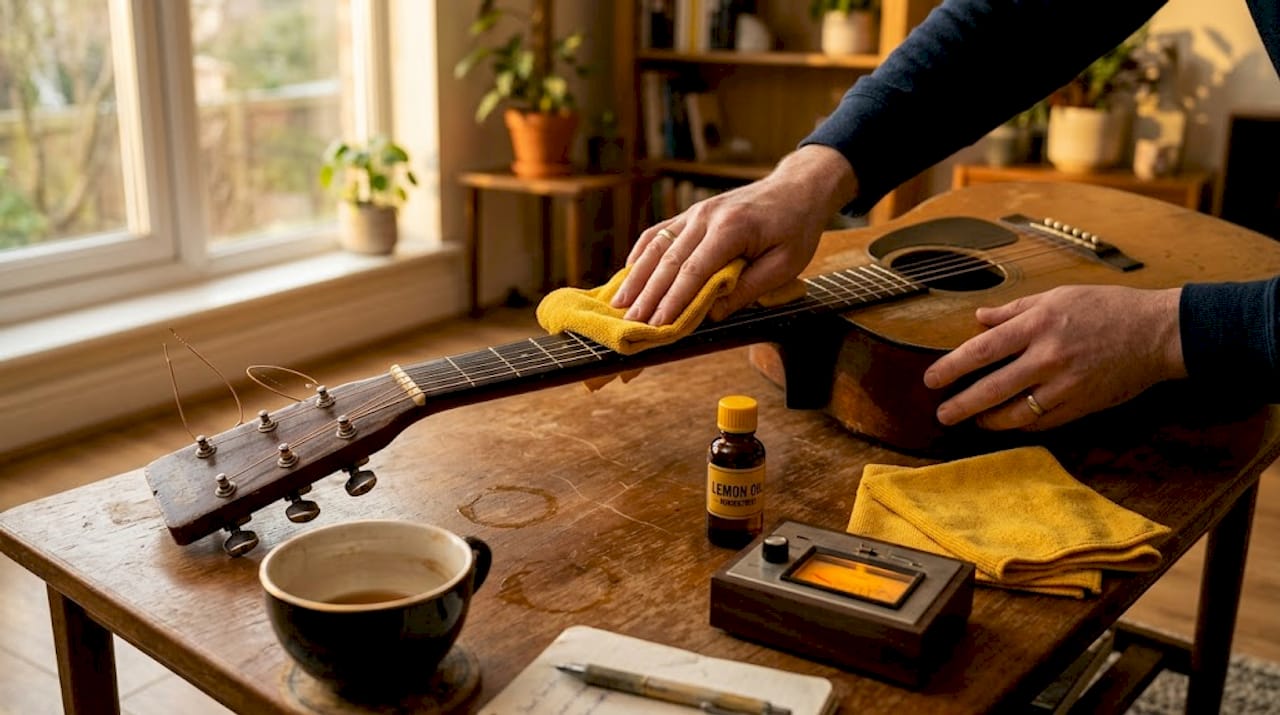
This step gets skipped constantly and it should not be. Sweat, skin oils, and atmospheric dust do not pause their damage just because the guitar is not being played. Leaving them on the fretboard, strings, and body during storage allows grime to work into the wood grain and corrode the finish over time.
Before any extended storage period, wipe down the body, neck, and strings thoroughly. For a complete approach to cleaning before storage, use appropriate products for your finish type. Nitrocellulose finishes require different care from polyurethane, and the fretboard material matters too.
A light conditioning of an unfinished fretboard (ebony or rosewood) before storage also helps prevent the wood from drying out while the guitar sits unused.
5. Detune strings slightly, but never remove them
One of the most misunderstood guitar storage tips concerns string tension. Many players assume that removing strings entirely relieves stress on the neck during long-term storage. It does the opposite. The neck is built and set up to function under string tension. Removing strings completely can cause the neck to bow or twist as the wood shifts without its counterbalancing force.
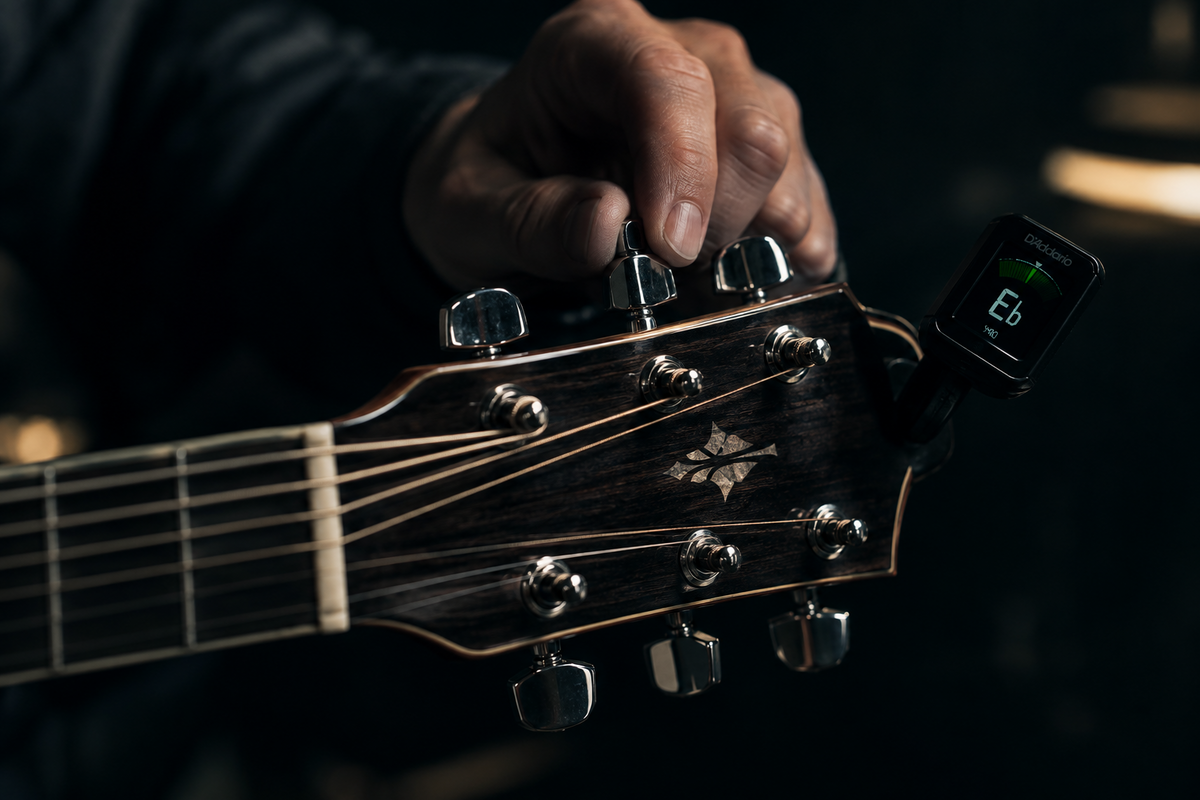
The correct approach is to detune by one to two whole steps. This reduces tension meaningfully without throwing the neck geometry out of balance. It takes stress off the headstock and tuning pegs while maintaining the neck’s structural integrity.
Pro Tip: Mark which tuning you stored the guitar in with a sticky note inside the case. When you return to it weeks later, you will tune to the right pitch from the start instead of guessing.
6. Position the guitar correctly in storage
How a guitar sits during storage matters as much as where it is stored. A few positioning rules worth following:
- Always store guitars upright in a case, not flat on their back with heavy items stacked on top.
- If using a stand, make sure the guitar rests on the lower bout and the neck does not bear downward pressure.
- Never lean a guitar against a wall unsecured. The risk of it sliding and falling is significant, and repeated sideways leaning can cause subtle neck twist over time.
- For storing electric guitars specifically, avoid leaving them in cases with poorly fitted neck supports, as the headstock can take strain if the guitar shifts.
When storing electric guitars long term, also consider the electronics. Extreme temperature swings can affect solder joints and potentiometer function, though this is a secondary concern compared to the wood itself.
7. Use humidifiers inside cases for long-term guitar care and storage
Once you have the right case and the right location, the final piece is active humidity management inside that case. A passive case humidifier, typically a small device containing a sponge or gel packet, releases moisture slowly to maintain a steady internal environment.
Place one inside the case and check it every two to three weeks during the winter months when central heating is running. Refill or replace as needed. For acoustic guitars, soundhole humidifiers sit directly in the guitar and are particularly effective at targeting the internal body cavity where humidity matters most for the top and braces.
This approach to guitar humidity tips is inexpensive and prevents the kind of damage that costs hundreds of pounds to repair. A cracked top or a lifted bridge joint on a quality acoustic is avoidable with a three-pound humidifier and a little routine attention.
8. Comparison of storage solutions at a glance
| Storage method | Protection level | Accessibility | Best suited for |
|---|---|---|---|
| Hardshell case with humidifier | High | Low (needs unpacking) | Long-term storage, valuable instruments |
| Gig bag | Low | High | Short trips, transport only |
| Guitar stand | Low to medium | Very high | Daily-use instruments in stable rooms |
| Wall hanger | Low to medium | Very high | Frequently played guitars, display use |
| Climate-controlled cabinet | Very high | Medium | Collectors or multiple guitar storage |
Understanding case materials and construction also helps here. Moulded ABS plastic cases, for example, offer a better seal than older chipboard designs and resist humidity transfer more effectively.
My honest take on guitar storage
I have seen players invest serious money in guitars and then leave them leaning against the radiator in a gig bag over winter. The damage is gradual, quiet, and always more expensive to fix than it would have been to prevent.
The mistake I see most often is treating all storage situations the same. A guitar you play every other day does not need the same regime as one sitting in a spare room for six months. My advice is to categorise your guitars honestly. Daily players can live on stands provided the room is stable. Secondary instruments deserve a proper case with a humidifier inside.
The other thing I have learned is that the inside of the case is its own world. I once assumed a room hygrometer reading of 48% meant everything was fine. It was not. The reading inside the closed case was 31%. That guitar had a developing crack at the bass bout. Checking conditions inside the case, not just the room, changed how I approached storage permanently.
Proactive maintenance costs very little compared to reactive repairs. A complete guitar maintenance habit built around storage and seasonal checks will keep your instruments playing exactly as they should for years.
— Musicstreet
Protect your guitar with the right gear from Musicstreet

At Musicstreet, we stock everything you need to put these storage tips into practice. From quality hardshell cases and padded gig bags to digital hygrometers, soundhole humidifiers, and wall hangers with non-reactive cradles, our range covers every storage scenario. Whether you are protecting a daily player or putting a prized acoustic away for the season, the right accessories make a genuine difference. Browse our full selection of guitars and accessories at Musicstreet, or visit us in store in Huntingdon, Cambridgeshire, where our team can help you choose exactly what your instrument needs.
FAQ
What humidity level is best for storing a guitar?
The ideal relative humidity for guitar storage is between 45% and 55%. Staying within this range prevents cracking, warping, and fret sprout caused by air that is too dry or too moist.
Should I loosen guitar strings when storing for a long time?
Detune by one to two whole steps rather than removing strings entirely. Removing strings fully removes the tension the neck is built to work against, which can cause neck bow or twist during extended storage.
Is a gig bag sufficient for long-term guitar storage?
A gig bag is suitable for transport but not for long-term storage. It offers minimal protection against humidity and temperature changes. A hardshell case with an internal humidifier is the better choice for safe guitar storage over weeks or months.
Where should I avoid storing my guitar at home?
Avoid storing guitars in basements, attics, and areas near radiators, windows, or exterior walls. These locations experience the most dramatic temperature and humidity swings, which cause the most damage to wood and hardware.
Do I need a hygrometer inside my guitar case?
Yes. The humidity inside a closed case can differ significantly from room readings, sometimes by 15 to 20 percentage points. Placing a hygrometer inside the case gives you the only accurate reading of what your guitar is actually experiencing.






Share:
Acoustic guitar shop guide for UK guitar enthusiasts
Types of guitar tuners: a player's complete guide