


You can start playing a 12-string guitar today by tuning each course to standard 12-string pitch, fitting lighter gauge strings to reduce tension, and adjusting your fretting hand to press down both strings in each pair cleanly. The instrument feels more demanding than a six-string at first, but the gap closes quickly once you understand what is actually different.
Three things to do right now:
-
Tune to standard 12-string tuning (eE aA dD gG BB EE) using a chromatic clip-on tuner, starting from the thickest string in each course.
-
Fit extra-light strings or detune a semitone to reduce tension and make fretting less fatiguing while you build strength.
-
Adopt a flatter fretting position, pressing with more of the finger pad rather than just the tip, so both strings in each course ring clearly.
Pro Tip: In your first five minutes, play a single open E chord and listen carefully to each course. If any pair sounds dull or buzzy, that course is your first fretting problem to fix — not your technique overall.
Table of Contents
How is a 12-string guitar tuned?
A 12-string guitar has six courses, each course being a pair of strings played together as one unit. The lower four courses (E, A, D, G) pair a standard-gauge string with a thinner string tuned an octave higher. The top two courses (B and high E) are doubled in unison, meaning both strings in those pairs sit at the same pitch. That octave doubling on the bass side is what gives the instrument its characteristic shimmer and fullness.
Standard 12-string tuning is expressed as:
| Course | Primary string | Paired string | Relationship |
|---|---|---|---|
| E | E2 | E3 | Octave |
| A | A2 | A3 | Octave |
| D | D3 | D4 | Octave |
| G | G3 | G4 | Octave |
| B | B3 | B3 | Unison |
| High E | E4 | E4 | Unison |
Beyond standard pitch, players use several alternate tunings depending on the song or the instrument’s condition:
| Tuning | Description | Why players use it |
|---|---|---|
| Standard (eE aA dD gG BB EE) | Full concert pitch | Default for most 12-string songs |
| Half-step down (Eb) | All courses down one semitone | Reduces tension; capo at fret 1 restores concert pitch |
| Whole-step down (D) | All courses down a full tone | Significant tension relief; suits older or lighter-built instruments |
| Open G / Open D | Courses tuned to a major chord | Slide playing, folk, and blues styles |
Pro Tip: Some players swap the octave pairs on the B and high-E courses for unison pairs tuned slightly differently — a technique borrowed from requinto-style playing. Unless you are deliberately chasing that sound, stick with standard unison pairs on those courses until you are comfortable with the instrument’s tension.
How does playing technique differ from a six-string?
The single most important adjustment is your fretting hand. On a six-string, pressing near the tip of the finger is standard. On a 12-string, that approach often mutes the second string in a course, leaving you with a dull thud instead of a ringing pair. The fix is a flatter fretting technique: use slightly more of the finger pad so the pressure spreads across both strings evenly.

Fretting and barre chords
Barre chords are the hardest adjustment for most players coming from a six-string. The extra tension across twelve strings means you need more grip strength, but brute force is not the answer. Roll your barre finger very slightly towards the headstock so the bony edge of the finger, rather than the soft pad, contacts the strings. This gives a firmer, more consistent press with less effort. Build up to full barre chords gradually — start with partial barres covering three or four strings and work outward.
Strumming
A compact, controlled arm motion is what separates clean strumming from a muddy mess on a 12-string. Wide, sweeping strokes that work fine on a six-string tend to catch courses unevenly, producing a lopsided sound where some pairs ring and others do not. Keep the elbow relatively still and drive the motion from the wrist. The pick should travel a shorter distance than you are used to.

Pick choice matters more than most beginners expect. A thin or medium pick flexes on contact and tends to snag between courses. A medium-to-firm pick with a rounded tip gives you cleaner, more even contact across both strings in a course. Experienced teachers often recommend a lighter pick or fingerpicks specifically to balance attack and preserve clarity across courses.
Fingerpicking
Fingerpicking on a 12-string rewards patience. The thumb handles the bass courses (E, A, D) and the fingers handle the treble courses (G, B, high E), just as on a six-string. The difference is that each pluck now sounds two strings, so any inconsistency in angle or pressure is amplified. Start with simple alternating-bass patterns at a slow tempo and focus on getting each pair to ring together rather than as two separate notes. Fingerpicks (the metal or plastic type that fit over the fingertip) can help balance volume between thumb and fingers, particularly on steel-string acoustics.
A common mistake is over-plucking the octave strings on the bass courses, which makes the higher octave string dominate and sounds thin. Aim for a balanced attack that lets both strings in the pair contribute equally.
Pro Tip: When practising fingerpicking, mute the guitar with your palm and pluck each course individually before playing any pattern. Listen for whether both strings in the pair respond at the same volume. If one is quieter, adjust your finger angle slightly until they balance.
How do you tune a 12-string guitar step by step?
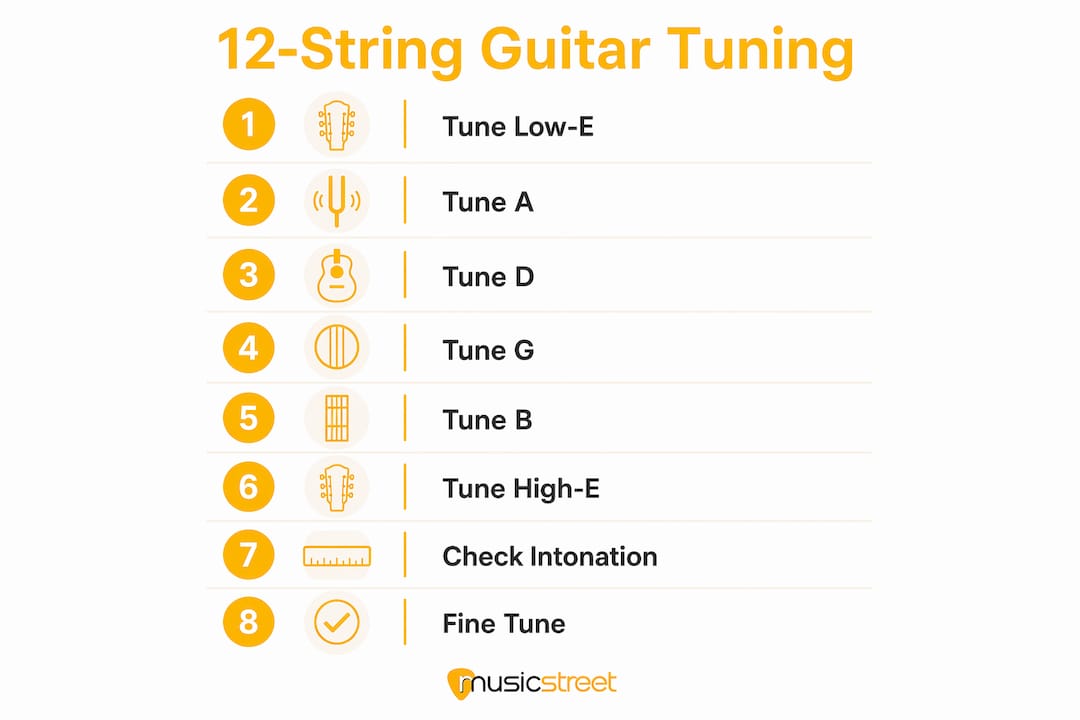
Tune the low-E course first and always tune up to pitch, never down. That single rule prevents most of the tuning drift and string-seating problems players run into.
Here is the full workflow:
-
Clip on a chromatic tuner (or use a tuner pedal or a reliable tuning app). A chromatic tuner reads individual string pitches accurately, which matters on a 12-string where paired strings can confuse a standard guitar tuner.
-
Start with the thickest string of the low-E course (the E2 string). Tune it to pitch.
-
Tune the paired octave string (E3) of the same course.
-
Work through each course in order: A, D, G, B, high E — tuning the primary string first, then the paired string.
-
Always tune up to pitch. If you overshoot, drop below the target and come back up. This seats the string in the nut slot and reduces slippage.
-
Stretch the strings gently by pulling each course away from the body slightly along its length, then retune. New strings need this most.
-
Do a second full pass from low E to high E. The first pass shifts tension across the neck, which pulls earlier courses slightly flat.
-
Check octave pairs by ear after the second pass. Each octave pair should sound like a clean, shimmering unison when both strings ring together.
Tuning stability checklist:
-
Stretch strings after every restring and after the first tuning pass.
-
Check nut slots: a binding nut slot causes a string to jump pitch when you tune or bend. If a string pings when you tune it, the slot needs lubricating or filing.
-
Check bridge saddle seating: a saddle that rocks or sits unevenly causes intonation problems.
-
Repeat tuning passes until the guitar holds pitch through a full strum.
-
If the guitar will not stay in tune after three passes, a professional setup is likely needed.
Recommended tools: a chromatic clip-on tuner, a tuner pedal for stage use, a reliable tuning app as a backup, a capo, and a string winder to speed up restringing. A well-stocked guitar accessories kit covers all of these.
How to restring a 12-string and choose the right gauges
Restringing a 12-string is not complicated, but the order matters. Removing all twelve strings at once releases tension suddenly and can stress the neck and bridge. The safer approach is to change strings in a planned sequence that keeps tension distributed across the neck throughout the process. Change one course at a time — remove the old pair, fit the new pair, bring them up to rough pitch, then move to the next course.
For a full step-by-step restringing guide, Musicstreet has a dedicated walkthrough that covers string order and bridge pin technique for acoustic 12-strings.
String gauge recommendations
Gauge affects tension directly. Heavier strings sound fuller but are harder to fret; lighter strings are easier to play but can sound thinner. For most beginners and intermediate players, extra-light 12-string sets are the practical starting point.
| Setup | Recommended gauge | Best for |
|---|---|---|
| Standard tuning, acoustic | Extra-light | Most beginners and intermediate players |
| Half-step down with capo | Extra-light or light | Fingerpickers; players with smaller hands |
| Whole-step down | Light or medium-light | Older or vintage instruments; reduced structural stress |
| Electric 12-string | Dedicated electric 12-string set | Electric players wanting clarity and easier bending |
Avoid medium or heavy gauge sets until you are comfortable with the instrument. The tension on a 12-string at standard pitch is already considerably higher than a six-string, and heavy strings compound that significantly.
Pro Tip: Some players build their own custom 12-string set by buying two extra-light six-string sets and pairing the strings manually. This gives you more control over the octave string gauges and can be cheaper than dedicated 12-string sets. Just make sure the octave strings are plain (unwound) for the G, B, and high-E courses.
Maintenance checks to run at every restring:
-
Nut slots: each slot should hold the string without binding. Run a pencil tip (graphite) through each slot to lubricate it.
-
Saddle: check it sits flat and is not rocking. A rocking saddle causes intonation problems.
-
Action height: if the strings feel very high at the 12th fret, the action needs reducing — this is a job for a technician.
-
Truss rod: sight down the neck from the headstock. A slight forward bow (relief) is normal; a severe bow or a back-bow needs professional attention.
Practical ways to make a 12-string easier to play
Much of the difficulty players feel on a 12-string is not permanent. Most of it is tension, and tension is adjustable.
-
Tune down a semitone (to Eb) and fit a capo at fret 1. You play the same chord shapes as standard tuning, but the strings are physically shorter and looser. This is the single most effective quick fix for players who find standard tension painful.
-
Tune down a full tone (to D) and capo at fret 2 for even more relief. This approach is particularly useful for older or vintage instruments where sustained high tension risks structural damage.
-
Choose extra-light strings. Lighter gauges reduce tension at any given pitch. Combined with a detune-and-capo setup, the difference in playability is substantial.
-
Lower the action via a professional setup. High action is the most common reason a 12-string feels unplayable. A technician can lower the saddle and adjust the nut slots without compromising tone.
-
Use a partial capo on specific courses if you want to experiment with altered voicings while keeping tension manageable.
The capo-and-detune workflow in practice: tune the whole guitar down a semitone, clip a capo at fret 1, and play normally. Your chord shapes produce the same pitches as standard tuning. The strings are under less tension, the nut slots are under less stress, and your fingers will thank you after a long session. Many players use this approach long-term, not just as a beginner workaround.
If the action is still high after fitting lighter strings, a quick interim fix is to check whether the bridge saddle can be lowered slightly. On acoustic guitars, the saddle is usually a removable bone or synthetic piece that can be sanded down carefully. This is worth attempting only if you are comfortable with basic guitar maintenance; otherwise, book a setup.
Pro Tip: On vintage 12-strings, avoid returning to heavy strings or standard tuning without a structural check first. Older bracing and bridges were often designed for lighter tension than modern sets deliver. A luthier can tell you what the instrument was built to handle.
A short practice plan to build 12-string confidence
Short, focused daily practice beats long, unfocused sessions every time. Twenty minutes of deliberate work on a specific problem will move you forward faster than an hour of noodling.
Week 1: Tuning and open chords
Spend the first five minutes of every session tuning the guitar properly. This is not wasted time — it trains your ear and builds the habit of checking pitch before you play. Then spend ten minutes on open chord shapes (G, C, D, Em, Am), pressing each chord and picking through the strings one course at a time to identify any muted pairs. Finish with five minutes of slow strumming, focusing on a compact wrist motion.
Week 2: Fretting drills and barre chords
Start with a paired-string chromatic exercise: fret the first course at fret 1, then 2, then 3, then 4, using each finger in sequence. Listen for both strings ringing cleanly at every position. Move to partial barre chords — try an F chord shape but only barre the top four strings. Build to a full barre over two or three sessions, not in one.
Week 3: Fingerpicking and dynamic control
Introduce a simple alternating-bass fingerpicking pattern: thumb on the low-E course, index on G, middle on B, ring on high E. Play it slowly with a metronome at 60 BPM. Once every pair rings cleanly at 60, nudge the tempo to 70. The goal is clarity across all courses, not speed.
Metronome use is non-negotiable for this stage. The 12-string’s extra strings mean timing errors are louder and more obvious than on a six-string. A free metronome app works fine; set it to a tempo where you can play every note cleanly, then increase by five BPM when you can do three consecutive clean passes.
Pro Tip: Record yourself on your phone once a week. Listening back reveals muted pairs and uneven strumming that you simply cannot hear while you are playing. It is the fastest feedback loop available to a self-teaching player.
Common problems and when to get a professional setup
The most frequent reason a 12-string feels unplayable is not the player — it is the setup. High action, binding nut slots, excessive neck relief, and heavy strings account for the vast majority of complaints from players who feel the instrument is “too hard.”
Before booking a setup, work through these questions:
-
Does it buzz on open chords? Buzzing on open strings usually points to low action or a nut slot that is too deep. Buzzing only when fretting suggests a high fret or uneven fretboard.
-
Do the octave pairs ring clearly? If one string in a course sounds dull or dead, check whether the nut slot is binding or whether the string is seated correctly at the bridge.
-
Does the neck look straight? Sight down the neck from the headstock. A severe forward bow (too much relief) or a back-bow both affect playability and require truss rod adjustment.
-
Is the bridge lifting? On acoustic guitars, a lifting bridge is a structural issue that needs immediate professional attention.
A professional setup for a 12-string typically includes truss rod adjustment, nut slot filing and lubrication, saddle height reduction, and a fret level if needed. The technician will also check intonation at the 12th fret for each course. This is not a luxury — on a 12-string, a good setup can transform an instrument that feels impossible into one that plays beautifully.
Red flags that need a specialist rather than a general setup:
-
Severe bridge lifting or cracking around the bridge plate.
-
A twisted or severely warped neck.
-
Frets that are worn to the point of buzzing on multiple positions.
-
Tuning pegs that slip even after tightening.
For guidance on spotting these issues early, Musicstreet’s article on signs your guitar needs a setup covers the key warning signs in plain language.
Pro Tip: Ask your technician specifically about compensated saddles when booking a 12-string setup. A compensated saddle accounts for the slight intonation difference between the primary and octave strings in each course, and it makes a noticeable difference to how in-tune the guitar sounds when you play up the neck.
Key takeaways
Playing a 12-string well comes down to four things done in order: tune correctly, reduce tension if needed, adapt your fretting and strumming technique, and practise progressively with a metronome.
| Point | Details |
|---|---|
| Tune courses in order | Start with the low-E course, tune primary string first, then the paired string; always tune up to pitch. |
| Reduce tension early | Detune a semitone and capo at fret 1 to play at concert pitch with less physical demand. |
| Use extra-light strings | Extra-light gauge sets reduce tension and make fretting and fingerpicking more manageable. |
| Adapt fretting technique | Use a flatter finger pad position to press both strings in each course cleanly; essential for barre chords. |
| Musicstreet setup and stock | Musicstreet offers professional setups, in-store tryouts, and pre-owned and new 12-string options including the Tanglewood TW12CE and Yamaha FG720S-12. |
The learning curve is shorter than you think
The 12-string has a reputation for being difficult that is only half-deserved. The physical demands are real — more tension, more strings to fret cleanly, more tuning to manage — but most of what makes a 12-string feel hard is a setup problem, not a skill problem. A guitar with high action and heavy strings will defeat almost anyone. The same instrument with a proper setup, extra-light strings, and a semitone detune becomes genuinely enjoyable to play within a week or two of consistent practice.
What actually matters in the first month is not playing complex chord progressions or ambitious fingerpicking arrangements. It is getting one open chord to ring cleanly across all six courses. That small win, when it happens, tells you the technique is working. Everything else builds from there.
The tone trade-off is worth acknowledging honestly. A 12-string tuned down a semitone with a capo does not sound quite the same as one at full standard pitch. The shimmer is slightly different, the resonance shifts a little. For most players, that is an acceptable compromise while they build strength and technique. Once fretting feels natural and your hand is stronger, you can experiment with returning to standard pitch and heavier strings if the instrument handles it.
The instruments that tend to reward patience most are the ones with a good factory setup or a professional once-over before you start. A pre-owned Yamaha FG720S-12 or a new Tanglewood TW12CE with a proper setup is a far better learning tool than a cheaper instrument left in factory condition with high action and medium strings.
Ready to find your 12-string?
Musicstreet stocks a range of 12-string guitars for players at every stage, from pre-owned acoustics to new electro-acoustics and vintage electrics, all inspected and available for in-store tryouts at the Huntingdon shop.

If you are buying your first 12-string, the Tanglewood TW12CE Winterleaf is a strong starting point: a cutaway electro-acoustic with a factory setup that suits both strumming and fingerpicking. For players on a tighter budget, the used Yamaha FG720S-12 is a well-regarded acoustic that holds its setup well. Electric players should take a look at the used Rickenbacker 360/12 in Mapleglo, a genuinely iconic instrument.
When booking a setup at Musicstreet, ask specifically for: truss rod check, nut slot filing and lubrication, saddle height reduction, and intonation check across all courses. The team can advise on string gauge choices for your playing style and whether a compensated saddle would benefit your instrument. Visit the Musicstreet shop or get in touch to arrange an in-store appointment.
Useful sources
For players who want to go further, these resources are worth bookmarking:
-
Musicstreet’s beginner 12-string guide covers instrument selection and first steps in more detail, useful if you are still deciding which 12-string to buy.
-
Musicstreet’s restringing guide walks through string order and bridge pin technique for acoustic 12-strings step by step.
-
The essential guitar maintenance guide from Musicstreet covers humidity care, cleaning, and storage — all relevant to 12-strings, which are more sensitive to environmental changes than most six-strings.
-
D’Addario’s 12-string tuning guide is a clear, authoritative reference for standard tuning notation and course arrangement.
-
Gearank’s tuning workflow offers a practical step-by-step tuning sequence with stability tips.
-
GrainMark Leather’s pick and AirTag case is a handy accessory for keeping your picks organised and your guitar bag trackable.
UK players with vintage or high-tension instruments should seek a local luthier or specialist setup service rather than attempting truss rod or nut work at home. Musicstreet’s repair and setup service in Huntingdon is available for both in-store visits and postal bookings for smaller components.
FAQ
Is a 12-string guitar hard to play for beginners?
It is more demanding than a six-string, mainly because of higher tension and the need to fret two strings cleanly per course. A proper setup with extra-light strings makes the difference between frustrating and manageable.
How do you make a 12-string easier to play?
Tune down a semitone and fit a capo at fret 1 to play at concert pitch with significantly less string tension. Fitting extra-light strings and having the action lowered by a technician are the other two most effective adjustments.
Do you play both strings in each course on a 12-string?
Yes. Both strings in each course are fretted and strummed together as a single unit. The lower four courses pair a string with its octave; the top two courses (B and high E) are paired in unison.
What is a 12-string guitar best used for?
The instrument suits strummed acoustic parts, fingerpicked folk and country arrangements, and jangly electric sounds. Its natural chorus effect from the octave pairs adds depth and shimmer that a six-string cannot replicate without effects.
How often does a 12-string need tuning?
More often than a six-string, particularly with new strings or after a change in temperature or humidity. Stretching strings after fitting them and doing two tuning passes before playing speeds up the settling process considerably.









Share:
How to tune an electric guitar: beginner's guide
Maton guitars: the UK buyer's complete guide