


- Piezo pickups respond to guitar body vibrations, capturing natural acoustic-like tone.
- They are versatile, compatible with any string material and ideal for feedback-free live use.
- Proper installation and impedance matching are essential for optimal piezo sound quality.
Most guitarists assume their choice of magnetic pickup is the final word on tone. It isn’t. Piezo pickups operate on an entirely different principle, responding to the physical vibration of the guitar body itself rather than the magnetic field around the strings. The result is a sound with natural clarity, warmth, and acoustic character that a standard magnetic pickup simply cannot reproduce. Whether you play acoustic, electric, or something in between, understanding how piezo technology works can genuinely change the way you think about your instrument’s voice and what it can do on stage or in the studio.
Table of Contents
- What is a piezo pickup?
- How piezo pickups differ from magnetic pickups
- Installation and practical considerations
- Tonal shaping, hybrids, and performance tips
- Choosing the right piezo system and related accessories
- The overlooked power of piezo pickups
- Upgrade your guitar with piezo expertise
- Frequently asked questions
Key Takeaways
| Point | Details |
|---|---|
| Acoustic-like clarity | Piezo pickups capture the true resonance of your guitar, resulting in a brighter, more ‘acoustic’ sound. |
| Pro fitting recommended | Proper installation is essential to avoid uneven tone and maximise your pickup’s performance. |
| Blending options | Combining piezo and magnetic pickups gives you versatile control over your electric and acoustic tones. |
| Use a buffer preamp | Pairing a piezo with a buffer preamp prevents treble loss and ensures full, dynamic sound. |
What is a piezo pickup?
The word piezo comes from the Greek word for pressure. The piezoelectric effect is a property of certain crystals and ceramic materials: when they are physically compressed or bent, they generate a small electrical charge. In a guitar pickup, this principle is put to work by placing a thin piezoelectric sensor beneath the saddle or directly against the bridge plate. Every time a string vibrates, the saddle moves, the sensor is compressed, and that mechanical energy becomes an electrical signal your amplifier can use.
This is fundamentally different from how a magnetic pickup works. A magnetic pickup uses a coil of wire around a magnet. When a ferrous (steel) string vibrates within that magnetic field, it disturbs the field and induces a current in the coil. The entire process is electromagnetic. Piezos, on the other hand, respond to physical movement, which means they capture resonance from the entire guitar body, not just the strings moving above the pickup.
Because piezos detect mechanical stress from any string type and body resonance rather than just ferrous string vibrations, they deliver more acoustic-like tone with greater natural detail. This also means they work with nylon strings, gut strings, or any other material, making them versatile across many guitar styles.
Here are the defining features of a piezo pickup:
- Works with any string material, including nylon, steel, and bronze
- Captures the full resonance of the guitar body, not just string movement
- Produces a bright, natural, acoustic-like tone
- Suitable for under-saddle, bridge plate, or soundboard mounting
- Compatible with both acoustic and electric guitar configurations
A properly placed piezo doesn’t just amplify your strings. It amplifies your entire instrument, including the subtle taps, resonances, and air that give a guitar its voice.
To understand how piezos fit into the broader world of pickups, it helps to explore the role of guitar pickups and how different designs serve different tonal purposes.
How piezo pickups differ from magnetic pickups
Knowing what a piezo is only gets you halfway. The real insight comes from seeing how it behaves differently from a magnetic pickup in real playing situations.
| Feature | Piezo pickup | Magnetic pickup |
|---|---|---|
| Sound character | Natural, bright, acoustic | Warm, thick, electric |
| Placement | Under saddle or bridge | Above strings at body |
| String compatibility | Any material | Steel/ferrous only |
| Feedback resistance | Very high | Lower at high volumes |
| Body resonance capture | Yes | No |
| Typical use | Acoustic, hybrid, live | Electric, studio |
The tonal contrast is significant. A magnetic pickup colours your tone with the warmth of the coil and magnet interaction. A piezo strips that away and gives you something much closer to what a microphone placed in front of your guitar would capture. That transparency is both its greatest strength and its most discussed limitation.

Piezo excels in feedback-free live use but contrasts with magnetic pickups’ electric warmth. Hybrid systems that blend both signals can reduce the characteristic ‘quack’ of a pure piezo signal, offering a rounder, more balanced output.
Here is when each type makes the most sense:
- Piezo only: Acoustic gigs, fingerpicking, folk, classical, and any setting where natural tone is the priority
- Magnetic only: Rock, blues, jazz, or any style that benefits from sustain and coil character
- Blended hybrid: Singer-songwriters performing live, country players, or anyone who needs both worlds from a single instrument
For a deeper look at how magnetic designs work and compare, our electric guitar pickups guide covers the full picture. If you’re considering a combined amp setup to handle both signal types, understanding hybrid guitar amps is well worth your time.
Installation and practical considerations
Understanding the technology is satisfying, but installation is where theory becomes reality. Getting a piezo pickup fitted correctly is arguably more important than which brand you choose.
A typical under-saddle installation follows these steps:
- Saddle slot preparation: The slot must be the correct width and depth to ensure even pressure across all six string contact points
- Transducer placement: The piezo strip is seated flat at the base of the slot with no gaps or rocking
- Wiring routing: The cable is routed internally through the guitar body to an output socket, usually an endpin jack
- Preamp or buffer installation: A preamp or buffer circuit is fitted to manage impedance and provide volume or EQ control
- Saddle refit and intonation check: The saddle is replaced and string height and intonation are verified
Poor placement causes uneven string response or dead spots, with some strings sounding louder or thinner than others. This is the most common complaint from DIY installations, and it nearly always comes down to the saddle slot not being perfectly flat or the transducer strip not sitting correctly.
Pro Tip: Always use a buffer preamp with your piezo system. The high-impedance output of a raw piezo signal will lose treble and dynamics if plugged directly into a standard guitar amplifier. A buffer preserves the full frequency range and natural character of the pickup.
The good news is that a professional installation is fully reversible with care. Your original saddle can be retained, and the endpin jack can be removed without affecting the guitar’s structural integrity. This matters if you ever intend to sell the instrument. Products like the L.R. Baggs Element Active Pickup are designed with clean installation in mind and come with detailed fitting guidance.
Tonal shaping, hybrids, and performance tips
Once your piezo system is in place, how you use it on stage or in the studio determines the result. A raw piezo signal straight into a PA can sound brilliant or brittle, depending entirely on the surrounding gear and settings.
The most effective live approach most players discover is blending. When a piezo signal is mixed with a magnetic pickup signal, the quack and harshness of the piezo is softened by the warmth of the magnetic coil, and the clarity of the piezo lifts the magnetic signal out of muddiness. The blend point is different for every guitar and player, which makes experimentation genuinely worthwhile.
Because piezo output can reach 1 to 10 MΩ impedance, plugging directly into a low-impedance guitar amp causes treble loss and a distinctly thin, tinny sound. A dedicated acoustic preamp or quality DI box with high input impedance solves this immediately.
Here are practical tips for getting the most from your piezo live:
- Use a high-impedance input: Either an acoustic preamp, a quality DI box, or an acoustic-specific channel on a mixer
- Cut harsh high-mids: Around 2kHz to 3kHz is where piezo quack lives; a small cut here smooths the tone significantly
- Roll back the treble slightly: Especially if playing in a live room with hard reflective surfaces
- Experiment with blending ratios: If your guitar has both pickup types, spend time finding the blend that sounds natural to your ears
- Check your cable quality: High-impedance signals are more susceptible to cable capacitance affecting tone
Pro Tip: Try blending 60% piezo with 40% magnetic during soundcheck, then adjust from there. Most players find they want more piezo in quieter passages and more magnetic in fuller band arrangements.
For more ideas on coaxing the best from any pickup type, our articles on electric pickup tips and upgrading your pickups are worth reading alongside this guide.
Choosing the right piezo system and related accessories
With the fundamentals clear, the practical question is: which piezo system suits your guitar and how you play?
| System type | Best for | Example use | Price range |
|---|---|---|---|
| Under-saddle transducer | Acoustic guitars, natural tone | Live performance, recording | £60 to £200 |
| Soundboard transducer | Fingerstyle, classical, nylon string | Studio, intimate venues | £30 to £120 |
| Hybrid (piezo + magnetic) | Electric and semi-acoustic guitars | Versatile live and studio | £150 to £400 |
| Active preamp system | Any guitar needing onboard EQ | Professional gigging | £100 to £350 |
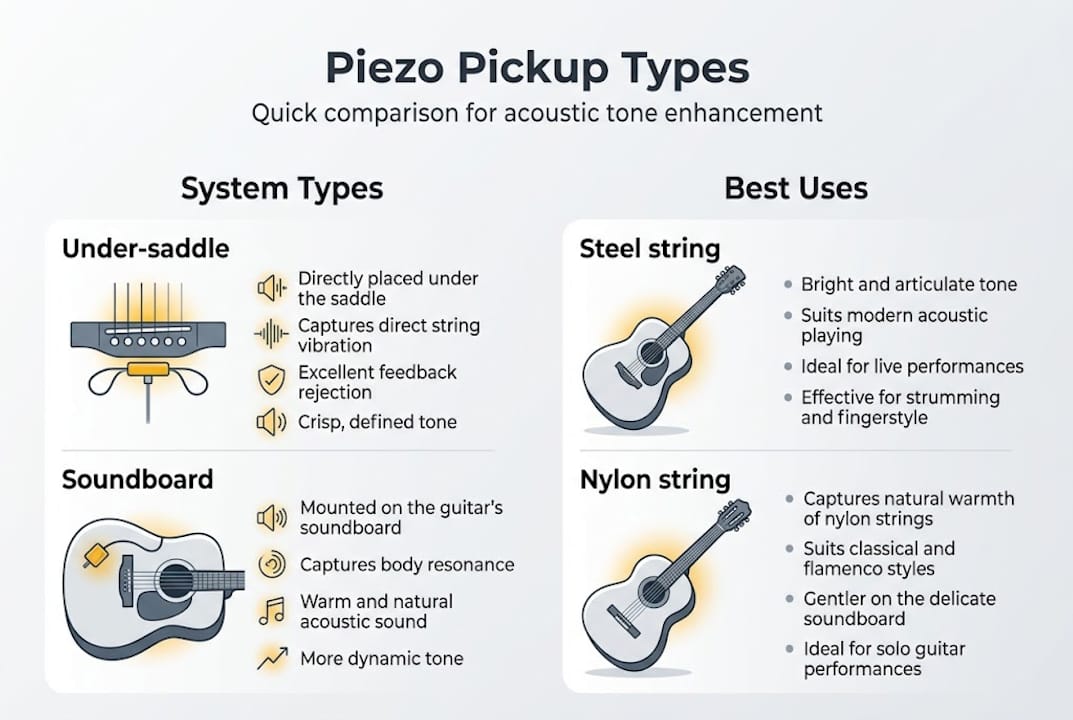
Under-saddle systems are the most popular choice for steel-string acoustics because they sit invisibly inside the guitar and produce a reliable, balanced signal. Soundboard transducers stick to the guitar’s top and pick up more of the body resonance, giving a slightly looser, more organic character that suits fingerpickers particularly well.
For acoustic guitars, useful accessories to optimise your setup include:
- A dedicated acoustic preamp or pedal with high-impedance input
- Quality shielded cables to maintain signal integrity
- An endpin jack that accepts a standard instrument cable cleanly
- A feedback buster or sound hole cover for loud stage environments
- A blending controller if running dual pickup systems simultaneously
Two strong options for acoustic pickup upgrades are the L.R. Baggs M1 Active Sound Hole Pickup and the M1 Passive Soundhole Pickup, both of which pair beautifully with or as alternatives to under-saddle piezo systems depending on your tonal goals.
The overlooked power of piezo pickups
Here is something most pickup guides skip over entirely: the reason piezos get a bad reputation is almost never the technology. It is almost always a bad installation or an ignored impedance mismatch.
We have seen players dismiss piezos entirely because one fitted at a budget music shop sounded thin and hollow into their valve amp. That is not a piezo problem. That is a chain problem, and it is entirely fixable. When a piezo system is properly installed, paired with the right preamp, and dialled in through an appropriate amp or DI, the results can genuinely surprise even experienced players.
The ‘either/or’ mentality around pickups also limits creative possibilities. Rather than choosing between acoustic clarity and electric warmth, a hybrid system gives you both from one guitar. On a gig, that means fewer instruments, simpler logistics, and more sonic flexibility mid-set. That is a practical advantage that gets overlooked when the conversation focuses purely on tonal purity.
Thinking about why you upgrade pickups should include asking whether a piezo addition, rather than a pickup swap, serves your actual needs better. Sometimes the answer genuinely is yes.
Upgrade your guitar with piezo expertise
If this guide has sparked your curiosity about what a quality piezo system could do for your sound, the next step is finding the right fit for your guitar and playing style.

At MusicStreet, we stock a carefully selected range of piezo and hybrid pickup systems, including the L.R. Baggs Element Active Pickup, alongside expert advice to help you choose wisely. Whether you’re looking to upgrade an acoustic you already love or explore top guitar brands that come piezo-equipped from the factory, our team is ready to help. Visit us in Huntingdon or shop online, and let’s find the system that gives your guitar the voice it deserves.
Frequently asked questions
Do piezo pickups work with both acoustic and electric guitars?
Yes, piezo pickups work across both types because they detect any string type and body vibration rather than relying on magnetic fields, making them genuinely versatile.
Why does my piezo pickup sound thin or harsh?
The most likely cause is impedance mismatch. Piezo pickups have a high-impedance output requiring a buffer preamp to preserve tone and prevent treble loss when connected to a standard amp.
Can I install a piezo pickup myself?
DIY installation is possible, but poor saddle slot fit leads to uneven string response or dead spots, so professional installation is strongly recommended for reliable results.
What are the main advantages of a piezo pickup for live performance?
Piezos offer feedback-free live performance and deliver clear, natural acoustic tone even in loud stage environments where microphones would be impractical.









Share:
Noise gates explained: cleaner sound for every musician
Master guitar tuning methods for better sound quality