

Reverb is what happens when sound waves bounce off surfaces and return to your ears so quickly that they blur into a continuous, fading tail rather than distinct echoes. Reflections arriving within roughly 50 milliseconds of the original sound create reverberation; anything slower becomes audible delay. For guitarists, that distinction matters every time you reach for a pedal: reverb adds space, depth, and ambience to your tone, from a subtle studio bloom to the cavernous wash you hear on classic surf recordings.
Table of Contents
- What does reverb mean in music, and how does it work?
- Which reverb types suit guitarists best?
- Where should reverb sit in your signal chain?
- Practical habits that actually improve your reverb use
- A short history of reverb hardware
- How to demo reverb in-store or at home
- Key takeaways
- The part most guides get wrong about reverb
- Reverb pedals available at Musicstreet
- Useful sources
- FAQ
What does reverb mean in music, and how does it work?
Sound leaves your guitar, hits a wall, ceiling, or floor, and bounces back. In a real room you hear dozens of these reflections simultaneously. Early reflections arrive first and carry information about the room’s size and shape. Late reflections pile up into a dense, diffuse tail that gradually fades, which is the reverb effect in music you recognise as “wet” sound.
The four controls you will find on almost every reverb pedal or amp:
- Mix (wet/dry): balances the original dry signal against the reverberated wet signal. Start low and creep it up until the space feels natural.
- Decay/Time: controls how long the tail lasts. Short decay keeps things tight; long decay creates atmospheric swells.
- Pre-delay: inserts a brief gap between the dry note and the reverb onset. Even 20–30 ms of pre-delay preserves your pick attack and stops the reverb from swallowing the note.
- Damping/Tone: rolls off high frequencies in the tail, mimicking how soft furnishings or air absorption tame brightness in real rooms.
Increase pre-delay and your guitar cuts through a dense mix while still sitting in a convincing space. Push decay too far and single-note lines turn to mush.
Which reverb types suit guitarists best?
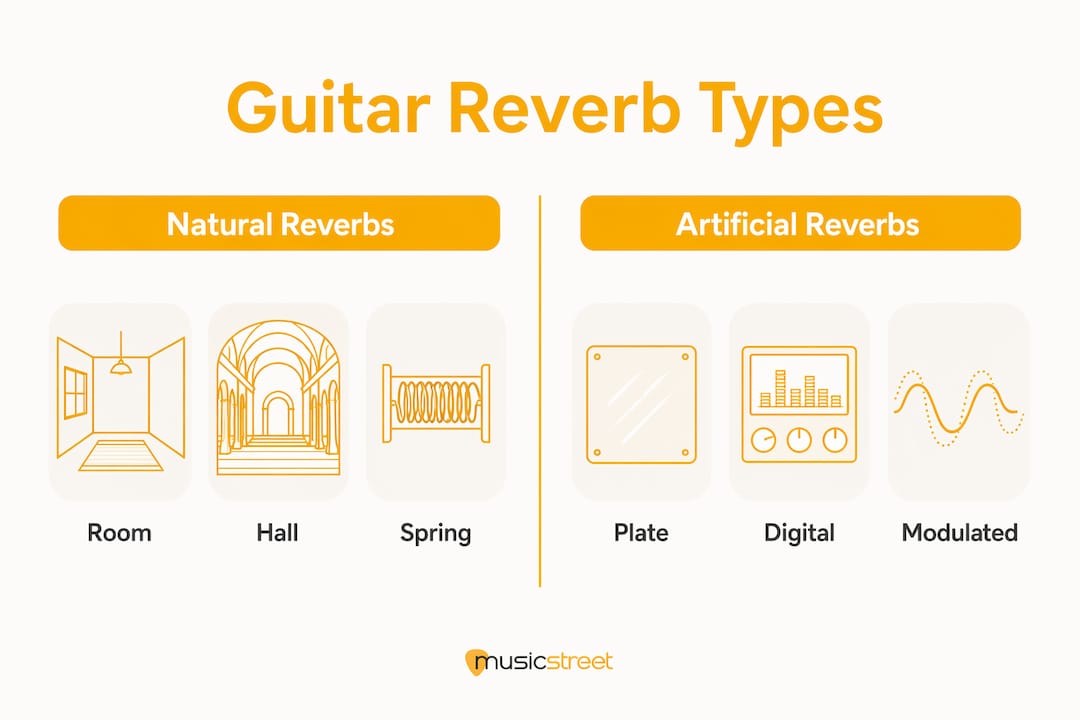
Reverb types in audio are usually named after the spaces or machines that inspired them. Here is a quick guide to the most useful ones:
- Spring: produced by physical springs inside an amp tank. Bright, slightly metallic, with a characteristic “boing” on transients. The go-to for surf, blues, and vintage country.
- Plate: originally a large suspended metal sheet vibrated by a transducer. Dense, smooth, and musical on almost anything. Plate reverbs required dedicated isolation rooms; modern pedals recreate the character without the hassle. Excellent for clean electric and fingerpicked acoustic.
- Room: a short, natural-sounding decay that mimics a small studio or rehearsal space. Ideal as an always-on setting because it adds warmth without obvious effect.
- Hall: longer and more diffuse than room. Works well for slow chord passages, ballads, and anything that benefits from a grand, open feel.
- Chamber: sits between room and hall in size, with a slightly coloured character. Think classic 1960s studio recordings.
- Shimmer: pitches the reverb tail up an octave (or more), creating ethereal, synth-like pads. Reserve this for ambient passages and swells rather than lead lines.
- Modulated: adds subtle chorus-like movement to the tail. Gives clean arpeggios a lush, slightly vintage quality without sounding obviously effected.
- Convolution: uses impulse responses recorded in real spaces to emulate rooms from small studios to cathedrals with high accuracy. Common in DAW plug-ins and higher-end pedals.
A quick decision rule: if you are unsure, start with room or plate. Both sit naturally in a mix and suit the widest range of styles.
Where should reverb sit in your signal chain?
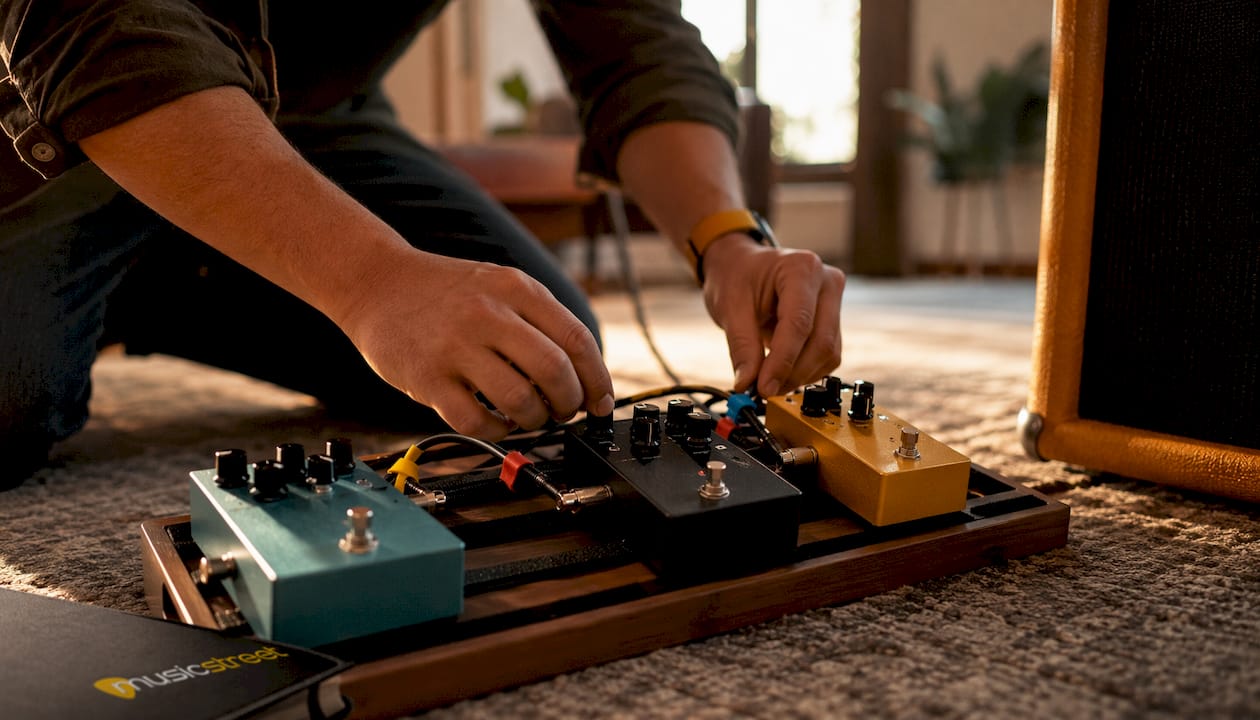
Reverb almost always goes last in your pedal chain, after drive, compression, and modulation. Placing it before a distortion pedal feeds the reverb tail into the gain stage, which creates a noisy, indistinct mess.
For amp users with a built-in spring tank, the amp’s effects loop is the cleanest option. Running a reverb pedal into the front of a clean amp is perfectly fine too, and many players prefer the slight interaction it creates.
| Preset name | Decay | Mix | Pre-delay |
|---|---|---|---|
| Small room (always-on) | short decay | low mix | brief pre-delay |
| Plate lush (clean electric) | moderate decay | moderate mix | brief pre-delay |
| Spring (blues/surf) | moderate decay | moderate mix | minimal pre-delay |
| Ambient shimmer (swells) | long decay | higher mix | longer pre-delay |
In a DAW or home studio, engineers route reverb on a parallel send/aux bus so multiple tracks share a single virtual space. That approach produces a cohesive room impression and keeps individual tracks clean.
Pro Tip: Start with mix at 15% and decay under two seconds. Most players who complain that reverb sounds artificial have simply set both too high. A natural “breathing” ambience is almost always more musical than an obvious wash.
Practical habits that actually improve your reverb use
Good reverb use is mostly about listening before tweaking. These habits make a real difference:
- Check your attack first. Play a single note and listen to whether the pick transient is clear before the reverb blooms. If the note sounds blurred from the start, reduce mix or add pre-delay.
- Always-on clean patch: light room or plate at 15–20% mix, decay around 1.5 seconds. This is your foundation tone for practice and recording.
- Surf/blues spring recipe: zero pre-delay, mix at 30–35%, decay around two seconds. Let the spring character do the work; you do not need much.
- Ambient shimmer for swells: engage shimmer only when you are playing slow volume swells or pads. On fast passages it turns to noise.
- Live versus studio: live, cut mix by 5–10% compared to your home setting. Room acoustics at a venue add natural reverb that your pedal will stack on top of.
- Reverb with delay: if you are running both, put delay before reverb. The reverb then wraps around the delay repeats rather than the other way around, which sounds far more natural. For cinematic production contexts, atmospheric layering of reverb and delay is a core technique.
A short history of reverb hardware
The first artificial reverb appeared in the 1930s, when engineers played recordings through loudspeakers in reverberant rooms and re-recorded the result. Bill Putnam took it further in 1947, using a bathroom at his studio as an echo chamber on the Harmonicats’ “Peg o’ My Heart.”
Plate reverb arrived in the late 1950s with the EMT 140, a large suspended metal sheet that produced a dense, musical tail. Spring tanks followed, becoming standard in guitar amplifiers throughout the 1960s. Digital reverb entered the picture in 1976 with the EMT 250, and the Lexicon 224 and 480L became the studio benchmarks for density and lushness that modern pedals still reference. Digital guitar pedals arrived in 1987 with the Boss RV-2, opening the door to the vast range of reverb pedals available today. Convolution reverb, which uses impulse responses of real spaces, became practical for real-time use when Sony released the DRE S777 in 1999.
Every reverb type on a modern pedal traces its character back to one of these eras. When a pedal’s spring setting has that metallic “boing,” it is emulating the physical resonance of an actual spring tank.
How to demo reverb in-store or at home
A structured demo takes five minutes and tells you far more than turning knobs at random.
- Play a single sustained note dry (reverb off) and listen to your base tone.
- Switch reverb on at a low mix setting (around 15%) and repeat the note. Notice whether the space feels natural or artificial.
- Increase decay gradually until the tail becomes obvious, then back off slightly. That edge is where the pedal sounds most musical.
- Play a chord and listen for note separation. If individual strings blur together, reduce mix or add pre-delay.
- Play a short melodic phrase at tempo. Does the reverb tail clear before the next phrase, or does it pile up?
- Try a different reverb type on the same pedal. Spring versus room on the same guitar and amp tells you more than any spec sheet.
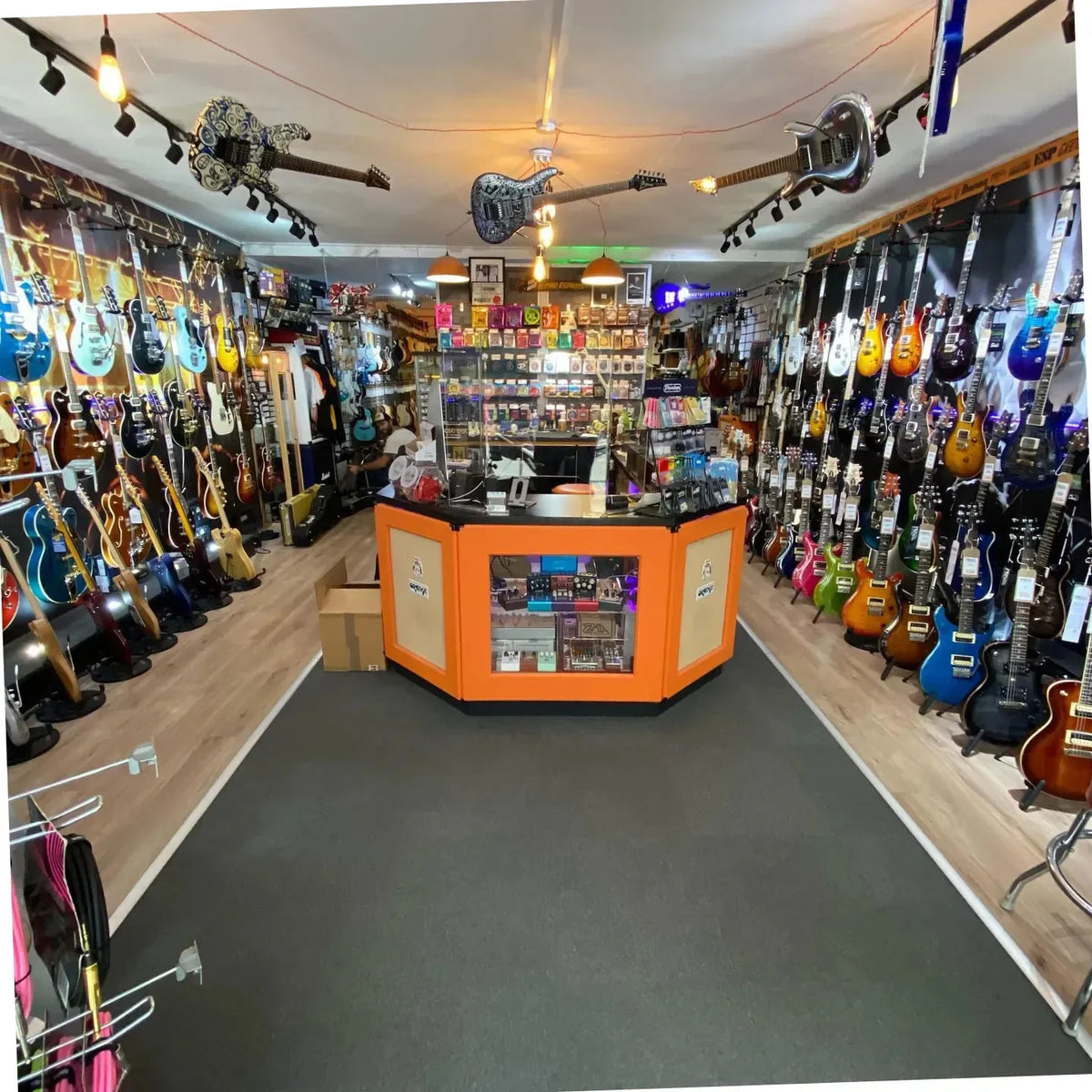
- If you are in-store, ask to try the pedal through your preferred amp setting. Musicstreet’s team at the Huntingdon store can set up a demo rig and walk you through controls on any pedal in stock.
Key takeaways
Reverb is the acoustic phenomenon of blended sound reflections, and understanding its controls lets you dial in exactly the space your guitar tone needs.
| Point | Details |
|---|---|
| Core definition | Reverb is blended sound reflections arriving within ~50 ms, creating a continuous decay rather than distinct echoes. |
| Critical controls | Mix, decay, pre-delay, and damping each shape a different aspect of the reverb tail. |
| Type selection | Start with room or plate for always-on use; spring for blues/surf; shimmer only for deliberate ambient passages. |
| Less is more | Begin at 15% mix and under two seconds decay, then adjust by ear from there. |
| Musicstreet demo | The Musicstreet store in Huntingdon offers in-store demos and professional setup on reverb pedals including the MXR M300, Fender Marine Layer, and Boss RV6. |
The part most guides get wrong about reverb
Most reverb guides spend their energy on types and controls, which is useful. What they rarely say is that reverb is primarily a listening skill, not a settings skill. The players who use reverb well are not the ones who memorise the “correct” decay for a hall preset. They are the ones who can hear when a tail is too long for the tempo, or when a spring setting is fighting the room acoustics at a venue.
The other thing worth saying: the importance of reverb is often overstated for beginners. A dry guitar through a good amp in a decent room already has natural ambience. Adding reverb on top of that can easily double the effect and push your tone into the background of a mix. The most common reverb mistake is not choosing the wrong type; it is using too much of the right one.
Reverb pedals available at Musicstreet
If you are ready to try reverb in practice, Musicstreet stocks three pedals that cover the full range of what most guitarists need. The MXR M300 Digital Reverb packs six reverb types into a compact chassis and is a strong first pedal for players who want versatility without complexity. The Fender Marine Layer Reverb Pedal delivers classic plate and spring characters with a warmth that suits Fender-style clean tones particularly well. The Boss RV6 Reverb Pedal is one of the most widely used reverb pedals on the market, offering eight modes and Boss’s characteristically reliable build.
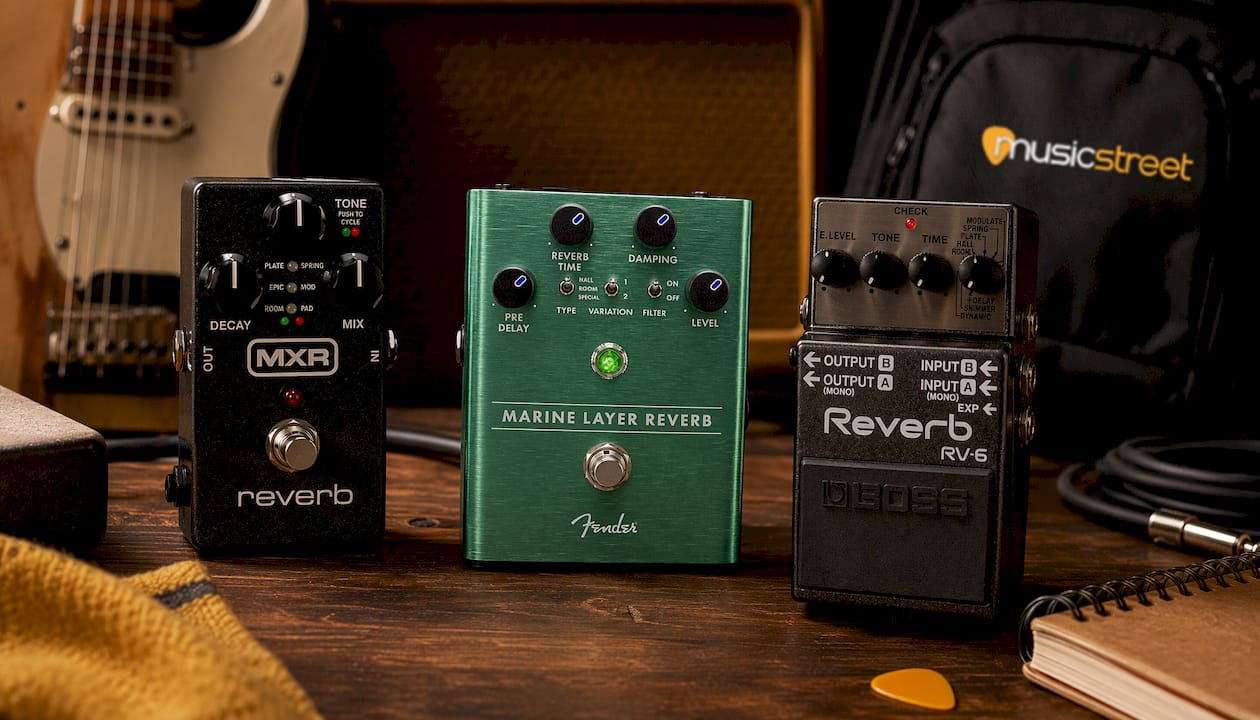
All three are available online with free UK delivery on qualifying orders, or you can try them in person at the Musicstreet store in Huntingdon, Cambridgeshire. The team can set up any pedal through a rig that matches your guitar and amp, so you hear exactly what you are buying before you commit.
Useful sources
- MusicRadar: What actually is reverb? — Clear technical explanation of the 50 ms perceptual boundary between reverb and delay.
- Fender: Pedal board primer — reverb — Practical overview of reverb types and the less-is-more principle from a manufacturer’s perspective.
- Guitar Wiz: Guitar reverb pedal guide — Detailed breakdown of controls and type-matching advice for guitarists.
- Premier Guitar: Reverb therapy, part 1 — Historical context on plate, spring, and Lexicon hardware.
- Berklee Online: What is reverb in music? — Studio-focused explanation of parallel routing and shared reverb buses.
- JustinGuitar: Your ultimate guide to reverb — Beginner-friendly introduction to reverb as a naturally occurring effect.
- Musicstreet blog: Reverb explained — Retail-focused guide to matching reverb pedal types to playing style.
FAQ
What does reverb mean in music?
Reverb is the continuous decay of sound caused by multiple reflections blending together in a space. In music, it adds a sense of room, depth, and ambience to an instrument’s tone.
How is reverb different from delay?
Reflections arriving within ~50 ms of the original sound create reverb; reflections arriving later are heard as distinct echoes, which is delay.
Which reverb type should a guitarist start with?
Room or plate reverb suits the widest range of styles and sits most naturally in a mix. Spring reverb is the classic choice for blues and surf playing.
Where does a reverb pedal go in the signal chain?
Reverb goes last in the chain, after drive and modulation pedals. For amp users, the effects loop keeps the signal cleanest.
Can I try reverb pedals before buying in the UK?
Yes. Musicstreet’s store in Huntingdon, Cambridgeshire offers in-store demos on pedals including the MXR M300, Fender Marine Layer, and Boss RV6, with professional setup support available.

Share:
Acoustic pickups for gigging and recording: a buying guide
How to tune an electric guitar: beginner's guide