


- Intonation ensures pitch accuracy along the entire guitar neck, not just at open strings.
- Poor intonation causes chords to sound off and notes to clash, especially higher up the neck.
- Regular setup and calibration help improve sound quality, blending, and playing accuracy.
You tune up, strum a chord, and everything sounds great. Then you play the same chord further up the neck and something feels wrong. The notes sound slightly sour, almost clashing with each other. Your tuner still says you’re in tune, yet something clearly isn’t right. That frustrating disconnect is almost always down to intonation, not tuning. Understanding the difference between the two is one of the most underrated skills a guitarist can develop, and it applies whether you’ve been playing for six months or sixteen years.
Table of Contents
- What is guitar intonation?
- Why intonation matters for sound and expression
- Common challenges and real-world compromises
- How to check and improve your guitar’s intonation
- Our take: Intonation mastery is about balance, not perfection
- Get more from your guitar with expert setups
- Frequently asked questions
Key Takeaways
| Point | Details |
|---|---|
| Intonation affects every note | Intonation ensures your guitar sounds in tune everywhere, not just on open strings. |
| Perfection is impossible | Accepting the limits of guitar physics lets you focus on what’s musically practical. |
| Balance beats obsessing | Prioritise intonation in the areas you play most, rather than chasing absolute perfection. |
| Regular checks matter | Checking and adjusting intonation keeps your performance consistent and expressive. |
| Professional help pays off | Expert setups make achieving good intonation easier and more reliable over time. |
What is guitar intonation?
Intonation describes the accuracy of pitch at every point along the fretboard, not just at the open string. When your guitar has good intonation, a note fretted at the 5th position rings at the correct pitch. A note at the 12th position does the same. When intonation is poor, notes go progressively sharper or flatter as you move up the neck, even though your open strings were perfectly in tune to begin with.
This is where many players get confused. Tuning refers to the pitch of your open strings. Intonation refers to whether your fretted notes match their intended pitches across the entire fretboard. Think of tuning as the starting point and intonation as the ongoing accuracy as you move along the neck. Both matter, but they solve different problems. A guitar setup explained in full detail will always treat these as two distinct but equally important elements.
Common symptoms of poor intonation include:
- Chords sounding slightly off or clashing, even after tuning
- Notes at the 7th to 12th fret sounding noticeably sharp or flat
- Harmonics that don’t match fretted notes at the same position
- Difficulty sitting in pitch with other instruments in a band setting
- Clean recordings that sound slightly out of tune despite careful preparation
Perfect intonation is impossible due to the compromises inherent in equal temperament tuning, fretting pressure, and string bending. Rather than chasing an absolute, experienced players aim for a working balance that suits where they perform most on the neck and trust their ears as much as a tuner.
That nuance is important. Intonation is not a binary pass or fail. It is a spectrum, and understanding that frees you to make more musical decisions about how you set up and play your instrument.
Why intonation matters for sound and expression
With a clear definition in place, let’s explore why getting intonation right is so crucial to sounding your best.
Poor intonation creates something players often describe as a “sour” quality. Your tuner might confirm that each open string is spot on, but the moment you fret a chord in a higher position, the notes pull against each other. The result is a subtle yet persistent wrongness that audiences notice even if they can’t identify the cause. It’s one of those things that makes a recording feel unprofessional without anyone being able to name exactly why.
In a band context, the consequences multiply quickly. When a guitarist with poor intonation plays alongside a pianist or another guitarist, the harmonic clashes become far more obvious. Overtones from each instrument interact, and if those overtones don’t align, the blend sounds muddy and unstable. Knowing how to maintain guitar setup regularly goes a long way towards preventing these situations.

The flip side of this is worth acknowledging too. Chasing perfect intonation can, in some cases, make a guitar sound almost sterile. Slight, musical imperfections can add warmth and character, particularly in ensemble settings where a little natural variation creates a richer, more human texture. Blues and country players have understood this for decades.
Pro Tip: Play a note at the 12th fret, then sound the natural harmonic at the same position without pressing the string down. If the fretted note is sharper than the harmonic, your saddle needs moving back. If it’s flatter, move it forward. This comparison, done across all six strings, gives you an immediate and reliable picture of where your intonation stands. Pairing this with the right guitar tuning methods will make your checks far more accurate.
Here’s how intonation accuracy affects your playing at different levels:
| Level of intonation accuracy | Single notes | Chords | Ensemble playing |
|---|---|---|---|
| Poor | Notes sound sharp or flat above 5th fret | Chords clash noticeably in higher positions | Difficult to blend; creates harmonic tension |
| Moderate | Single notes mostly accurate in mid positions | Chords reasonably in tune up to 7th fret | Acceptable for casual settings with some adjustment |
| Good | Consistent accuracy across the full neck | Clean, balanced chords across most positions | Sits comfortably with other well-tuned instruments |
| Excellent | Near-perfect pitch from open to 12th fret and beyond | Harmonically rich chords at any position | Blends seamlessly in studio and live environments |
The goal for most players is “good” rather than “excellent.” Reaching excellent requires regular professional attention and careful personal calibration, which we’ll cover shortly.
Common challenges and real-world compromises
Understanding the benefits and artistry of intonation also means accepting its limits and learning to work with them.
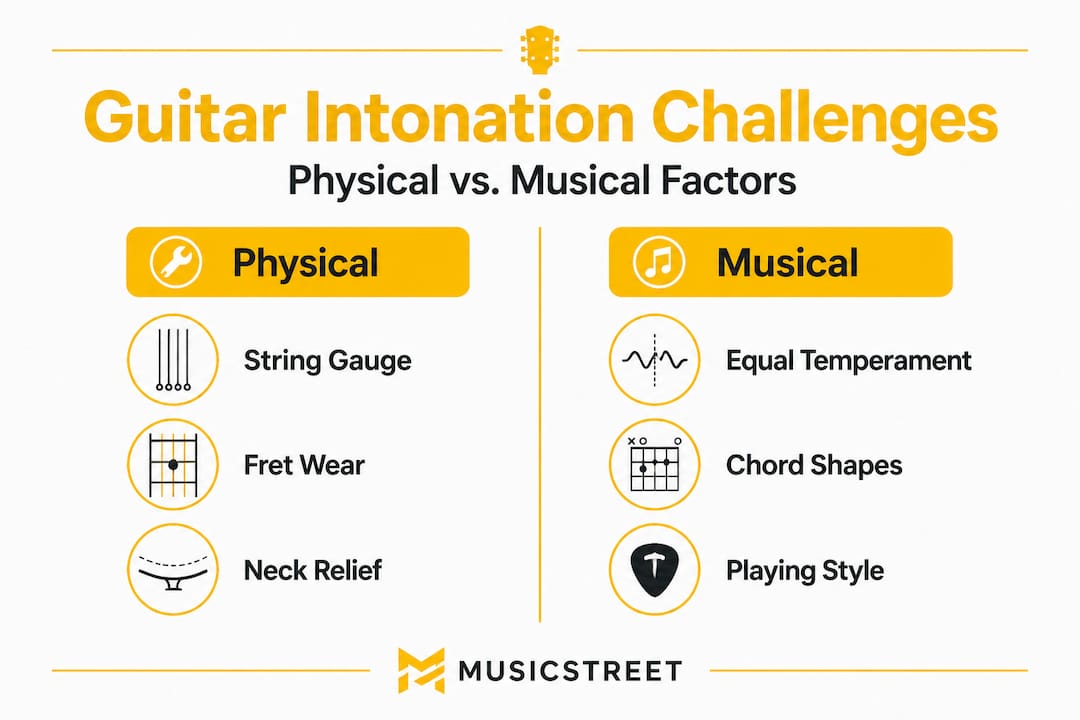
The fundamental problem is equal temperament. Modern Western guitars are tuned using a system that divides the octave into twelve equal semitones. This system makes it possible to play in any key without retuning, which is obviously practical. But it also means that no interval except the octave is mathematically pure. Every fifth, every third, every chord is a tiny compromise. Intonation is a player and style-specific compromise, and experienced luthiers and technicians always prioritise accuracy in the positions a guitarist uses most rather than chasing theoretical perfection everywhere on the neck.
There are also physical variables that affect intonation constantly. String gauge plays a significant role. Heavier strings require more tension and can pull sharp more easily when fretted hard. Playing pressure matters too. If you tend to grip the neck firmly, you’ll bend the string slightly sharp just by pressing down. Temperature and humidity affect the wood itself, causing the neck to bow or straighten, which shifts intonation across the board. This is why custom guitars built to a player’s specific style and technique often feel more consistently in tune than off-the-shelf instruments. A custom build accounts for how you actually play, not how an average player plays.
Here’s how intonation priorities differ between studio and live performance contexts:
| Setup context | Priority areas | Acceptable compromises |
|---|---|---|
| Studio recording | Full fretboard accuracy, especially above 7th fret | Minor inconsistencies in rarely played positions |
| Live performance | Lower positions where rhythm and chord playing happen | Upper neck can tolerate slight sharpness |
| Acoustic performance | Open chords and first five frets | Less critical at extremes of the neck |
| Lead/solo playing | 12th fret and above for melodic accuracy | Open strings can be slightly adjusted |
When deciding where to focus your intonation efforts, work through these steps:
- Identify the key positions you play most. Rhythm players should prioritise the lower five frets. Lead players need accuracy from the 7th fret upward.
- Decide your primary style. Acoustic and electric guitars present different intonation challenges, and your approach should reflect which you use most.
- Assess your strings. Old strings go false, meaning their pitch becomes inconsistent along the length. Fresh strings are essential before any intonation work.
- Consider your playing pressure. If you play with a light touch, your intonation work will be more predictable than if you dig in aggressively.
- Set realistic expectations. Aim for accuracy where it counts most, then accept small compromises elsewhere.
How to check and improve your guitar’s intonation
Now let’s get practical. Here’s how you can diagnose and fix your guitar’s intonation at home.
The standard method is the 12th fret test, and it’s straightforward once you understand what you’re looking for. Follow these steps:
- Tune your guitar fully using a reliable chromatic tuner. Make sure your strings are relatively new, as old strings will skew the results.
- Play the open string and confirm the pitch is accurate on your tuner.
- Fret the same string at the 12th fret and check the pitch. The fretted note should be exactly one octave higher than the open string.
- If the fretted note is sharp, the string is too short. Move the saddle back (away from the nut) to lengthen the string.
- If the fretted note is flat, the string is too long. Move the saddle forward (towards the nut) to shorten the string.
- Repeat this process for every string, retuning the open string each time before checking the fretted 12th.
This process is straightforward on most electric guitars, where individual saddle positions are easily adjustable with a small screwdriver. Acoustic guitars can be trickier, as the saddle is often a single piece of bone or plastic. On acoustics, minor compensation can sometimes be achieved by angling the saddle, but significant correction usually requires a luthier to reshape or replace it entirely.
Following a thorough step-by-step guitar setup guide will help you understand where intonation sits within the broader context of nut height, action, truss rod relief, and string choice. These elements interact closely. Correcting your intonation without addressing the action first can produce misleading results, since high action forces the string to stretch further when fretted, which pushes notes sharp regardless of saddle position.
When checking intonation, a reliable step-by-step tuning guide will help you set a solid baseline before you begin. A false starting point means every measurement after it is wrong.
Pro Tip: Perfect intonation is practically unattainable because equal temperament, fretting pressure, and string bending all introduce variables that no saddle adjustment can fully resolve. Work to get your intonation as close as possible at the positions you use most, then trust your ears for the rest. Recheck intonation every time you restring, after any travel, and whenever the seasons change significantly.
Our take: Intonation mastery is about balance, not perfection
Here’s an honest perspective on what really matters to seasoned musicians, now that we’ve covered the technical side.
There’s a certain type of player who becomes almost obsessive about intonation. They carry strobe tuners everywhere, adjust saddles after every string change, and spend more time calibrating than playing. We understand the impulse, but in our experience it often produces guitarists who are technically precise but musically rigid.
The truth is that some of the most characterful guitar tones in recorded history come from instruments with imperfect intonation. Old blues recordings, classic rock from the 1960s and 1970s, much of the Americana that audiences love, all of it was made on guitars that wouldn’t pass a modern setup inspection. The slight sharpness of a bent string, the warmth of an open chord with a bit of natural detuning between notes, these things create an emotional texture that a perfectly calibrated instrument can sometimes lack.
That said, there is a meaningful difference between intentional character and sloppy neglect. Chasing perfect intonation to the point of sterility is one mistake, but ignoring intonation entirely is another. The real skill is understanding your own playing well enough to know where accuracy matters most to you.
Intonation is always a player-specific compromise, shaped by the positions you favour, the style you play, and the physical reality of your instrument. A jazz player comping in the lower positions needs solid intonation up to the 7th fret and can live with a little variance higher up. A prog player soloing above the 12th fret has the opposite priorities. Neither approach is wrong. Both are valid, and a good setup technician will ask about your playing before touching a single saddle.
Our advice: personalise your guitar setup to reflect how you actually play, not how a textbook says you should play. Set your intonation well in the positions you use most, learn to recognise when something sounds genuinely off versus pleasingly characterful, and resist the urge to chase the last cent on a digital display. Music lives between the numbers.
Get more from your guitar with expert setups
If reading this has made you realise your guitar could sound considerably better with some proper attention to intonation and setup, you’re not alone. Most guitars benefit from professional care at least once a year, and many players are surprised by how much difference a well-executed setup makes to playability and tone.

At MusicStreet, we provide expert guidance whether you’re trying to understand your instrument better or looking for a guitar that arrives ready to play at its best. Our professional guitar setup guide is a great place to start if you want to understand what a proper setup involves and what to ask for. We also offer in-store support at our Huntingdon, Cambridgeshire location, where you can have your guitar inspected and discussed with someone who genuinely knows the instrument. Good intonation doesn’t have to be a mystery, and it doesn’t have to cost a fortune either.
Frequently asked questions
What causes intonation problems on a guitar?
Common causes include incorrect saddle positioning, worn frets, old or false strings, and heavy fretting pressure. Changes in humidity and temperature can also shift the neck and affect intonation over time.
Can you fix intonation without special tools?
You can check intonation and make basic saddle adjustments using a standard chromatic tuner and a small screwdriver, but achieving truly accurate results often benefits from a professional setup with precision tools and experienced hands. Intonation is best treated as part of a broader setup process rather than an isolated adjustment.
How often should I check my guitar’s intonation?
Check it every time you change strings, after any travel or significant temperature changes, and at least twice a year even if nothing obvious feels wrong. Seasonal shifts in humidity and temperature affect wood and string behaviour more than most players realise.
Does intonation matter more for acoustic or electric guitars?
Both types require good intonation, but electric guitars are generally easier to adjust because most feature individually movable saddles. Acoustic guitars often need a luthier to modify or replace the saddle for meaningful intonation correction.
Why do some notes still sound off after tuning?
Open strings can be perfectly in tune while fretted notes remain sharp or flat because tuning only sets the starting pitch of each string. Intonation errors compound across the neck as you fret higher positions, meaning a well-tuned open string offers no guarantee that the same string will be in tune at the 9th or 12th fret.







Share:
Nitro guitar finish: tone, feel, and vintage appeal
Epiphone SG Buying Guide: Standard vs '61 vs Special — Which Is Right for You?