

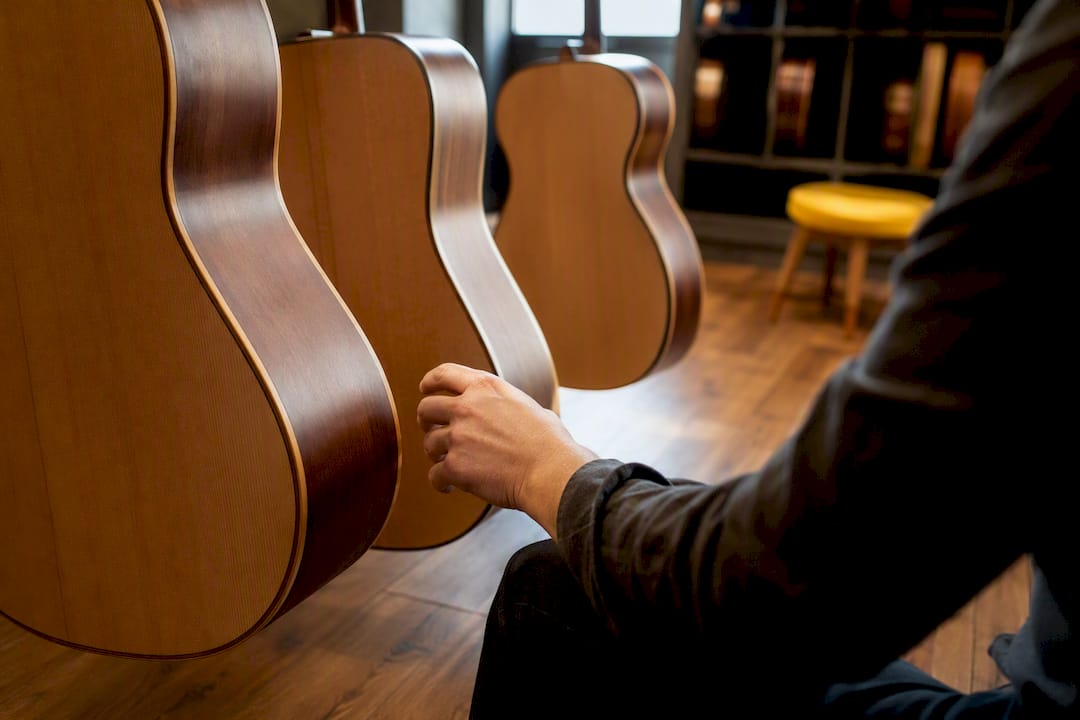
Fingerstyle players get the most out of a parlour, 0, 00 or 000/OM; strummers and flatpickers want a dreadnought or jumbo; travellers and smaller players need a mini or 3/4; and singer-songwriters who mix techniques usually land on a grand auditorium. Body shape shifts bass response, projection and comfort more than it shifts overall quality, so the right choice depends entirely on what you play and how you sit or stand while doing it. The catalogue below breaks down each family in detail.
- Small-bodied guitars like parlour, 0, and 00 shape emphasize midrange and articulation, making them ideal for fingerstyle and recording, despite their perceived lower volume.
- Medium-sized bodies such as grand concert and grand auditorium balance fingerstyle clarity and strumming, with specific design features like neck join and scale length affecting playability.
- Large shapes such as dreadnoughts and jumbos prioritize volume and bass response, but body depth and comfort should guide selection over simple outline shape.
- Construction elements like bracing pattern, top wood, and scale length often impact tone more than shape, requiring careful in-store testing with personal playing material.
- Authentic evaluation through hands-on testing and matching physical comfort to playing style surpasses reliance on shape reputation or brand mythology.
Table of Contents
- Acoustic guitar forms: small, medium and large explained
- Small bodies: parlour, 0, 00 and travel guitars
- Medium bodies: the versatile middle ground
- Large bodies: dreadnoughts, jumbos and grand orchestra shapes
- How to choose the right acoustic guitar shape
- Construction matters as much as shape: tonewoods, bracing and scale length
- How MusicStreet helps you choose the right shape
- Popular models that represent each body shape
- Where these shapes came from: a brief history
- Steel-string versus nylon-string body shapes
- Which shape suits which genre best
- How body depth and width change sound and comfort
- What actually matters when you’re choosing a shape
- Try these MusicStreet acoustics that match the shapes above
- Sources
- FAQ
Acoustic guitar forms: small, medium and large explained
Every acoustic guitar shape on the market falls into one of three rough size categories, and understanding this grouping does more for your buying decision than memorising individual model names.
Small bodies include parlour, 0, 00 and travel/mini shapes. Medium bodies cover concert, grand concert, 000/OM, grand auditorium and grand symphony. Large bodies are dreadnoughts, jumbos and grand orchestra shapes. Guides that map the historical development of these categories, such as Guitar World’s breakdown of acoustic shapes, consistently show that each group carries predictable tonal and ergonomic tendencies, even though individual builders bend those rules constantly.
The physics behind this is straightforward. A guitar’s top and back enclose a fixed volume of air, and that air cavity resonates at frequencies tied to its size and shape. A smaller box favours higher, tighter frequencies, which is why a parlour guitar sounds focused and immediate. A larger box has room for longer sound waves to develop, which produces the deep, room-filling bass of a dreadnought or jumbo. Waist width, upper bout size and body depth all interact with this air volume, so two “medium” guitars can still sound quite different depending on exactly how their curves are drawn.
Here’s the part most buying guides gloss over: shape sets the tendency, not the outcome.
- Top wood (spruce versus cedar, for instance) shifts brightness and headroom.
- Bracing pattern controls how freely the top vibrates, which affects sustain and volume.
- Scale length changes string tension, which alters how tight or loose the bass feels.
- Setup quality (action, nut and saddle work) can make or break how any shape actually plays.
Practitioner commentary on soundboard design backs this up directly: bracing pattern and tonewood selection often carry as much or more influence over the final tone than the shoulder shape itself, according to analysis from Premier Guitar. Treat shape as your starting filter, not your final answer, and you will make a far better decision in the shop.
Small bodies: parlour, 0, 00 and travel guitars
Small-bodied acoustics reward technique over volume, which is exactly why fingerstyle players and recording musicians gravitate towards them.
Parlour, 0 and 00 shapes produce a focused midrange with clear, articulate trebles. Individual notes in a fingerpicked arrangement stay distinct rather than blurring into a wash of low end, which is precisely what you want when a recording engineer is trying to capture detail rather than fight boom. These shapes also suit smaller players or anyone who finds a dreadnought’s lower bout awkward against the body while seated.
A common misconception is that small guitars are simply quieter. They are not quieter so much as narrower in their resonant frequency range. Within that range, a well-built parlour or 00 can sound surprisingly loud and lively, a point practitioner analysis on soundboard behaviour makes clear when comparing perceived volume against actual low-frequency output, per Premier Guitar’s soundboard analysis.
Travel and mini guitars (often labelled 3/4 or mini-jumbo variants) trade low end for portability and a scaled-down neck that suits smaller hands. Shorter scale lengths reduce string tension slightly, which can make barre chords easier for developing players or anyone with smaller hands, though the reduced body size does mean less bass presence than you would get from even a 00.
When you’re testing a small body in the shop, run through this checklist:
- Play a full open chord and listen for how long individual notes sustain before decaying.
- Fingerpick a simple pattern and check whether the bass and treble strings stay separated or blur together.
- Strum hard once and note whether the top compresses or stays articulate under pressure.
- Compare the same passage on a 00 and a 000 to hear how much low end you’d be giving up.
Pro Tip: Bring the exact style you play at home, not a generic demo riff. A parlour that sounds thin on a shop assistant’s blues lick might sound perfect once you play your own fingerstyle arrangement on it.
Medium bodies: the versatile middle ground
If you play more than one style, a medium-bodied guitar is almost always where you should start looking. This group includes concert, grand concert (GC), 000/OM, grand auditorium (GA) and grand symphony (GS) shapes, and it covers more working musicians than any other category.
The 000 and OM shapes look nearly identical but differ in two meaningful ways: scale length and neck join. The OM (Orchestra Model) typically uses a longer scale and a 14-fret neck join, while a traditional 000 sometimes uses a shorter scale and a 12-fret join. That neck join matters more than it sounds. A 14-fret design shifts the bridge position and, according to manufacturer explainers such as Taylor’s guide to body shapes, gives noticeably better access to the upper frets, which matters if you play lead lines or solo above the twelfth fret.
The grand auditorium has become something close to the default choice for gigging singer-songwriters, and for good reason. Its narrower waist reduces the boomy low-mid frequencies that can make strumming sound muddy, while keeping enough lower-bout volume for the guitar to still feel full during accompaniment. That balance between fingerstyle clarity and strumming body is why one Taylor-sourced insight describes the GA as a practical compromise for players who move between techniques within the same set.
The grand symphony sits a step up in size from the GA, adding more bass and overall body without tipping fully into dreadnought territory. It suits players who want the GA’s balance but with noticeably more low-end weight underneath.
To find the right medium shape for you, try this sequence in the shop:
- Play a fingerpicked pattern first and note how separated the bass and treble feel.
- Follow immediately with an aggressive strummed chord progression on the same guitar.
- Move up the neck past the twelfth fret and check how easily your hand reaches without straining against the body.
- Repeat the same three steps on a second medium shape and compare balance across the neck, not just volume.
- Ask what scale length the guitar uses, since a longer scale will feel tighter under the fingers even at identical string gauge.
The Yamaha FGX5 is a solid real-world example of this category in action: a genuinely versatile mid-size acoustic built for exactly the mixed-technique player this section describes.
Large bodies: dreadnoughts, jumbos and grand orchestra shapes
Large-bodied guitars exist for one main reason: volume and low-end weight that can hold up against a full band or a heavy strumming hand.
The dreadnought is the shape most people picture when they hear the word “acoustic guitar.” Martin introduced it in the early 20th century, and it remains the benchmark for pronounced bass and raw projection, a history and tonal profile well documented on Wikipedia’s dreadnought entry). Its square shoulders and deep lower bout push out a strong, punchy low end that suits flatpicking, bluegrass rhythm and vigorous open-chord strumming better than almost any other shape.
Within the dreadnought family, slope-shoulder variants offer a subtly different character than the traditional square-shoulder design. Rounding the upper bout tends to tame some of the midrange harshness that square-shoulder dreads can produce under hard strumming, which is why some players specifically seek out slope-shoulder models for cutting rhythm parts without the edge becoming fatiguing.
Jumbo and grand orchestra shapes push the size further still, delivering a big, balanced low end with strong sustain that suits players who want maximum output for solo performance or recording without amplification. The trade-off is comfort: a deep, wide jumbo body can feel unwieldy for smaller players, particularly when seated, and the extended reach across the lower bout while strumming can strain the picking arm during long sessions.
Before committing to a large body, check the following:
- Sit with the guitar as you normally would and note whether the waist rests comfortably against your leg or ribs.
- Strum a full chord progression for several minutes and watch for arm fatigue, not just tone.
- Compare a square-shoulder and slope-shoulder dreadnought back to back if the shop stocks both.
- Ask about body depth specifically, since two dreadnoughts with identical outlines can differ meaningfully in depth and therefore bass output.
Musicstreet’s guide on the dreadnought guitar type covers this shape in more depth if you want the full picture before deciding.
How to choose the right acoustic guitar shape
Start with what you actually play most often, not what looks impressive on a wall of guitars. The decision framework below moves from broad category down to a concrete in-shop test sequence.
- Identify your primary use. Solo fingerstyle or recording points towards small or medium bodies; rhythm-heavy strumming or band work points towards dreadnought or jumbo; portability needs point towards travel or mini shapes.
- Pick a size preference within that category. If fingerstyle is your focus, decide whether you want the intimacy of a parlour/00 or the added low end of a 000/OM.
- Test with your own material, not a shop demo riff, across at least two shapes in your chosen category.
- Check upper-fret access if you play lead lines or solos, since neck joint position (12-fret versus 14-fret) changes this significantly.
- Confirm comfort seated and standing, especially for anything in the jumbo or grand orchestra range.
Ask about (or check in any online listing) the scale length, bracing notes if listed, how many frets sit clear of the body, and the actual body depth in millimetres or inches, not just the outline shape. Two guitars can share a body name and still play very differently once depth and bracing vary.
Watch for red flags too: a neck that feels bowed under light pressure, strings sitting unusually high off the fretboard (poor action), buzzing on open chords, or a top that looks visibly sunken around the bridge. Any of these points to a poorly set-up instrument regardless of how good the shape is on paper, and guides on shape selection consistently recommend real A/B testing over relying on shape names alone, as Stringjoy’s body shape overview points out.
Pro Tip: If you’re torn between two shapes, ask to play them back to back on the exact same song, ideally something with both a fingerpicked verse and a strummed chorus. The contrast reveals more in ninety seconds than an hour of separate noodling.
Musicstreet’s guide to choosing the right guitar walks through this same process with more detail on fit and sizing for different body types.
Construction matters as much as shape: tonewoods, bracing and scale length
Bracing pattern and top wood selection frequently move the tone needle further than shoulder shape alone, according to practitioner analysis from Premier Guitar. That single point should temper how much weight you put on shape names when comparing guitars.
Scale length adds another variable. A longer scale increases string tension at the same pitch, which tightens low-end response and can make fingerstyle articulation crisper for players who like a firmer feel under the fingers, a relationship Stringjoy’s technical guide explains in more detail. Shorter scales feel looser and can suit lighter playing touches or smaller hands.
To hear this for yourself, try these quick in-store tests:
- Compare two similarly sized guitars with different top woods (spruce versus cedar, for example) and listen for headroom under hard strumming.
- If the shop has anything with scalloped bracing versus standard X-bracing, play both and listen for differences in sustain and midrange “bloom” rather than just raw bass.
- Ask what scale length each guitar uses before you play it, then see if you can feel the tension difference blind.
Body shape is one variable among several that interact to produce a guitar’s final voice. Treat it as a strong starting filter, but never assume the label on the headstock tells the whole story.
How MusicStreet helps you choose the right shape
Reading about body shapes only gets you so far. At some point you need hands on wood, which is exactly what Musicstreet’s online store and Huntingdon retail location are set up for.
Every instrument that leaves Musicstreet, new or pre-owned, goes through an expert inspection and setup before sale, and post-sale support and repair remain available afterwards. If you’re planning an in-store tryout, bring the material you actually play (not a generic demo piece), and ask the technician directly about action height, neck relief and bracing type on whatever you’re trying. Online orders can include a setup request at checkout, so distance from Huntingdon needn’t stop you getting a properly adjusted instrument.
Popular models that represent each body shape
Seeing a named production model against each shape category makes the abstract concrete.
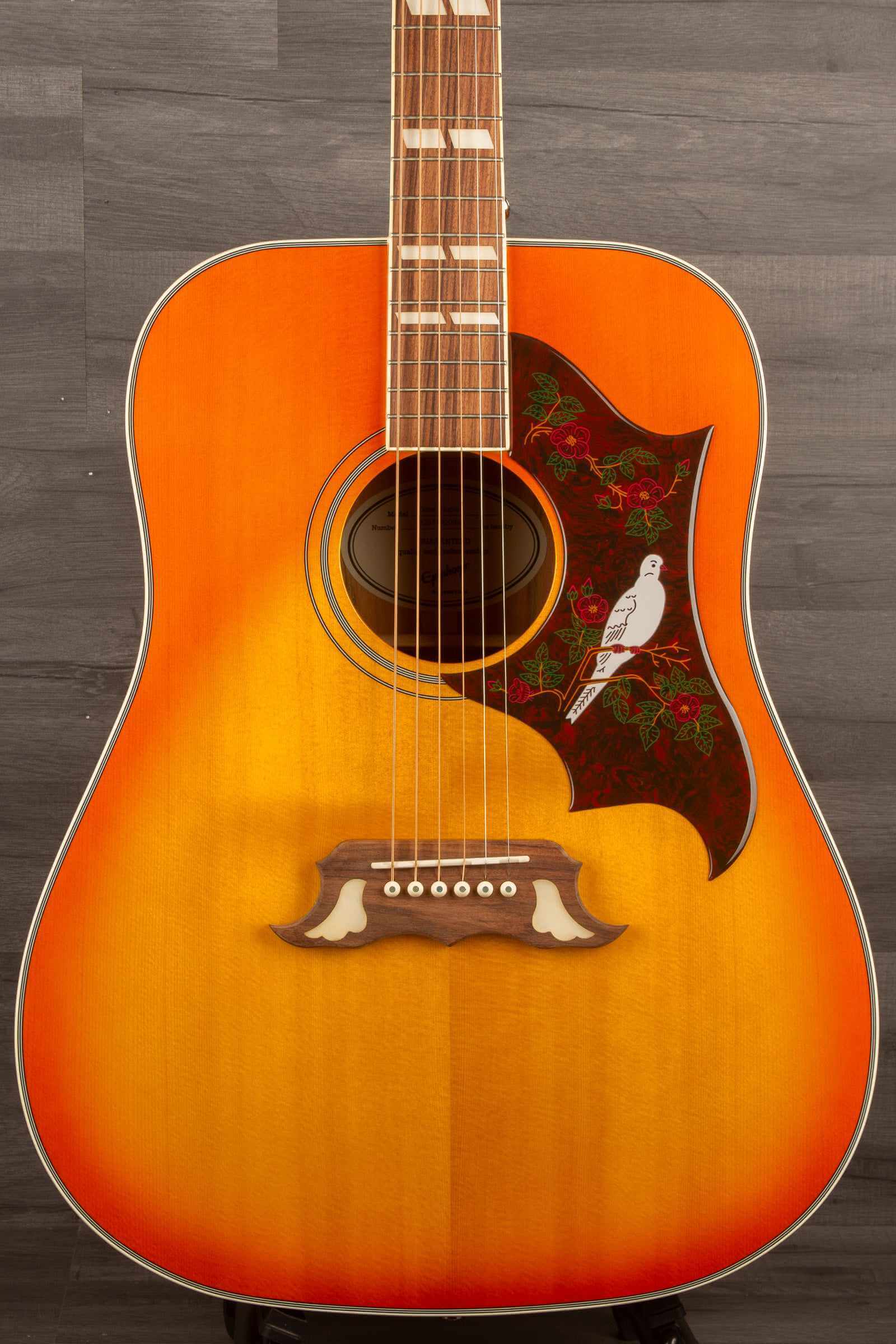
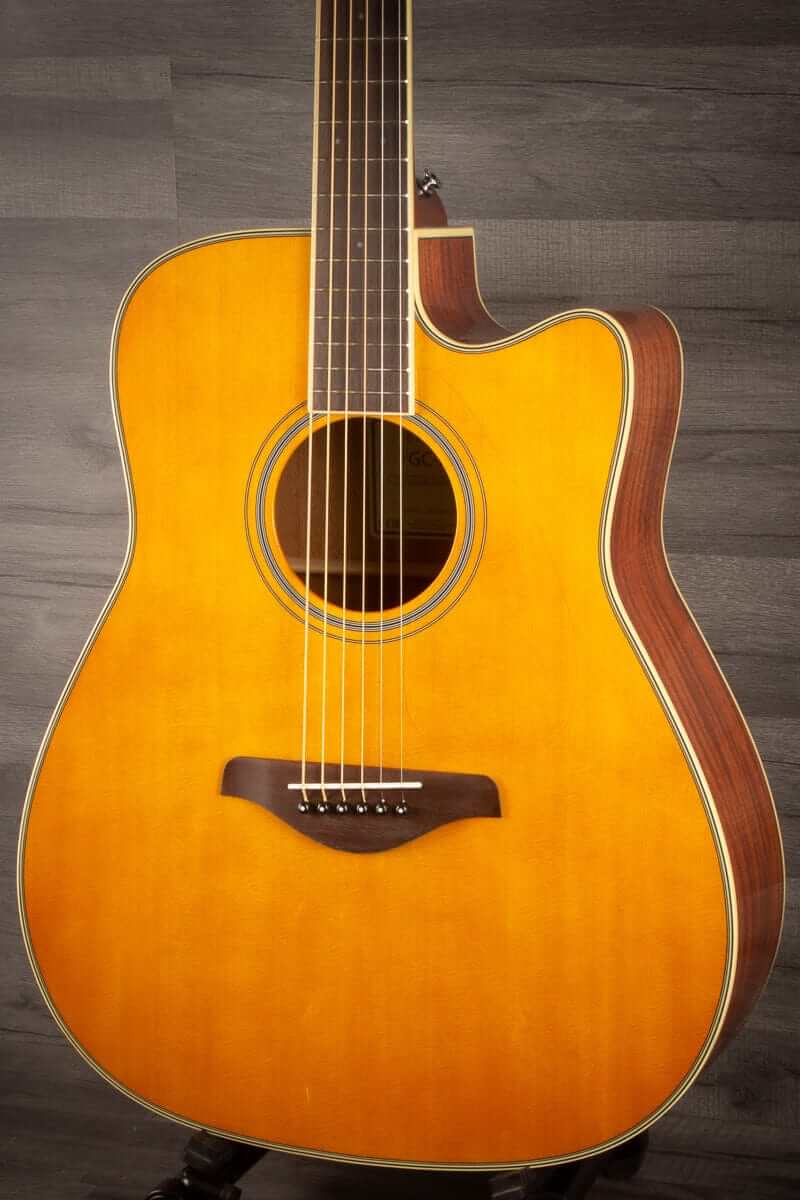
For small bodies, dreadnought maker Martin’s own smaller-bodied 00 and 0 series remain reference points that many other builders’ parlour-style guitars are measured against. For medium bodies, the Epiphone Dove Studio represents a square-shouldered take with a distinctive voice that sits between traditional dreadnought punch and a more balanced mid-size feel, wrapped in a striking violinburst finish. For players who want a cutaway medium body with amplification built in, the Yamaha FGC-TA TransAcoustic in vintage tint adds onboard reverb and chorus effects generated acoustically through the top itself, alongside a cutaway for upper-fret access. For grand auditorium style versatility, the Yamaha FGX5 covers the mixed fingerstyle-and-strumming use case that dominates this size category. For large bodies, Martin’s original D-18 and D-28 dreadnoughts remain the shape’s defining historical reference, still cited by builders whenever a new square-shoulder dreadnought is described.
Where these shapes came from: a brief history
Modern acoustic guitar shapes did not appear all at once. The parlour guitar dates back furthest, built small and light for home playing in an era before amplification, when a guitar simply had to be portable and pleasant in a domestic room rather than loud enough for a stage.
The 000 and OM shapes emerged in the early 20th century as builders looked for more volume and low end than a parlour could offer while keeping the guitar comfortable to play, and the OM specifically introduced the 14-fret neck join that later became standard across most steel-string acoustics.
The dreadnought arrived through Martin in the early 1900s, originally developed for the Ditson company before Martin took the design forward under its own name, according to Wikipedia’s account of the dreadnought’s origins. It was built explicitly for volume, to project over a band or fill a room without amplification, and it became the dominant flattop shape across country, folk and bluegrass through the mid-20th century.
Jumbo shapes followed as builders pushed size further still, chasing even more bass and sustain for solo performers who needed a full sound with no other instruments to lean on. More recently, manufacturers like Taylor formalised categories such as the Grand Auditorium and Grand Symphony, giving names to shapes that had been evolving informally for decades, as detailed in Taylor’s own shape guide.
Steel-string versus nylon-string body shapes
Steel-string and nylon-string (classical) guitars share some shape names in casual conversation, but their bodies are built to fundamentally different specifications. A classical guitar body is generally shaped closer to a concert or 00 profile, with a wider, flatter neck designed for nylon strings’ lower tension and a fanned internal bracing pattern suited to their gentler pull on the top.
Steel strings exert considerably more tension than nylon, so steel-string bodies need heavier internal bracing (typically X-bracing rather than fan bracing) simply to survive the pull without the top collapsing over time. This structural difference means you cannot simply restring a classical guitar with steel strings, or vice versa, without risking real damage to the instrument.
Playability differs too. Classical necks are wider and flatter, suited to the thumb-and-finger classical technique, while steel-string necks are narrower and often slightly curved (radiused) for barre chords and pick-based playing. If your genre involves classical or flamenco repertoire, a nylon-string body is the only sensible starting point; for folk, pop, rock, country or blues, steel-string shapes are what you want to be comparing.
Which shape suits which genre best
Genre preference narrows the shape conversation considerably, even before you factor in personal comfort.
Folk and singer-songwriter material tends to favour grand auditorium or 000/OM shapes, since both handle the fingerstyle-to-strumming switch that this genre often demands within a single song. Bluegrass and flatpicking almost always points towards a dreadnought, where the pronounced bass and cutting midrange support fast alternating bass runs and aggressive rhythm work. Blues, particularly acoustic and delta styles, often suits smaller bodies like the 00 or parlour, where the focused midrange complements slide technique and fingerpicked patterns without overwhelming low end.
Jazz and fingerstyle-heavy solo performance frequently favours 000 or grand concert shapes for their note separation and balance across registers. Rock and pop rhythm work, especially when recorded or played live with a band, often leans towards jumbo or grand orchestra shapes for the sheer output needed to compete with other instruments. None of these are hard rules. Plenty of recorded blues has been played on dreadnoughts, and plenty of bluegrass flatpickers have used smaller-bodied guitars. Genre is a strong starting signal, not a restriction.
How body depth and width change sound and comfort
Body depth (the distance from front to back through the guitar’s ribs) has an outsized effect on bass response that outline shape alone does not capture. A deeper body increases internal air volume even when the outline stays identical, pushing the resonant frequency lower and adding perceived bass weight. This is why two dreadnoughts with the same silhouette can sound noticeably different if one has a deeper body than the other.
Width, particularly across the lower bout, affects both projection and comfort. A wider lower bout generally means more surface area for the top to move, which typically increases volume and sustain, but it also means more guitar pressing against your body while seated or slung on a strap while standing.
For comfort specifically, depth matters more than most players expect. A guitar with a shallow body sits closer to your torso and can feel far less imposing during long sessions, even if its outline looks similarly sized to a deeper instrument on paper. If you’ve struggled with a jumbo or dreadnought feeling awkward against your ribs, checking the depth spec rather than dismissing the whole shape category is worth doing first.
What actually matters when you’re choosing a shape
The conventional advice on acoustic guitar shapes leans too heavily on brand mythology: buy a dreadnought because Martin invented it, buy a jumbo because it looks impressive on stage. That advice skips the part that actually determines whether you’ll enjoy playing the instrument in six months’ time.
Playability and real testing beat shape names every time. A well-braced, well-set-up medium body will often serve a mixed-technique player better than a poorly set-up dreadnought bought purely for its reputation. The research on bracing and tonewood influence backs this up clearly: shape sets a tendency, construction and setup decide the outcome.
If there’s one thing worth prioritising above all else, it’s testing your own material on the actual instrument, in person, before committing. Read the shape guides, understand the categories, but let your hands make the final call rather than a spec sheet or a famous name on the headstock.
— Music
Try these MusicStreet acoustics that match the shapes above
Reading about shapes is useful, but nothing replaces playing the instrument. Acoustic guitars are available across the size categories covered in this guide, with full setup and inspection completed before any instrument leaves the shop.
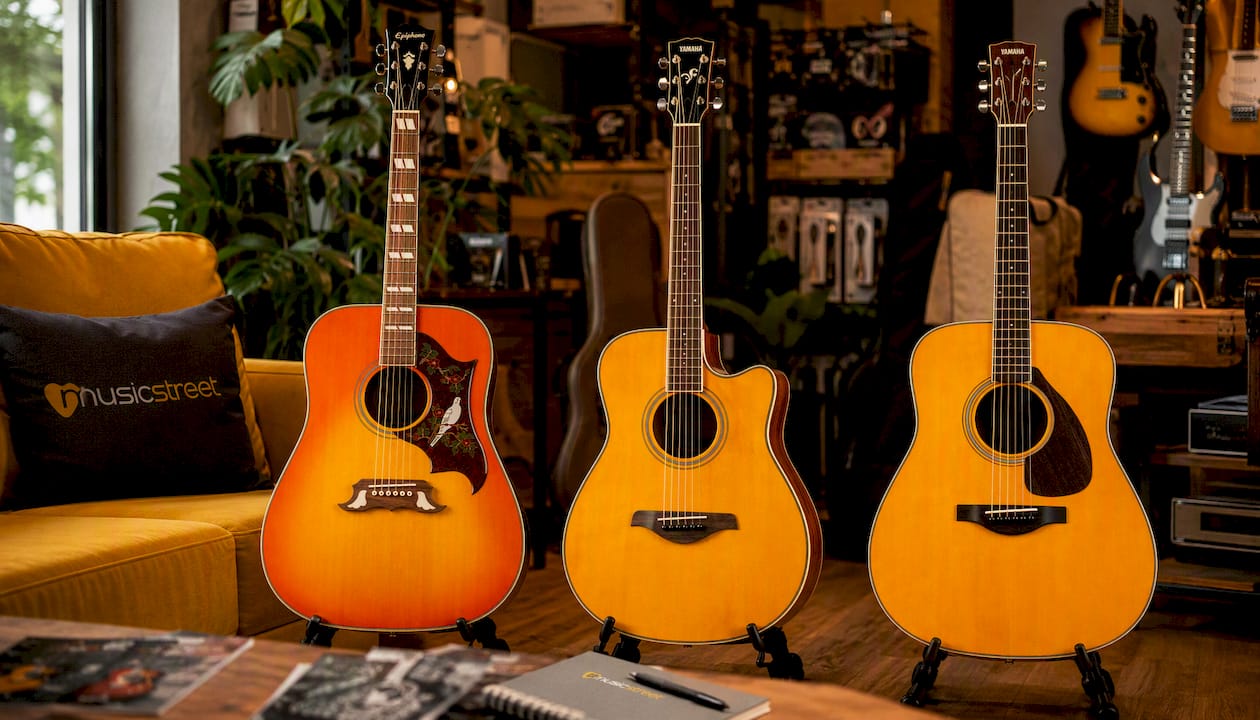
The Epiphone Dove Studio in Violinburst suits players drawn to a square-shouldered medium body with a distinctive look and voice, ideal if you want something between dreadnought punch and mid-size balance. The Yamaha FGC-TA TransAcoustic fits players who need a cutaway for upper-fret access plus built-in acoustic effects for solo performance without a separate amp. The Yamaha FGX5 matches the grand auditorium profile this guide recommends for anyone who splits their playing between fingerstyle and strumming.
You can arrange an in-store tryout at the Huntingdon location, or order online with a setup request added at checkout. New and pre-owned instruments both come with professional inspection completed beforehand, and free UK delivery applies on qualifying orders. Browse the full range at Musicstreet and book a tryout or place an order when you’re ready to hear one of these shapes for yourself.
Sources
- Acoustic guitar body shapes: a guide — Taylor Guitars
- Acoustic guitar shapes explained — Guitar World
- Acoustic soundboard: the shape of things — Premier Guitar
FAQ
What are the different acoustic guitar shapes?
The main families are parlour, 0 and 00 (small), 000/OM, grand concert and grand auditorium (medium), and dreadnought, jumbo and grand orchestra (large), plus travel/mini shapes and nylon-string classical bodies.
Why does Ed Sheeran use a 3/4 guitar?
Smaller-bodied 3/4 guitars offer a scaled-down neck and body that suit compact playing styles and percussive strumming techniques, while remaining easy to handle on stage and during travel.
What is the holy grail of acoustic guitars?
There’s no single “holy grail” shape. What counts as ideal depends entirely on playing style: fingerstyle players often prize 000/OM or grand concert bodies, while flatpickers and rhythm players tend to favour dreadnoughts for volume and bass.
What are the most popular guitar shapes?
The dreadnought remains the most widely recognised and purchased shape, largely thanks to its history with Martin and its versatility for strumming, with the grand auditorium a close second among singer-songwriters who mix techniques.
Do body shape and size affect tone more than the wood used?
Not necessarily. Practitioner analysis consistently finds that bracing pattern and top wood selection often influence final tone as much as, or more than, shoulder shape alone, so both deserve equal attention when comparing instruments.





Share:
Guitar Repair Shop Huntingdon: Realistic Turnaround Times
The Ultimate PRS Guitars Buyer's Guide: Models, Tones, and Playability Explained