


- Practicing guitar scales effectively requires proper warm-ups, a metronome, and slow, precise playing.
- Structured, gradual techniques and focus on musicality and articulation lead to genuine skill development.
- Breaking scales into chunks, intentional memorization, and slowing down foster long-term mastery and creativity.
Countless guitarists spend months running the same scale shapes up and down the fretboard and wonder why their playing never seems to improve. The frustration is real: you’re putting in the time, yet the results feel miles away. The truth is that repetition alone does not build skill. What transforms a mechanical exercise into genuine technique is how you practise, not simply how often. This guide walks you through every stage, from setting up the right environment and mindset, to building speed, developing musicality, and locking scale shapes into long-term memory so they become second nature.
Table of Contents
- What you need to practise guitar scales successfully
- Step-by-step routine: building technique and speed
- Adding musicality: how to make scales sound like music
- Memorisation and overcoming plateaus
- Why slow practice and creativity matter most
- Get more from your guitar journey with MusicStreet
- Frequently asked questions
Key Takeaways
| Point | Details |
|---|---|
| Start slow with a metronome | Clean timing and accuracy matter more than speed when first practising scales. |
| Use structured routines | Progress in stages—cycle, randomise, then apply scales musically for best results. |
| Add musicality | Experiment with rhythm, dynamics, and phrasing to make scales sound expressive and engaging. |
| Break scales into chunks | Memorising small sections and using visual shapes helps locked-in memory and speedy recall. |
What you need to practise guitar scales successfully
Before you play a single note, the foundations matter enormously. Turning up to a practice session without a proper warm-up, a reliable metronome, or a comfortable instrument is like trying to run a sprint in heavy boots. You might get somewhere, but you’ll work far harder than necessary and risk forming bad habits along the way.
Warm up first, every time. Spend at least ten minutes on finger stretches and gentle hand exercises before touching the fretboard. This reduces the risk of repetitive strain injury and primes your muscles for the precise movements scales demand. Simple spider exercises across the strings and gentle wrist rotations are a good starting point.
The metronome is non-negotiable. Daily routine benchmarks show that starting at 40 to 60 BPM, then increasing in 5 BPM increments only when your playing is flawless, is the most effective way to build reliable tempo. Many players skip the metronome because it feels slow and boring. That is precisely why most players plateau.
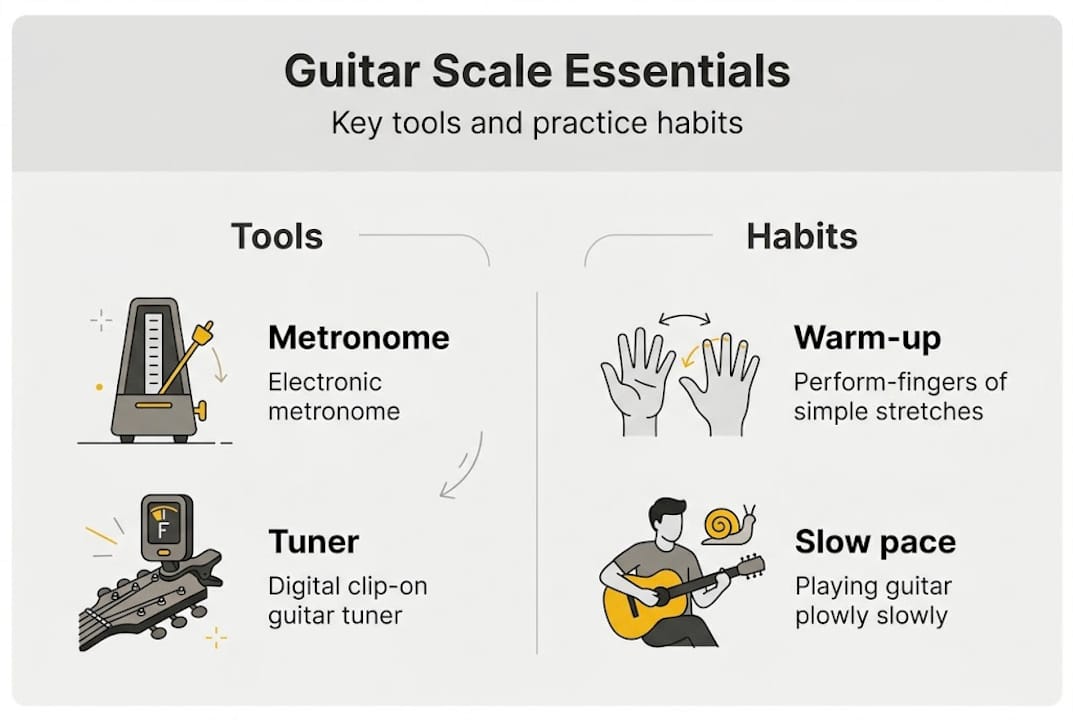
Start slow with a metronome, focusing on clean notes, proper fingering using one finger per fret, and even timing before increasing speed in small increments. This is not a suggestion; it is the bedrock of technique development.
Choose a guitar that fits your hands. Playability matters far more than brand prestige at the practice stage. A guitar with high action or a poorly set-up neck makes clean fretting exhausting, particularly for beginners working through scale shapes for the first time. A well-maintained instrument removes unnecessary friction from the process. Check out our guitar maintenance tips to keep your guitar in the best possible condition for practice.
Here is a quick comparison of common practice setups and their effectiveness:
| Setup | Pros | Cons |
|---|---|---|
| Acoustic guitar, no metronome | Builds finger strength | Timing suffers without a beat reference |
| Electric guitar with metronome app | Flexible, portable, precise | Headphones required for quiet practice |
| Electric with proper amp and metronome | Best tone feedback | Requires more setup time |
| Classical guitar for technique work | Excellent for finger independence | String spacing differs from electric |
The key mindset shift you need to make is this: slow and clean always beats fast and sloppy. Speed is a byproduct of accuracy, not the other way around. The beginner guitar workflow guide on our blog breaks this down further if you want a broader framework for your early practice sessions.
- Warm up for 10 minutes before every session
- Set your metronome between 40 and 60 BPM to begin
- Use one finger per fret for clean, independent movement
- Keep sessions to 20 to 30 minutes of active scale work
- Always prioritise tone and accuracy over tempo
Pro Tip: Record yourself on your phone for 60 seconds while practising a scale. Listening back reveals timing inconsistencies and muted notes that your fingers simply do not notice in the moment.
Step-by-step routine: building technique and speed
Once you have your essentials ready, it is time to get into the nuts and bolts of your routine. Having the right gear and mindset is only half the battle. Without a structured method, even motivated players tend to spin their wheels, repeating the same patterns without any real progression.
Start every session by selecting a single scale and sticking with it for the entire practice block. Jumping between shapes might feel productive, but depth beats breadth every time. If you are a beginner, start with the C major or A minor pentatonic scale. Both are forgiving and widely applicable.
Follow a structured five-stage method. JustinGuitar’s 5-stage method is one of the most well-regarded approaches for scale development:
- Cycle up and down the scale perfectly four times in a row without any mistakes
- Introduce random direction changes so you are not just running top to bottom automatically
- Play random notes within the scale to build genuine knowledge of the shape rather than muscle memory alone
- Play the scale in thirds, which develops melodic thinking and ear training simultaneously
- Play four notes in a line, shifting up one note each time, which builds phrasing vocabulary
Each stage must be completed cleanly at your current tempo before you progress. This is not a race.
Here is a useful practice tempo roadmap to guide your progression:
| Tempo (BPM) | Stage | Expected timeline |
|---|---|---|
| 40 to 60 | Slow, clean fundamentals | Week 1 to 2 |
| 65 to 80 | Introducing direction changes | Week 3 to 4 |
| 85 to 100 | Thirds and four-note sequences | Month 2 |
| 105 to 120 | Full musical application | Month 3 onwards |
“Practice makes permanent. Slow, perfect repetitions build speed without embedding bad habits. Always contextualise with backing tracks to develop your ear and phrasing, and avoid noodling aimlessly.” Guitar scale exercises
Pattern choices matter enormously. Practise patterns such as box patterns for beginners, three-notes-per-string for building speed, and vertical or horizontal movement across the fretboard each serve distinct purposes. Box patterns help you map out the neck visually. Three-notes-per-string patterns encourage efficient picking technique and better legato runs. Mixing both approaches gives you a more versatile toolkit.
Alternate picking should be your default technique throughout every exercise. Down-up-down-up, consistently and consciously, builds the mechanical foundation for speed that feels effortless rather than forced. Our article on guitar lessons for beginners covers picking mechanics in more detail if you want to nail this early.
Pro Tip: Once you can play a scale cleanly at 80 BPM, add a simple backing track in the same key and improvise freely for two minutes. This bridges the gap between exercise and real music faster than any technical drill alone.
As you grow in confidence, explore guitar mastery tips to understand how these scale fundamentals fit into a longer-term development plan.
Adding musicality: how to make scales sound like music
After developing solid mechanics and speed, bringing scales to life is the next step. This is where many technically proficient guitarists get stuck. They can run a scale cleanly at 120 BPM but still sound robotic and expressionless when improvising. The reason is simple: they have never deliberately practised making scales musical.

Vary your rhythms. Playing every note as an identical eighth note is the fastest route to sounding mechanical. Try inserting triplets, dotted rhythms, and syncopated phrasing into the same scale shapes you already know. A simple pentatonic run suddenly becomes compelling when you delay the resolution by half a beat. It is not magic; it is just rhythm.
Vary your dynamics. Practise the same phrase piano (softly) and then forte (loudly). Notice how the emotional weight of the phrase changes entirely. Incorporate musicality by varying rhythms, dynamics, and articulation, and by targeting chord tones for better improvisation. This single change separates players who have learned scales from players who can use them.
Articulation is everything. Hammer-ons, pull-offs, slides, and bends are not embellishments you add after you are “good enough.” They are core to expressive playing and should be woven into scale practice from day one. A slide into the third note of a pentatonic lick sounds immediately musical. The same three notes played with stiff, even picking sounds like a warm-up exercise.
Here are practical articulation techniques to incorporate into your daily scale work:
- Hammer-ons and pull-offs: Reduce pick strokes to create legato phrases
- Slides: Connect scale positions fluidly and add forward momentum to phrases
- Vibrato: Apply at the end of held notes to add singing quality to your tone
- Bends: Target the third or fifth of the underlying chord for expressive impact
- Dynamics: Consciously soften and push your picking attack within the same phrase
Target chord tones deliberately. When a C major chord is playing underneath you, lean on C, E, and G within your scale runs. Your ear will immediately notice how certain notes feel resolved while others create tension. Learning to control that tension and release is what improvisation is actually about. Our guide on guitar playing techniques explores this concept in depth.
For more structured daily approaches, the practice tips for electric guitarists on our blog are well worth reading alongside this section.
Memorisation and overcoming plateaus
While musicality is motivating, real retention and beating ruts rely on smart memorisation. Many guitarists can play a scale in one key and completely fall apart when asked to transpose it. This is because they have memorised a shape without understanding why it works. Real fluency means knowing the scale across the entire neck in multiple keys.
Break it into chunks. Memorise scales by breaking them into smaller chunks, visualising the shapes, and learning one position deeply before adding more. Trying to learn five positions of the pentatonic scale simultaneously leads to shallow knowledge of all five. Mastering one position completely, until you can play it forwards, backwards, in thirds, and rhythmically varied, is far more valuable.
Here is a step-by-step memorisation process to work through:
- Learn the scale in one box position in the key of A
- Play it slowly, always starting and ending on the root note so your ear learns the tonal centre
- Close your eyes and visualise the shape on the fretboard before playing
- Practise the same shape in the key of E using the circle of fifths as your guide
- Once both keys are solid, connect the two positions horizontally across the neck
The circle of fifths is your best friend. Moving through keys in fifths (C, G, D, A, E, B and so on) rather than randomly means each new key feels logically related to the last. Progress through the circle at a rate of one new key per week, only moving on when the previous key is genuinely solid.
“Always start and end on the root note. Your ear needs to understand where home is before it can navigate freely within a scale.” Beginners scale FAQ
Plateaus are normal, but not inevitable. If you feel stuck, the most common cause is that you have been practising the same patterns in the same keys at the same tempos for too long. Introduce one new element, whether that is a new key, a new rhythm, or a new position, and the stagnation usually breaks quickly.
Pro Tip: Spend one session each week playing scales exclusively from memory, without looking at your hands. This forces your brain to build a stronger mental map of the fretboard rather than relying on visual confirmation.
For players also working on bass, the bass guitar scales guide is a solid companion resource. And when you feel ready to apply your scales in a song context, exploring easy guitar songs for beginners is an excellent next step.
Why slow practice and creativity matter most
Here is an opinion that contradicts what most guitarists chase: speed is one of the least important goals in scale practice, at least for the first year. The obsession with playing fast comes from watching videos of skilled players and assuming that their speed is what makes them compelling. It is not. What makes them compelling is that every note they play sounds intentional.
Common pitfalls in scale practice include rushing speed and causing mistakes, practising without a metronome which leads to uneven timing, and treating scales as isolated exercises without musical application. The result is what experts call “scalular” playing, robotic runs that sound like warm-ups regardless of how fast they travel. Depth in a few scales with creative phrasing always outperforms a superficial knowledge of many.
We have seen players at MusicStreet come in after years of frustrated practice, running scales for 45 minutes a day at full tilt and wondering why their solos sound empty. The breakthrough, almost without exception, comes when they slow down, listen more carefully, and start asking “does this phrase mean something?” rather than “how fast can I play this?”
Creativity in scale practice is not a luxury you earn after technique is sorted. It is a core ingredient from day one. Play less, but play with more intention. That shift, perhaps more than any technical drill, is what separates players who grow from those who stagnate. Explore more on building long-term skill at mastering the guitar.
Get more from your guitar journey with MusicStreet
Ready to transform your scale practice into real progress? Having the right instrument makes a genuine difference to how motivated and comfortable you feel during daily sessions.

At MusicStreet, we stock a carefully selected range of electric, acoustic, and bass guitars from trusted brands, all professionally inspected and set up before they reach you. Whether you are a beginner looking for your first playable instrument or an experienced player seeking an upgrade that inspires new creativity, our team in Huntingdon is here to help. Browse our full collection online, book an in-store tryout, or get in touch for personalised advice. Free UK delivery is available on qualifying orders, and every purchase comes with expert post-sale support.
Frequently asked questions
How many minutes a day should I practise guitar scales?
Aim for 20 to 30 minutes of focused scale practice daily, which supports steady improvement without causing fatigue or mental burnout.
Is it better to practise scales fast or slow?
Always start slow with a metronome and only increase tempo when every note is clean; slow, accurate repetitions are what genuinely build lasting speed and reliable technique.
What scale patterns should beginners use?
Box patterns for beginners provide the clearest visual map of the fretboard, so start there with one key before exploring three-notes-per-string or horizontal patterns.
How can I memorise guitar scales easily?
Break scales into chunks, learn one position thoroughly, always start and end on the root note, and work through new keys using the circle of fifths for structured, lasting retention.








Share:
7 Signs Your Guitar Needs a Professional Setup
Top 5 Challenges Beginners Encounter When Selecting Their First Guitar Model Explained