


Many guitarists assume P90 pickups are simply another type of single-coil, similar to Fender Stratocaster pickups, or perhaps a weaker humbucker. Neither assumption is accurate. P90 pickups occupy a unique sonic territory, delivering a gritty, punchy tone that bridges the clarity of single-coils with the warmth of humbuckers. This guide explores what P90 pickups are, their historical origins, how they differ from other pickup types, and why they might be the perfect upgrade for your guitar.
Table of Contents
- Key takeaways
- What is a P90 pickup? Origins and design essentials
- Understanding P90 tone and variants: what sets them apart
- How P90 pickups compare with single-coils and humbuckers
- Practical applications and choosing the right P90 for your guitar
- Explore premium guitars with P90 pickups at MusicStreet
- FAQ
Key Takeaways
| Point | Details |
|---|---|
| Origins and design | The P90 was developed by Gibson in 1946 as a single coil with a wider, shorter bobbin to increase output and alter frequency response. |
| Distinct tonal niche | It sits between Fender style single coils and humbuckers, delivering gritty punch and midrange warmth with clear articulation. |
| Variants and mounting | Variants include soapbar, dog ear, humbucker sized and mini P90s, each with different mounting and tonal character. |
| Dynamic response and output | P90s respond dynamically to pick attack, offering more output than standard single coils while maintaining clarity and touch sensitivity. |
What is a P90 pickup? Origins and design essentials
The P90 pickup is a single-coil electric guitar pickup developed by Gibson in 1946, marking a significant innovation in electric guitar pickups. Unlike the Fender single-coils that would emerge later, Gibson designed the P90 with a wider, shorter bobbin construction that fundamentally altered its tonal characteristics. This design choice wasn’t arbitrary but rather a deliberate engineering decision to create a pickup with more output and a different frequency response.
The physical construction of a P90 features a wider, shorter bobbin than Fender single-coils, with bar magnets under adjustable steel pole pieces, producing higher output. This configuration uses bar magnets positioned beneath the bobbin rather than individual pole piece magnets. The adjustable steel pole pieces sit above these bar magnets, allowing players to fine-tune the output balance between strings. This arrangement contributes to the pickup’s distinctive voice and increased power compared to traditional single-coils.
Electrically, P90 pickups exhibit specific characteristics that define their performance. The DC resistance typically measures between 7.5kΩ and 8.5kΩ, placing them in a middle ground between lower output single-coils and higher output humbuckers. The bobbin contains approximately 8,000 to 9,500 turns of AWG 42 wire, creating a resonant frequency around 6.4 kHz. This resonant peak influences the pickup’s tonal emphasis, contributing to the pronounced midrange character that P90s are known for.
Key design elements include:
- Wide, short bobbin configuration for increased magnetic field
- Bar magnets beneath adjustable pole pieces for balanced output
- DC resistance of 7.5kΩ to 8.5kΩ for moderate output
- Resonant frequency near 6.4 kHz emphasising midrange frequencies
- Single-coil construction maintaining clarity and detail
The P90 pickup Wikipedia article provides additional technical details about the variations and historical context of these pickups. Understanding these design fundamentals helps explain why P90 pickups sound distinctly different from both Fender single-coils and humbuckers, occupying their own sonic niche in the pickup landscape.
Understanding P90 tone and variants: what sets them apart
The P90’s tone is gritty, thick midrange, warmer and punchier than Fender single-coils but brighter and edgier than humbuckers with dynamic response to pick attack. This tonal character makes P90 pickups immediately recognisable. When you strike a string hard, the pickup responds with aggressive bite and clarity. Play softly, and it cleans up beautifully, offering touch sensitivity that many humbuckers cannot match. This dynamic range makes P90s exceptionally versatile across different playing styles and gain settings.

The physical variants include soapbar (rectangular), dog-ear (protruding mounts), humbucker-sized, and mini P90s with magnets Alnico II, V, and IV affecting smoothness versus aggression. Soapbar P90s feature a simple rectangular housing that mounts directly into the guitar body, representing the original design. Dog-ear variants include protruding mounting tabs on either side, allowing installation on guitars with different routing. Mini P90s fit into humbucker-sized cavities, making them ideal for guitars originally designed for humbuckers without requiring modification.
| Variant | Mounting style | Tonal character | Best for |
|---|---|---|---|
| Soapbar | Direct body mount | Classic P90 tone | Les Paul Juniors, SGs |
| Dog-ear | Protruding tabs | Slightly airier top end | Archtops, ES models |
| Mini P90 | Humbucker-sized | Compact P90 voice | Humbucker-routed guitars |
| Humbucker-sized | Standard humbucker mount | Full P90 tone in HB cavity | Modern guitars |
Magnet selection significantly impacts the final tone. Alnico V magnets deliver more aggressive saturation with tighter bass response and pronounced treble bite, making them ideal for rock and punk applications. Alnico II magnets provide smoother warmth with softer attack characteristics, favouring blues and jazz players who want vintage sweetness. Alnico IV sits between these extremes, offering balanced output with moderate aggression. Winding tension, whether scatter or layered, and enamel type alter clarity versus focus, with Alnico V providing aggressive saturation.
Additional tonal factors include:
- Wire gauge and insulation affecting capacitance and high-frequency response
- Bobbin material influencing magnetic field shape
- Pole piece height adjustment for string-to-string balance
- Cover material (if used) slightly dampening treble frequencies
Pro Tip: When selecting a P90 variant, consider your guitar’s existing routing first. Installing a soapbar P90 in a humbucker-routed guitar requires significant woodwork, whilst humbucker-sized P90s drop straight in. If you value authenticity and have proper routing, soapbar or dog-ear variants deliver the most traditional P90 experience.
Understanding these variants and magnet options helps you make informed decisions when upgrading guitar pickups. The right combination depends on your playing style, musical genre, and the specific tonal qualities you’re seeking. Testing different configurations reveals how sensitive P90 tone is to these variables.
How P90 pickups compare with single-coils and humbuckers
P90 pickups occupy a midpoint tone and output between single-coils and humbuckers, combining single-coil clarity with humbucker warmth, with DC resistance of 7 to 9kΩ versus single-coil 5 to 7kΩ and humbucker 7 to 15kΩ. This electrical specification directly translates to sonic characteristics. Fender single-coils typically measure 5kΩ to 7kΩ, producing bright, articulate tones with pronounced treble and scooped midrange. Humbuckers range from 7kΩ to 15kΩ or higher, delivering thick, warm tones with compressed dynamics and reduced high-frequency content.
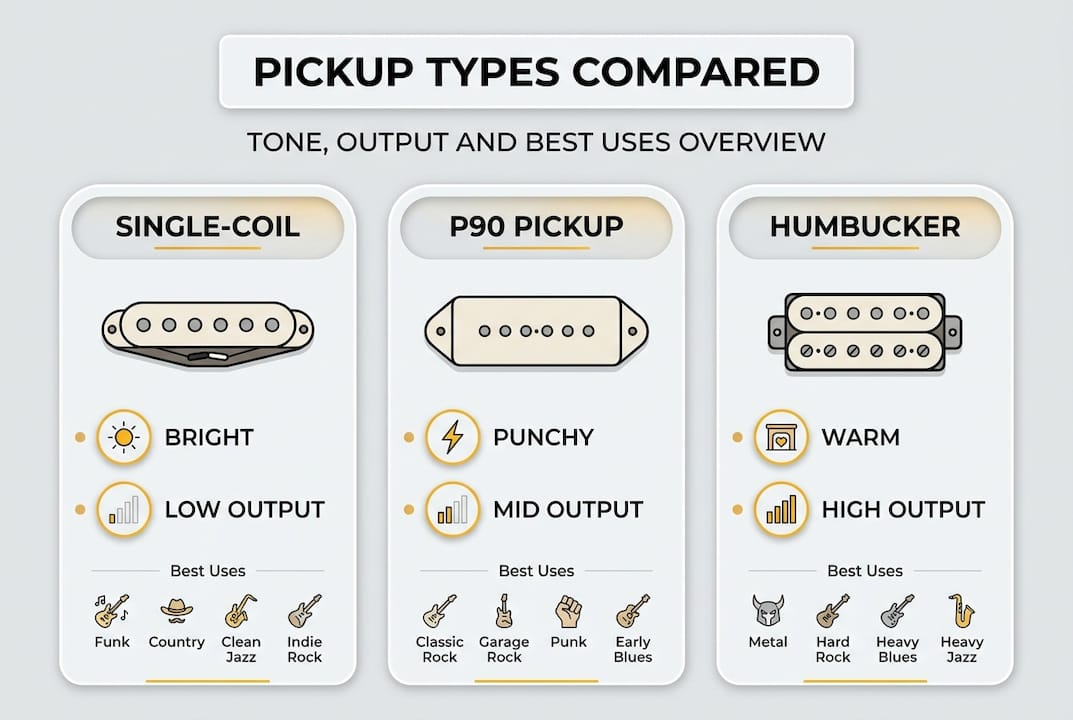
The inductance and capacitance values of P90 pickups also fall between these two extremes, affecting how they interact with your guitar’s tone controls and cable capacitance. Higher inductance in P90s compared to Fender single-coils results in more midrange emphasis and slightly rolled-off treble. Lower inductance compared to most humbuckers maintains better high-frequency clarity and pick attack definition. This balance creates the P90’s signature voice.
| Pickup type | DC resistance | Tonal character | Hum susceptibility | Best for |
|---|---|---|---|---|
| Fender single-coil | 5-7kΩ | Bright, articulate, scooped mids | High | Clean tones, funk, country |
| P90 | 7-9kΩ | Gritty, thick mids, balanced | Moderate | Blues, rock, punk, jazz |
| Humbucker | 7-15kΩ | Warm, thick, compressed | Low (cancelled) | High-gain rock, metal |
Single-coils offer exceptional clarity and string separation, making them ideal for clean tones and styles requiring precise articulation. However, they generate significant 60-cycle hum in environments with electromagnetic interference. Humbuckers eliminate this hum through their dual-coil design but often compress dynamics and reduce high-frequency sparkle. Some players prefer P90s for superior dynamics and clarity over humbuckers’ compression, whilst humbuckers excel for high-gain noise-free metal.
P90 pickups generate moderate hum, more than humbuckers but typically less than Fender single-coils due to their construction and winding characteristics. This hum becomes noticeable in high-gain situations or near electromagnetic interference sources like transformers and fluorescent lights. However, many players accept this trade-off for the raw, dynamic character that P90s provide. The hum is part of the vintage authenticity that defines the P90 experience.
Key comparison points:
- Output level: P90s deliver more punch than single-coils, less thickness than humbuckers
- Frequency response: Balanced across spectrum versus single-coil brightness or humbucker warmth
- Dynamic response: P90s maintain excellent touch sensitivity unlike many humbuckers
- Noise characteristics: Moderate hum acceptable for vintage tone seekers
Pro Tip: If you’re switching from humbuckers to P90s, expect your amp settings to require adjustment. P90s have more treble content and midrange bite, so you’ll likely need to reduce treble and increase bass slightly. The increased dynamics also mean your playing technique becomes more apparent, rewarding clean execution.
Understanding the role of guitar pickups in sound helps contextualise these differences. Each pickup type serves specific musical purposes, and P90s excel where you need aggressive midrange character without sacrificing clarity or dynamic range.
Practical applications and choosing the right P90 for your guitar
P90 pickups are ideal for blues, rock, punk, and jazz upgrades seeking raw vintage grit without full humbucker smoothness, with pickup height testing crucial for edge cases like feedback. These genres benefit from the P90’s ability to deliver both clean articulation and aggressive overdrive characteristics. Blues players appreciate how P90s respond to volume knob adjustments, cleaning up beautifully when rolled back. Rock guitarists value the midrange punch that cuts through band mixes without excessive treble harshness.
When selecting a P90 for your guitar, follow these steps:
- Verify your guitar’s pickup routing dimensions and mounting style requirements
- Determine which variant (soapbar, dog-ear, mini, or humbucker-sized) fits your existing cavities
- Choose magnet type based on desired aggression level (Alnico II for warmth, V for bite)
- Consider whether you need a bridge or neck position pickup with appropriate output balance
- Test pickup height settings to optimise tone, output, and feedback control
- Evaluate your amplifier and effects chain compatibility with P90 tonal characteristics
Guitar compatibility extends beyond physical dimensions. Solid-body guitars like Les Paul Juniors, SGs, and certain Telecaster models traditionally house P90s and provide ideal tonal platforms. Semi-hollow and hollow-body guitars also work excellently with P90s, though feedback management becomes more critical. The wood type, body thickness, and scale length all interact with P90 pickups to shape the final tone.
Pickup height adjustment significantly affects P90 performance. Setting the pickup too close to the strings increases output but can cause unwanted magnetic pull on the strings, affecting sustain and intonation. Positioning too far reduces output and clarity. Start with the pickup approximately 3mm from the strings when fretted at the highest fret, then adjust to taste. Bridge pickups typically sit slightly closer than neck pickups to balance output levels.
Practical considerations include:
- Shielding your guitar’s control cavity to minimise hum interference
- Using quality capacitors in tone circuits to preserve P90 clarity when rolled off
- Matching pickup output levels between neck and bridge positions for smooth switching
- Considering coil-splitting or phase-switching options for tonal versatility
- Testing different string gauges as heavier strings can enhance P90 midrange punch
Pro Tip: P90 pickups reveal every nuance of your playing technique and amplifier settings. Before upgrading, ensure your current setup is optimised. Poor technique or mismatched amplifier settings will become more apparent with P90s. This transparency is an asset for players wanting to refine their tone, but it requires attention to the complete signal chain.
Upgrading to P90s can transform your guitar’s voice without losing single-coil clarity. Many players discover new tonal possibilities that inspire different playing approaches and songwriting ideas. The key is matching the right P90 variant and specification to your musical goals and existing equipment. Experimenting with electric guitar and amp duos helps identify which combinations maximise P90 potential.
Genre-specific applications demonstrate P90 versatility. Blues players benefit from the warm, vocal-like quality that responds to subtle volume and tone control adjustments. Rock guitarists exploit the aggressive midrange that cuts through dense mixes without harshness. Punk musicians appreciate the raw, unpolished character that adds authenticity to power chord riffs. Jazz players value the warmth and clarity for complex chord voicings and single-note lines.
Testing different amplifier settings reveals P90 adaptability. Clean amp settings showcase the pickup’s clarity and dynamic range. Light overdrive brings out the gritty character that defines the P90 sound. High-gain settings can work but may emphasise the hum, making noise gate pedals useful. Many players find P90s excel in the sweet spot between clean and heavily distorted, where the pickup’s natural compression and harmonic richness shine.
Explore premium guitars with P90 pickups at MusicStreet
If you’re ready to experience the distinctive character of P90 pickups firsthand, MusicStreet offers an expertly curated selection of guitars featuring authentic P90 configurations. Whether you’re a beginner exploring your first serious upgrade or a professional seeking vintage tone for studio work, you’ll find instruments suited to every skill level and budget.

Our team provides personalised guidance to help you select the ideal P90-equipped guitar for your playing style and musical goals. Visit our Huntingdon showroom to test various models through quality amplifiers, or explore our online catalogue featuring detailed specifications and setup information. Every guitar receives professional inspection and setup before delivery, ensuring optimal playability and tone from the moment you receive it.
FAQ
What is the noise level of P90 pickups compared to others?
P90s are susceptible to 60-cycle hum similar to single-coils, less than Fender single-coils but more than humbuckers. The single-coil design means they pick up electromagnetic interference, though their construction typically generates slightly less hum than traditional Fender-style pickups. Humbuckers remain the quietest option due to their noise-cancelling dual-coil design. Some manufacturers offer hum-cancelling P90 variants using stacked coils or dummy coils, reducing noise whilst attempting to preserve the classic P90 tone.
Can I install P90 pickups in any electric guitar?
P90 installation depends on your guitar’s existing pickup routing and mounting configuration. Guitars originally designed for P90s accept them directly, whilst others require routing modification or adapter rings. Soapbar P90s need specific rectangular cavities, dog-ear variants require different mounting points, and humbucker-sized P90s fit standard humbucker routes without modification. Always measure your guitar’s pickup cavities and consult a qualified guitar technician before purchasing P90 pickups to ensure compatibility and avoid irreversible modifications.
What music styles benefit most from P90 pickups?
P90 pickups excel in blues, rock, punk, and jazz genres where gritty midrange character and dynamic response enhance the musical expression. Blues players appreciate the vocal-like quality and touch sensitivity for expressive lead work. Rock guitarists value the aggressive punch that cuts through band mixes. Punk musicians favour the raw, unpolished character that adds authenticity. Jazz players benefit from the warmth and clarity for complex chord voicings. The versatility across these styles demonstrates why P90s remain popular nearly 80 years after their introduction.
How do I adjust P90 pickup height for optimal tone?
Start by fretting each string at the highest fret and measuring the distance between the pickup pole piece and string bottom. Begin with approximately 3mm for the bass side and 2.5mm for the treble side, then adjust based on your preferences. Raising the pickup increases output and midrange emphasis but can cause magnetic interference with string vibration. Lowering it reduces output but improves clarity and sustain. Make small adjustments, testing tone and playability after each change, until you achieve the balance you want.
Are P90 pickups suitable for high-gain metal tones?
Whilst P90 pickups can handle moderate to high gain, they’re not typically the first choice for extreme metal applications. The single-coil design generates hum that becomes problematic at high-gain levels, and the pronounced midrange can sound harsh with excessive distortion. However, some metal players use P90s for specific tonal qualities, employing noise gates to manage hum. Humbuckers generally provide better noise performance and smoother saturation for high-gain metal, though P90s work well for classic rock, hard rock, and punk styles requiring aggressive but not extreme distortion levels.






Share:
Master acoustic guitar maintenance steps for lasting sound
Understanding tonewood: How guitar woods shape your sound