


Most players moving to a 7‑string should buy a 26.5in or 27in scale if the goal is a tight, clear low B, or stick with the familiar 25.5in scale if they want a six‑string feel with one extra low string bolted on. Baritone lengths near 30in exist, but they’re built for A standard or lower, not general‑purpose metal or prog work.
The reasoning comes down to physics: at the same pitch, a longer scale needs more tension to reach that note. More tension means a tighter, clearer low string and less flabby buzz when you drop to B or A. Shorter scales feel more familiar under the fretting hand but need thicker strings or lower tuning targets to compensate.
- Want tight low‑B or Drop A with minimal fuss? Go 26.5in–27in.
- Coming from a six‑string and want the same reach? Stay at 25.5in with a properly gauged set.
- Tuning to G or lower, bass‑adjacent tone? Only then consider a baritone scale up to roughly 30in.
Pro Tip: Don’t chase scale length numbers in isolation. A 26.5in neck with the wrong nut slots and a mismatched string set will feel worse than a well‑set‑up 25.5in guitar. Setup quality often matters more than the extra inch.
Key Takeaways
Scale length sets string tension at a given pitch, and choosing 26.5–27in for low tunings or 25.5in for a familiar feel is the single decision that shapes playability and tone on a 7‑string.
| Point | Details |
|---|---|
| Pick scale by tuning goal | Choose 25.5in for B standard familiarity, 26.5–27in for tighter low B or Drop A clarity. |
| Match gauge to tension, not habit | Target 16–19 lb on the low B; .010–.059 gives around 15.9 lb, .011–.064 around 18.8 lb. |
| Multi‑scale suits extremes | Fanned frets help very low tunings and heavy palm muting, at the cost of a short adaptation period. |
| Nut and saddle checks matter most | A proper 7‑string nut and full saddle intonation range prevent the most common setup failures. |
| Get a professional setup | Musicstreet’s shop inspection checks nut, saddle, relief and pickup clearance after any gauge or scale change. |
Table of Contents
- What is 7 string guitar scale length and why does it matter?
- Which scale lengths are common on 7‑string guitars?
- What string gauges suit each tuning and scale length?
- Should you choose multi‑scale or single‑scale frets?
- What setup changes does a 7‑string need?
- How do you choose a scale length for your hands and style?
- What mistakes should you avoid when converting to a 7‑string?
- Where can you check tension and scale length data?
- What Musicstreet sees in the shop
- How Musicstreet helps you get the setup right
- Sources
- FAQ
What is 7 string guitar scale length and why does it matter?
Scale length is the distance from the nut to the saddle, the vibrating portion of the string that determines pitch, tension and fret spacing. It’s a simple measurement with outsized consequences for how a 7‑string feels and sounds.
The physics is straightforward: to hit the same note, a string on a longer scale must carry more tension than the identical string on a shorter scale. That single fact drives everything else. More tension on the low B or A string means less flab, cleaner note definition, and a tighter feel under palm mutes. It also nudges fret spacing wider, which changes stretch requirements for chords near the nut.
Picture the guitar laid flat: the nut sits at one end, the saddle at the other, and the ruler runs dead straight between them. That single number cascades into string mass choices, intonation range at the saddle and how far your fretting hand has to stretch for a low‑position chord.
- Higher tension improves clarity and reduces the “gnarly” wobble on de‑tuned notes.
- Wider fret spacing on longer scales asks slightly more of hand stretch, especially in first position.
- Reduced inharmonicity keeps notes sounding musical rather than flabby or out of tune with themselves at low pitches.
Most seven‑string production guitars sit at 25.5in as the industry default, with many builders offering 26.5in or 27in as an upgrade path for lower tunings. If you want the full mechanics of the measurement itself, Musicstreet’s breakdown of guitar scale length walks through it in more depth.
Which scale lengths are common on 7‑string guitars?
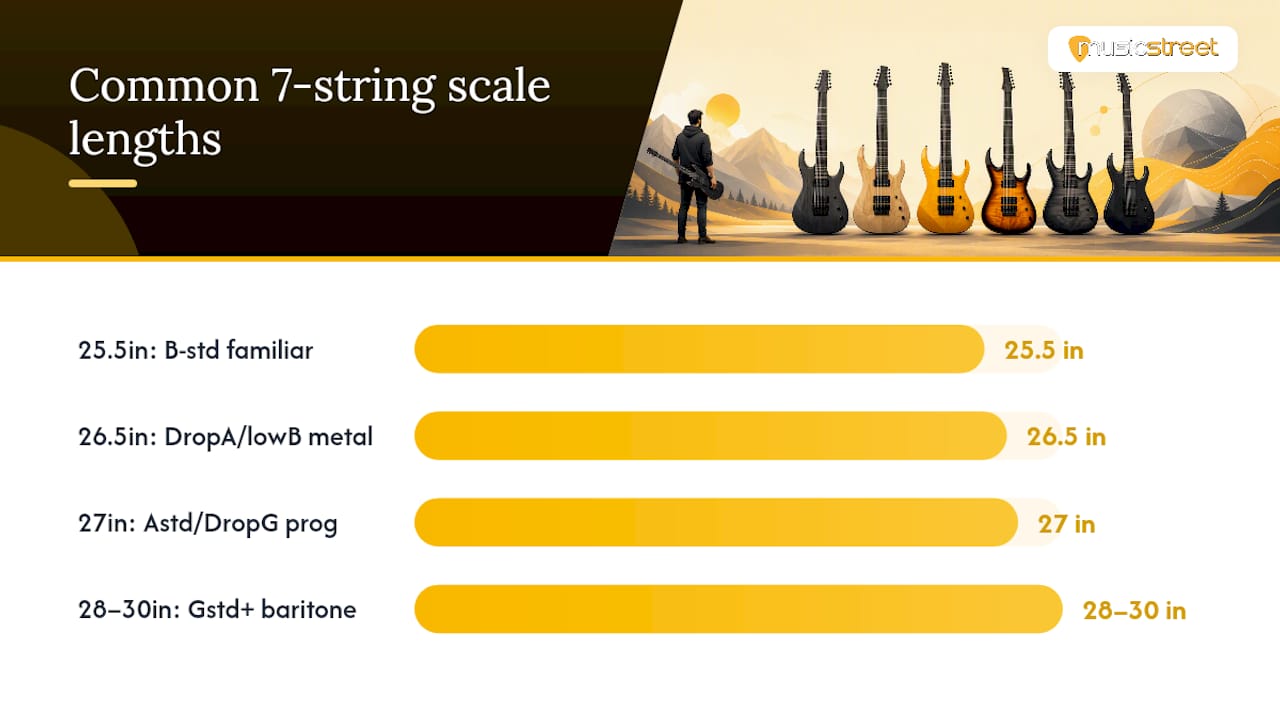
Four scale families cover almost every 7‑string on the market, and each one suits a different tuning range and playing style.
25.5in is the standard inherited from six‑string design. It handles B standard comfortably with a properly gauged set and feels immediately familiar if you’re coming from a regular electric. Entry‑level and midrange models frequently use this length to keep manufacturing costs down and playability approachable.
26.5in is the practical middle ground favoured by a lot of metal and djent players. It tightens the low B noticeably without asking for a huge adjustment in technique, and it’s often recommended for anyone who wants clarity in Drop A or lower without full baritone commitment.
27in pushes further still, common on guitars built specifically around A standard or Drop G tunings where the low string needs serious authority to avoid flapping against the frets.
Baritone lengths (roughly 28–30in) exist for players chasing genuinely low, bass‑adjacent tones. These aren’t general‑purpose 7‑strings; they’re specialist tools.
| Scale length | Typical tuning range | Best suited to |
|---|---|---|
| 25.5in | B standard | Familiar feel, budget and midrange models |
| 26.5in | Drop A, low B | Metal and djent players wanting tighter low end |
| 27in | A standard, Drop G | Technical/prog players needing serious low clarity |
| ~28–30in (baritone) | G standard and below | Bass‑adjacent low tunings, specialist use |
If you already play a six‑string and want to understand how these numbers compare against what you’re used to, Musicstreet’s guide to short scale versus long scale instruments is a useful companion read.
What string gauges suit each tuning and scale length?
String choice and scale length are two sides of the same tension equation, and getting one wrong undoes the benefit of getting the other right.
A useful target for the low B string is a comfortable tension that balances playability and note clarity. Below that range, the string feels loose and buzzes; above it, fretting becomes a workout. A .010–.059 seven‑string set produces around 15.9 lb at B1, sitting at the lighter end of comfortable. Step up to a .011–.064 set and tension climbs, giving a noticeably tighter, punchier low string.
Here’s where scale length changes the maths: because a longer scale generates more tension for the same gauge and pitch, a 26.5in guitar can use a lighter gauge than a 25.5in guitar to land in the same tension window. That’s genuinely useful if you find thick strings uncomfortable but still want a tight low B.
- B standard, 25.5in: .010–.059 or .011–.064 depending on preferred feel.
- Drop A or A standard, 26.5in–27in: .011–.064 or heavier, custom low string often needed.
- G standard, baritone scale: manufacturer‑specific heavy sets, usually beyond standard off‑the‑shelf gauges.
Rather than guessing from gauge numbers alone, run your target tuning through an online tension calculator or check a manufacturer’s published tension table before ordering strings. Musicstreet’s guides on what gauge to use and why gauge matters both walk through the process step by step.
Pro Tip: Balance the whole set, not just the low string. A super‑heavy low B paired with a stock high E can feel lopsided under the fretting hand. Match wound string mass progressively across the set rather than fixating on one string in isolation.
Should you choose multi‑scale or single‑scale frets?
Multi‑scale, or fanned‑fret, guitars let each string run its own optimal length: longer on the bass side for tension and clarity, shorter on the treble side for comfortable bends and a familiar feel up top. It’s a genuine engineering solution, not a gimmick.

The core benefit is per‑string tension optimisation, which improves low‑end clarity while keeping the treble strings from feeling overly stiff. There’s also an ergonomic upside: the angled frets align more naturally with a relaxed fretting wrist, which some players find reduces strain during long practice sessions compared with parallel frets.
It’s not free, though. Fanned frets take a short adaptation period, particularly around barre chords and any position shift near the nut. Setup and fretwork are more involved, which usually means a higher price and a smaller pool of shops comfortable servicing them.
Multi‑scale suits players chasing very low tunings or heavy technical palm‑muted riffing where every fraction of tension counts. If your playing sits mostly in B standard or Drop A and you’re not chasing the absolute tightest low end, a well‑set‑up single‑scale 26.5in or 27in guitar covers most needs without the learning curve. Musicstreet’s piece on why multi‑scale guitars benefit UK players goes deeper into the trade‑offs.
What setup changes does a 7‑string need?
Buying the right scale length is half the job. The setup that follows determines whether that scale length actually delivers.
- Measure scale length precisely, nut to saddle, before ordering strings or planning a tuning.
- Select gauge based on target tension for your tuning, not habit or guesswork.
- Check nut slot width and depth for the low B string; a repurposed six‑string nut is too narrow and will choke tone and cause tuning instability.
- Confirm saddle intonation range covers the low string’s compensation needs at that gauge.
- Adjust truss rod relief to suit the new string tension, since a heavier set changes neck deflection.
- Check action and fret buzz across the whole neck, not just the low string.
- Reassess pickup height, since a heavier low string with more excursion can hit the pickup if it’s set too close.
Longer scales and thicker gauges put more sustained pull through the neck, and that load shifts with humidity and temperature. A guitar that’s perfectly set up in summer can develop relief changes by winter, so periodic truss rod checks matter more on a heavily strung 7‑string than on a standard six.
Pro Tip: A Musicstreet shop inspection typically covers nut slot width, saddle travel, relief, action height and pickup clearance in one pass, which catches the small mismatches that cause buzzing or tuning drift after a gauge change.
How do you choose a scale length for your hands and style?
The right answer depends on what your hands do most and what genre you’re chasing, not just the tuning on the box.
If you play mostly chordal rhythm work, a 25.5in or 26.5in scale keeps stretches manageable. Fast single‑note lines and wide legato runs tend to favour whatever scale feels most familiar under your existing technique, so testing matters more than theory here. Heavy palm‑muted riffing in Drop A or lower genuinely benefits from the extra tension a 26.5in–27in scale provides.
At the shop, test three things specifically: how the low string feels under a palm mute at your target tuning, whether your hand comfortably reaches chord shapes near the 12th fret, and whether high‑fret bends past the 20th fret feel cramped on a longer scale. Bring your actual tuning to the test, not standard tuning, since tension feel changes dramatically once you drop the pitch.
If you already own a six‑string and are adding a 7‑string to your collection, stick with 25.5in unless you specifically want tighter low‑end clarity for lower tunings. Stepping to 26.5in or 27in is worth the adjustment period only if your tuning genuinely calls for it.
Pro Tip: Bring your own pick and play your usual riffs, not a demo lick. Tension feel and fret spacing reveal themselves in the parts you actually play, not in a generic showroom noodle.
What mistakes should you avoid when converting to a 7‑string?
A handful of setup errors show up repeatedly, and they’re avoidable once you know what to check.
The most common one is fitting a six‑string nut and simply adding a seventh string alongside it. The slot is too narrow, tone suffers, and tuning stability drops. Related to that, some players buy a standard six‑string set and add a single low string rather than choosing a genuinely balanced seven‑string or custom set, which leaves the low string feeling disconnected from the rest.
Ignoring intonation at the 12th fret after a gauge change is another frequent slip. A heavier low string needs more saddle compensation, and skipping that check leaves the guitar sounding slightly sharp or flat as you move up the neck.
Proper 7‑string setup consistently comes down to three things: a correctly sized nut, a genuinely balanced custom string set, and saddle travel that actually covers the low string’s intonation range. Skip any one of them and the guitar never quite feels right, no matter how good the scale length choice was.
Don’t try to fix a poor scale length choice by over‑thickening the low string without adjusting the rest of the setup. A mismatched, overly heavy string on an unadjusted neck just trades one problem for another.
Where can you check tension and scale length data?
Online tension calculators take the guesswork out of gauge selection. Rather than relying on anecdotal “use .011s for Drop A” advice, plug your actual scale length, tuning and preferred gauge into a calculator and check the resulting tension against the 16 to 19 lb target for the low B.
Manufacturer string tension charts, such as those published alongside common string sets, give you the raw data behind gauge recommendations. Cross‑referencing a calculator result against a published chart is the most reliable way to avoid buying a set that turns out too loose or too stiff for your tuning.
For further reading on Musicstreet, the guides on gauge and playability and popular electric guitar types both build on the concepts covered here. If you’re curious about the harmonic side of extended‑range playing once your setup is sorted, Soundbridge’s explainers on the pentatonic scale and the blues scale are solid educational reading for applying those low strings musically.
What Musicstreet sees in the shop
Players walking in with a new 7‑string almost always want the same thing: a genuinely heavy low end that doesn’t fight them on the frets. The two rarely arrive together out of the box, which is exactly why setup work exists.
The most common adjustment isn’t the scale length at all, it’s the string set and the nut. A guitar bought for its low‑end promise often turns up with a stock light gauge that never reaches proper tension for the tuning the player actually wants. Recutting a nut slot or fitting a genuinely balanced custom set solves more playability complaints than any scale length swap would.
Post‑sale, the conversation doesn’t stop at the till. Setup checks, warranty queries and general advice on gauge changes are part of ongoing support once you’ve bought a guitar, and that’s worth factoring in when you’re weighing up where to buy from, not just what to buy.
How Musicstreet helps you get the setup right
Getting the scale length right is only useful if the guitar underneath it is properly dialled in, and that’s where Musicstreet’s inspection and setup service earns its keep. Every instrument that leaves the shop has had its nut, saddle range, relief and action checked against the strings actually fitted, not a generic factory spec.
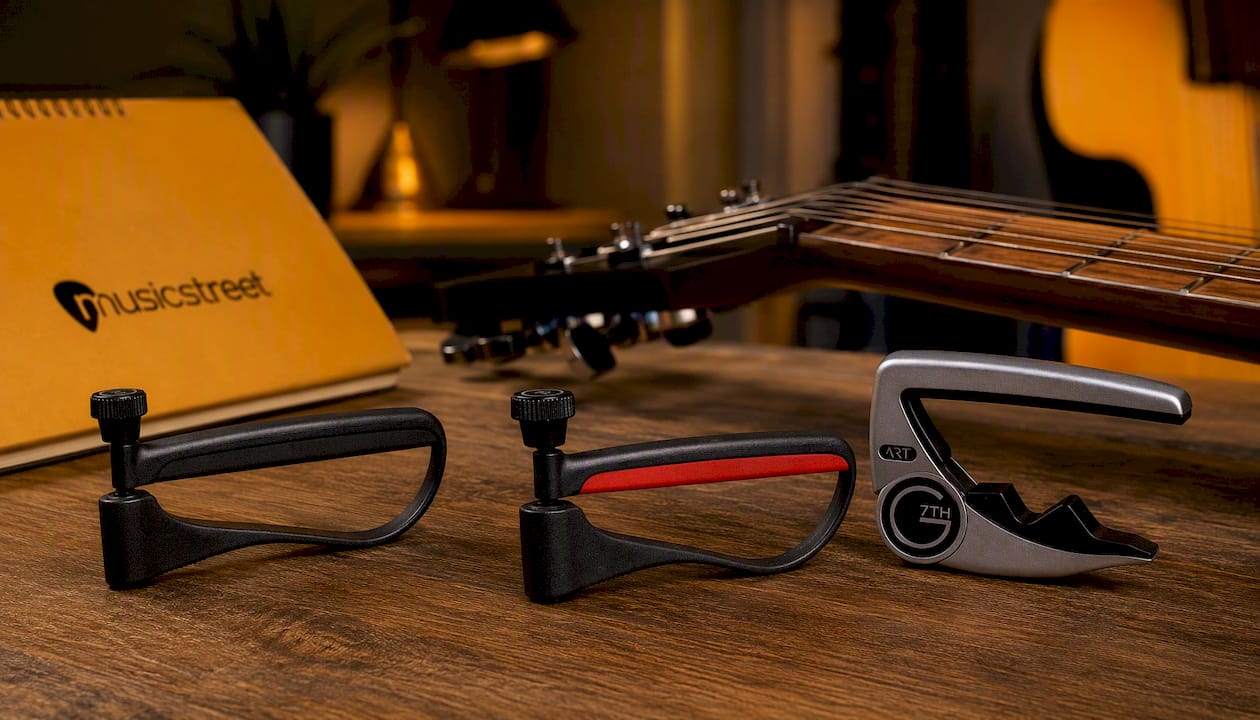
If you’re converting a 7‑string to a lower tuning or picking gauges for a new low B, Musicstreet can restring with a properly matched, balanced set rather than a generic off‑the‑shelf pack, and check intonation across the full range while it’s on the bench. For quick tuning stability once you’re gigging, the G7Th Performance 3 Silver capo and tuner combination is worth having in your gig bag, and the G7Th Ultralight capo in red or black both sit comfortably on a 7‑string neck without deadening the low strings. Pop into the shop or browse online to book a setup and get your scale length, gauge and tuning working together properly.
Sources
- The ultimate guide to 7‑string electric guitars: extended range essentials
- Standard tuning for 7 string guitar
- Guitar scale lengths: everything to know
- Best 7‑string guitar guide 2026 — Complete buyer’s guide
- Extending the range – the essential guide to seven‑string guitars
FAQ
What is the best scale length for a 7‑string guitar?
There’s no single best length: 25.5in suits players wanting a familiar six‑string feel in B standard, while 26.5in or 27in gives a tighter, clearer low string for Drop A and lower tunings.
Can I use a 25.5in scale for Drop A tuning?
Yes, with a sufficiently heavy custom gauge set, though tension will feel looser than on a 26.5in or 27in instrument tuned to the same pitch.
What string gauge should I use on a 7‑string in B standard?
A .010–.059 or .011–.064 set both work well for B standard, with the lighter set sitting at the comfortable low end and the heavier giving a tighter, punchier low string.
Is a multi‑scale 7‑string worth the extra cost?
It’s worth it if you play very low tunings or heavy technical riffing and want optimised tension per string, but a well‑set‑up single‑scale guitar covers most other players’ needs.
Does Musicstreet offer setup services for 7‑string guitars?
Yes, Musicstreet’s professional setup and inspection service checks nut slots, saddle intonation range, truss rod relief and pickup height to match your chosen scale length and string gauge.








Share:
Fender amp types explained: which one suits you?
What a patch cord is used for on your pedalboard