


- Effective guitar practice requires structured routines focused on weaknesses, objective measurement, and daily repetition. Recording sessions and focusing on one skill at a time accelerate progress, while environment setup and short, intentional sessions promote consistency. Combining scale and arpeggio work over loops enriches your blues improvisation, with discipline and environment being key to sustained improvement.
Effective guitar practice tips are structured routines that prioritise your real weaknesses, measure progress objectively, and repeat daily until improvement becomes automatic. Random playing feels productive but rarely is. The difference between a guitarist who plateaus and one who keeps improving comes down to one thing: deliberate structure. Platforms like TrueFire and communities like JamChallenged have built entire teaching systems around this principle, and the research backs them up. Whether you have ten minutes or two hours, the approach below will transform how you practise.
1. How to structure an effective guitar practice routine
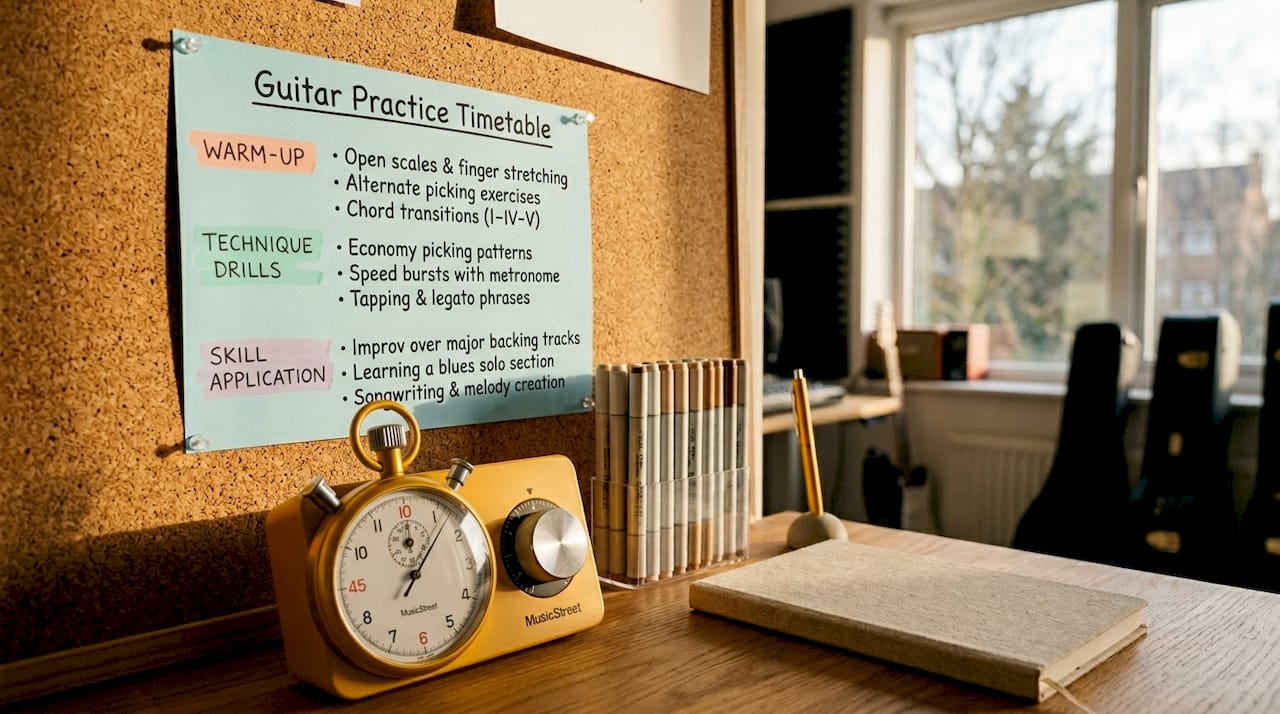
Structured practice sessions outperform random playing because they allocate time proportionally to what actually moves the needle. The four essential blocks are: warm-up, targeted weakness work, reinforcement of recent gains, and musical application. Getting the proportions right matters more than total session length.
A practical breakdown looks like this:
- Warm-up (20%): Gentle scales, chromatic exercises, or fingerpicking patterns to prepare your hands without fatigue.
- Targeted weakness work (45%): The hardest, most uncomfortable material. This is where real progress happens.
- Reinforcement (20%): Revisit something you improved recently to consolidate it into muscle memory.
- Musical application (25%): Play actual music. Songs, jams, or improvisation. This keeps practice enjoyable and contextualises everything else.
A ten-minute session using these proportions is more effective than an hour of noodling through familiar material. The key is sustainability. A short, structured session you repeat every day beats a two-hour session once a week, every time.
Pro Tip: Set a timer for each block. It stops you spending 45 minutes on warm-up because it feels comfortable, and forces you into the harder work where growth actually lives.
2. Why recording your practice sessions accelerates progress
Recording is the single most underused technique in a guitarist’s toolkit. Most players rely on how their playing feels in the moment, but perception and reality are rarely the same thing. Recording focused portions of your practice, even just four bars, gives you objective feedback that your ears cannot provide in real time.
The process is straightforward:
- Record a short, repeatable passage rather than an entire song.
- Listen back critically for timing inconsistencies, tonal issues, and pitch accuracy.
- Identify the single weakest element in that recording.
- Repeat the passage with that specific issue as your only focus.
- Record again and compare.
You do not need expensive equipment. A smartphone propped on a music stand, a basic looper pedal, or a free digital audio workstation like GarageBand captures everything you need. The goal is honest feedback, not studio quality.
One barrier players face is “Red Light Syndrome,” the tendency to tighten up and play worse the moment a recording starts. Reducing this anxiety comes from recording constantly, not occasionally, until the presence of a microphone feels normal.
Pro Tip: Keep a practice journal alongside your recordings. Log the date, what you worked on, what the recording revealed, and what you will target next. This turns your practice into a clear roadmap rather than a series of disconnected sessions.
3. Focus on one specific skill at a time
Scattered goals are the most common reason guitarists stop improving. Trying to work on bending, chord transitions, fingerpicking, and rhythm simultaneously means none of them receive enough focused repetition to stick. Setting clear, specific goals before each session is the single most effective habit you can build.
JamChallenged recommends a 14-day focused method: choose one skill, practise it daily, record each session, then compare your first and last recordings. The contrast is usually striking and deeply motivating.
The benefits of this approach include:
- Faster muscle memory formation: Repetition of a single movement pattern accelerates neural encoding.
- Clearer progress markers: You know exactly what you are improving and can measure it.
- Reduced decision fatigue: You sit down knowing precisely what to do, so you start immediately.
- Better use of short sessions: Ten minutes on one skill daily outperforms a 90-minute session covering six topics.
Backing tracks are particularly useful here. Playing a targeted lick or pattern over a looped chord progression keeps the exercise musical while maintaining focus. Save dated recordings so you can compare week one to week two. The evidence of your own progress is the most powerful motivator available.
4. Mastering complex fingerstyle coordination
Fingerstyle guitar is where many players stall because it demands two independent voices from one pair of hands. The thumb handles an alternating bass line while the fingers pick a syncopated melody on top. Success depends on mastering the relationship between these two roles before attempting anything near full tempo.
Charlie Starr, known for his Piedmont fingerstyle work, advises starting so slowly that both parts feel almost boring. The thumb and fingers need to learn their individual jobs before they can cooperate. Rushing this stage is the most common mistake.
Practical steps for building fingerstyle coordination:
- Practise the bass line alone until it is completely automatic.
- Practise the melody line alone at the same slow tempo.
- Combine both at 50% of target speed, focusing on synchronisation rather than rhythm.
- Increase tempo only when the combined version feels effortless, not just possible.
- Record each stage to confirm the coordination is genuine, not just perceived.
Slow, deliberate practice of this kind builds the neural pathways that allow complex patterns to become automatic. Speeding up before that foundation is solid creates sloppy habits that are genuinely difficult to unlearn.
5. Using dominant 7 arpeggios in blues improvisation
Blues improvisation is one of the most rewarding areas to develop, and dominant 7 arpeggios are one of the most direct routes to a more musical, varied solo vocabulary. A dominant 7 arpeggio contains the root, major third, perfect fifth, and minor seventh of a chord. Played over the matching chord in a blues progression, it outlines the harmony directly rather than relying solely on the pentatonic scale.
The most effective way to practise this is by combining arpeggio tones with the minor pentatonic scale you already know. The arpeggio notes act as target tones that give your phrases harmonic direction, while the pentatonic fills in the spaces with familiar blues colour.
Here is a comparison of the two approaches:
| Approach | Sound | Best used for |
|---|---|---|
| Minor pentatonic only | Raw, bluesy, familiar | General blues feel and comfort zones |
| Dominant 7 arpeggio only | Precise, chord-specific | Outlining chord changes clearly |
| Combined approach | Rich, varied, musical | Building expressive, structured solos |
Practise over a rhythm loop set to a slow 12-bar blues. Use articulation devices like slides into arpeggio tones and bends off the major third to add expression. The goal is not to play the arpeggio as a scale run but to weave individual notes into phrases that sound like music, not exercises.
6. Build a sustainable daily guitar practice schedule
Consistency is the variable that separates guitarists who improve from those who do not. A guitar left in its case across the room is unlikely to get played daily. Environment design is a practical, underrated tool. Keep your guitar on a stand in a visible, accessible spot. Pair your practice with a specific daily anchor, such as after your morning coffee or before dinner, so it becomes a habit rather than a decision.
K. Anders Ericsson’s research on deliberate practice and feedback loops confirms that the quality of practice matters far more than quantity. Focused sessions with immediate feedback, such as recording and reviewing, accelerate skill development faster than passive repetition. This is why a structured daily routine built around honest self-assessment is the foundation of every effective practice system.
For beginners, the beginner guitar practice guide from Musicstreet offers a clear starting framework for building these habits from day one. For electric players, the daily practice tips resource covers session structure specific to the electric guitar context.
Key takeaways
Structured, targeted, and consistently recorded practice is the most direct path to measurable guitar improvement at any skill level.
| Point | Details |
|---|---|
| Structure beats duration | Divide sessions into warm-up, weakness work, reinforcement, and application regardless of length. |
| Record every session | Short recordings of focused passages provide objective feedback that perception alone cannot deliver. |
| One skill at a time | A 14-day focus on a single technique produces faster, measurable progress than broad weekly goals. |
| Environment drives consistency | A visible, accessible guitar paired with a daily anchor event removes the decision barrier to practising. |
| Combine scales and arpeggios | Mixing dominant 7 arpeggios with the minor pentatonic scale builds a richer blues solo vocabulary. |
What I have learned from years of watching guitarists practise
The most common mistake I see is not laziness. It is comfort. Players gravitate towards what they already do well because it feels like progress. Nailing a song you learned two years ago is enjoyable, but it is not practice in any meaningful sense. The hardest part of effective practice is honestly identifying what you cannot do yet and sitting with that discomfort long enough to change it.
I have also seen how environment shapes behaviour more reliably than motivation. Motivation is inconsistent. A guitar on a stand next to your sofa gets played. A guitar in a case in the spare room does not. These are not personality traits. They are design problems with practical solutions.
The players who improve most consistently are not the most talented. They are the ones who set small, honest targets, record themselves without flinching, and show up the next day. Ten minutes of genuinely focused work, repeated daily, compounds into something remarkable over months. You do not need to overhaul your life to get better at guitar. You need a clear structure, an honest ear, and the willingness to practise what you cannot yet play.
— Musicstreet
Gear and resources to support your practice
Whether you are building your first structured routine or refining an advanced technique, having the right instrument makes every session more productive and more enjoyable.

At Musicstreet, we stock a carefully selected range of electric, acoustic, and bass guitars suited to every stage of development, from beginner-friendly models to professional-grade instruments. Our team in Huntingdon, Cambridgeshire offers expert setup and personalised advice so your guitar plays exactly as it should. Explore our full range of guitars and accessories to find the right instrument for your practice goals. The right guitar does not just sound better. It makes you want to pick it up every day.
FAQ
How long should a guitar practice session be?
Session length matters less than structure. A ten-minute session divided into focused blocks produces more improvement than an hour of unstructured playing.
What are the most common guitar practice mistakes?
The most common mistakes are practising comfortable material instead of weaknesses, skipping warm-ups, and never recording sessions to assess progress objectively.
How do I improve guitar skills faster?
Record short passages during practice, listen back critically, and focus on one specific weakness at a time. Deliberate practice with feedback loops is the fastest route to measurable improvement.
What should a beginner guitar practice routine include?
A beginner routine should include a short warm-up, focused work on one chord or technique, brief reinforcement of something recently learned, and a few minutes playing a simple song for enjoyment.
How do I stay consistent with daily guitar practice?
Keep your guitar on a stand in a visible location and attach practice to a specific daily event such as a meal or morning routine. Consistency comes from removing friction, not from willpower.



Share:
Best guitar string material: tone, feel and durability
What size strings for acoustic guitar: a player's guide