

Table of Contents
- Humbucker vs P-90 Pickups: Which Suits Jazz?
- Understanding P-90 vs Humbucker Sound
- Best Pickups for Jazz Guitar
- P-90 Pickup Noise and Shielding
- Jazz Guitar Pickup Height and Setup
- Practical Comparison: Which Pickup Wins for Jazz
- Frequently Asked Questions
Last Updated: 18 October 2026
Humbucker vs P-90 Pickups: Which Suits Jazz?
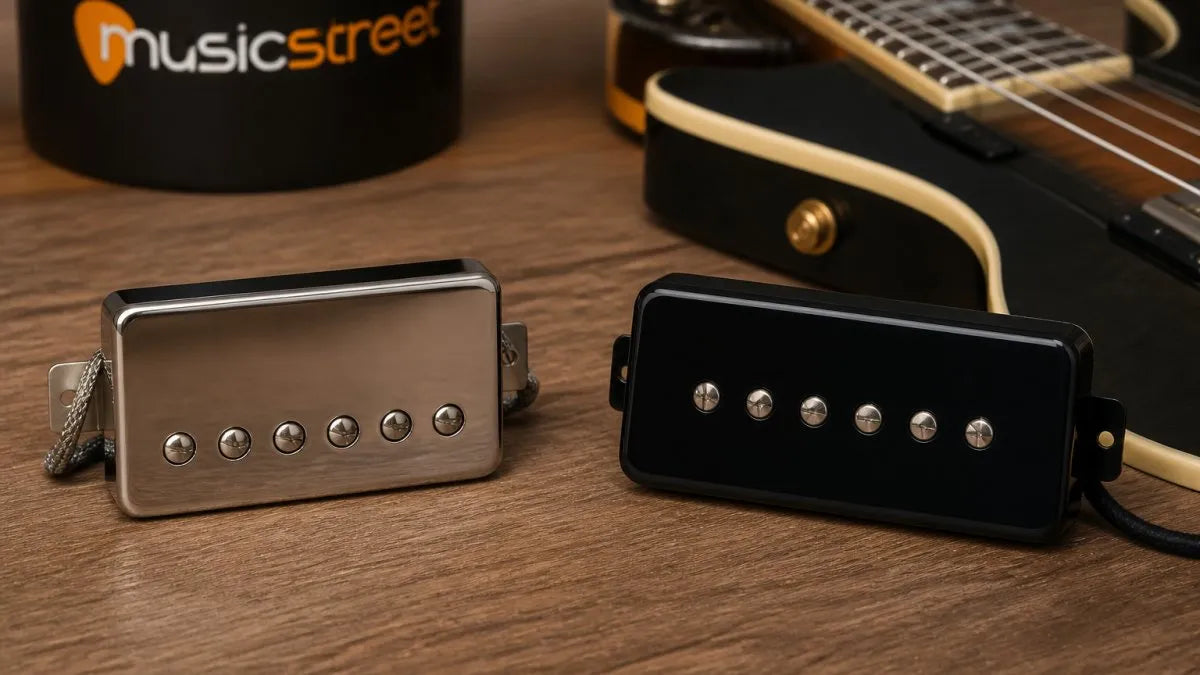
When you're choosing pickups for jazz guitar, the decision between humbucker vs P-90 pickups shapes everything from your tone to how your amp responds. Both designs deliver character, but they work in fundamentally different ways. The humbucker's dual-coil design reduces noise and delivers thick, warm output. The P-90, a single-coil design, produces brighter, more articulate tones with less filtering. Neither is objectively "better", it depends entirely on what sound you're chasing and how you play.
At MusicStreet, we work with jazz players across all skill levels who are wrestling with this exact choice. Some arrive convinced they need a humbucker for the classic smooth jazz tone. Others have heard P-90s can deliver surprising versatility in a jazz context. The truth is more nuanced than either camp suggests.
Below, we'll walk you through the tonal characteristics of each pickup type, show you how to set them up properly for jazz, and help you decide which one actually fits your playing style and your guitar.
Understanding P-90 vs Humbucker Sound
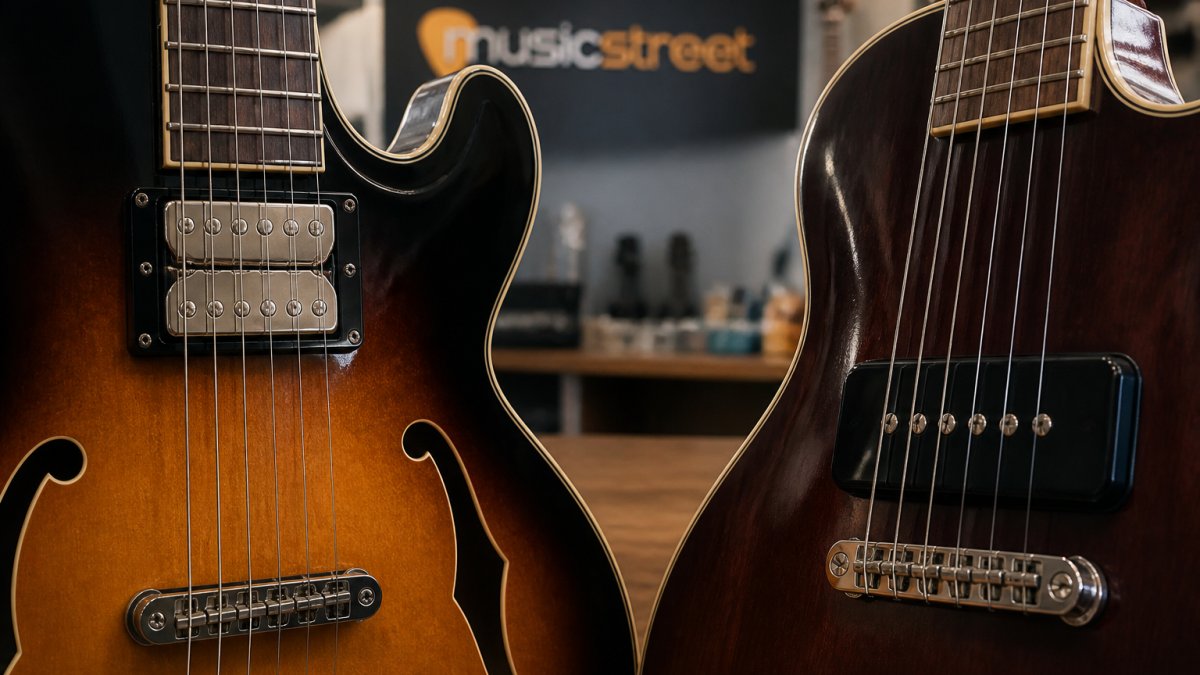
The fundamental difference between these two pickup types lies in their construction and how they respond to string vibration.
P-90 Tonal Characteristics
A P-90 is a single-coil pickup with a larger bobbin than a traditional Fender single-coil, delivering warm midrange and articulate highs without heavy filtering. The design captures string vibration directly, producing tones that feel immediate and responsive.
P-90s excel at revealing playing dynamics. When you dig into the strings, you hear that aggression. When you play gently, the tone backs off accordingly. This responsiveness makes them excellent for jazz comping, where subtle touch variations matter. The midrange punch cuts through a mix without sounding harsh. Rolled-back tone controls smooth the brightness when needed, helping achieve that classic warm jazz sound many players pursue.
A common misconception is that P-90s are unsuitable for jazz because of single-coil noise. However, many jazz players find that the trade-off, slightly more hum in exchange for tonal immediacy, is worthwhile. Rolling down the tone control reduces buzz significantly. In quieter recording environments or on stage with proper shielding, the noise becomes negligible.
Humbucker Tonal Characteristics
A humbucker uses two coils wound in opposite directions to cancel hum while capturing a thicker, darker overall tone. This dual-coil design naturally filters some high-frequency content, producing what many describe as a "warmer" or "smoother" voice.
For jazz, humbuckers deliver the classic smooth tone associated with instruments like the Gibson ES-335 or Les Paul. The reduced high-end content means fewer piercing frequencies, which works well in traditional jazz settings. Humbuckers also handle overdrive more gracefully than P-90s, responding to amp saturation with musical compression rather than grinding distortion.

The trade-off is immediacy. Humbuckers feel slightly less responsive to pick attack than P-90s. They compress dynamics somewhat, which some players love for consistency and others find less expressive.
Best Pickups for Jazz Guitar
The best pickup for jazz depends on your playing context and sonic preference. There's no single answer that works universally.
Choose a humbucker if you're playing traditional jazz in quieter settings where you want maximum smoothness and minimal noise. The classic jazz tone most people imagine, smooth, warm, sustaining, comes naturally from a humbucker. They're also the practical choice if your guitar already has humbucker routing and you want to avoid modification costs.
Choose a P-90 if you value tonal responsiveness and don't mind managing a bit of hum. P-90s suit players who like their tone to react to their playing dynamics. They work particularly well in blues-influenced jazz or fusion contexts where that extra edge adds character.
According to Jazz Guitar Online forum discussions, some experienced players argue that a P-90's brighter character and single-coil responsiveness can actually serve jazz well, especially when paired with proper amp settings and shielding. The key is matching the pickup to your playing style, not chasing an imaginary "correct" jazz tone.
P-90 Pickup Noise and Shielding
Single-coil pickups, including P-90s, are inherently more susceptible to electromagnetic hum than humbuckers. This is physics, not a design flaw. The question isn't whether P-90s hum, they do, but whether the hum bothers you in your playing environment.
In a recording studio with proper shielding and grounding, P-90 hum becomes nearly inaudible. On stage with monitor wedges and other electrical equipment nearby, you might notice it more. The solution isn't complicated: turn the tone control down slightly. A P-90 with tone rolled back 10-15% loses most of its brightness but also loses most of its hum, while retaining the core character that makes it worth using.
USED - Gibson Les Paul Standard 50's P90 Electric Guitar - Tobacco Burst →
Shielding your guitar's cavity reduces hum significantly. Many guitars with P-90s benefit from copper tape lining the electronics compartment.
Jazz Guitar Pickup Height and Setup
Pickup height dramatically affects tone, regardless of whether you're using a humbucker or P-90. Incorrect height is one of the most common reasons players feel disappointed with a pickup they've just installed.
For jazz, most players prefer pickups set slightly lower than factory defaults. Lower pickup height reduces output slightly, which means your amp doesn't work as hard and you get cleaner tone at higher volumes. It also reduces the risk of magnetic pull on the strings, which can dampen sustain and cause tuning issues.
A practical starting point: set your pickups so the gap between the pickup and the strings (at the 12th fret, strings fretted normally) measures around 2.5mm on the bass side and 2mm on the treble side. This is a rough guide, adjust from there based on what your ears tell you.
If you're unfamiliar with pickup adjustment, proper guitar setup procedures recommend having a professional handle it. At MusicStreet, we set up every guitar that leaves our workshop, and we can adjust pickup height during that process to match your playing style.
Practical Comparison: Which Pickup Wins for Jazz
| Characteristic | P-90 | Humbucker | Winner for Jazz |
|---|---|---|---|
| Tonal clarity | High, articulate and immediate | Moderate, warmer, filtered | P-90 for responsiveness |
| Noise floor | Higher single-coil hum | Lower, hum cancellation | Humbucker for quiet settings |
| Dynamics responsiveness | Excellent, reacts to pick attack | Good, slightly compressed | P-90 for expressive playing |
| Classic jazz tone | Good with tone rolled back | Excellent, natural warmth | Humbucker for traditional jazz |
| Overdrive character | Gritty, grinding | Musical, compressed | Humbucker for smooth saturation |
| Setup flexibility | Requires shielding consideration | Plug-and-play | Humbucker for ease |
The practical reality: both work for jazz. The choice comes down to your environment and what you value in your tone.
If you're recording or playing in controlled settings and want maximum expression, a P-90 delivers. If you're playing live in noisy environments or prefer the classic smooth jazz sound without fuss, a humbucker is the more practical choice.
Many jazz players end up with both, a humbucker guitar for traditional settings and a P-90 guitar for blues-influenced or fusion contexts. This isn't indecision; it's recognising that different tools suit different jobs.
If you're looking to upgrade your pickups, Lollar Pickups' jazz-focused designs offer both humbucker and P-90 options specifically voiced for jazz and blues applications. The Lollar Imperial Low Wind Set (£379.00) delivers the clarity and definition many jazz players seek from a humbucker, while their P-90 Dogear '50's Set (£229.00) captures that early Freddie King character with lower output and a brighter overall tone.

For players wanting to experience P-90 tone without committing to a full guitar swap, the Gibson Les Paul Standard 50's P90 (£1,999.00) offers authentic vintage character with warm, articulate tones. If you're after a boutique option with P-90 versatility, the Patrick James Eggle Macon models, available with dual P90 pickups starting at £4,799.00, represent hand-voiced masterpieces built specifically for expressive playing.
Frequently Asked Questions
Are humbuckers or P-90s better for jazz?
Neither is universally better, it depends on your style. Humbuckers excel at smooth, warm, articulate tones ideal for traditional jazz, whilst P-90s offer gritty mids and single-coil brightness that work brilliantly for blues-influenced or modern jazz. Many jazz players find humbuckers more forgiving for clean playing, though P-90s can achieve jazz tones by rolling back the tone control. Your amp and playing technique matter equally.
Can you play jazz with P-90 pickups?
Yes, absolutely. P-90s are entirely viable for jazz, particularly if you favour a warmer, more character-driven sound. Rolling the tone control down reduces single-coil brightness and helps achieve a smoother jazz voice. The pickup's articulate midrange cuts through an ensemble well, making it popular with blues-jazz and vintage-inspired players. Success depends more on your amp settings and technique than the pickup alone.
Are P-90 pickups noisier than humbuckers?
P-90s tend to pick up more hum and environmental noise than humbuckers because they use a single-coil design without the hum-cancelling dual-coil structure. However, modern P-90s with quality shielding and Alnico magnets, like the Lollar P-90 Dogear set at £229.00, minimise this problem significantly. Proper pickup height adjustment and amp grounding also reduce noise substantially. In a quiet studio, the difference is minor; on a noisy stage, humbuckers have an edge.
What should I do about pickup height when setting up a jazz guitar?
Pickup height directly affects tone and sustain. For jazz, aim for a balanced position: typically 2-3mm from the strings at the treble side and slightly higher at the bass side. Lower pickups reduce output and hum but thin the tone; higher pickups boost output and warmth but increase noise. Start with manufacturer recommendations, then adjust by ear. A professional setup, available through MusicStreet's in-house workshop, ensures optimal height for your specific instrument and playing style.
The humbucker vs P-90 debate often feels more complicated than it needs to be. Both pickups work for jazz when matched to the right player and setup. The real decision is whether you prioritise tonal responsiveness and character (P-90) or smooth, noise-free output with classic warmth (humbucker). At MusicStreet, we stock guitars and pickups from both camps, expertly set up and ready to play. SHOP NOW and find the pickup character that matches your jazz voice.


Share:
What Is Open D Tuning? Notes, Setup and Chord Shapes