

Quick Summary
To estimate your used guitar's trade-in value online, identify the exact model and year, then compare recent sold prices for similar guitars in similar condition. Take the median of at least five sales, adjust honestly for wear and repairs, and apply a dealer discount, since trade-in offers usually sit below private-sale figures.
- Confirm the exact brand, model, year and serial number before comparing any prices.
- Use completed sales from the last three to six months, not current asking prices.
- Use the median of at least five comparable sales, excluding outliers.
- Grade cosmetic and functional condition separately, and be strict with yourself.
- A trade-in offer is a range, so ask what would need to change for it to move.
Table of Contents
- Why Online Trade-In Estimates Differ From Final Offers
- Identifying Your Guitar's Exact Model and Year
- Researching Recent Sold Prices for Comparable Guitars
- Grading Your Guitar's Condition Honestly
- Working Through a Used Guitar Value Calculator Step by Step
- Trade-In Versus Private Sale: Which Pays More?
- Getting Your Trade-In Quote From MusicStreet
- Frequently Asked Questions
How to Estimate Used Guitar Trade-In Value Online
Last Updated: October 29, 2026
Trying to work out what your used guitar is worth? At MusicStreet, we know that a good online estimate starts with the right research. This guide walks you through the process step by step, so you can judge a trade-in value offer before you commit to one.
Here is the honest starting point: online estimates and final offers often differ. Condition, model details and market demand all shift the number.
Why Online Trade-In Estimates Differ From Final Offers
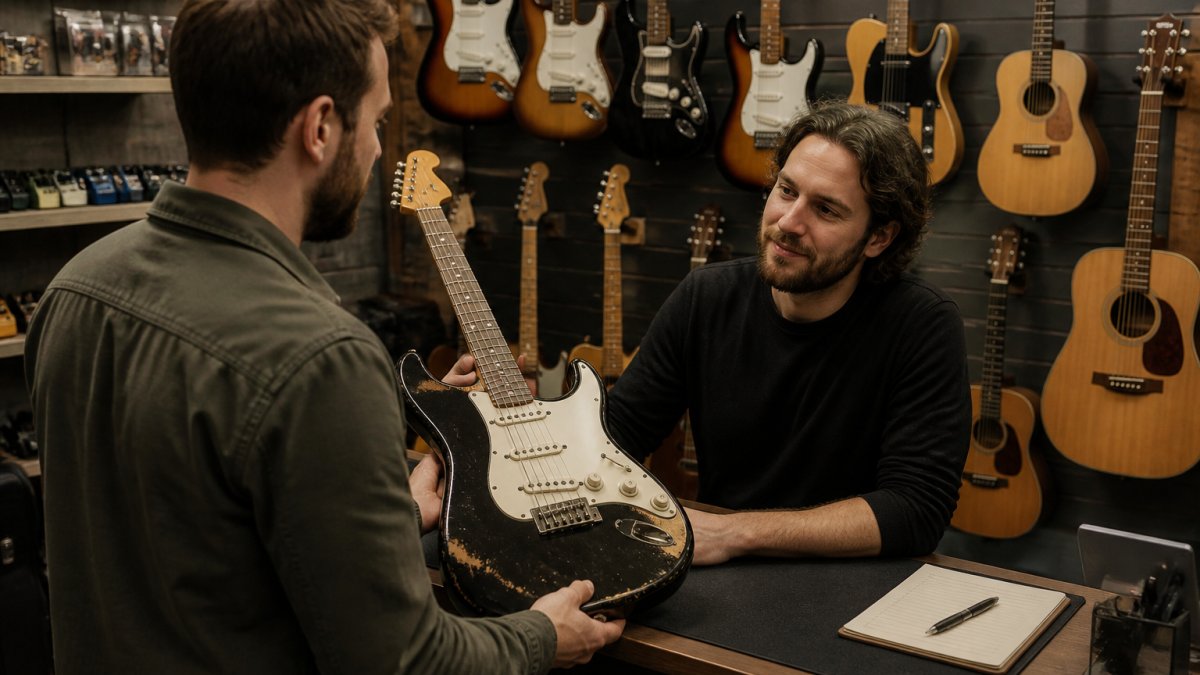
An online estimate is a starting point, not a guarantee. Most shops look at photos and your description first, then confirm the details once the instrument is in front of them.
The gap usually comes from three things:
- Condition: Scratches, fret wear and electronics issues often only show up in person.
- Model details: A guitar that looks like a standard model may turn out to be a different variant with a different value.
- Market demand: Prices for used instruments move, so the figure can change between your estimate and the offer.
Knowing this helps you read an offer fairly. If the final number is lower, ask which of these factors changed.
Identifying Your Guitar's Exact Model and Year
Before you estimate anything, you need the exact brand, model and year. Small differences matter a lot in used guitar pricing.
Check these places:
- Headstock: Look for the brand logo and model name.
- Neck heel or back of the headstock: Serial numbers often sit here.
- Inside the soundhole (acoustics): Some makers print labels or serials here.
- Original case or paperwork: Receipts and certificates can confirm the model.
Once you have a serial number, check it against the maker's records or a reputable serial lookup. Note any finish, pickup or hardware variants, as these change the value.
Researching Recent Sold Prices for Comparable Guitars
Asking prices tell you what sellers hope for. Sold prices tell you what buyers actually paid. The difference matters because a listing that has sat unsold for months is not evidence of value, it is evidence that the asking price was too high.
Here is a repeatable method for judging comparable listings:
- Search for your exact brand, model and year. Use the full model name and any variant codes. A "Standard" and a "Standard Plus" can differ by hundreds of pounds, so check the specification before you compare.
- Filter for sold or completed listings where the marketplace allows it. On sites that only show active listings, look for listings marked as sold or ended, and treat current asking prices as a ceiling rather than a benchmark.
- Record at least five recent sales of guitars in similar condition. Note the sale date, the final price, whether postage was included, and what accessories came with the guitar.
- Discard outliers such as listings with missing parts, unusual modifications, or clearly unrealistic prices. One unusually cheap sale does not reset the market, and one unusually high sale may reflect a rare variant or included extras.
- Work out the average of the remaining prices. Use the median rather than the mean if one sale is far above or below the rest, as the median is less distorted by extremes.
Asking Prices Versus Completed Sales
A common mistake is to average the prices of active listings. Those are asking prices, not achieved prices. A guitar listed at £600 that has not sold in three months is not worth £600, it is worth whatever a buyer will actually pay. Where possible, compare your guitar against completed sales from the last three to six months, as older sales may reflect a different market.
Adjusting for Location, Accessories and Listing Condition
Two guitars of the same model and year can sell for different amounts depending on:
- Location: Collection-only listings often sell for less than listings that offer postage, because the pool of buyers is smaller.
- Included accessories: A hard case, original paperwork, tremolo arm or case candy can add value. A guitar sold without its case is not directly comparable to one sold with it.
- Listing condition: A guitar described as "mint" in the listing may arrive with wear that was not photographed. Compare like with like, and discount listings where the condition description is vague.
A Rough Guide, Not a Rule
Used instruments in good condition often sell for a fraction of their original list price. Treat this as a rough guide only, since model age, demand and condition change the figure. A limited-edition model may hold value far better than a mass-produced one, and a discontinued model may attract buyers who cannot find it new.
Grading Your Guitar's Condition Honestly
Condition is where most people overestimate their guitar. Be strict with yourself, because buyers will be.
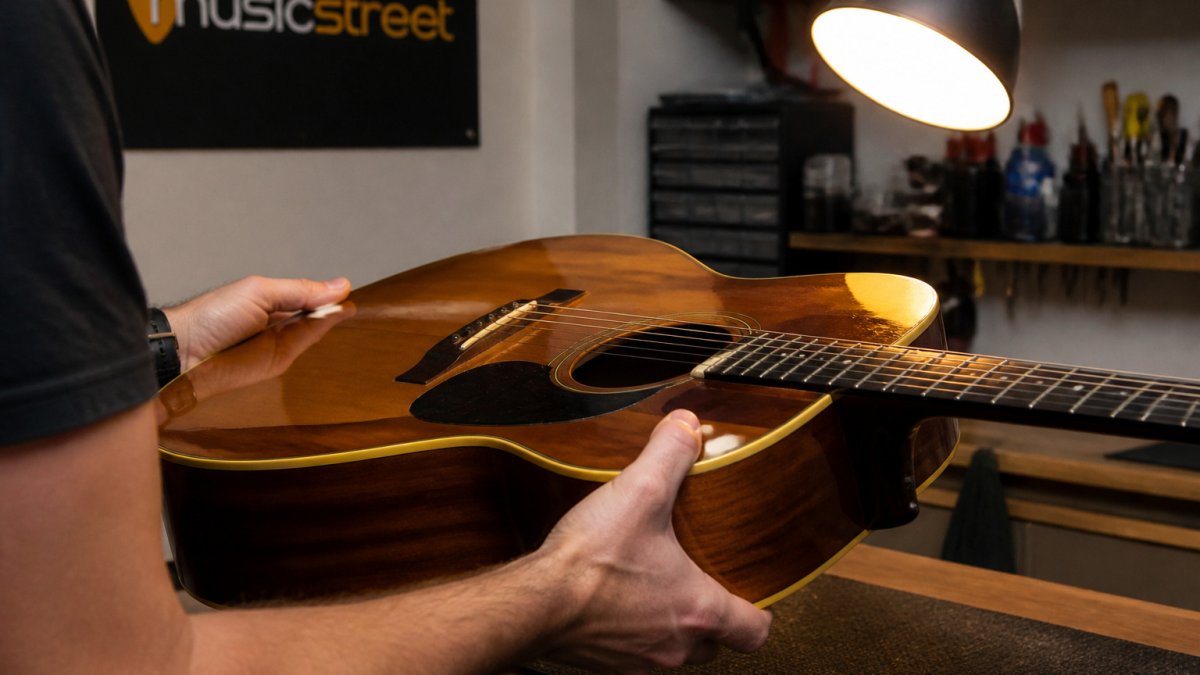
Step-by-step diagram illustrating how to inspect an acoustic guitar body and fretboard for condition grading.
Cosmetic and Functional Condition
Split your grading into two parts:
Cosmetic condition:
USED - PRS Silver Sky John Mayer Signature Model - Midnight Rose →
- Finish wear, dings, scratches and cracks
- Fading or colour loss
- Replacement parts that don't match
Functional condition:
- Action (string height) and fret wear
- Whether it stays in tune
- Electronics, switches and pickups working properly
Rate each part from excellent to poor. A guitar with cosmetic wear can still play perfectly, and that difference affects the offer you should expect.
Working Through a Used Guitar Value Calculator Step by Step
Online calculators can speed things up, but only if you feed them accurate inputs. Here is a method you can follow by hand, with a worked example so you can see how the numbers fit together.
The Calculation, Step by Step
- Start with your average sold price from comparable listings. Use the median of at least five recent sales in similar condition.
- Adjust for condition. Lower the figure if your guitar has more wear than the sold examples, and raise it if yours is cleaner. Be strict: buyers will be.
- Subtract any repair costs you would need to pay to bring it up to standard, a setup, fret dress, new nut or electronics repair.
- Add value for extras such as a hard case, original paperwork or a certificate of authenticity.
- Estimate your trade-in offer as a percentage of that figure. Trade-in offers are usually set below the average current used value, and the exact figure depends on the shop and the instrument.
A Worked Example
Suppose you have a used electric guitar with these details:
- Comparable sold prices: five recent sales at £420, £450, £460, £480 and £520. The median is £460.
- Condition adjustment: your guitar has more fret wear than the comparables, so you deduct 10%, £46, leaving £414.
- Repair costs: a setup and fret dress would cost around £60, so you subtract that, leaving £354.
- Extras: the guitar comes with its original hard case, which you judge to be worth around £40, bringing the figure to £394.
- Trade-in estimate: at 60% of £394, a dealer offer might land around £236.
That is not a promise of what you will be offered. It is a sense check. If an offer is lower than you expected, ask which factor changed. If it is higher, check whether the offer is conditional on a purchase or subject to inspection.
Why the Trade-In Figure Is Lower Than the Private-Sale Figure
A dealer's offer is lower than a private-sale figure for a reason. The difference covers:
- Preparation: cleaning, setup and any repairs needed before resale.
- Risk: the guitar may take time to sell, and prices may move.
- Convenience: you avoid the time, messages, haggling and postage of a private sale.
If you plan to buy something else straight away, a trade-in can make the numbers work even when the headline offer looks lower, because the value is applied towards your next purchase.
Trade-In Versus Private Sale: Which Pays More?
Private sales usually pay more, but they take more effort. You handle listing photos, messages, haggling and postage. A trade-in is faster and carries less risk, but the offer is typically lower.
Weigh these points:
- Private sale: Higher potential price, but time-consuming and sometimes uncertain.
- Trade-in: Quicker and simpler, with the value often applied towards a new purchase.
- Hybrid: Some players sell privately for cash and trade in when they want an upgrade fast.
If you plan to buy something else straight away, a trade-in can make the numbers work even when the headline offer looks lower.
The two routes differ in price, effort and speed, as summarised below.
Route |
Main advantage |
Main drawback |
|---|---|---|
Private sale |
Higher potential price |
Time-consuming and sometimes uncertain |
Trade-in |
Quicker and simpler, with less risk |
Offer is typically lower |
Hybrid |
Cash from a private sale, fast upgrade through trade-in |
Needs both routes to be managed |
Getting Your Trade-In Quote From MusicStreet
When you are ready, send us your guitar's details and photos and we will give you an estimate. Your estimate is based on the model, year, condition and current demand, and we will confirm the final figure once we have the instrument in hand.
If you want to buy a replacement, our range includes the USED Epiphone J45 Studio Solid Top Vintage Sunburst Acoustic Guitar at £249.00, which is fully set up in store, and the USED Samick LC-650 White at £250.00, also set up and checked. Browse our full used range online.
Frequently Asked Questions
How can I determine the value of a guitar?
Start by identifying the exact make, model and year, then check recent sold prices for comparable guitars in similar condition. Sold listings tell you what buyers actually paid, which is more reliable than asking prices. Adjust the figure for condition, included accessories and any modifications. A trade-in quote will usually sit below the private-sale value, so treat your estimate as a range rather than a single number.
Does minor damage reduce a guitar's trade-in value?
Yes, but usually by less than most owners expect. A small ding on the back of the neck or light lacquer checking that does not affect playability typically lowers the offer modestly. Structural damage, a warped neck, cracks near the bridge or a non-working electronics section reduce value more significantly. Be honest about every mark when you describe the guitar, because an accurate description avoids a lower offer after inspection.
Are online guitar valuations the same as trade-in offers?
Not always. An online estimate is based on the information you supply and recent market data, while a trade-in offer follows a physical inspection. The final figure can change if the guitar's condition, set up or provenance differs from your description. Ask for the conditions attached to any quote so you understand what could alter the offer before you send the instrument.
Is a 25-year-old guitar considered vintage?
A guitar is commonly described as vintage once it is around 25 years old, although the term is used loosely in the market. Age alone does not guarantee higher value. Model, condition, originality and demand matter more than age, so a 25-year-old guitar in average condition may be worth less than a newer model that is in excellent condition.
Ready to see what your guitar is worth? Get a trade-in quote from MusicStreet today, or explore our range of used electric guitars and used acoustic guitars to find your next instrument.






Share:
The Seven Modes of the Major Scale: A Guitarist's Guide
What Is an Echo? A Guitarist's Guide to the Effect