


The minor pentatonic scale is a five-note scale built from the formula 1, ♭3, 4, 5, ♭7. In the key of A minor, that gives you A, C, D, E, G, a shape you can find and play within minutes of picking up a guitar. Guitarists reach for it constantly because it fits comfortably under the fingers, avoids awkward semitone clashes, and works across blues, rock, and improvised solos without demanding much theory upfront.
- The minor pentatonic scale uses five notes that avoid semitone clashes, making it especially forgiving for beginners practicing across the fretboard.
- Learning all five box patterns with overlapping notes is crucial for connecting different positions and improving fretboard fluency.
- The scale’s five notes are the same in major and minor forms, with the tonal center determining whether it sounds bright or moody.
- Proper technique, including bends, slides, vibrato, and phrasing exercises, is more important than speed early in practice.
- Using the right instrument, like a guitar with comfortable setup or a model with built-in reverb, supports consistent practice and musical development.
Table of Contents
- What is the minor pentatonic scale, and why does it work?
- The five fretboard positions and how they connect
- Fingerings and technique that make it sound musical
- How the same five notes shift between major, minor, and blues
- Practice routines that actually build fretboard fluency
- Gear that supports the practice, from Musicstreet
- Common mistakes that stall pentatonic progress
- Why the five-box method still beats the shortcuts
- Find the right instrument for your pentatonic practice at Musicstreet
- Sources
- FAQ
What is the minor pentatonic scale, and why does it work?
Strip a natural minor scale down to five notes and remove the 2nd and 6th degrees, and you get the minor pentatonic. Those two notes are the ones most likely to create harsh semitone clashes against the underlying chord, so cutting them leaves a scale that sounds musical almost by accident, even when you’re not thinking about theory at all.
The interval pattern between consecutive notes runs minor third, whole step, whole step, minor third, whole step. That spacing is what makes the scale so forgiving. There’s no half-step anywhere in the shape, so pentatonic construction naturally sidesteps the tension that trips up beginners on seven-note scales.
Compare the two formulas directly and the relationship becomes obvious:
- Minor pentatonic: 1, ♭3, 4, 5, ♭7
- Major pentatonic: 1, 2, 3, 5, 6
Both are five-note subsets of their parent scales. The difference in flavour comes entirely from which degrees are flattened, not from any added complexity.
The five fretboard positions and how they connect
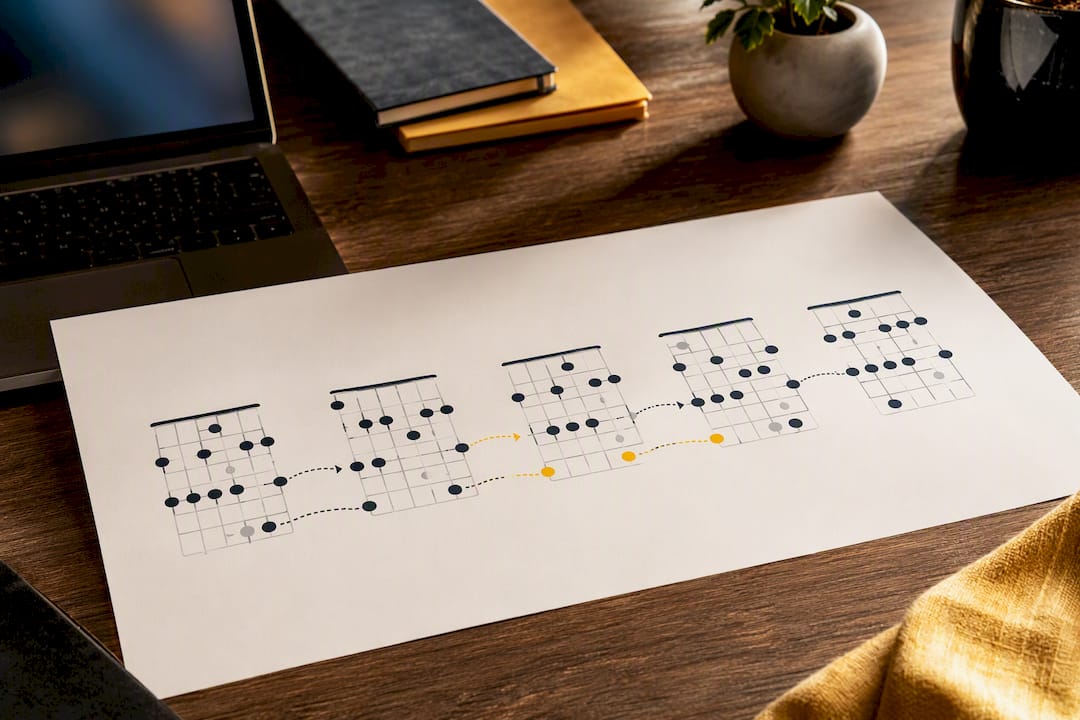
Every guitarist eventually learns the minor pentatonic as five box shapes, often called Patterns 1 through 5. Each box covers roughly four to five frets, and together they tile the entire neck. Learn where the root note sits in each one and you can find A minor pentatonic anywhere on the fretboard without hunting.
- Pattern 1: root on the low E string, typically fretted with the first finger; for A minor pentatonic this starts at the 5th fret.
- Pattern 2: root shifts to the A string, played from around the 7th to 10th fret.
- Pattern 3: root sits on the low E and D strings higher up, roughly frets 9 to 12.
- Pattern 4: root appears on the A and G-strings, around frets 12 to 15.
- Pattern 5: root returns to the low E string an octave up, near the 17th fret, before looping back into Pattern 1 two octaves higher.
Each pattern shares two or three frets with its neighbour, so the top notes of Pattern 1 are the bottom notes of Pattern 2, and so on round the neck. That overlap is the key to gliding between boxes rather than jumping blindly.
| Pattern | Approximate fret range (A minor) | Root string |
|---|---|---|
| 1 | 5th to 8th | Low E |
| 2 | 7th to 10th | A |
| 3 | 9th to 12th | Low E / D |
| 4 | 12th to 15th | A / G |
| 5 | 15th to 17th | Low E |
Once you can see the shared notes between adjacent boxes, the fretboard stops looking like five separate puzzles and starts looking like one long, connected shape.
Fingerings and technique that make it sound musical
Most players use one finger per fret within a box, sliding the hand rather than stretching wildly. In Pattern 1, that means index on the 5th fret, ring on the 7th, and pinky reaching the 8th where needed, with occasional finger substitutions on bends.
Technique is what separates someone running scales from someone actually playing; learning gitaartechnieken voor rockmuziek can help develop this further. A few moves do most of the work:
- Bend the ♭3 up towards the major 3rd for that classic blues push, and bend 4 towards 5 for a similar effect higher in the shape.
- Slide between notes on the same string instead of always changing strings, which smooths out the phrasing.
- Add vibrato on sustained notes, especially the root and the ♭7, to stop lines sounding flat.
- Try double-stops, playing two adjacent strings together for a fuller, more vocal sound.
Pro Tip: Play the scale, then play it again targeting only the root note on every beat, resting between phrases. That single exercise does more for your phrasing than an hour of straight scale runs.
Speed will come. What matters more early on is connecting boxes with melodic phrasing rather than isolated pattern practice, since technical fluency without musical intent tends to sound exactly like what it is: an exercise.
How the same five notes shift between major, minor, and blues
Here’s the part that surprises a lot of players: A minor pentatonic and C major pentatonic use the identical five notes, A, C, D, E, G. The only thing that changes is which note you treat as home. Land your phrases on A and it sounds minor and moody; land them on C and the same shape suddenly sounds bright and major. This relative major/minor relationship means one pattern effectively gives you two scales, depending entirely on which chord is underneath you.
Context changes the flavour further:
- Over minor chords or minor-key progressions, the scale sounds naturally at home.
- Over major triads, shifting your ear to hear the relative major turns the same notes bright and consonant.
- Over dominant or blues progressions, particularly a 12-bar blues in A, the minor pentonic supplies most of the vocabulary guitarists reach for by instinct.
Add one extra note, the ♭5, and the minor pentatonic becomes the blues scale. That flatted fifth is a passing tone rather than a note to rest on. Used sparingly as a quick slide into the 4th or 5th degree, it adds the tension-and-release wobble that gives blues phrasing its character. Overuse it and every lick starts sounding like a cliché.
Practice routines that actually build fretboard fluency
Fifteen minutes a day beats an hour once a week. Structure that time and progress comes fast.
- Warm-up and box drilling (5 to 10 minutes): play through Pattern 1 ascending and descending slowly, then repeat in Pattern 2. Focus on clean, even tone before speed.
- Linking shapes (10 to 15 minutes): set a metronome at a comfortable tempo, then play a phrase that starts in Pattern 1 and finishes in Pattern 2 using the shared notes as a bridge. Increase the tempo by five beats per minute once it’s clean.
- Call-and-response phrasing (10 to 15 minutes): put on a slow backing track in A minor and play a short phrase, then leave a gap, then answer it. Bring in one bend or the blue note per phrase rather than every note.
- Track your tempo weekly. Moving from 80 to 100 beats per minute cleanly over a month is a realistic, measurable goal for most players working through this routine.
For deeper drills on timing and technique, Musicstreet’s guide to practising guitar scales covers metronome work in more depth than fits here.
Gear that supports the practice, from Musicstreet
The right instrument makes repetitive practice far less of a chore. The Yamaha FGC-TA TransAcoustic Electro Acoustic Cutaway in Vintage Tint and its Black counterpart both give you built-in reverb and chorus without an amp, useful for late-night box drilling. The Yamaha FGX5 Acoustic Guitar offers a similarly comfortable neck for players logging long practice sessions on scale shapes.
Bass players working the low end can start on the USED- Ibanez Gsr200, a genuinely playable entry point for exploring pentatonic lines below the sixth fret. And once your action or intonation starts drifting from daily bending and sliding, the CruzTools Groovetech Guitar Player Tech Kit and CruzTools Groovetech Acoustic Guitar Player Tech Kit cover setup adjustments at home, with the Groovetech Mini Multi-Tool handy for quick fixes between sessions.
Musicstreet’s in-store team in Huntingdon also carries out full instrument setups and post-sale support, so an instrument stays properly playable long after it leaves the shop.

Common mistakes that stall pentatonic progress
Most sticking points come down to habits, not lack of talent.
- Running the scale mechanically from bottom to top without resting. Target the root note and leave gaps; phrasing beats speed every time.
- Ignoring the metronome. Fast fingers with sloppy timing sound worse than slow, locked-in playing.
- Fretting too hard. Excess thumb pressure and white-knuckle grip tire the hand fast and choke off tone, especially on bends.
Pro Tip: If a bend sounds flat or sharp, check your thumb position first. A thumb wrapped too far over the neck usually means the bending finger can’t push through cleanly.
Why the five-box method still beats the shortcuts
Plenty of guitar content promises a faster route past the five positions, jumping straight to CAGED or three-notes-per-string systems before a player has any of the shapes under their fingers. That’s backwards. The boxes exist because they’re the fastest way to get sound out of an instrument, and sound is what keeps a beginner practising.
What conventional teaching gets wrong more often is sequencing: too much time drilling shapes, not enough time treating those shapes as a vocabulary of licks and phrases you can actually use. A player who knows three real phrases in Pattern 1 will out-improvise one who can run all five boxes cleanly but has never bent a note with intent.
Prioritise this: learn Pattern 1 properly, add bends and rests before you add Pattern 2, and only chase speed once phrasing feels natural. Everything else, the full five-box map, the blues scale, moving between relative major and minor, builds on that foundation rather than replacing it.
— Music
Find the right instrument for your pentatonic practice at Musicstreet
Musicstreet gets you playing sooner than ordering blind online, because every guitar sold gets a proper setup and every purchase comes with post-sale support if something needs adjusting later. That matters more than most players realise when you’re bending strings daily and relying on consistent action and intonation to make those bends land in tune.
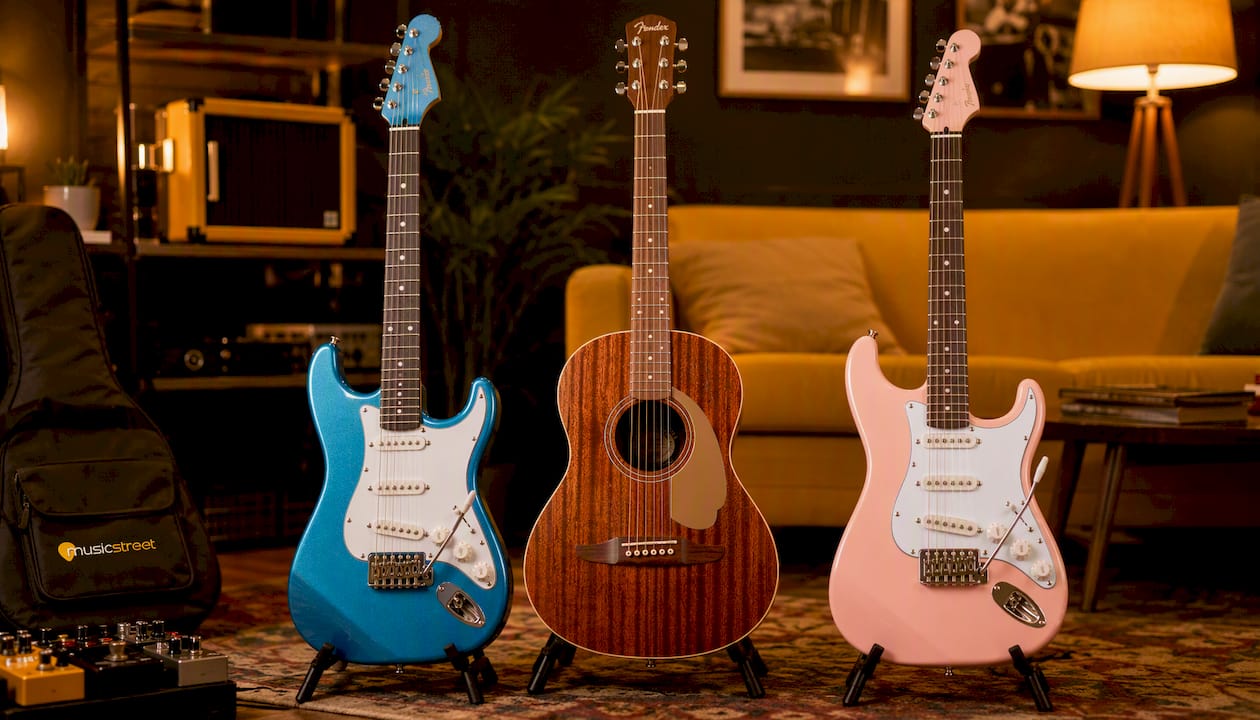
If you’re starting out on the minor pentatonic, the Yamaha FGC-TA TransAcoustic Electro Acoustic Cutaway gives you built-in ambience for practice without needing an amp nearby, while bass players exploring the low-string version of these shapes can look at the USED- Ibanez Gsr200 for a genuinely usable, budget-friendly starting point. Once you’re gigging or recording, a setup like the B Stock Music Man Luke III Steve Lukather Signature HSS rewards the phrasing work you’ve put in with proper sustain and tone. Browse the current range or visit the Huntingdon store to try instruments in person before you commit, and pair anything you buy with a CruzTools Groovetech Guitar Player Tech Kit to keep it properly maintained between practice sessions.
Sources
- A minor pentatonic scale | AppliedGuitarTheory
- A guitarist’s guide to major and minor pentatonic scales | Yamaha
- The pentatonic scale | Berklee (Pulse)
- A minor pentatonic scale: notes, shapes and how to play it | Interactive Chord Finder
- Guitar-chords
FAQ
What are the five notes of the minor pentatonic scale?
The minor pentatonic follows the formula 1, ♭3, 4, 5, ♭7. In A minor, those degrees give you A, C, D, E, G, five notes covering the whole fretboard across five box patterns.
What are the notes in the A minor pentatonic scale?
A minor pentatonic contains A, C, D, E, and G. It’s often the first scale guitarists learn because the shape sits naturally under the fingers and works over countless blues and rock progressions.
What is the difference between a major pentatonic scale and A minor pentatonic scale?
A minor pentatonic (A, C, D, E, G) and C major pentatonic share the exact same five notes; the difference lies purely in the tonal centre, not the notes themselves. Resolve to A and it sounds minor; resolve to C and the identical shape sounds major.
Can you explain the pentatonic scale simply?
A pentatonic scale is any five-note scale, and the minor pentatonic specifically removes the 2nd and 6th degrees from a natural minor scale to eliminate harsh semitone clashes. That gap-free interval pattern is why it sounds musical even when played almost at random.
Does Musicstreet sell guitars suited to learning the minor pentatonic?
Yes. Musicstreet stocks acoustic-electric models like the Yamaha FGX5 and FGC-TA TransAcoustic range alongside basses such as the USED- Ibanez Gsr200, all set up in-store before sale to make scale practice comfortable from day one.




Share:
Build a UK Recording Studio for £250–£500: Room and Interface First
Choosing the Best Guitar Amp: Expert Guide to Tube vs Solid State Amplifiers for UK Musicians