


- Starting to learn acoustic guitar can be both exciting and frustrating for beginners. Choosing a well-set-up guitar within £150–£400, maintaining proper posture, and practicing focused sessions of 20–30 minutes daily significantly accelerate progress. Mastering five essential open chords and developing clean transitions builds a strong foundation for playing real songs efficiently.
Starting out on acoustic guitar is genuinely exciting. It is also, if nobody warns you, a little frustrating. Your fingertips hurt, chords sound muffled, and the gap between what you hear in your head and what comes out of the strings feels enormous. These acoustic guitar beginner tips are designed to close that gap faster, not by telling you to practise more hours, but by showing you how to use every minute you do have far more effectively.
Table of Contents
- Key takeaways
- Acoustic guitar beginner tips: choosing the right guitar
- Posture and technique: get the foundations right
- How to structure your practice sessions
- Learning your first chords
- Common beginner mistakes and how to fix them
- My honest take on learning acoustic guitar
- Start your guitar journey with Musicstreet
- FAQ
Key takeaways
| Point | Details |
|---|---|
| Choose the right guitar | A well-set-up guitar in the £150–£400 range makes learning significantly easier and more enjoyable. |
| Posture and finger placement matter | Pressing close behind the fret with good posture prevents buzzing and reduces strain from the start. |
| Short, focused sessions beat long ones | Daily practice of 20–30 minutes with clear goals produces faster progress than occasional marathon sessions. |
| Learn five chords first | Mastering Em, Am, G, C, and D gives you the building blocks to play thousands of real songs. |
| Consistency is everything | Avoiding more than two consecutive days off keeps momentum alive and skills sharp. |
Acoustic guitar beginner tips: choosing the right guitar
The first decision you make sets the tone for your entire learning experience. A poorly made guitar with high string action (the gap between the strings and fretboard) will make everything harder. Chords will buzz. Your fingers will ache more. You will likely give up before you ever hear what you are actually capable of.
Experts recommend spending between £150 and £400 on your first instrument. Guitars priced below that threshold often have manufacturing shortcuts that no amount of practice can compensate for. You do not need to spend a fortune, but you do need a guitar that has been properly set up to play well.
Body shape and size
Body shape affects both comfort and sound, and it matters more than most beginners realise. Here is a quick breakdown:
- Dreadnought: The most common shape. Big sound, great for strumming, but can feel bulky for smaller players or children.
- Parlour: Smaller body, easier to hold, and surprisingly full-sounding. A solid choice if the dreadnought feels unwieldy.
- Mini or travel guitar: Great for young players or those with smaller hands, though the sound is less resonant for home practice.
When you are comparing options, reading a detailed first guitar buying guide can save you from expensive mistakes.
Essential accessories for acoustic guitar
You will need a few things alongside the guitar itself:
- A clip-on chromatic tuner (or a free tuning app)
- A selection of picks in light, medium, and heavy gauges
- A capo, which opens up new chord voicings without extra theory
- A digital metronome, either a physical one or an app
Pro Tip: Buy a spare set of strings at the same time as your guitar. Strings break, usually at the worst possible moment, and having a backup keeps your practice uninterrupted.
Posture and technique: get the foundations right
Bad habits formed in the first few weeks can persist for years. Getting your posture and hand position right early is one of the least glamorous but most worthwhile things you can do as a new player.
Sit with your back straight and the guitar resting on your strumming arm’s thigh. The neck should point slightly upward, not drop toward the floor. Your fretting hand should curve around the neck with your thumb resting gently behind the neck, roughly in line with your middle finger. A common beginner error is wrapping the thumb over the top of the neck, which limits your reach and forces awkward stretches.
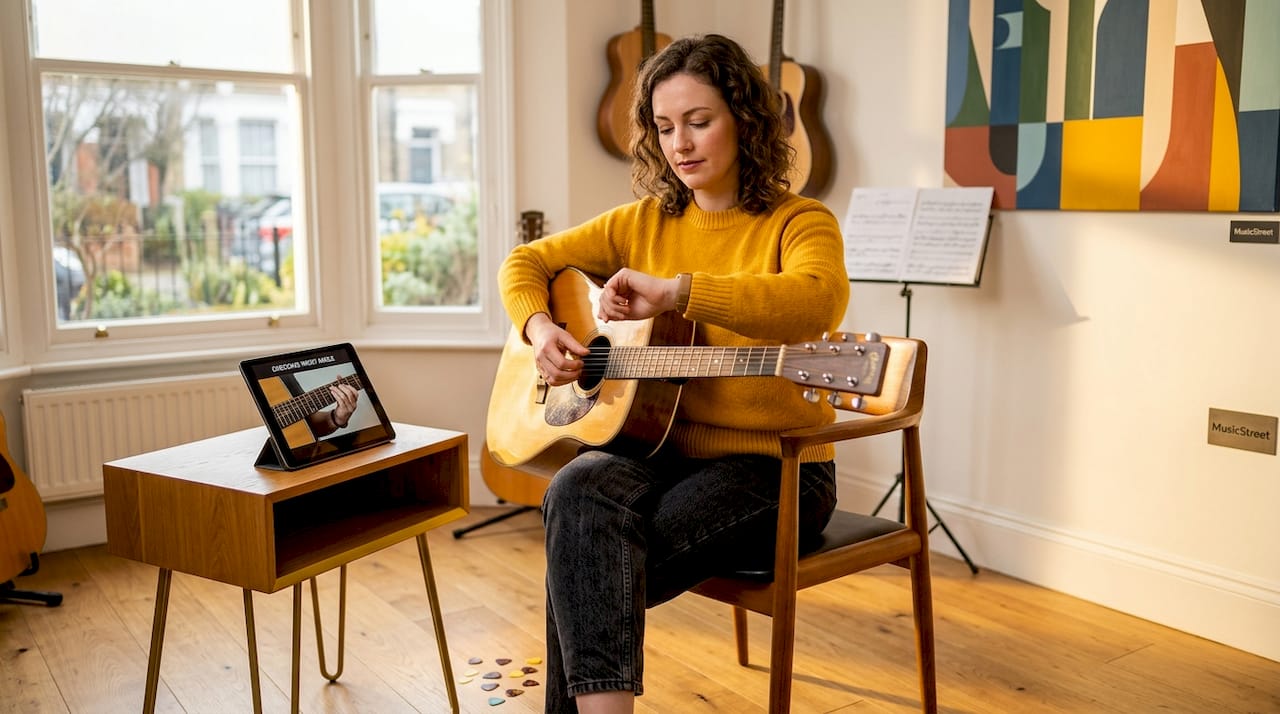
Fretting cleanly without buzzing
Fret buzz often comes from pressing in the middle of the fret rather than just behind the metal fret wire. Move your finger as close to the fret as possible. You need less pressure this way, and the note rings out far more cleanly.
Use the tips of your fingers, not the pads. Your fingers should be slightly arched so they do not accidentally mute adjacent strings. This feels awkward at first. It becomes natural within a couple of weeks of deliberate practice.
Finger soreness and calluses
Your fingertips will be sore for the first two to three weeks. This is completely normal. Calluses form gradually through regular contact with the strings, and once they do, the soreness disappears entirely. Short daily sessions are actually better for callus formation than occasional long ones, because the skin gets consistent stimulus without becoming raw.
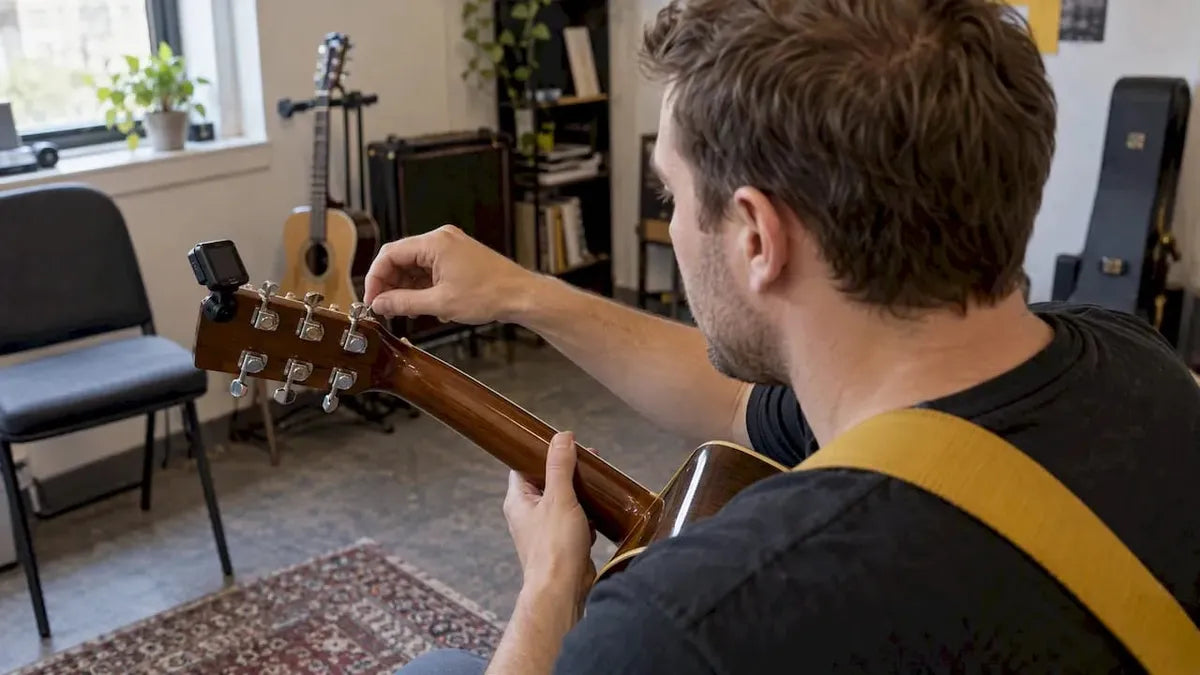
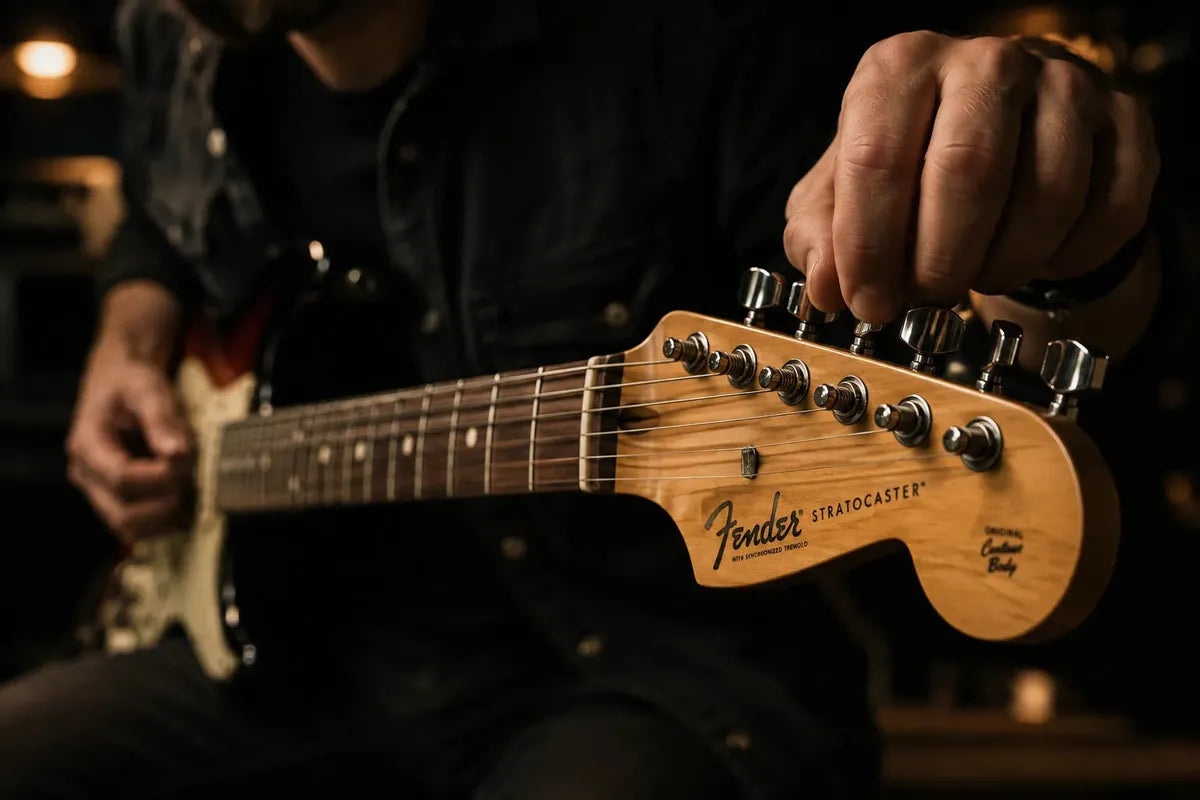
Pro Tip: Tune your guitar every single time you pick it up. It trains your ear, keeps the instrument sounding good, and takes less than 60 seconds.
How to structure your practice sessions
The biggest myth in learning acoustic guitar is that more hours automatically equals more progress. Five minutes of focused, intentional practice produces more improvement than 30 minutes of unfocused noodling. The difference is mental engagement.
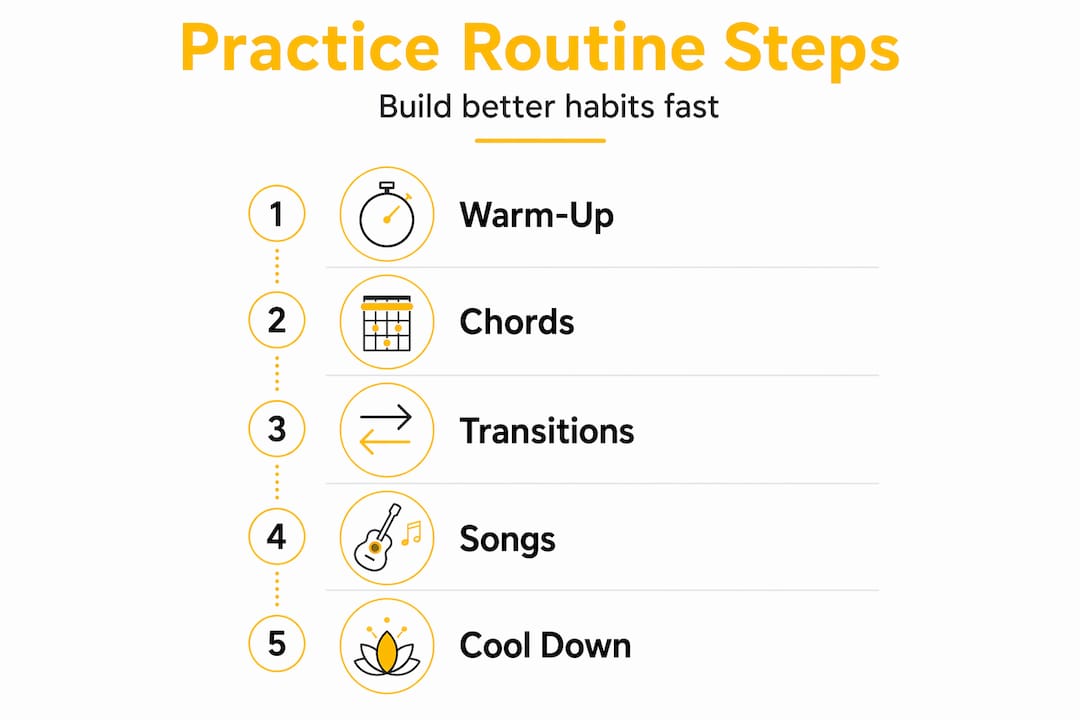
Splitting your session roughly 50/50 between chord shape memorisation and rhythmic strumming gives you the best of both worlds. You build muscle memory and musical feel at the same time, rather than being technically competent but rhythmically stiff.
Here is a simple structure for a 25-minute practice session:
- Tune up (2 minutes): Always start in tune. Non-negotiable.
- Warm-up (3 minutes): Slowly fret individual notes up and down the neck to loosen fingers.
- Chord shapes (10 minutes): Work on one or two specific chord shapes. Aim for clean, buzzing-free notes.
- Chord transitions (5 minutes): Switch between two chords repeatedly, keeping steady rhythm with a metronome.
- Song practice (5 minutes): Apply what you have practised to an actual song you enjoy.
Pro Tip: Use the tempo ladder when working with a metronome. Start slow enough that every note is clean, then raise the tempo by 5 bpm only when you can play through without errors. Speed is the byproduct of accuracy, not the starting point.
Avoiding more than two consecutive days off keeps your muscle memory sharp and prevents the frustrating feeling of starting over. Fifteen minutes on a busy day is far better than nothing.
Learning your first chords
You do not need to learn 20 chords to start playing real music. Beginners can master basic songs with as few as three or four open chords within one to two weeks of focused daily practice. The key is not learning more chords but getting faster and cleaner at switching between the ones you already know.
Start with these five essential open chords: Em, Am, G, C, and D. Between them, they cover a huge proportion of popular songs. Here is a practical method to build them properly:
- Learn the shape first: Press the chord, strum each string individually, and identify which ones buzz. Adjust until every string rings clearly.
- Memorise it without looking: Practise placing the chord shape with your eyes closed. This builds genuine muscle memory rather than visual dependency.
- Drill the transition: Focus on key chord pairs like Em to G and Am to C. Set a timer for 60 seconds and count how many clean transitions you can make. Try to beat that number the next day.
- Add a strumming pattern: Once the transition is reasonably smooth, add a simple down strum on each beat. This makes it musical, which keeps motivation high.
- Play a real song: Find a simple song that only uses the chords you know. Playing music, not just exercises, is what makes practice feel worthwhile.
The chord transition drill is underrated. Most beginners spend too long perfecting static shapes and not enough time actually moving between them. The movement is where the real playing happens.
Common beginner mistakes and how to fix them
Knowing what not to do saves you weeks of frustration. These are the mistakes that come up again and again for new players:
- Pressing too hard: More force does not equal better tone. It causes fatigue and pain. Aim for the minimum pressure needed for a clean note.
- Playing in the middle of the fret: As noted above, press just behind the fret wire, not in the centre of the fret space.
- Rushing the tempo: Playing fast before you have mastered accuracy at slow speeds bakes errors into your muscle memory.
- Skipping the tuner: A guitar even slightly out of tune makes everything sound wrong and confuses your developing ear.
- Never recording yourself: Recording a short clip on your phone is uncomfortable but genuinely useful. You hear things you simply do not notice while playing.
“The goal in the early weeks is not to sound impressive. It is to build the physical habits that will make sounding impressive possible later.”
Pro Tip: When you make a mistake mid-song, do not stop and restart from the beginning. Learn to recover and keep going. In real playing, nobody restarts. Building that recovery reflex early makes you a more natural musician.
Muscle memory lags behind intellectual understanding considerably. You can know exactly how a chord should be shaped and still have your fingers fumble it. This is not a talent issue. It is biology. Slow, deliberate repetition is the only solution, and it genuinely works.
My honest take on learning acoustic guitar
What I have seen, time and again, is that the players who progress fastest are not the ones who practise longest. They are the ones who treat every session as a problem to solve rather than time to fill. They come in with one specific goal: nail the G to C transition, or keep rhythm steady through an entire verse.
In my experience, the guitar choice matters more than people expect. A well-set-up instrument in a sensible price range does not just sound better. It physically reduces the effort required to play, which keeps you at it during the hard early weeks when most beginners quit.
I have also noticed that beginners worry far too much about sounding bad, and far too little about practising the right things slowly. The discomfort of slow practice feels like going backwards. It is not. It is how you build the kind of technique that eventually feels effortless.
If you take nothing else from this article, take this: practise less and practise better. Your progress will speak for itself within a month.
— Musicstreet
Start your guitar journey with Musicstreet
Whether you are still choosing your first instrument or looking for guidance on getting the most from the one you have, Musicstreet is here to help. At our Huntingdon store and online shop, you will find a carefully selected range of acoustic guitars suited to beginners, each inspected and set up by our team before it reaches your hands.

Browse our best acoustic guitars for beginners to find instruments matched to your budget and playing goals. If you want to dig deeper into what to look for before you buy, our guide on choosing your first guitar covers everything from body shape to string action in plain, practical terms. And once you own your guitar, our acoustic maintenance guide will keep it playing beautifully for years.
FAQ
What is the best budget for a beginner acoustic guitar?
Experts suggest spending between £150 and £400 for a beginner acoustic guitar. Instruments below this range often have poor playability that makes learning harder than it needs to be.
How long should I practise as a beginner?
Daily sessions of 20 to 30 minutes focused on specific goals produce faster results than occasional longer sessions. Consistency matters far more than duration.
Which chords should a beginner learn first?
Start with Em, Am, G, C, and D. These five open chords appear in thousands of songs and give you a solid musical foundation to build on quickly.
Why do my chords buzz so much?
Buzzing almost always comes down to finger placement. Press your fingertip just behind the fret wire rather than in the middle of the fret space, and use the very tip of your finger to avoid muting adjacent strings.
How often should I practise to see real progress?
Play every day if you can, even for 15 minutes. Avoiding more than two days off in a row keeps muscle memory intact and prevents the frustrating feeling of having to relearn what you already knew.


Share:
Best Gretsch Guitars 2025: The Ultimate Buyer's Guide
Best Electric Guitars for Beginners in 2026