

Table of Contents
- What to Look for in Guitar Maintenance Kits
- Quick Comparison: Top Kits at a Glance
- 1. Dunlop DGT102 System 65 Guitar Tech Kit
- 2. Taylor Guitars Maintenance Kit
- 3. MusicNomad Premium Guitar Tech Tool Set
- 4. StewMac Guitar Tech Starter Kit
- 5. Ernie Ball Musician's Tool Kit
- 6. Hiscox Guitar Care Pack
- How to Prevent Guitar Hardware Corrosion in Humid Climates
- Essential Guitar Setup Tools for Beginners
- Acoustic Guitar Fretboard Oiling Guide
- Frequently Asked Questions
Last Updated: 20 September 2026
What to Look for in Guitar Maintenance Kits
A good guitar maintenance kit should cover three jobs: cleaning, string changes, and basic setup adjustments. Miss any one of those and you'll end up buying the missing pieces separately, usually at a worse price.
This guide from MusicStreet covers the six kits worth considering for acoustic players in 2026, with honest notes on where each one falls short. Below, we'll show you exactly what separates a genuinely useful kit from a box of filler tools, and which kits suit which players.
Here's what most buyers get wrong: they judge a kit by tool count. A 72-piece set sounds impressive until you realise half of it is Allen keys in sizes your guitar will never use. According to Guitar World's 2026 review of guitar cleaning kits and maintenance tools, nine kits were evaluated for long-term instrument preservation, and the winners were judged on tool quality rather than volume.
Guitar maintenance kits for acoustic players need to handle delicate finishes, humidity-sensitive wood, and hardware that corrodes faster than most owners expect. Three things matter most:
- Finish-safe cleaning products. Acoustic tops are often satin or nitrocellulose, and harsh cleaners dull them permanently.
- Setup tools that fit your hardware. Truss rod keys, saddle files, and hex keys must match your instrument.
- Fretboard care. A dry fretboard causes buzzing and cracking. Conditioning oil is not optional.
Quick Comparison: Top Kits at a Glance
The best all-round kit for most acoustic players is the Dunlop DGT102 System 65, which covers cleaning and basic maintenance at a sensible price. If you want setup tools rather than polish, the MusicNomad or StewMac sets are the stronger buys.
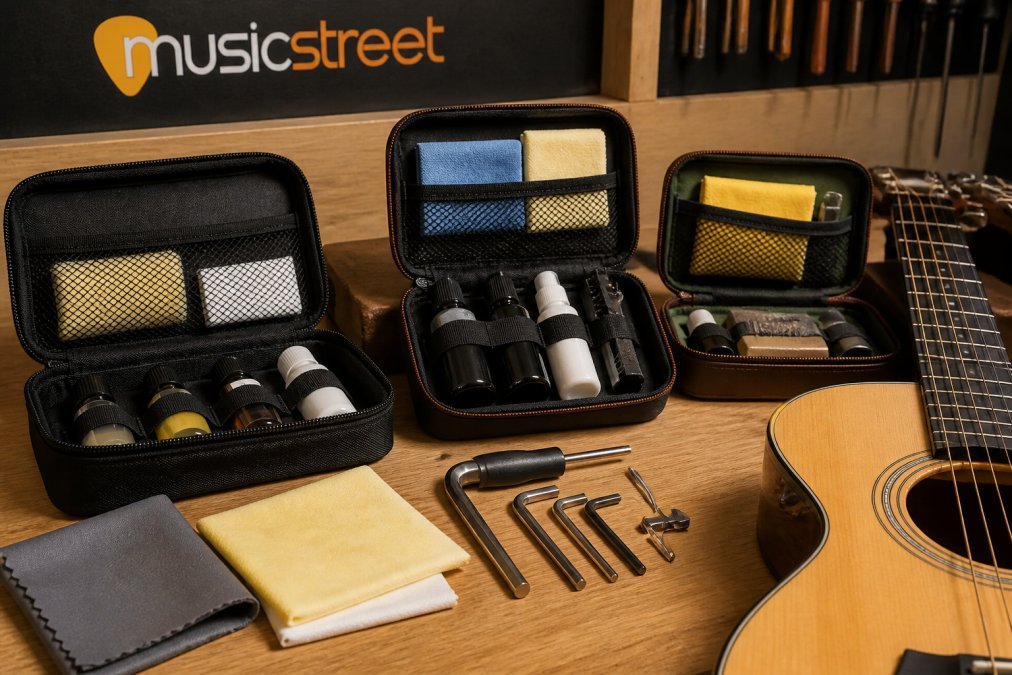
Here's the short version before the detail:
| Kit | Price | Best For | Standout Feature |
|---|---|---|---|
| Dunlop DGT102 System 65 | £35 | All-round home care | Formula 65 cleaners |
| Taylor Maintenance Kit | £22 | Premium acoustics | Finish-safe polish |
| MusicNomad Tech Tool Set | £45 | DIY setup work | Precision hex keys |
| StewMac Tech Starter Kit | £60 | Serious enthusiasts | Measuring tools |
| Ernie Ball Musician's Kit | £30 | Gigging players | Portability |
| Hiscox Guitar Care Pack | £15 | Hardware protection | Anti-corrosion cloth |
1. Dunlop DGT102 System 65 Guitar Tech Kit
The Dunlop DGT102 is the kit most acoustic players should buy first. It covers cleaning, conditioning, and string changes in one box, and the chemical formulas are the same ones used in professional workshops.
You get Formula 65 cleaner and polish, Fretboard 65 Ultimate Lemon Oil, a string cutter, string winder, multi-tool, and microfibre cloths. That's the full routine for a guitar that needs regular care rather than a full setup.
The limitation is honest and worth stating: there are no feeler gauges or precision measuring tools here. If you want to set your own action and relief, you'll need to add them.
2. Taylor Guitars Maintenance Kit
Taylor's kit is built for one job, and it does that job properly: keeping a high-end acoustic looking and feeling right. The polish and cleaner are formulated for delicate acoustic finishes, which matters if your guitar has a nitrocellulose or thin satin top.
At around £22 it's the cheapest genuinely safe option for expensive instruments. The microfibre cloth is good quality, and the compact pouch fits in a gig bag pocket.
What it doesn't do is adjust anything. There are no hex keys, no winder, no cutter. Buy this as a cleaning kit, not a maintenance kit.
3. MusicNomad Premium Guitar Tech Tool Set
MusicNomad's set flips the usual formula: this is a tool kit with cleaning supplies as an afterthought. Precision hex keys, screwdrivers, a string winder, and a cutter all come in an organised case, built from steel that won't round off after a few uses.
At £45 it sits in the middle of the range, and it's the pick for players who want to adjust their own bridge, saddle, and truss rod. The components are professional grade.
The catch is real. Using these tools safely requires some technical knowledge. A quarter turn too far on a truss rod can damage a neck, and this kit won't teach you how.
4. StewMac Guitar Tech Starter Kit
StewMac's kit is the one to buy if you're past basic maintenance and want to work like a luthier. It includes precision measuring tools for action and relief, plus specialised fretboard cleaning and polishing supplies.
The £60 price reflects that. StewMac backs its maintenance tools with a lifetime promise, which changes the maths on a kit you'll keep for a decade.
For most acoustic players this is more kit than they need. For anyone who owns several guitars and wants to stop paying for setups, it pays for itself quickly.
5. Ernie Ball Musician's Tool Kit
Ernie Ball's kit is designed around the gigging musician's problem: something breaks mid-set and you have ten minutes. Microfibre cloth, wonder wipes, string winder, heavy-duty cutters, and a full set of hex keys all fit in a compact case.
At £30, it's the best portable option here. The brand's reputation for string hardware is earned, and the cutters in particular are better than most bundled tools.
Cleaning supplies are thin compared to dedicated kits. This is a repair kit, not a care kit.
6. Hiscox Guitar Care Pack
Hiscox built this pack around two specific threats: wood drying out and hardware corroding. The polish protects the finish, and the anti-corrosion cloth handles the metal parts, which is a genuine concern if you play near the coast or in humid rooms.
At £15 it's the cheapest entry point on this list, and the anti-corrosion cloth alone justifies the price for players in damp conditions.
The scope is narrow. No tools, no fretboard oil, no string-changing equipment. It's a supplement, not a starter kit.
How to Prevent Guitar Hardware Corrosion in Humid Climates
Corrosion prevention comes down to three habits: wipe hardware after every session, keep the instrument in a stable humidity range, and store it with a moisture absorber. Acoustic hardware, particularly tuners and bridge pins, corrodes faster than most players expect.
An anti-corrosion cloth used weekly makes a measurable difference. So does keeping your guitar out of its case in a damp room, since sealed cases trap moisture against metal.
For players in coastal or humid areas, a Hiscox care pack plus a room hygrometer is a sensible pairing. If corrosion has already set in, that's a workshop job rather than a home fix.
Essential Guitar Setup Tools for Beginners
Beginners need four tools before anything else: a string winder, a string cutter, the correct truss rod key, and a set of hex keys for bridge and saddle adjustments. Everything else can wait until you know what you're adjusting.
According to Acoustic Tuesday's episode on must-have acoustic maintenance tools, ten specific tools cover fundamental acoustic maintenance and setup. That's a useful ceiling for beginners, because it stops you buying tools you'll never touch.
Start with the Dunlop or Ernie Ball kit, learn to change strings properly, and add setup tools once you understand what action and relief actually mean.
Acoustic Guitar Fretboard Oiling Guide
Fretboard oiling should happen roughly twice a year, or whenever the wood looks pale and dry. Apply a small amount of lemon or mineral oil to a cloth, work it along the fretboard between the frets, wait a few minutes, then wipe off the excess.
According to Shaevle's comparative testing of fretboard conditioning oils, eight different fretboard oils were tested for acoustic instrument care.
Frequently Asked Questions
What should be included in an acoustic guitar maintenance kit?
A useful acoustic kit covers cleaning, conditioning and basic adjustment. Look for a body cleaner and polish, fretboard oil, microfibre cloths, a string winder and cutter, and hex keys for truss rod and bridge adjustments. The Dunlop DGT102 System 65 includes Formula 65 cleaner, Fretboard 65 Ultimate Lemon Oil and basic tools, making it a solid all-round starting point for home players.
How often should I clean my acoustic guitar?
Wipe the strings and body after every session to remove oils and dust. A deeper clean with polish and fretboard conditioning every one to three months suits most players. If you gig regularly or play in humid conditions, clean more often and check hardware for early signs of corrosion. The acoustic guitar fretboard oiling guide above explains how to condition without oversaturating the wood.
Is it safe to use household furniture polish on a guitar?
No. Furniture polish often contains silicone, which can build up on the finish and make future repairs difficult. It may also damage nitrocellulose lacquer found on many acoustic guitars. Purpose-made products such as those in the Taylor Guitars Maintenance Kit are formulated to be safe for instrument finishes and will not leave harmful residue.
Do I need professional tools for basic acoustic guitar maintenance?
For cleaning and string changes, a basic kit is enough. If you want to adjust action, relief or intonation, you need precision tools such as feeler gauges and accurate hex keys. The StewMac Guitar Tech Starter Kit and MusicNomad Premium Guitar Tech Tool Set include these. If you are unsure, a professional setup from a specialist will save you from costly mistakes.
How do I protect my acoustic guitar from humidity damage?
Keep relative humidity between 45% and 55% using a hygrometer and a soundhole humidifier in dry spells. In humid climates, use silica gel packs in the case and avoid storing near radiators or windows. The Hiscox Guitar Care Pack includes an anti-corrosion cloth to help protect hardware. For persistent issues, a professional inspection is worthwhile.







Share:
Guitar Dealers UK: Finding the Right Shop for Your Needs