

Table of Contents
- What You'll Need Before You Start Tuning
- Standard Guitar Tuning Notes Explained
- How to Tune a Guitar by Ear
- How to Use a Clip-On Guitar Tuner
- Why Guitars Go Out of Tune
- Common Tuning Problems and How to Fix Them
- Conclusion
- Frequently Asked Questions
Last Updated: September 24, 2026
What You'll Need Before You Start Tuning
Guitar tuning is the process of adjusting each string's tension so it produces the correct pitch, and getting it right starts with having the right tools to hand. According to Cognitive Market Research's guitar tuners market report, the global market for guitar tuners was valued at $179.471 million in 2021 and is projected to reach $247.37 million by the end of 2026. That growth tells you something simple: more players are tuning with electronic help rather than by ear alone.
At MusicStreet, we set up and repair guitars, and we often see beginners rush the basics, then wonder why chords sound sour.
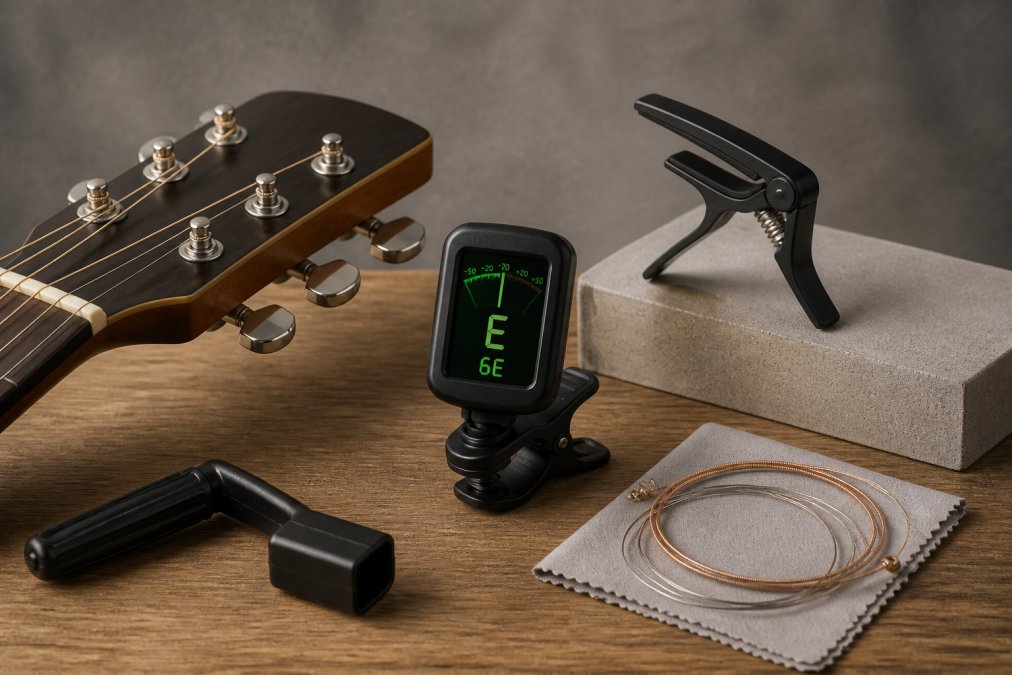
Before you turn a single peg, gather these:
- A clip-on tuner or a tuning app on your phone
- A quiet room, so you can actually hear the strings
- A soft cloth to wipe the strings down afterwards
- Spare strings, in case one snaps mid-tune
- A small screwdriver for tightening loose machine heads
That's it. No expensive kit needed.
One quick note on safety: never over-tighten a string to force a pitch. You'll either snap it or damage the nut. If a string feels stiff and won't budge, stop and check it.
Standard Guitar Tuning Notes Explained
Standard guitar tuning notes are E, A, D, G, B and E, running from the thickest string to the thinnest. This layout, usually written as EADGBE, gives you the range and chord shapes most songs are built around.
The order matters more than beginners expect. Get one string wrong and every chord above it sounds off.
String Order and Pitch Reference
Here's the sequence, from low to high:
String |
Note |
Thickness |
Common Name |
|---|---|---|---|
6th |
E |
Thickest |
Low E |
5th |
A |
Thick |
A string |
4th |
D |
Medium |
D string |
3rd |
G |
Medium-thin |
G string |
2nd |
B |
Thin |
B string |
1st |
E |
Thinnest |
High E |
A useful memory trick: Eddie Ate Dynamite, Good Bye Eddie. Silly, but it sticks.
440Hz vs 432Hz: Why Bands Need One Reference
Pitch reference is the fixed frequency a tuner uses as its baseline, and the standard is 440Hz. That means the A above middle C vibrates 440 times per second.
Some players prefer 432Hz, claiming it sounds warmer. There's no strong evidence for that, but there is a real problem with mixing the two. If one band member tunes to 440Hz and another to 432Hz, the whole group sounds slightly out, even when everyone's tuner says "in tune."
Pick one reference and stick to it. Most gigging bands use 440Hz because it matches pianos, backing tracks and studio gear.
How to Tune a Guitar by Ear
Tuning by ear means matching each string's pitch to a reference, either an external note or another string on the guitar. It's a skill worth learning, even if you rely on a tuner most of the time.
Using a Reference Pitch
Start with one accurate note. Options include:
- A piano or keyboard playing the low E
- A tuning fork or pitch pipe
- A tuning app set to play a reference tone
- Another guitarist who's already in tune
Play the reference note, then adjust your low E string until the two match. Once that string is right, you can tune the rest from it.
The Fifth Fret Method
The fifth fret method tunes each string to the one below it, and it's the classic way to tune without any device.
Here's how it works:
- Play the 5th fret of the low E string. That note is an A. Tune your open A string to match it.
- Play the 5th fret of the A string. That's a D. Tune your open D string to match.
- Play the 5th fret of the D string. That's a G. Tune your open G string to match.
- Play the 4th fret of the G string. That's a B. Tune your open B string to match. This is the one step that changes.
- Play the 5th fret of the B string. That's an E. Tune your high E string to match.
The jump from the G string to the B string catches everyone out the first time. Mark it in your head: fourth fret, not fifth.
How to Use a Clip-On Guitar Tuner
A clip-on guitar tuner is a small device that clamps onto the headstock and reads the string's vibration, then shows you whether the note is sharp, flat or spot on. It's the fastest way for most players to get in tune, especially on stage or in a noisy room.

Clip it on, switch it on, and give it a second to settle.
Reading the Display and Adjusting Pitch
Most tuners show a needle or a set of lights. Here's what you're looking at:
- Centre or green light: the string is in tune
- Needle to the left: the note is flat, so tighten the string
- Needle to the right: the note is sharp, so loosen the string
- Letter shown: which note the tuner thinks you're playing
Pluck one string at a time and let it ring. Muting the other strings with your palm helps the tuner lock on faster.
Turn the tuning peg in small steps, then check again. Big turns overshoot the note and you'll spend twice as long correcting.
Why Guitars Go Out of Tune
Guitars go out of tune because string tension changes with temperature, humidity, playing force and string age. It's normal. A guitar that never drifts usually means it isn't being played.
New Strings, Temperature, and Playing Style
New strings stretch for the first few days, so expect to retune often during that window. Once they settle, they hold pitch far better.
Temperature and humidity matter just as much. Wood expands and contracts, and metal strings react to heat. A guitar that's been in a cold car or a hot van will drift. Let it reach room temperature before you tune it.
Your playing style plays a part too. Heavy strumming and big bends pull strings sharp. Players who attack hard retune between songs more often than gentle fingerpickers.
According to SoundPure's guide to guitar intonation, players increasingly lean on electronic tuners rather than tuning by ear, largely because so many physical factors affect how an instrument holds pitch.
That's the honest truth about tuning: it's not a one-off job. It's maintenance.
Common Tuning Problems and How to Fix Them
Most tuning problems come down to a handful of causes, and each has a fix you can try at home before booking a repair.
Here's the quick-reference version:
Problem |
Likely Cause |
Fix |
|---|---|---|
String won't reach pitch |
Old or stretched string |
Fit a new string |
Tuner jumps between notes |
Too much background noise |
Move somewhere quieter |
Guitar sounds off in some chords |
Worn nut or saddle |
Book a setup |
Strings slip after tuning |
Loose tuning peg |
Tighten the peg screw |
Constant drift while playing |
Temperature or humidity swing |
Let the guitar settle |
Buzzing on certain frets |
Action set too low |
Some issues you can sort in five minutes.
Conclusion
Tuning a guitar isn't complicated, but it does reward patience. Learn the standard notes, pick one pitch reference, and get comfortable with both your ear and a clip-on tuner. That combination covers you in any room, at any gig.
Frequently Asked Questions
How do I tune my guitar for the first time?
Start with the lowest string (the thickest one) and work upwards. Pluck it, check the pitch against a clip-on tuner or reference tone, and turn the tuning peg slowly until the display shows the correct note. Move to the next string and repeat. New strings stretch, so expect to retune two or three times in the first week. Take your time and never force a peg, as over-tightening can snap a string.
What is the standard tuning for a 6-string guitar?
Standard guitar tuning notes run from the lowest to highest string as E, A, D, G, B, and E. The lowest E is two octaves below the highest E. This layout gives you the chord shapes most players learn first, which is why the vast majority of songs, tutors, and chord charts assume it. Once you can find these six notes reliably, you can move on to alternative tunings such as Drop D or Open G.
Why does my guitar keep going out of tune?
New strings stretch and settle over several days, so they drift until broken in. Temperature and humidity changes also affect the neck and strings. Beyond that, friction at the nut or bridge can stop strings returning to pitch after bends, and worn tuning pegs slip under tension. If your guitar goes out of tune within minutes of playing, a professional setup will usually identify whether the nut, bridge, or machine heads need attention.
Can I use an online tuner to tune my guitar accurately?
Yes, a phone or browser-based tuner can get you close, and the market for tuning apps has grown alongside hardware. Accuracy depends on your device's microphone and background noise, so a quiet room helps. Clip-on tuners read vibration directly through the headstock, which makes them more reliable on stage or in a noisy room. For everyday practice at home, an online tuner is perfectly adequate.









Share:
What is zero fret and how does it enhance guitar tone?