


Table of Contents
- What You'll Need to Measure Guitar Action
- How to Measure String Height at the 12th Fret
- What Is the Ideal Electric Guitar Action Height?
- How Often Should You Check Your Guitar's Action?
- Common Mistakes and Troubleshooting
- Conclusion
- Frequently Asked Questions
Last Updated: September 8, 2026
Checking your guitar's action is one of the most valuable skills you can learn as a player. Put simply, guitar action refers to the height of the strings above the fretboard, and it directly determines how comfortable your instrument feels. If the strings sit too high, playing becomes a strain on your fingers; if they sit too low, you'll hear an annoying buzz with every note. Learning how to check guitar action takes about five minutes and requires no specialist knowledge, just a ruler and a steady hand. At MusicStreet, we understand exactly what makes a guitar play beautifully.
Most players only think about their action when something feels wrong, but a quick check every few months keeps your guitar feeling consistent. Below, we'll walk you through the process step by step, covering the tools you need, the correct measuring technique, and what numbers you should actually be aiming for.
What You'll Need to Measure Guitar Action
Before you start, gather a few simple guitar action measurement tools. The essential item is a steel ruler with millimetre markings, ideally one that reads accurately down to fractions of a millimetre. A dedicated string action gauge is a worthwhile upgrade if you plan to check multiple guitars, as it combines a ruler with notches for common height settings. You will also need your guitar tuned to pitch, since string tension changes the measurement, and a clean cloth to wipe the fretboard.
A capo is useful for one part of the process, though you can manage without one if you have a spare hand. The key is consistency: use the same tools and technique each time so you can compare readings across different guitars and setups. Many industry guides, including those from Sweetwater's guitar setup resources, recommend the 12th fret as the primary reference point for measuring action.
How to Measure String Height at the 12th Fret
The standard method for checking action involves measuring the gap between the top of the 12th fret and the bottom of the string. Rest your guitar flat on a stable surface with good lighting, then place the ruler vertically against the 12th fret, ensuring it touches both the fret wire and the string without pressing the string down. Read the measurement at the bottom edge of the string, and repeat this for each string, though the low E and high E are usually sufficient for a general assessment.
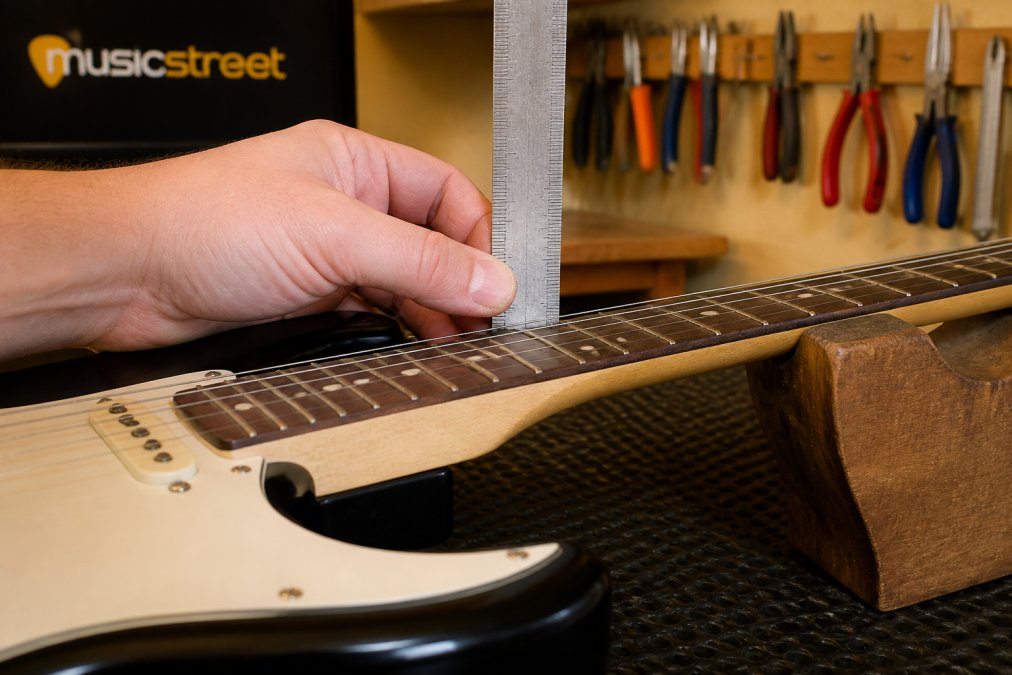
For accuracy, sight the ruler at eye level to avoid parallax error, where the angle of your view makes the reading appear different from the true value. Some technicians prefer measuring at the 17th fret, but the 12th fret remains the industry standard because it sits at the midpoint of the scale and gives a balanced representation of the overall setup. This multi-point approach is echoed in guidance from Acoustic Guitar magazine's setup advice, which also recommends checking neck relief separately.
What Is the Ideal Electric Guitar Action Height?
There is no single perfect number, as the ideal electric guitar action height depends on your playing style and the guitar itself. As a general starting point, most players find that a measurement of around 1.6 mm on the high E string and 2.0 mm on the low E string at the 12th fret feels comfortable and buzz-free (sweetwater.com). These figures suit a modern electric with a straight neck and well-dressed frets.
For acoustic guitars, the action typically sits higher due to the heavier string gauges and the physics of the instrument, often around 2.0 mm on the high E and 2.5 mm on the low E. If you play with a heavy pick attack or favour aggressive bends, you may need slightly higher action to prevent buzzing. Conversely, if you are a beginner or prefer fast lead playing, a lower action feels easier, but you risk fret buzz if you push too far. The right setting is ultimately whatever feels playable to you without unwanted noise.
How Often Should You Check Your Guitar's Action?
A common question we hear is how frequently this check needs repeating. As a rule of thumb, check your action whenever you change string gauge, adjust the truss rod, or notice a change in playability. Seasonal changes also affect your guitar, as wood responds to humidity and temperature shifts, which is particularly relevant in the variable climate we experience in the UK.
For most players, a thorough check two or three times a year is sufficient to catch issues early. If you play daily and travel with your guitar regularly, you might find it drifts out of adjustment more quickly. Guitars are not static objects; they settle, shift, and respond to their environment, so treating setup as routine maintenance rather than a one-off task keeps your instrument playing at its best.
Common Mistakes and Troubleshooting
The most frequent error when learning how to check guitar action is pressing the string down while measuring, which gives a false reading. The ruler should rest lightly on the fret with the string untouched. Another common mistake is measuring with the guitar out of tune, as lower tension raises the strings and skews your results.
If your action reads higher than expected, the cause may not be the bridge at all. Neck relief, checked by pressing the string at the first and last frets and looking at the gap around the 7th fret, often contributes more to playability than people realise. A neck with too much bow raises the action artificially, while a back-bowed neck causes buzzing regardless of bridge height. Nut slots also play a role, particularly on open chords, so check the height at the first fret if open strings buzz but fretted notes feel fine.
If your measurements are inconsistent across the strings, the bridge saddle may need individual adjustment rather than a whole-bridge change. Most electric guitars allow per-string saddle height adjustment, so you can level each string independently. When in doubt, a professional setup is money well spent, as a skilled technician will balance the nut, neck, and bridge together rather than treating each element in isolation.
Conclusion
Checking your guitar action is a simple skill that pays off every time you pick up your instrument. Measure at the 12th fret with your guitar in tune, aim for the ballpark figures we have covered, and revisit the check whenever your guitar feels different or the seasons change. If your measurements look reasonable but the guitar still plays poorly, the issue likely lies elsewhere in the setup, and that is when expert help makes the difference.
Every guitar sold by MusicStreet passes through our in-house workshop, where it is expertly set up by players, for players, before it reaches you. Whether you need a professional setup, a repair, or advice on a new instrument, our family-run team in Huntingdon is here to help. Browse our hand-selected inventory of guitars, amps, and pedals, and get in touch if you would like us to make your current guitar play its best. SHOP NOW
Frequently Asked Questions
Do I need special tools to measure guitar action?
You can get a good reading with a simple steel ruler marked in millimetres, but purpose-built gauges make the job easier and more accurate. A string action gauge typically combines a ruler for the 12th fret with notches for checking nut height. Many also include a feeler gauge for measuring neck relief at the 7th fret. These tools are inexpensive and remove the guesswork, especially when you are setting up multiple guitars or trying different setups.
What is the difference between action and neck relief?
Action is the height of the strings above the fretboard, usually measured at the 12th fret. Neck relief is the slight forward bow of the neck, measured by the gap between the bottom of a string and the top of the 7th fret when you hold the string down at the 1st and 14th frets. Both affect playability. High action often comes from too much relief, but adjusting the truss rod alone will not fix action problems caused by a poorly cut nut or a worn saddle.
Can high action cause fret buzz?
No, high action usually prevents fret buzz. Fret buzz happens when a string vibrates against a higher fret than intended, often because the action is too low. If your guitar buzzes, raising the action slightly at the bridge can often solve it. However, buzz can also come from uneven frets, a neck with too little relief, or a loose truss rod. Checking action is a good first step, but if buzz persists at a normal height, the frets or nut may need professional attention.






Share:
The Ultimate PRS Guitars Buyer's Guide: Models, Tones, and Playability Explained
Best Beginner Electric Guitar for Rock (2026 Guide)