


Stringing a 12-string guitar is the process of installing twelve strings in paired courses, balancing tension and intonation to produce the instrument’s signature rich, chorus-like sound. Knowing how do you string a 12 string guitar correctly matters more than on a standard six-string, because doubled tension places far greater stress on the neck, bridge, and nut. Get the process wrong and you risk tuning instability, buzzing, or structural damage. Get it right and you unlock one of the most rewarding sounds in acoustic or electric guitar playing.
What tools and materials do you need for stringing a 12-string guitar?
Preparation is the single biggest factor separating a clean string change from a frustrating one. Gather everything before you remove a single string.

String gauge selection is the first decision. Octave strings typically run .010–.011 gauge, roughly 60–70% of the gauge of their paired fundamental strings. That ratio preserves harmonic balance and keeps overall tension manageable. Avoid ultra-light sets, which produce thin tone, and avoid heavy sets, which overload the neck.
Here is what you need on your workbench:
- String set rated for 12-string use (medium-light gauges work well for most players)
- String winder to speed up the winding process across twelve tuning posts
- Wire cutters for trimming excess string after installation
- Clip-on or strobe tuner for accurate pitch verification across all pairs
- String lubricant such as MusicNomad TUNE-IT for nut and saddle slots
- Soft cloth to clean the fretboard and body while strings are off
- Guitar neck rest or support to keep the instrument stable during the change
The lubricant deserves special attention. Applying lubricant to nut and saddle slots at every string change reduces friction, binding, and tuning instability. On a 12-string, where twelve strings pass through those slots, friction compounds quickly and causes strings to bind and detune under playing pressure.
A clean, well-lit workspace also matters. Twelve strings and twenty-four tuning posts create real scope for tangling or misrouting if you work in poor conditions.
How do you string a 12-string guitar step by step?
The core rule is simple: change strings one at a time to maintain consistent neck and bridge tension throughout the process. Removing all twelve strings at once releases tension suddenly and can shift the neck or cause the bridge to lift on acoustic instruments. Work through each paired course sequentially.
Follow these steps for each string pair:
- Remove the old string by loosening the tuning peg until the string goes slack, then unwinding it fully. Pull the ball end free from the bridge pin or slot.
- Clean the exposed fretboard with a soft cloth while that section of the neck is accessible. This is the easiest time to condition the wood.
- Seat the new ball end firmly into the bridge pin hole or bridge slot. On pin-style bridges, press the pin in with the ball end seated against the side of the hole, not sitting on top of the pin.
- Route the string to the tuning post without kinking it. Leave roughly 5–7 cm of slack before cutting or winding, which gives you enough wraps around the post without excess.
- Hold the string slightly elevated above the nut and saddle slots while winding. Bringing strings to pitch while elevated prevents the string from acting like a saw and cutting into the slot material prematurely.
- Wind downward on the post so each new wrap sits below the previous one. This creates a downward break angle over the nut, which improves sustain and tuning stability.
- Bring the string close to pitch before moving to its paired string. Install the paired string using the same method, then bring both strings up to pitch together.
- Repeat for all six courses, working from the lowest to the highest.
Pro Tip: On the lower four courses, which are tuned in octaves, install the thicker fundamental string first and bring it close to pitch before installing the thinner octave string. This prevents the octave string from going sharp as the fundamental pulls tension across the bridge.
Tuning sequence and string stretching
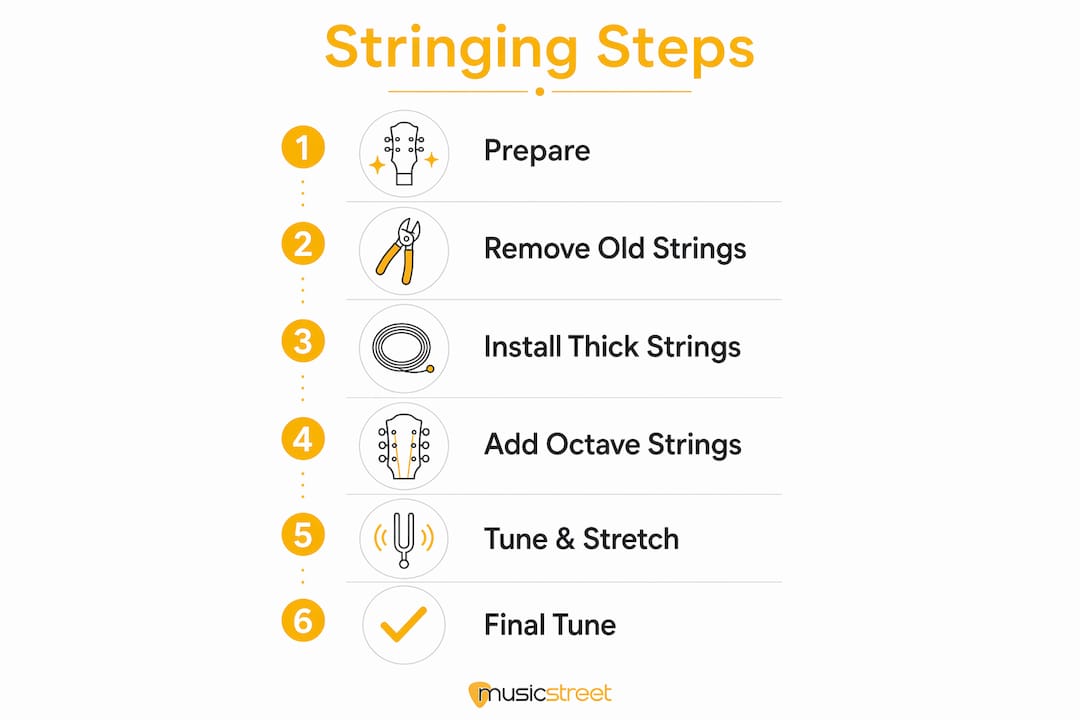
Tuning a 12-string guitar requires a specific sequence. Tune the lower octave string in each pair first, then tune the higher string to match. Work from the lowest course upward. Once all twelve strings are roughly at pitch, begin stretching.
Pull each octave string approximately 0.5 inches at the 12th fret three times, then retune. Repeat this stretch-and-retune cycle across all strings. After stretching, allow the guitar to rest for one hour before a final tuning check. New strings settle under tension and will detune repeatedly until the windings compress fully around the posts.
What are the common challenges when stringing and tuning a 12-string guitar?
A 12-string guitar magnifies every stringing error. Understanding where things go wrong helps you avoid them.
Tension overload is the most serious risk. Over-tensioning beyond standard pitch risks irreparable damage to the neck and bridge. Never tune above standard pitch to test string stability. If a string feels unusually stiff before reaching pitch, check that the ball end is seated correctly and that you have the right gauge installed.
String binding at the nut causes tuning instability that no amount of retuning will fix. The symptom is a string that returns to pitch after tuning but goes flat the moment you play a chord. Lubricating the nut slot solves this in most cases.
Intonation problems are more pronounced on 12-string guitars because each paired course vibrates differently. Compensated saddles with staggered break points are the correct solution for achieving accurate intonation across all pairs. If your guitar has a straight saddle and intonation is consistently sharp or flat, a compensated saddle replacement is worth considering. You can read more about why guitar intonation affects tone to understand the full picture.
“Due to doubled string tension, 12-string guitars magnify intonation errors, requiring precise setup beyond tone considerations to avoid physical frustration in playability. Balanced tension profiles across all twelve strings are impossible to achieve equally, but the goal is complementary tension curves that match the guitar’s bracing.”
Buzzing on the lower courses often points to insufficient neck relief rather than a stringing error. Professional luthiers recommend approximately 0.012 inches of neck relief at the 7th fret, measured with a capo at the first fret and a finger at the last fret. If buzzing appears after a fresh string change, wait for the strings to settle fully before adjusting the truss rod.
A strobe tuner or a high-accuracy clip-on tuner is the right tool for verifying intonation on a 12-string. Standard tuners lack the resolution to confirm that octave pairs are correctly matched in pitch.
How do you maintain a 12-string guitar after restringing?
Post-stringing care determines how long your setup stays stable and how well the instrument plays over time.
The most common mistake is adjusting the truss rod immediately after restringing. Doubled tension moves the neck and bridge for days after a fresh string change. Making truss rod corrections before the neck settles leads to repeated adjustments that chase a moving target. Wait at least 48–72 hours after restringing before evaluating neck relief, then make small incremental turns with rest periods between each adjustment.
Humidity and temperature directly affect neck stability on a 12-string. Wood expands in high humidity and contracts in dry conditions, both of which shift neck relief and string action. Store the guitar in a case with a humidity control pack, targeting 45–55% relative humidity. Sudden temperature changes, such as moving from a cold car to a warm room, cause the most rapid shifts.
Pro Tip: Apply a small amount of string lubricant to each nut slot and saddle contact point every time you change strings. This single habit extends nut and saddle life significantly and keeps tuning stable under heavy playing.
Tuning checks during the first week after restringing should happen before every playing session. Strings continue to settle for several days, particularly on a 12-string where the combined tension is substantial. A detailed tuning routine helps you build this habit efficiently.
If action rises noticeably after restringing, or if the neck develops a pronounced forward bow that does not correct after the settling period, a professional setup is the right call. A luthier can assess the truss rod, nut height, and saddle in one visit and save you from compounding adjustments.
Key takeaways
Stringing a 12-string guitar correctly requires sequential string changes, proper stretching, and a settling period before any neck adjustments are made.
| Point | Details |
|---|---|
| Change strings one at a time | Removing all strings at once releases tension suddenly and risks neck or bridge damage. |
| Choose the right gauge | Octave strings at .010–.011 gauge, roughly 60–70% of the fundamental gauge, maintain harmonic balance. |
| Stretch and rest new strings | Pull each octave string 0.5 inches at the 12th fret three times, then allow one hour of rest before final tuning. |
| Lubricate nut and saddle slots | Apply string lubricant at every string change to prevent binding, wear, and tuning instability. |
| Wait before adjusting the truss rod | Allow 48–72 hours for the neck to settle under doubled tension before making any relief corrections. |
What I have learned from stringing 12-string guitars
The players who struggle most with 12-string setup are the ones who treat it like a six-string with extra steps. It is not. The doubled tension changes the physics of every part of the process, from how you seat ball ends to how long you wait before trusting your tuning.
The single habit that made the biggest difference for me was patience with the settling period. New strings on a 12-string will lie to you for the first 24 hours. They feel stable, you tune them carefully, and then they drift. Stretching helps, but it does not replace time. Players who accept this and build a retuning routine into their first week get far better results than those who chase perfect tuning on day one.
I have also seen players skip the lubricant step and wonder why their strings bind at the nut every time they bend or use a capo. On a six-string, you might get away with it. On a 12-string, the friction across twelve contact points adds up fast. A small bottle of string lubricant is one of the cheapest, most effective maintenance tools you can own.
The other thing worth saying plainly: if your intonation is consistently off after a careful restring, the problem is almost certainly the saddle, not your technique. A compensated saddle is not a luxury on a 12-string. It is the correct hardware for the job. Investing in a proper step-by-step restringing approach and the right setup components will serve you far better than repeated tuning corrections on a poorly equipped instrument.
— Music
Gear for your 12-string at Musicstreet
Musicstreet stocks quality instruments and the tools you need to keep them playing well.

Whether you are looking for a quality 12-string to restring or the right maintenance kit to do the job properly, Musicstreet has you covered. The CruzTools Groovetech Acoustic Guitar Player Tech Kit includes the key tools for a clean, controlled string change. If you are ready to upgrade your instrument, the Gretsch G5422G-12 is a superb 12-string option available at Musicstreet. Browse the full range online or visit the Huntingdon store for hands-on advice from the team.
FAQ
How often should you restring a 12-string guitar?
Restring every 3–4 months for regular players, or sooner if strings feel dull or lose tuning stability. Heavy players may need to restring more frequently.
Does stringing a 12-string guitar damage the neck?
Stringing a 12-string guitar does not damage the neck when done correctly. Changing strings one at a time maintains consistent tension and prevents structural stress.
What gauge strings are best for a 12-string guitar?
Medium-light sets with octave strings in the .010–.011 range work well for most players. This gauge balances playability with sufficient tension for stable intonation.
Why does my 12-string keep going out of tune after restringing?
New strings need time to settle under tension. Stretch each string at the 12th fret, retune, and allow at least one hour of rest. Unlubricated nut slots also cause binding and tuning drift.
When should I get a professional setup after restringing?
Seek a professional setup if the action rises noticeably, the neck does not settle after 72 hours, or intonation remains consistently off after a careful restring and string stretch.








Share:
Electric vs acoustic guitar strings: what's the difference?
Acoustic vs electric guitar: which is right for you?