


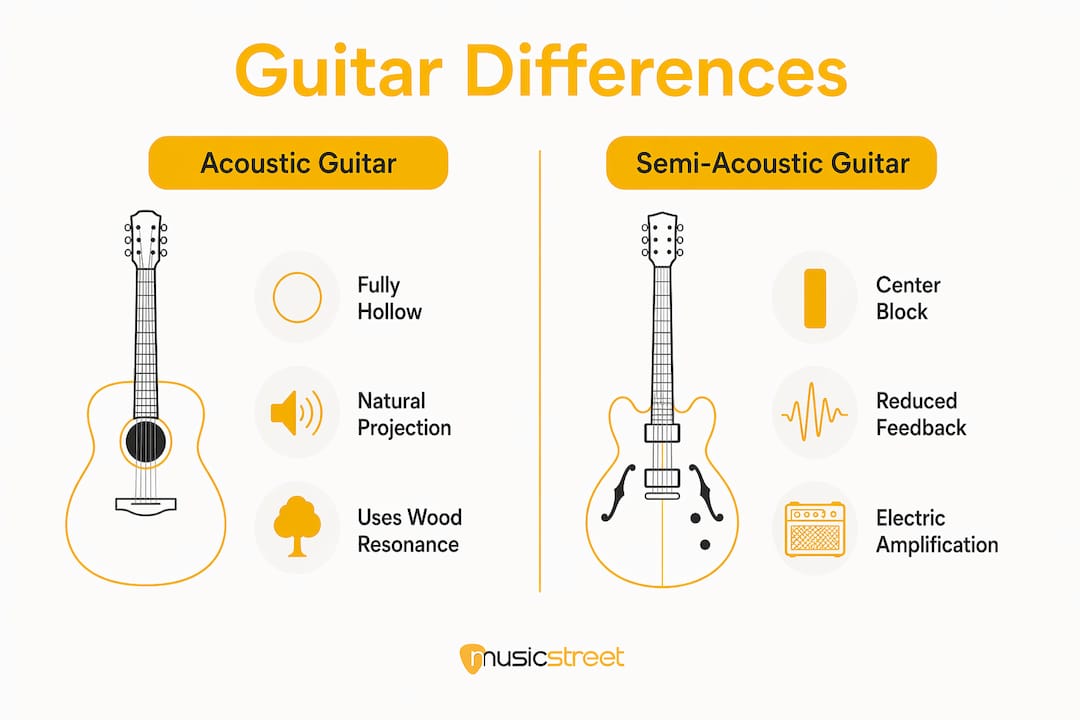
Acoustic guitars have fully hollow bodies that produce sound naturally without amplification. Semi-acoustic guitars feature hollow wings and a solid center block, allowing amplified use with reduced feedback. The choice depends on genre, playing comfort, and whether natural or amplified sound suits the musician’s style.
The difference between semi-acoustic and acoustic guitar comes down to body construction and how each instrument produces sound. An acoustic guitar uses a large, fully hollow body with no internal support blocks, relying entirely on natural resonance to project sound. A semi-acoustic guitar, known in the industry as a semi-hollow body electric, features hollow wings flanking a solid centre block, with magnetic pickups fitted for amplified use. These structural choices shape everything from tone and volume to genre suitability and playability. Understanding them helps you choose the right instrument for your needs, whether you are buying your first guitar or adding to an existing collection.
What is the difference between semi-acoustic and acoustic guitar construction?
The acoustic guitar’s fully hollow body is its defining feature. No internal support block exists inside the body, so the entire wooden shell vibrates freely, converting string energy into natural acoustic resonance. This produces a loud, warm, and open sound without any electronics involved.

The semi-acoustic guitar takes a fundamentally different approach. Its solid centre block runs through the middle of the body, with hollow chambers on either side. Magnetic pickups sit on this block, feeding the signal to an amplifier. The hollow wings still contribute warmth and resonance, but the centre block controls how the body behaves under amplification.
| Feature | Acoustic guitar | Semi-acoustic guitar |
|---|---|---|
| Body type | Fully hollow | Hollow wings, solid centre block |
| Sound source | Natural resonance only | Magnetic pickups plus body resonance |
| Feedback resistance | Low at high volume | High, due to centre block |
| Unplugged volume | Loud and projecting | Quiet, suitable for practice |
| Typical string type | Steel or nylon | Electric guitar strings |
Pro Tip: If you plan to play at bedroom volumes without an amp, the acoustic guitar wins on raw projection. If you need both quiet practice and stage volume, the semi-acoustic gives you that flexibility.
How does the centre block affect sustain and feedback?
The centre block in a semi-acoustic guitar does more than prevent feedback. It efficiently transfers string energy, producing a longer and more predictable sustain than a fully hollow body can achieve. A fully hollow guitar loses string energy quickly as the body vibrates freely in all directions. The centre block channels that energy more deliberately, creating a sustain profile that sits between a solid-body electric and a fully hollow archtop.
This coupled oscillation between the hollow wings and the solid block produces harmonic complexity. The result is a tone that sounds richer than a solid-body electric but more controlled than a fully hollow guitar. Jazz players prize this quality because notes bloom and decay with musical character rather than cutting off abruptly.
Acoustic guitars produce sustain differently. The entire body resonates as one unit, which creates a natural, organic decay. This suits fingerpicking styles and singer-songwriter contexts where the guitar’s natural voice is the centrepiece of the sound.
Which genres suit acoustic versus semi-acoustic guitars?
Genre fit is one of the clearest ways to distinguish these two instruments. Acoustic guitars excel in folk, singer-songwriter, classical, and unplugged performance contexts where natural projection and tonal warmth carry the music without amplification.
Semi-acoustic guitars dominate in genres where amplification and tonal warmth must coexist. Jazz, blues, country, and indie rock all rely on the semi-acoustic’s ability to deliver warm, rounded tones through an amplifier without the harsh feedback that a fully hollow guitar produces at stage volumes.
Acoustic guitar suits:
- Folk and traditional music
- Singer-songwriter and open-mic performances
- Classical and fingerstyle playing
- Campfire and unplugged settings
- Recording sessions requiring natural room sound
Semi-acoustic guitar suits:
- Jazz and swing
- Blues and rhythm and blues
- Country and rockabilly
- Indie rock and alternative
- Stage performances requiring amplified warmth
The tonal versatility of a semi-acoustic makes it a genuine hybrid. You get acoustic depth with electric playability, which is why working musicians who cover multiple genres often reach for a semi-acoustic as their primary gigging instrument.
Playability and ergonomics: how each guitar feels to play
Acoustic guitars are physically demanding, particularly for beginners. Higher string tension and heavier string gauges make fretting chords harder on fingertips and hands. The body is also typically larger and deeper, which can feel unwieldy for smaller players or those new to the instrument.
Semi-acoustic guitars borrow their neck profiles and string gauges from electric guitar design. Lighter strings, lower action, and slimmer neck profiles make them noticeably easier to play, especially for extended sessions. The body is usually thinner than a full-depth acoustic, reducing arm fatigue during long performances.
Pro Tip: If you are choosing the best guitar for beginners and physical comfort is a priority, a semi-acoustic guitar will feel easier to play from day one. If you commit to an acoustic from the start, your finger strength and technique will develop faster, which pays dividends later.
Key ergonomic differences to consider:
- Body depth: Acoustic bodies are deeper, semi-acoustics are typically thinner
- String gauge: Acoustics use heavier gauges; semi-acoustics use lighter electric strings
- Neck profile: Semi-acoustics often have slimmer, faster necks
- Weight: Semi-acoustics are generally lighter than full-body acoustics
- Action: Semi-acoustics can be set up with lower action for easier fretting
The guitar body type you choose directly affects how quickly you progress. A guitar that is comfortable to hold encourages more practice time, which matters more than any other factor in the early stages of learning.
Semi-acoustic vs acoustic-electric: clearing up the confusion
This is where many buyers make costly mistakes. A semi-acoustic guitar and an acoustic-electric guitar are not the same instrument. Acoustic-electric guitars are acoustic instruments with a built-in pickup or preamp added to allow amplification. They are not electric guitars in acoustic clothing. Their sound when plugged in is still fundamentally acoustic in character.
A semi-acoustic guitar is an electric instrument at its core. It uses magnetic pickups, requires an amplifier to be heard properly in most settings, and produces a very different tone from an acoustic-electric when plugged in. Guitar body terminology is frequently misused in product listings, which creates genuine confusion for buyers.
Follow these steps before purchasing to verify what you are actually buying:
- Check the pickup type. Magnetic pickups indicate a semi-acoustic electric. A piezo or undersaddle pickup indicates an acoustic-electric.
- Check whether the guitar can be played acoustically at a useful volume. A semi-acoustic produces very little unplugged sound. An acoustic-electric sounds full and projecting without an amp.
- Read the body construction description carefully. Look for the terms “semi-hollow,” “centre block,” or “hollow body electric” to confirm a semi-acoustic.
- Verify the guitar type before purchasing by consulting a specialist retailer who can clarify the specification.
Buyers who confuse these categories often end up with an instrument that does not suit their intended use. A semi-acoustic will not replace an acoustic guitar for campfire playing, and an acoustic-electric will not deliver the jazz warmth of a proper semi-hollow body.
Key takeaways
The core difference between semi-acoustic and acoustic guitars is body construction: acoustics use a fully hollow body for natural projection, while semi-acoustics add a solid centre block and magnetic pickups for amplified versatility.
| Point | Details |
|---|---|
| Body construction | Acoustic guitars are fully hollow; semi-acoustics have a solid centre block with hollow wings. |
| Sound and feedback | The centre block reduces feedback and improves sustain in semi-acoustic guitars at amplified volumes. |
| Genre suitability | Acoustics suit folk and unplugged settings; semi-acoustics excel in jazz, blues, and indie rock. |
| Playability | Semi-acoustics use lighter strings and slimmer necks, making them easier to play than most acoustics. |
| Terminology pitfall | Acoustic-electric guitars are not semi-acoustics; they differ in pickup type, tone, and function. |
My honest view on choosing between these two guitars
Players often ask me which type is “better,” and the honest answer is that the question is wrong. These instruments solve different problems. An acoustic guitar is a self-contained sound system. You pick it up, you play, and the room fills with sound. There is nothing between you and the music. That directness is genuinely irreplaceable for certain styles and settings.
A semi-acoustic guitar is a different proposition entirely. It is an electric instrument that happens to breathe. The hollow wings give it warmth and character that a solid-body electric cannot replicate, but it still needs an amplifier to perform at its best. Players who buy a semi-acoustic expecting acoustic volume are always disappointed.
What I find most interesting about the semi-acoustic vs acoustic debate is how often players underestimate the acoustic guitar’s physical demands. Many beginners abandon acoustic guitars not because they dislike the sound but because the instrument hurts to play in the early weeks. A semi-acoustic removes that barrier. If getting someone playing and enjoying music is the goal, the easier instrument wins every time.
The construction nuance that most players miss is the centre block’s effect on sustain. It is not just a feedback-prevention device. It changes the character of every note you play, giving the semi-acoustic a singing quality that sits in a mix differently from both a solid-body electric and a fully hollow archtop. That quality is worth understanding before you buy.
— Music
Guitars worth trying at Musicstreet
Musicstreet stocks a carefully selected range of acoustic and semi-acoustic guitars, from entry-level instruments to professional-grade models, all inspected and set up before they reach you.

If you are drawn to the acoustic route, the Yamaha FGX5 delivers exceptional natural tone and projection, making it one of the strongest acoustic options available at its price point. For players who want amplified warmth and the versatility of a semi-hollow design, the used Gretsch G5422G-12 is a standout instrument with genuine character. The team at Musicstreet’s Huntingdon store can walk you through both options in person, or you can browse the full range online with free UK delivery available on qualifying orders.
FAQ
What is the main difference between a semi-acoustic and acoustic guitar?
An acoustic guitar uses a fully hollow body to project sound naturally, with no electronics. A semi-acoustic guitar has a solid centre block with hollow wings and uses magnetic pickups to amplify its signal through an amplifier.
Can a semi-acoustic guitar be played without an amp?
A semi-acoustic produces very little unplugged volume due to its centre block construction. It is playable without an amp for quiet practice, but it is not designed to fill a room acoustically the way a standard acoustic guitar does.
Is a semi-acoustic guitar good for beginners?
A semi-acoustic is a strong choice for beginners because lighter strings and a slimmer neck make it physically easier to play than most acoustic guitars. The trade-off is that you will need an amplifier to get the full benefit of the instrument.
What is the difference between a semi-acoustic and an acoustic-electric guitar?
A semi-acoustic is an electric guitar with a hollow body and magnetic pickups. An acoustic-electric is an acoustic guitar with a piezo or undersaddle pickup added for amplification. They differ in tone, construction, and how they sound both plugged in and unplugged.
Which guitar type suits jazz and blues best?
Semi-acoustic guitars are the standard choice for jazz and blues. Their centre block design delivers warm, sustained tones through an amplifier without the feedback problems that affect fully hollow guitars at stage volumes.




Share:
How to choose a guitar pick: the complete guide
What is a guitar luthier: the complete craft guide