


TL;DR:
- True bypass pedals switch the effect circuitry out of the signal path for a pure tone when off.
- Long cables and multiple true bypass pedals can cause high-frequency tone loss due to capacitance.
- Using buffers strategically helps maintain tone clarity in complex pedal setups.
The phrase ‘true bypass’ gets thrown around constantly in guitar circles, often as shorthand for ‘better tone’ or ‘professional quality.’ But the reality is more nuanced than that. Many guitarists chase true bypass pedals without fully understanding what the circuitry actually does, or when it genuinely helps versus when it quietly works against them. This guide breaks down exactly how true bypass operates, how it compares to buffered bypass, and what the science says about cable length, capacitance, and high-frequency loss. Whether you’re assembling your first pedalboard or refining a complex rig, understanding this topic will help you make smarter choices.
Table of Contents
- What is true bypass and how does it work?
- True bypass vs buffered bypass: Key differences
- The science behind true bypass: Cable length, capacitance and tone loss
- When is true bypass the right choice?
- A fresh look at true bypass: Why one size rarely fits all
- Explore more and optimise your setup
- Frequently asked questions
Key Takeaways
| Point | Details |
|---|---|
| True bypass defined | True bypass completely removes a pedal’s circuitry from your signal when switched off for a cleaner path. |
| Tone loss risks | Using many true bypass pedals with long cables can dull your tone from cumulative capacitance. |
| Buffer pedals’ role | Quality buffer pedals preserve high frequencies and clarity in larger pedal setups. |
| Best of both | A mix of true bypass and buffers is usually optimal for most modern pedalboards. |
| Choose by setup | Pick your bypass approach based on the number of pedals, cable length, and your own listening tests. |
What is true bypass and how does it work?
True bypass in guitar pedals refers to a switching mechanism that completely removes the pedal’s effect circuitry from the signal path when the pedal is disengaged. In plain terms: when you switch the pedal off, your guitar signal travels directly from the input jack to the output jack, touching nothing else inside the pedal. The effect circuit is completely isolated.
This matters because older pedal designs used what’s called ‘true hardwire bypass’ or, worse, a simple transistor-based bypass that still routed the signal through part of the circuit even when ‘off.’ That leftover circuitry could colour your tone in unwanted ways.
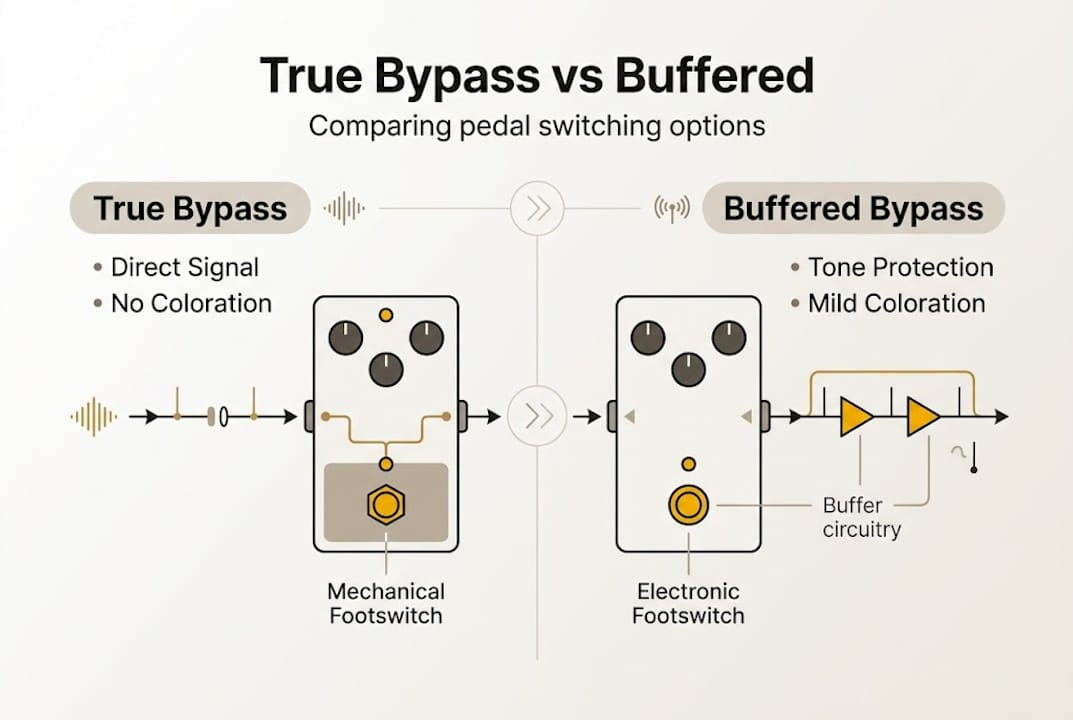
The most common way true bypass is achieved today is through a 3PDT switch, which stands for Triple Pole Double Throw. This mechanical footswitch physically routes the signal along two separate paths: one through the effect circuit when the pedal is active, and one that bypasses it entirely when switched off. A typical 3PDT switch is rated for around 30,000 cycles, which sounds like a lot until you’re a gigging musician stomping on it every night.
A more modern alternative is relay true bypass, which uses an electronic relay rather than a mechanical switch to redirect the signal. The practical benefit is a shorter, cleaner signal path with reduced capacitance, and it tends to be far quieter when switching. Relay bypass also avoids the physical wear of mechanical switches.
If you’re building your pedalboard from scratch, knowing which type of bypass your pedals use helps you plan a more reliable and better-sounding setup.
Key benefits and downsides of true bypass:
- Preserves your guitar’s natural tone when the pedal is off
- No additional circuitry in the signal path when bypassed
- Ideal for smaller, simpler pedalboards
- Mechanical switches can wear out over time
- Can cause an audible ‘pop’ when switching
- Multiple true bypass pedals accumulate cable capacitance, causing tone loss
| Feature | True bypass | Relay bypass |
|---|---|---|
| Signal path when off | Direct wire | Electronic relay |
| Switching noise | Can pop | Near silent |
| Component wear | Moderate | Low |
| Capacitance in path | Minimal | Very low |
“When a true bypass pedal is off, the signal path is a straight wire. No buffers, no op-amps, no colouration. What goes in comes out.”
True bypass vs buffered bypass: Key differences
Now that you know what true bypass is, it’s crucial to understand how it compares to the main alternative: buffered bypass.
A buffered bypass pedal keeps a small active circuit in the signal path even when the effect is switched off. This circuit, called a buffer, takes your high-impedance guitar signal and converts it to a low-impedance signal. That low-impedance signal is far more resistant to the tone-degrading effects of long cables and multiple pedal connections.
Here’s the key insight that surprises many guitarists: true bypass is not always superior. A quality buffered bypass can actually prevent signal degradation in complex rigs far more effectively than a chain of true bypass pedals.
| Factor | True bypass | Buffered bypass |
|---|---|---|
| Tone colouration when off | None | Minimal (quality-dependent) |
| Long cable performance | Poor | Excellent |
| Multiple pedal setups | Degrades | Maintains signal |
| Switching noise | Possible pop | Silent |
| Vintage fuzz compatibility | Good | Can cause issues |
For understanding buffer pedals in more depth, the key takeaway is that a good buffer is transparent. It doesn’t colour your tone; it simply protects it.
When to choose each:
- Use true bypass when you have a small board with fewer than five pedals and short cable runs.
- Use buffered bypass when you have a large board, long cables, or a complex effects chain guide with many connections.
- Use true bypass for vintage fuzz or treble booster pedals, which often react poorly to buffered inputs.
- Use buffered bypass at the start of a long signal chain to maintain clarity throughout.
There’s also a persistent myth worth addressing. Boutique pedal makers often market true bypass as a premium feature, implying that buffered bypass is somehow inferior. In the 1980s, cheap buffers in mass-produced pedals genuinely did degrade tone. But a well-designed modern buffer is essentially inaudible. The marketing has outlived the problem.
Pro Tip: The most effective approach for most gigging guitarists is a hybrid setup. Use true bypass pedals throughout your board, but place one or two quality buffer pedals at strategic points, typically at the start and end of your chain, to protect signal integrity without colouring your tone.
The science behind true bypass: Cable length, capacitance and tone loss
Understanding the basic differences, let’s dig into the science of why having too many true bypass pedals can actually hurt your tone.
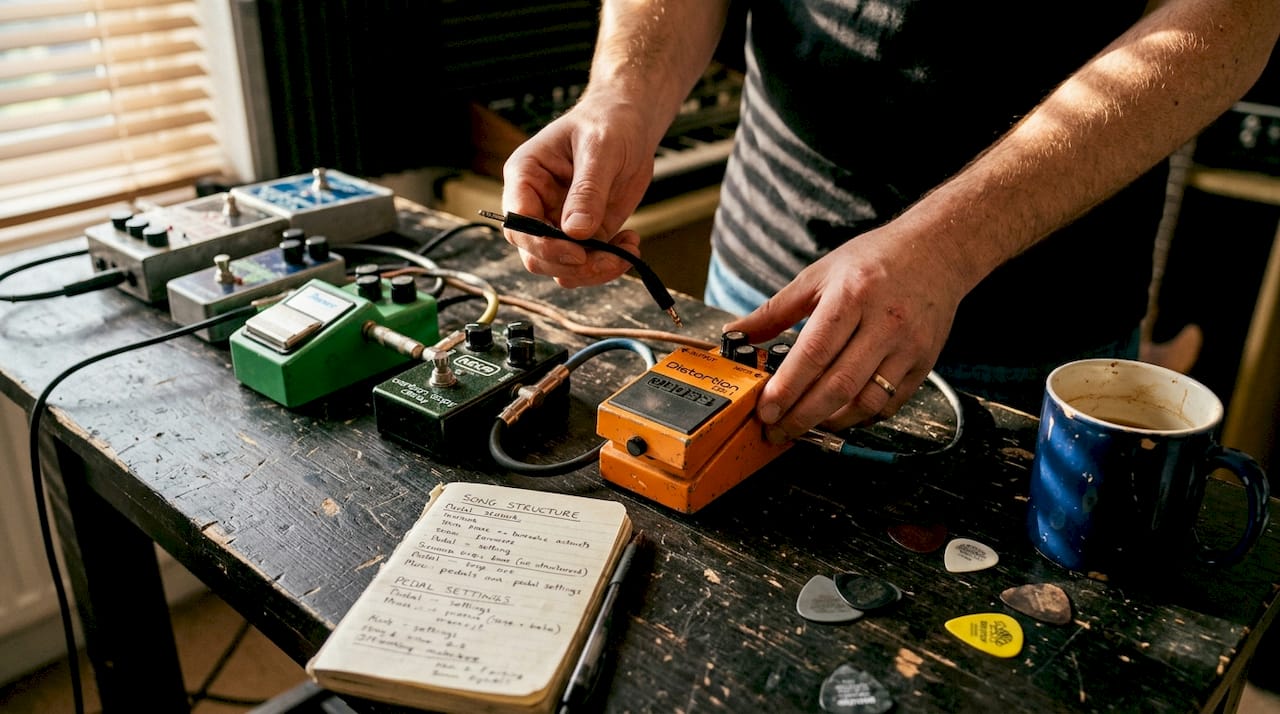
Every length of guitar cable acts like a tiny capacitor. Capacitance is the tendency of a cable to store electrical charge, and it directly affects how your high-frequency signal content travels. The longer the cable, the more capacitance, and the more high frequencies get rolled off before they reach your amplifier.
With a true bypass pedal switched off, the signal still travels through the patch cables connecting each pedal. Those cables add up. Multiple true bypass pedals combined with long cables over 20 feet in total cause cumulative capacitance loading, which leads directly to high-frequency loss, commonly called ‘tone suck.’
The numbers are striking. Capacitance calculations show that a Stratocaster pickup’s resonance peak can shift from 3.5 kHz down to 2.5 kHz when the total cable capacitance reaches around 600 pF. That’s a measurable, audible dulling of your tone, and it happens silently without you realising the cause.
| Setup | Total cable length | Approx. capacitance | Likely HF loss |
|---|---|---|---|
| 2 pedals, short cables | 10 ft | ~200 pF | Minimal |
| 5 pedals, medium cables | 25 ft | ~500 pF | Noticeable |
| 8 pedals, long cables | 40 ft | ~800 pF | Significant |
For more context on how different guitar effects types interact with your signal, the principle is the same: more connections mean more potential for signal loss.
Symptoms of tone suck to listen for:
- Your clean tone sounds duller than your guitar plugged straight in
- Loss of definition and articulation in chord voicings
- Reduced sparkle or ‘air’ in the high end
- Solos feel less present or cutting in the mix
- Your tone improves noticeably when you remove pedals from the chain
If any of those sound familiar, the fix may not be choosing better pedals but rather adding a buffer to manage the cumulative capacitance. The practical threshold most engineers and experienced players agree on is roughly 20 feet of total cable. Beyond that, a buffer becomes less of a luxury and more of a necessity.
When is true bypass the right choice?
Armed with the electronics and science, here’s how to decide what’s actually right for your setup.
The answer depends on three things: how many pedals you use, how long your cables are, and what types of pedals are in your chain. There’s no universal rule, but there is a practical framework.
Decision framework:
- Fewer than five pedals, short cables: True bypass is ideal. Your total capacitance stays low, and you get a completely clean signal path when pedals are off.
- More than five pedals or cable runs over 20 feet: Add at least one quality buffer, ideally at the start of the chain. This single addition can transform your tone on a large board.
- Fuzz or treble booster first in chain: Always place these before any buffered pedal. Vintage fuzz circuits are designed to interact with your guitar’s high-impedance output, and a buffer before them changes that interaction, often in an unpleasant way.
- Vintage pedals in the chain: Check whether they have true bypass or their original bypass circuit. Some vintage pedals with original circuitry can load the signal even when off.
- Multi-pedal rigs with daisy-chained power: Consider how power supply noise interacts with your bypass type, as some true bypass pedals can pick up interference through shared grounds.
For practical guidance on building effect chains, the order of your pedals matters as much as the bypass type.
Pro Tip: True bypass pedals can produce an audible ‘pop’ when you engage or disengage them, caused by a voltage spike at the moment of switching. If this is a problem in your live rig, look for pedals with relay-based true bypass, which eliminates this issue almost entirely. See examples of guitar pedals that use relay bypass for reference.
For most players with a modest board, true bypass throughout is perfectly fine. For anyone running a complex rig with multiple drives, modulations, and time-based effects, a hybrid approach is almost always the smarter solution.
A fresh look at true bypass: Why one size rarely fits all
Most online advice treats true bypass as the gold standard, full stop. But that framing does a disservice to guitarists who then spend money chasing a feature that may not solve their actual problem.
The honest truth is that true bypass is not always superior to quality buffered bypass, and in complex rigs, it can actively make things worse. We’ve seen players strip out perfectly good buffered pedals in favour of true bypass versions, only to find their tone became muddier and less defined. The buffer they removed was doing essential work.
The most valuable thing you can do is trust your ears over internet forums. Plug your guitar straight into your amplifier. Then add your pedals one at a time and listen carefully. If the tone dulls noticeably, that’s your signal that you need a buffer, not a new pedal. Explore the best guitar pedals with bypass type in mind, not as a marketing checkbox but as a practical tool in your specific context. Mixing true and buffered bypass based on what your rig actually needs is always the right approach.
Explore more and optimise your setup
Understanding true bypass is just one piece of building a great-sounding pedalboard. At MusicStreet, we’re here to help you make sense of the full picture, from signal chain decisions to finding the right pedals for your playing style.

Our team of experienced guitarists can offer personal advice whether you’re shopping online or visiting us in Huntingdon, Cambridgeshire. We stock a wide range of effects pedals and accessories, and our guitar pedal guide is packed with practical information to help you set up your board with confidence. If you have questions about bypass types, signal chains, or any aspect of your setup, get in touch. We love talking gear and we’re always happy to help you find the right solution for your sound.
Frequently asked questions
Does true bypass always sound better than buffered bypass?
No, true bypass is not always superior. In large pedal setups with long cable runs, buffered bypass preserves tone more effectively by preventing high-frequency loss caused by cumulative capacitance.
How many pedals can you use before you need a buffer?
If you have more than five true bypass pedals or cable runs over 20 feet, you should strongly consider adding a quality buffer pedal to maintain signal integrity.
Why does my true bypass pedal make a popping sound?
Mechanical true bypass switches create a brief voltage spike at the moment of switching, which causes an audible pop. Relay-based bypass designs minimise this issue significantly.
Is relay true bypass better than mechanical true bypass?
Relay true bypass reduces the cable length in the signal path and produces near-silent switching, making it a practical upgrade over traditional mechanical 3PDT switches for live performance.
What causes ‘tone suck’ when using only true bypass pedals?
‘Tone suck’ results from cumulative capacitance loading caused by multiple pedals and long cables, which progressively rolls off the high frequencies in your guitar signal.





Share:
How to improve guitar tone: essential tips for every player
The Complete Acoustic Guitar Buying Guide: How to Choose the Right Guitar for You