


If you want to join a band quickly, learn bass. If you want to sing and play solo, learn electric guitar. That single sentence covers most beginners’ decisions, and everything below explains the physical, sonic and practical reasons behind it.
Quick decision prompts:
-
“I want to play in a band as soon as possible” → bass
-
“I want to sing, write songs, or play solo” → electric guitar
-
“I have small hands or I’m buying for a child” → short-scale bass or a smaller-body electric
The rest of this article walks through the bass and electric guitar difference in detail: size, strings, tuning, musical role, amplification, learning curve, and UK starter costs.
Table of Contents
How do bass and electric guitars differ physically?
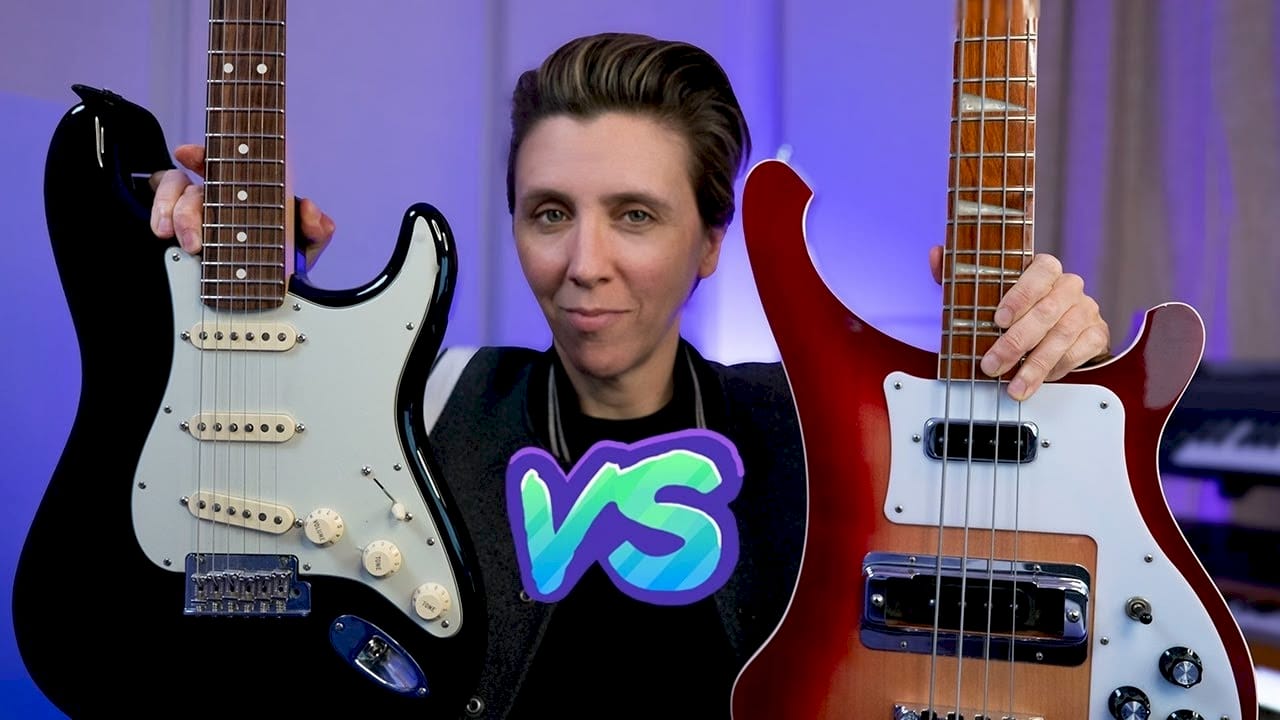
The most obvious difference is size. A standard long-scale bass has a scale length of around 34 inches, while most electric guitars sit between 24.75 and 25.5 inches. Scale length is the distance from the nut to the bridge saddle, and it directly affects how far apart the frets are. On a bass, you are stretching further between notes, which demands more from your fretting hand, especially in the early weeks.
Bass necks are also noticeably wider and thicker. The strings are longer, heavier, and require more finger pressure to fret cleanly. That physical demand is real, but most players adapt within a few weeks of consistent practice.
| Feature | Bass guitar | Electric guitar |
|---|---|---|
| Typical scale length | ~34" (long-scale) | 24.75"–25.5" |
| Number of strings | 4 | 6 |
| Low E string gauge | thicker strings | thinner strings |
| Neck width at nut | wider neck | narrower neck |
| Body size | Larger, heavier | Smaller, lighter |
| Short-scale option | ~30" (ideal for smaller players) | Yes (3/4 size models) |
A few things worth knowing before you pick one up:
-
Bass strings are thicker and usually more expensive than guitar strings, and they take longer to break in.
-
The wider fret spacing on a bass means chord shapes are impractical; you play single notes and intervals instead.
-
Short-scale basses at around 30 inches are a genuine solution for children, teenagers, or adults with smaller hands. They play and sound like a full bass, just with less reach required.
-
Short-scale basses and smaller-body electrics both address comfort concerns for younger beginners, though nylon-string or half-size guitars remain better fits for very young children.
What are the tuning and pitch differences?
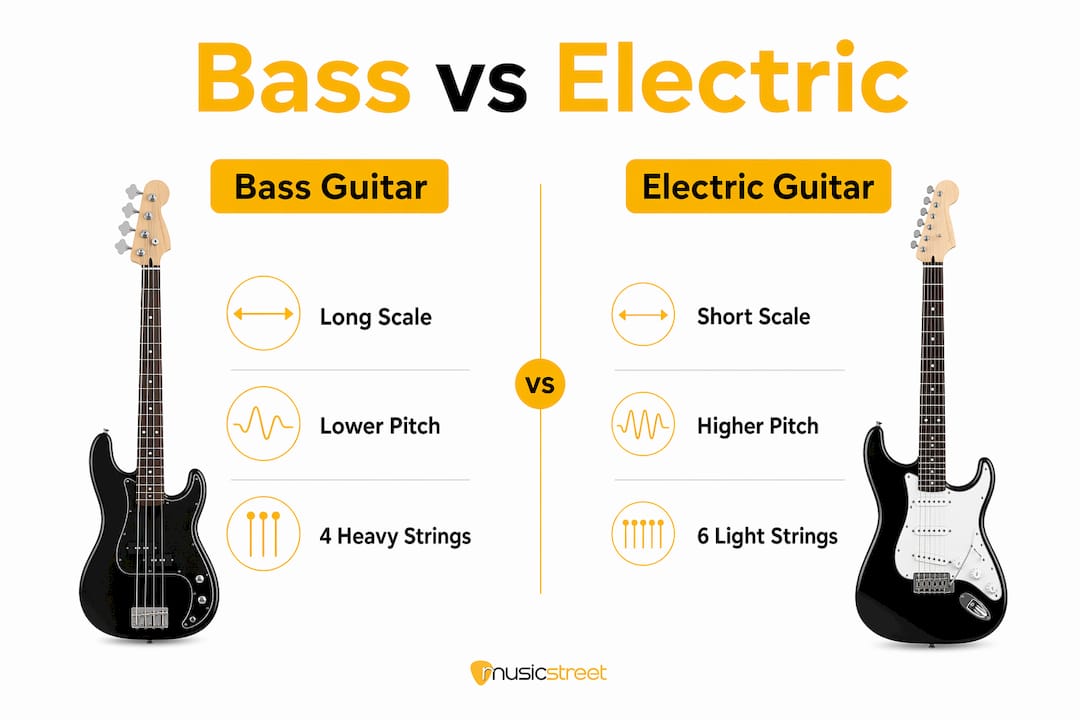
A standard bass is tuned E–A–D–G, the same note names as the lowest four strings on a guitar, but one full octave lower. The bass’s open low E rings at roughly 41 Hz. A guitar’s open low E sits an octave above that, around 82 Hz. That gap is what gives the bass its characteristic depth.
Tuning comparison at a glance:
-
Bass (4-string): E1 – A1 – D2 – G2
-
Electric guitar (6-string): E2 – A2 – D3 – G3 – B3 – E4
The shared note names mean the fretboard logic transfers between instruments more easily than most beginners expect. The bass uses perfect fourth intervals across all four strings, which makes scale shapes consistent and, for many learners, simpler to memorise than the guitar’s tuning, which breaks the pattern between the G and B strings.
In a band mix, the bass occupies the low-frequency space below roughly 300 Hz, providing the foundation that other instruments sit on top of. The electric guitar fills the mid-to-high range, typically 300 Hz and above, where chords, riffs and melodies cut through. Neither instrument does the other’s job particularly well, which is exactly why both exist.
What does each instrument actually do in a band?
The bass provides the rhythmic and harmonic backbone of a band by locking in with the drums. A good bass player makes the drummer sound better and gives the whole group a pulse to follow. The electric guitar, meanwhile, handles chords, riffs, lead lines and solos — the parts a listener hums afterwards.
That difference in role shapes what you practise from day one.
Common bass techniques:
-
Fingerstyle (plucking with index and middle fingers alternately)
-
Pick playing (faster attack, brighter tone)
-
Slap and pop (percussive funk technique, learned later)
-
Root-note locking (playing the root of each chord in time with the kick drum)
Common electric guitar techniques:
-
Strumming open and barre chords
-
Fingerpicking and hybrid picking
-
String bends, vibrato and hammer-ons
-
Lead playing: scales, riffs and solos
Practice focus for the first three months:
-
Bass: timing and consistency. Play root notes in time with a metronome or drum loop. Simple songs like “Come As You Are” by Nirvana or “Seven Nation Army” by The White Stripes are achievable within weeks and sound satisfying immediately.
-
Guitar: chord transitions. The first hurdle is moving cleanly between open chords (G, C, D, Em, Am) without pausing. This takes longer to feel natural, but once it clicks, songwriting opens up fast.
Pro Tip: For bass, set a metronome to 60 BPM and play nothing but root notes for ten minutes a day in your first month. It sounds boring, but your timing will be noticeably tighter than guitarists who skip this step. For guitar, practise chord transitions in isolation: set a timer for two minutes and switch between just two chords repeatedly before adding a third.
How do amps and effects differ for bass and guitar?
Bass amps are built for headroom and low-end clarity. They move more air, use larger speakers (typically 10"–15"), and are voiced to reproduce frequencies below 100 Hz without distortion. A guitar amp pushed hard produces pleasing harmonic distortion; a bass amp doing the same thing sounds muddy and loses definition.
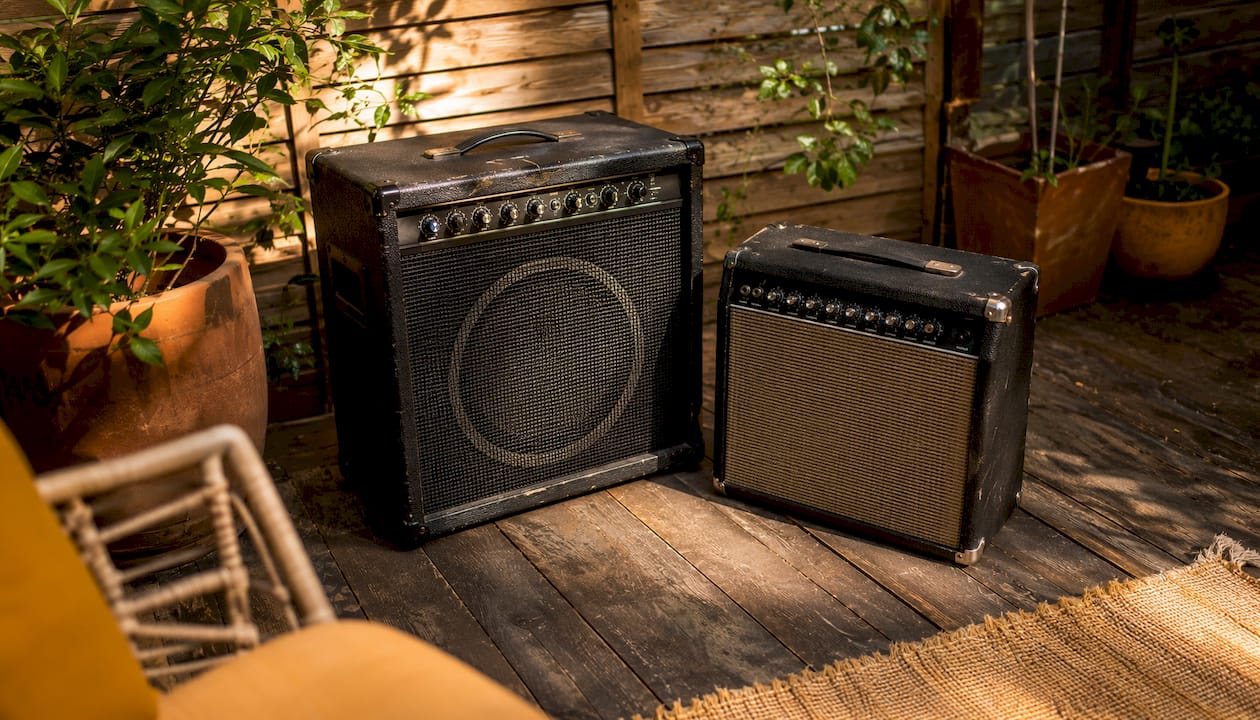
Bass rigs favour headroom and clear low-end reproduction, while guitar rigs use amp coloration and effects chains that shape mids and highs. Never run a bass through a small guitar combo at high volume — you risk blowing the speaker.
Typical pedals by instrument:
-
Bass: compression (evens out dynamics), subtle overdrive or fuzz (used sparingly), octave pedals, envelope filter for funk tones
-
Guitar: distortion and overdrive, delay, reverb, chorus, wah, modulation effects
Practical starter rig checklist:
-
Bass: a 20–30 watt practice combo (Fender Rumble 25 or similar) covers bedroom practice and small rehearsals. Add a tuner pedal and a strap.
-
Guitar: a 10–20 watt modelling amp (Boss Katana Mini or similar) gives you a range of tones without buying multiple pedals. Add a tuner and a cable.
-
Both: headphone output or a direct interface (such as the IK Multimedia AXE I/O) lets you practise silently, which matters in a flat or shared house.
A heavy fuzz or high-gain distortion that suits guitar will almost always muddy a bass signal. If you want grit on bass, a light overdrive or a dedicated bass fuzz (with a dry blend control) keeps the low end intact.
Which is easier to learn, and what does it cost in the UK?
Bass is often considered easier to start because it focuses on single-note parts and timing rather than chord coordination. That said, the two instruments reach parity at an advanced level — a skilled bassist and a skilled guitarist have both put in serious hours. The early challenges are just different.
Realistic timeline for each:
| Milestone | Bass | Electric guitar |
|---|---|---|
| 1 week | Plucking single notes cleanly, basic open strings | Fretting single notes, basic open strings |
| 1 month | Simple root-note basslines in time | Two or three open chords with slow transitions |
| 3 months | Band-ready on simple songs, locking with a drummer | Strumming four or five chords, basic riffs |
| 1 year | Solid groove, learning fills and simple slap | Chord vocabulary, basic lead lines, first solos |
UK starter costs (approximate):
-
Entry-level bass + small amp + accessories: £200–£350 new, £120–£220 used
-
Entry-level electric guitar + small amp + accessories: £200–£400 new, £130–£250 used
One practical note: bassists are often in higher demand in band settings because guitarists outnumber bassists significantly. If getting into a band quickly matters to you, that supply-and-demand reality is worth factoring in. A competent bassist can find a group to play with far more easily than a competent rhythm guitarist.
Beginners often progress to a useful bass part within a few months and can contribute to a band early, while guitar rewards persistence with broader songwriting possibilities once chord changes are mastered.
Can you play bass on an electric guitar?
You can approximate bass lines on an electric guitar, but you cannot replicate the physical low-end response and sustain of a proper bass. The guitar’s shorter scale and thinner strings simply do not move enough air at low frequencies.
Practical workarounds that actually help:
-
Play the lowest two strings (low E and A) and stay in the lower positions on the neck
-
Use an octave pedal or pitch-shifter set one octave down — this is the most effective non-destructive method
-
Switch to the neck pickup and roll the tone control down to reduce brightness
-
Boost low-mids on the amp EQ and cut the high frequencies
Why you should not fit bass strings to a guitar:
Bass strings are designed for a 34-inch scale. On a 25.5-inch guitar neck, they will be floppy and inharmonic, the nut slots are too narrow to accept the thicker gauges, the tuner peg holes are too small for a bass E string, and the added tension risks warping the neck or damaging the bridge. The modifications required are largely permanent.
Pro Tip: The safest way to emulate bass on guitar is an octave pedal (set one octave down) combined with a compressor. Dial in a touch of compression first, then add the octave effect. Set your amp EQ with the bass around 7, mids around 4, and treble around 3. It will not fool a bassist, but it works for demos and home recording.
Which instrument is right for you? A simple checklist
Step 1: What do you want to do?
-
Play in a band as soon as possible → bass
-
Write songs, sing, or play solo → electric guitar
-
Both, eventually → start with whichever excites you more; the fretboard knowledge transfers
Step 2: How do you want to perform?
-
Locking in with a drummer, holding down the groove → bass
-
Playing chords, melodies, or lead lines → electric guitar
Step 3: Body size and budget
-
Smaller hands or buying for a child → short-scale bass or 3/4 electric guitar
-
Tighter budget → a used bass package often delivers more playing value per pound at entry level
Scenario guide:
-
Singer/songwriter who wants to accompany themselves → electric guitar, no question
-
Aspiring band member who wants to gig within a year → bass; you will find a band faster and be playing live sooner
-
Teen or child with small hands → short-scale bass or a smaller-body electric; try both in store before buying
-
Undecided and curious → borrow or hire each for a week, book one lesson on each, and choose whichever felt rewarding after two practice sessions
Actionable next steps: visit a store, pick up both instruments, and play a simple open string pattern on each. The one that makes you want to keep going is the right answer. You can always learn the other one later, and the skills transfer more than most beginners expect.
Key takeaways
Bass suits beginners who want to join a band quickly; electric guitar suits those who want to sing, write songs, or play solo, with both instruments sharing fretboard logic that makes switching easier later on.
| Point | Details |
|---|---|
| Physical differences | Bass has a ~34" scale, four thick strings, and wider fret spacing; electric guitar is shorter, lighter, and has six thinner strings. |
| Musical role | Bass locks in with drums to provide rhythmic foundation; electric guitar handles chords, riffs, and melodies. |
| Learning curve | Bass is often easier to start on due to single-note parts; guitar rewards persistence with broader songwriting potential. |
| Band demand | Bassists are in higher demand than guitarists in most band settings, making it easier to find a group to play with. |
| Musicstreet starter options | Musicstreet stocks new and pre-owned beginner basses and electric guitars, with in-store tryouts and professional setup in Huntingdon. |
The instrument that actually gets you playing
There is a tendency in beginner advice to treat bass as the “easier” option and leave it at that, as though it is a consolation prize for people who could not manage guitar. That framing does a disservice to both instruments.
Bass is not easier in any absolute sense. It is differently demanding. The timing discipline required to be a genuinely good bassist is harder to develop than most people expect, and a sloppy bassist is far more exposed in a mix than a sloppy rhythm guitarist. What bass offers beginners is faster satisfaction: a simple root-note line sounds complete and musical almost immediately, whereas three open chords on guitar can sound rough for weeks before they click.
The more useful question is not which is easier, but which keeps you practising. Early dopamine wins matter. If playing four notes in a groove makes you want to pick the instrument up again tomorrow, that is the right instrument for you right now. The theory, the technique, and the gear decisions can all follow from that one habit.
Ready to try your first instrument at Musicstreet?
Choosing between bass and electric guitar is much easier once you have held both. At Musicstreet’s store in Huntingdon, Cambridgeshire, you can try instruments before you buy, with professional setup included so every guitar leaves playing its best. That matters more than most beginners realise: a poorly set-up instrument is harder to play and sounds worse, which makes practice feel like a chore.
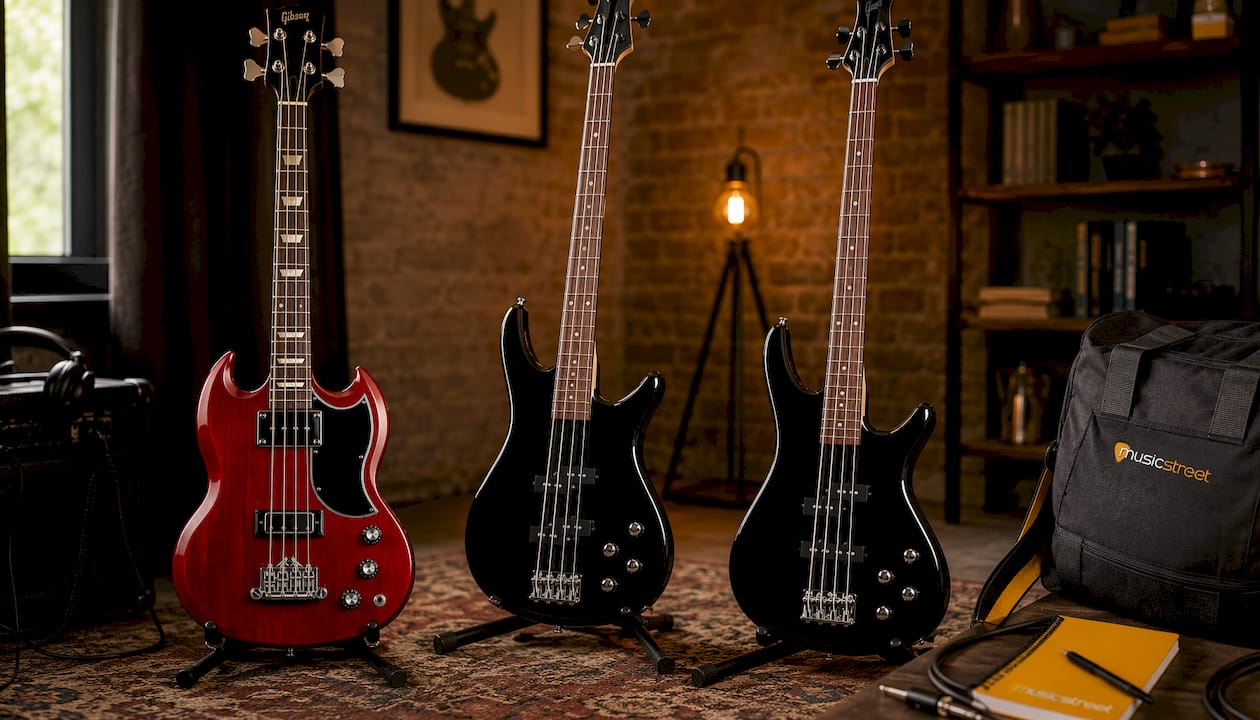
For bass beginners, three options worth looking at on the Musicstreet site: the Gibson SG Standard Bass is a full-size, professional-grade instrument with a shorter-than-average bass scale that suits players who find a 34-inch neck a stretch; the Ibanez GSR200 Bass Guitar in Black is a reliable, affordable new option that consistently tops beginner recommendations for its playability and tone at the price; and the used Ibanez GSR200 offers the same trusted model at a lower cost, ideal if you want to keep the initial outlay down while you decide whether bass is for you.
Free UK delivery is available on qualifying orders, and Musicstreet’s team is on hand for advice, repairs, and setup. Browse the full range or visit the store to try before you commit.
Useful sources
-
Fender: Bass vs guitar differences explained — manufacturer overview of scale length, strings and role differences
-
Guitar Space: Electric guitar vs bass, which is easier to learn? — practical learning curve comparison for beginners
-
Loop Music Academy: Guitar vs bass, which should you learn first? — timeline and motivation guidance for new players
-
MI.edu: Bass guitar and drums as the backbone of music — deeper look at the bass’s rhythmic role in an ensemble
-
Musicstreet: Best bass guitars for beginners — curated starter bass recommendations with buying notes
-
Musicstreet: Acoustic guitar vs electric guitar for beginners — useful if you are still deciding between acoustic and electric options
FAQ
Is bass guitar easier than electric guitar?
Bass is generally easier to start on because it focuses on single-note parts and timing rather than chord coordination. Both instruments become equally demanding at an advanced level.
Are bass and electric guitar the same instrument?
No. They share similar shapes and electronics, but differ in scale length, string count and gauge, tuning range, and musical role. A bass sits an octave below the guitar’s lowest four strings and primarily provides rhythmic and harmonic foundation in a band.
Which is better for a beginner: bass or electric guitar?
Neither is objectively better. Bass gets you into a band faster and offers quicker early wins; electric guitar opens up broader solo and songwriting possibilities once chord changes are mastered. Choose based on what you want to do musically.
Can you play bass on a normal electric guitar?
You can approximate bass lines using the lowest strings, an octave pedal, and adjusted EQ settings, but an electric guitar cannot reproduce the physical low-end response and sustain of a proper bass. For demos and practice it works; for live performance it is a compromise.


Share:
Nylon strings for steel string guitar: what to know
Acoustic pickups for gigging and recording: a buying guide