


Electric guitar pickups convert string vibrations into electrical signals through electromagnetic induction, shaping your tone profoundly. Choosing the right pickup type, magnet, and placement allows for precise control over sound, influenced by your genre and playing style. Properly adjusting pickup height and understanding their construction enhances tone before considering upgrades.
Electric guitar pickups are magnetic transducers that convert string vibrations into electrical signals, making them the single most influential component in shaping your guitar’s tone. Every note you play passes through these small but powerful devices before reaching your amplifier. Understanding how they work gives you direct control over your sound. Whether you play a Fender Stratocaster, a Gibson Les Paul, or a PRS Custom 24, the pickup sitting beneath your strings defines your tonal identity more than almost any other piece of gear.
How do electric guitar pickups work?
Electric guitar pickups operate through electromagnetic induction. A magnet inside the pickup creates a magnetic field around your strings. When you pluck a steel string, it vibrates and disturbs that field. That disturbance induces a small electrical current in the copper wire coil wound around the magnet. The induced current frequency matches the string’s vibration frequency exactly, which is why the pickup captures pitch and tone so accurately.
That electrical signal then travels through your guitar’s wiring, through the volume and tone controls, and out through the output jack to your amplifier. The amp takes that tiny signal and magnifies it into the sound you hear through the speaker. The quality and character of the signal at the pickup stage determines everything downstream.
Pickups fall into two broad categories: passive and active. Passive pickups are the industry standard and require no external power. They rely entirely on the magnetic and coil interaction to generate signal. Active pickups contain an internal preamp powered by a 9V battery. That preamp boosts the signal, reduces noise, and compresses the dynamics. Active pickups are favoured in high-gain metal and rock for their consistent volume and reduced interference.
Passive pickups tend to feel more dynamic and touch-sensitive. Active pickups feel tighter and more controlled. Neither is objectively better. The right choice depends entirely on your genre and playing style.
Pro Tip: If you use active pickups, always carry a spare 9V battery to every gig. A dead battery mid-set produces complete signal loss, not just tone degradation.
What are the main types of electric guitar pickups?
The three dominant pickup types are single-coils, humbuckers, and P90s. Each has a distinct construction, a distinct sound, and a distinct set of strengths.
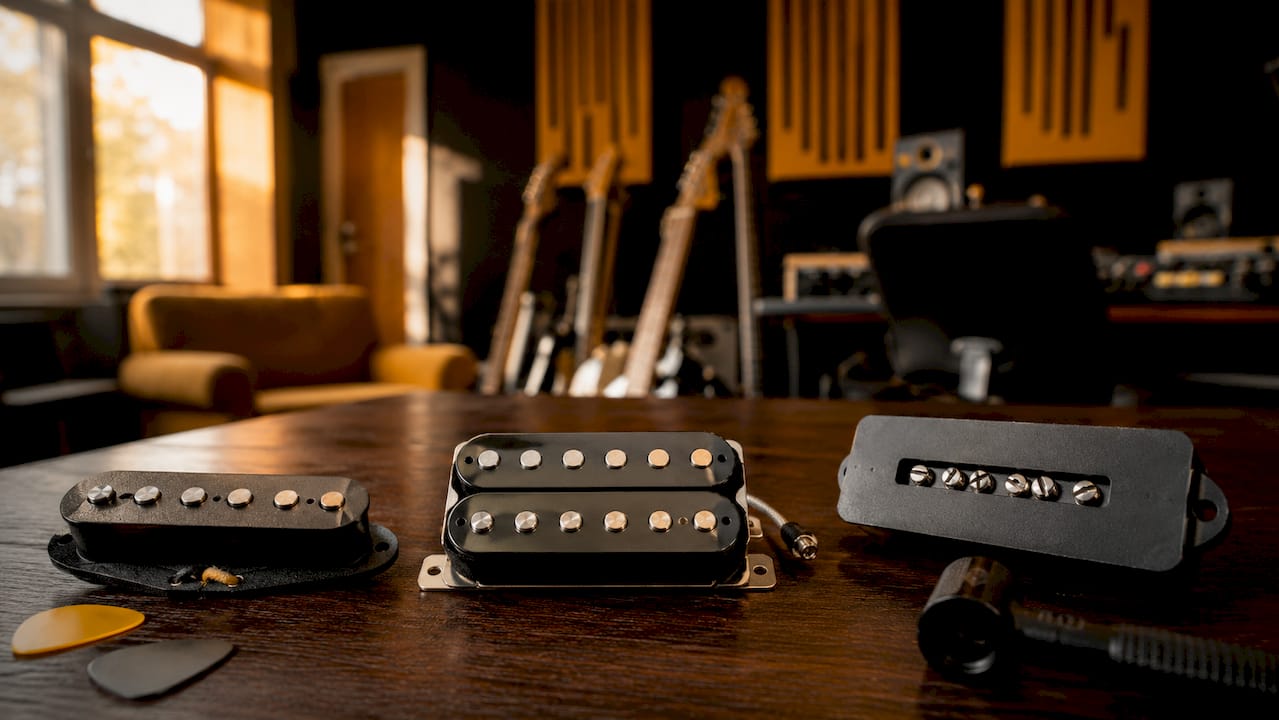
Single-coil pickups use one coil of wire wound around a set of pole pieces. They produce a bright, crisp, articulate tone with a characteristic “twang” that defines the sound of Fender Stratocasters and Telecasters. Single-coils dominate country, funk, and indie rock. The trade-off is susceptibility to 60-cycle hum, an audible buzz caused by electrical interference from mains wiring and lighting rigs.
Humbuckers solve the hum problem by using two coils wound in opposite directions with reversed polarity. The noise cancels out between the two coils while the signal combines and strengthens. The result is a thicker, warmer, higher-output tone that suits rock, metal, and punk. Gibson Les Pauls and ES-335s are the classic humbucker platforms.
P90 pickups sit between the two. They use a single coil but with a wider, flatter bobbin design. This gives them more output and warmth than a standard single-coil while retaining more bite and clarity than a full humbucker. Gibson used P90s extensively in the late 1940s and 1950s, and they remain a favourite for blues and garage rock.
| Pickup type | Construction | Tone character | Best suited genres |
|---|---|---|---|
| Single-coil | One coil, individual pole pieces | Bright, crisp, articulate | Country, funk, blues, indie rock |
| Humbucker | Two coils, reversed polarity | Warm, thick, high output | Rock, metal, jazz, punk |
| P90 | Single coil, wide flat bobbin | Mid-forward, punchy, gritty | Blues, garage rock, alternative |
| Active | Coil plus internal preamp | Tight, compressed, low noise | Metal, progressive rock |
How do magnet types and coil design influence pickup sound?
The magnet inside a pickup is not just a structural component. It is the primary driver of tonal character. Magnet alloy choice profoundly affects pickup character. Alnico magnets, made from aluminium, nickel, and cobalt, produce organic warmth, gentle compression, and a vintage quality that feels musical and responsive. Ceramic magnets deliver a stronger magnetic field, higher output, and a tighter, more aggressive attack suited to modern high-gain sounds.
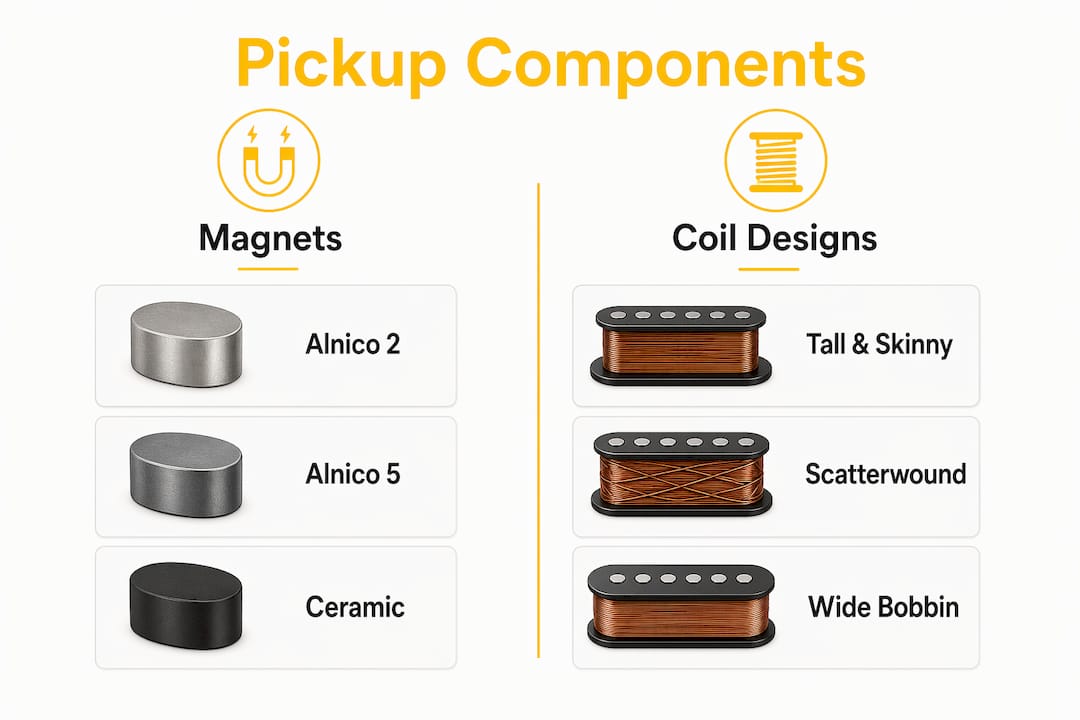
Within Alnico magnets, the grade matters too. Alnico 2 magnets produce a softer, warmer response with less sustain. Alnico 5 magnets are brighter and more articulate. Many boutique pickup builders like Mojo Pickups specify their magnet grade precisely because the difference is audible and significant.
Coil design shapes the pickup’s frequency response just as much as the magnet. Tall, skinny coils like those found in Stratocaster pickups emphasise bright, focused frequencies. Wider, flatter coils like those in P90s yield a warmer, punchier sound. This physical geometry determines which frequencies the coil resonates at most strongly.
Boutique builders also use a technique called scatterwinding, where the wire is wound irregularly rather than in neat, uniform layers. Irregular winding reduces distributed capacitance within the coil. Lower capacitance means the pickup’s high-frequency rolloff point rises, producing a more open, three-dimensional tone with clearer highs. Machine-wound pickups are consistent and cost-effective. Scatterwound pickups are less predictable but often more characterful.
Pro Tip: If you want vintage warmth, choose Alnico 2 or Alnico 5 magnets with a scatterwound coil. If you want modern aggression and clarity under heavy distortion, choose ceramic magnets with a tightly wound coil.
What impact does pickup placement have on guitar tone?
Where a pickup sits along the string’s length changes what it hears. Strings vibrate in a complex wave pattern, and the amplitude and harmonic content of that wave varies dramatically between the bridge and the neck. Bridge pickups yield bright, biting sounds because string vibration near the saddle is tight and small in amplitude. Neck pickups produce rounder, fuller, more sustain-rich tones because string vibration near the nut is wide and slow.
The middle pickup position, found on Stratocasters, captures a blend of both qualities. When combined with the neck or bridge pickup using the five-way selector switch, the out-of-phase interaction between coils produces the distinctive “quack” sound associated with positions two and four on a Strat.
| Pickup position | Tonal character | Common uses |
|---|---|---|
| Bridge | Bright, biting, percussive | Lead lines, rhythm crunch, attack-heavy playing |
| Middle | Balanced, clear, slightly nasal | Clean rhythm, funk, versatile playing |
| Neck | Warm, round, sustain-rich | Jazz, blues lead, smooth melodic lines |
| Bridge + middle | Glassy, quacky, complex | Funk, clean Stratocaster tones |
| Neck + middle | Full, warm, slightly hollow | Rhythm playing, clean chord work |
Pickup positioning is critical for desired tone shaping. Many players overlook this and focus entirely on pickup brand or type. The position is free to exploit through your guitar’s switching system, so learn what each position sounds like on your instrument before spending money on new pickups.
How to select and customise pickups for your playing style
Choosing the right pickup starts with your genre and then narrows down to your personal preferences. Follow this process to make a decision you will not regret.
-
Identify your primary genre. Single-coils suit country, blues, funk, and clean indie sounds. Humbuckers suit rock, metal, jazz, and heavier styles. P90s work brilliantly for blues, garage rock, and alternative music where you want grit without full humbucker thickness.
-
Assess your noise tolerance. If you play through high-gain amplifiers in venues with poor electrical shielding, single-coil hum becomes a real problem. Humbuckers or active pickups solve this. If you play clean or lightly overdriven, single-coil hum is rarely an issue.
-
Consider coil-splitting and wiring options. Many modern humbuckers include a coil-split function, accessible via a push-pull pot or a mini toggle switch. Splitting a humbucker deactivates one coil and produces a single-coil-like tone. Series and parallel wiring options also change the output level and tonal character without changing the pickup itself.
-
Adjust pickup height before buying anything new. Pickup height adjustment affects sustain and tone significantly. Too close to the strings causes magnetic pull that warps intonation and sustain, a problem known as “Stratitis” on Fender-style guitars. The optimal gap is roughly 2–3mm, adjusted by ear for volume consistency across all strings. Many players buy new pickups when a simple height adjustment would solve their problem.
-
Match pickup spacing to your bridge. Wide-spaced tremolos require specialised “F-spaced” or “Trembucker” pickups to align the pole pieces correctly with the strings. Standard-spaced pickups on a wide-spaced bridge produce uneven output across the strings.
-
Consider upgrading strategically. Replacing the bridge pickup first gives you the most noticeable tonal change, as it handles the majority of your lead and high-gain sounds. Read Musicstreet’s guide on whether to upgrade your pickups before committing to a purchase.
Key takeaways
The pickup is the single most influential component in your electric guitar’s signal chain, and understanding its construction, type, and position gives you direct control over your tone.
| Point | Details |
|---|---|
| Electromagnetic induction | Pickups convert string vibrations into electrical signals by disturbing a magnetic field around a copper coil. |
| Pickup type defines tone | Single-coils are bright and articulate; humbuckers are warm and thick; P90s sit between the two. |
| Magnet choice matters | Alnico magnets produce vintage warmth; ceramic magnets deliver modern aggression and higher output. |
| Position shapes character | Bridge pickups are bright and biting; neck pickups are warm and sustain-rich; exploit both through switching. |
| Adjust before you upgrade | Correct pickup height adjustment improves tone and sustain before spending money on replacements. |
Why pickups deserve more attention than most guitarists give them
Most guitarists spend hours researching amplifiers and effects pedals, then accept whatever pickups came fitted to their guitar without a second thought. That is a missed opportunity. The pickup is the first point of contact between your playing and your signal chain. Everything else reacts to what the pickup sends.
I have seen players spend hundreds of pounds on boutique overdrive pedals chasing a tone they could have found by simply swapping to a different pickup type. A ceramic-magnet humbucker through a clean amplifier sounds nothing like an Alnico 5 single-coil through the same amp. The pickup is doing that work, not the pedal.
The other common mistake is treating all humbuckers as interchangeable. A PAF-style humbucker from the late 1950s sounds completely different from a high-output ceramic humbucker designed for modern metal. Both are humbuckers. Both cancel hum. But their tonal personalities are worlds apart. Understanding how pickups shape your sound means you can make that distinction before you buy.
Experimenting with pickup height costs nothing and takes five minutes. Trying different switching positions on your existing guitar costs nothing either. Start there. Once you understand what your current pickups are actually capable of, you will know exactly what you are missing and what to look for next.
— Music
Find your tone with Musicstreet

Musicstreet stocks a carefully chosen range of electric guitars from PRS, Gibson, Fender, and Martin, each fitted with pickups that suit the instrument’s character and intended playing style. Whether you are looking for the glassy clarity of a Fender single-coil, the warm authority of a Gibson humbucker, or something in between, the team at Musicstreet can help you find the right match. Browse the full range at the Musicstreet guitar shop and take advantage of expert advice, professional setup, and free UK delivery on qualifying orders. If you are near Huntingdon, Cambridgeshire, you are welcome to try instruments in store before committing.
FAQ
What is an electric guitar pickup?
An electric guitar pickup is a magnetic transducer that converts string vibrations into electrical signals via electromagnetic induction. Those signals travel to an amplifier, which produces the audible sound.
What is the difference between single-coil and humbucker pickups?
Single-coil pickups produce a bright, articulate tone but are susceptible to 60-cycle hum. Humbuckers use two coils with reversed polarity to cancel that noise and deliver a warmer, thicker output.
Do active pickups sound better than passive pickups?
Active pickups are not better overall. They offer lower noise and tighter dynamics, making them well-suited to high-gain metal. Passive pickups feel more dynamic and touch-sensitive, which many players prefer for blues, rock, and clean styles.
How does pickup position affect tone?
Bridge pickups capture tight string vibration and produce bright, biting tones. Neck pickups capture wider string vibration and produce warm, round, sustain-rich tones. Switching between positions gives you access to both characters on the same guitar.
How do I know if I need to upgrade my pickups?
Start by adjusting pickup height to roughly 2–3mm from the strings and experimenting with all switching positions. If your tone still lacks the character you want after those adjustments, a pickup upgrade is worth considering.







Share:
Acoustic vs electric guitar strings: key differences
Difference between acoustic and acoustic electric guitars