

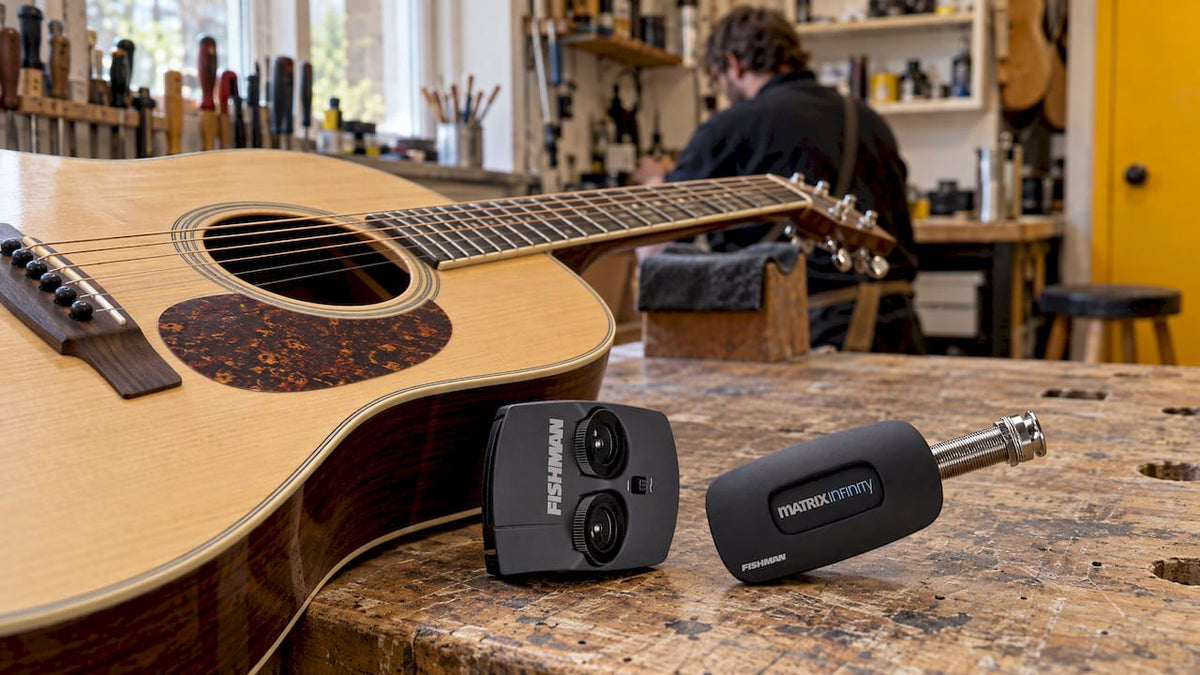
The right Fishman acoustic pickup depends on three things: how your guitar is built, where you play it and how much you want to change on the instrument itself. For most players who want a permanent, stage-ready system, an under-saddle Matrix Infinity is the benchmark. If you want something reversible that you can fit in a minute, a soundhole model is the answer. We stock the Fishman Matrix Infinity VT in the narrow format, and below we explain how each Fishman family works, how it sounds and how to check that it will suit your guitar before you buy.
Table of Contents
- The Fishman acoustic range at a glance
- Under-saddle systems: AG and Matrix
- Soundhole pickups: Blackstack, Neo-D, Rare Earth and Fluence
- How Fishman pickups sound, and what shapes the tone
- Will it fit your guitar? Check before you buy
- Installation: what is involved
- Fishman at MusicStreet
- Our view: a pickup is only as good as the guitar under it
- FAQ
- Sources
The Fishman acoustic range at a glance
Fishman’s Acoustic Series page lists several distinct families, and the names are easier to follow once you split them by where the pickup sits:
- Under-saddle: the passive AG Series and the Matrix systems. The sensor lies in the saddle slot, beneath the saddle.
- Soundhole: the passive, battery-free Blackstack humbucker, the plug-and-play Neo-D, the Rare Earth models with a built-in preamp and neodymium magnets, and the Fluence multi-voice models.
- Combined systems: the PowerTap range, which pairs a body sensor with a soundhole pickup.
- Lines named for playing style: Classic, Concert and Nashville.
The practical difference is how much work each one asks of you. A soundhole pickup clamps in. An under-saddle system means a jack in the endpin, a preamp and a saddle slot that suits the sensor. Neither is better in the abstract. They suit different guitars and different jobs.
Under-saddle systems: AG and Matrix
An under-saddle pickup is a thin strip sensor that sits between the saddle and the bottom of the slot. The bridge pressure from the strings is what it senses, which is why it handles volume well on a loud stage.
The AG Series is the classic passive ceramic version. Like other passive transducers, it needs no battery, which keeps things simple if you only want to plug into a preamp or mixer.
The Matrix range is the step up. Fishman describes the Matrix undersaddle pickup and Matrix Infinity preamp as the world’s best-selling acoustic pickups. The Infinity preamp has a single scoop Tone control that cuts the mids while lifting bass and treble, and two selectable voices: a flat response for larger bodies and a bass-boosted one for smaller bodies. Formats cover wide, narrow and split saddles, plus ukulele, with custom lengths available by special order.

MusicRadar’s 2026 round-up of acoustic pickups picks the Matrix Infinity VT as the best piezo system. It points to the one-knob tone control, the voicing switch for smaller guitars and the controls mounted discreetly inside the soundhole. It also advises having a luthier (a maker and repairer of stringed instruments) fit it. That is sound advice for any under-saddle system, and we come back to it in the installation section.
You can see one working in a real instrument too: we have a used Taylor 714 with a Fishman Matrix Infinity pickup from 2005, a good way to judge a system that is already installed and balanced.
Soundhole pickups: Blackstack, Neo-D, Rare Earth and Fluence
Soundhole pickups are the easy route. They sit across the hole, usually clamped to the edge, with no drilling and no saddle work. According to Fishman’s Acoustic Series page, the main options are these:
- Blackstack: a passive humbucking magnetic design, battery-free, with adjustable pole pieces so you can balance the strings against each other. The tone is vintage and cutting.
- Neo-D: a plug-and-play passive humbucker, so it works without a battery or an onboard control.
- Rare Earth: soundhole pickups with a built-in preamp and neodymium magnets.
The Fluence Acoustic range is the most modern. Three models, Rock Icon, Spotlight and Nashville Legend, each offer two switchable voices. Fishman describes Rock Icon as punchy and stage-ready for strumming, Spotlight as mellow for accompaniment and articulate for solos, and Nashville Legend as versatile and clear. The page states up to 70 hours of playtime from a single 9-volt battery, a boost control adding up to +8dB to Voice 2, and a curved body that sits away from the soundhole to keep the impact on the guitar’s resonance low.
Guitar World’s Neville Marten, reviewing a Fender acoustic in November 2023, described the Fishman Fluence as a fully analogue, neck-mounted pickup whose curve echoes the shape of the soundhole, which he found unobtrusive and attractive.
When a soundhole pickup is the better fit
Choose one when you do not want to modify the guitar. That covers a vintage instrument, a guitar you are borrowing, or one you plan to sell in its original state. It also suits a player who moves one pickup between a couple of guitars. The same logic applies to a steel-string and a classical guitar sharing a pickup, as long as the clamp fits the hole.
How Fishman pickups sound, and what shapes the tone
An acoustic guitar’s voice is made of string vibration, soundboard resonance and the air inside the body. Sound on Sound’s Fishman Aura review explains that piezo under-saddle pickups and magnetic pickups hear almost only the string. That is why the preamp matters so much: it shapes the part the pickup cannot hear.
That review also explains piezo behaviour. A piezo’s output is not linear: double the input gives roughly four times the output. This exaggerates the attack of a hard-picked note, which players call piezo quack. A well-voiced preamp is how you tame it, and it is the idea behind the Matrix scoop control.
The two Matrix voicings are explained in Fishman’s Acoustic Matrix guide. Natural I aims for accurate reproduction on well-balanced, smaller-bodied guitars (concert or auditorium size) and suits fingerpickers. Natural II is voiced for high-volume stage use on full-size guitars, controlling boominess and adding brightness.
For a real-world example, Guitar World’s Faith Eclipse review from March 2025 found the Fishman Ink preamp handled a 12-string well. A slight mid scoop and controlled brightness gave a balanced wash through an acoustic amp.
Matching the pickup to your style
| Playing situation | Sensible Fishman route | Why |
|---|---|---|
| Fingerstyle on a small-bodied guitar | Matrix Infinity, bass-boosted voice | Adds weight a small body lacks |
| Loud band or strummed stage sets | Matrix Infinity, flat voice, or Fluence Rock Icon | Tames boom and holds up at volume |
| Singer-songwriter wanting a mellow tone | Fluence Spotlight | Designed for accompaniment and solos |
| Vintage or borrowed guitar | Blackstack or Neo-D | No drilling or permanent change |
| Wanting body percussion and ambience | PowerTap | Adds a body sensor to the soundhole pickup |
The PowerTap range combines a Tap body sensor with a Matrix Infinity or Rare Earth soundhole pickup. It gives a discreet blend control for balancing percussion against ambience, and a stereo breakout cable is included for stereo or mono output.
Will it fit your guitar? Check before you buy
Under-saddle pickups are the ones with fit requirements, because the slot has to accept the sensor. Fishman’s Acoustic Matrix installation guide sets out the figures:
- String break angle: at least 20 degrees over the saddle, so the strings press firmly onto the sensor.
- Slot length: at least 73mm, with a maximum E-to-E string spacing of 63.5mm.
- Slot depth: with the pickup installed, no more than 50% of the saddle’s height should sit inside the slot.
- Width: the wide format is 3.17mm and the narrow format 2.39mm, so measure the slot against the format you plan to buy. Both are 67.3mm long.
The Matrix Infinity preamp guide sets a slightly different minimum slot length of 70.4mm, so confirm which system you are buying. A slot that is too wide or too short is the most common reason a pickup sounds uneven or gets returned. Measuring takes a few minutes with a rule and callipers, and your repairer will do it as a matter of routine.
Soundhole pickups skip most of this. You need only to confirm that the clamp suits the hole and the strings, and, for Fluence, that you have room for the pickup body. Our guide on how to choose the right pickup for your guitar and playing style walks through the same decision from the guitar’s side.
Installation: what is involved
Fishman’s Matrix Infinity installation guide shows what a proper fit includes:
- Drill a 15/32-inch hole in the endpin for the jack.
- Connect the pickup to the preamp’s terminal block.
- Fit a 9V battery in the adhesive battery bag. The patch takes 24 hours to bond fully.
- Set the jack so it protrudes 7.9 to 8.7mm.
Each of these steps is permanent or close to it. Drilling a hole in a guitar you love is the point where most players are glad to hand it to a specialist, and MusicRadar’s advice to use a luthier agrees. If you are weighing up cost and time, our section on adding a pickup to an acoustic, with UK costs and timelines covers it. Once the pickup is in, the advice on getting the best sound after installation helps with setup and troubleshooting.
On battery life, Fishman lists 6,000 hours from a 9V alkaline battery for the Matrix voicings, so a single battery covers years of regular playing.
Fishman at MusicStreet
If you want the pickup that Fishman calls its best seller, start with the Fishman Matrix Infinity VT in the narrow format. If you prefer to hear one first, you can try instruments in our Huntingdon, Cambridgeshire store, and we also offer guitar setups, servicing and repairs so the guitar is set up well around the pickup. For amplifying the result, the Fishman Loudbox Artist is an acoustic amp from the same maker, and our acoustic guitars range includes instruments with pickups ready fitted.

Our view: a pickup is only as good as the guitar under it
We think of an acoustic pickup as part of the instrument, not an add-on. A Fishman system can only reproduce what the guitar gives it, so the saddle, the slot, the string height and the overall setup decide how good the result is.
That is why every instrument we sell is inspected and set up by experts before it leaves us, and why we put personal service and post-sale support at the centre of what we do. When you buy from us, you can talk through your guitar, your playing and your stage, and we will point you to the pickup that fits, whether that is a Matrix Infinity or a soundhole model.
Our advice is simple. Measure the slot, decide whether you want a permanent or a reversible fit, and plan the install alongside a proper setup. Done that way, an acoustic pickup should feel like it was always part of the guitar.
Music
FAQ
How do Fishman pickups sound?
That depends on the family. Under-saddle Matrix systems give a balanced, full tone with a scoop control to cut the mids, and the two voicings suit either small or large bodies. Soundhole models such as Blackstack sound warmer and more vintage, and Fluence models offer two switchable voices.
Can any acoustic guitar have a Fishman pickup?
Almost any steel-string can take a soundhole pickup, and Fishman also makes formats for classical guitars and ukuleles. An under-saddle system needs a suitable saddle slot, with a break angle of at least 20 degrees and a slot length of at least 73mm for the Matrix. A qualified repairer can check this quickly.
Do Fishman acoustic pickups need a battery?
Not all of them. The AG Series and the Blackstack are passive and need no battery, and the Neo-D works without one as well. Matrix Infinity preamps use a 9V battery, and Fluence soundhole models also run on a 9V battery, with up to 70 hours of playtime stated.
Should I fit a pickup myself?
A soundhole pickup is an easy fit. Under-saddle systems involve drilling the endpin for the jack and working on the saddle slot, so they are best fitted by a repairer who can also check the setup. Our setup and repair service is the place to start.
Sources
- Fishman Acoustic Series
- Fishman Matrix Series Pickup Systems
- Fluence Acoustic Multi-Voice Pickups
- Fishman PowerTap Series Pickups
- Acoustic Matrix Installation Guide
- Matrix Infinity Preamp Installation Guide
- Sound on Sound: Fishman Aura review
- MusicRadar: Best acoustic guitar pickups 2026
- Guitar World: Fender Highway Series review
- Guitar World: Faith Eclipse review





Share:
5-String Bass Guitar Strings: Gauges, Tuning and How to Choose