


- Most guitar damage results from the gradual buildup of sweat, dust, and neglect, not heavy play. Regularly wiping down your guitar after each session with a microfiber cloth prevents corrosion, tone dulling, and fret wear. Implementing routine weekly, monthly, and seasonal maintenance ensures optimal performance and longevity of your instrument.
Your guitar’s worst enemy isn’t heavy playing or the occasional knock. It’s the slow accumulation of sweat, dust, and neglect that quietly degrades tone, tuning stability, and the very wood itself. Most guitarists don’t realise how much damage builds up between proper cleans, and by the time the symptoms show, a simple fix has become an expensive repair. This checklist covers everything from daily wipe-downs to twice-yearly setups, giving you a practical, structured approach to keeping your electric, acoustic, or bass guitar performing exactly as it should, for years to come.
Table of Contents
- Daily and post-play routines
- Weekly and monthly essentials
- Seasonal and environment care
- Twice-yearly: setup and inspection
- Why most guitarists skip maintenance—and what actually works
- Find the right tools for your guitar care routine
- Frequently asked questions
Key Takeaways
| Point | Details |
|---|---|
| Daily cleaning matters | Wiping your guitar after each use stops corrosion and keeps it feeling fresh. |
| Change strings regularly | Swapping strings every 1-3 months ensures great tone and playability. |
| Control humidity | Proper humidity prevents wood cracks and maintains your guitar’s shape. |
| Professional setup saves problems | A setup every six months can prevent most performance issues. |
Daily and post-play routines
After establishing why regular maintenance is crucial, let’s start with what you should do every time you play. These small actions take less than two minutes but deliver an outsized return on the health of your instrument.
The most important habit you can build is wiping down your guitar after every single session. Wipe down strings, body, and neck with a dry microfibre cloth to remove sweat, oils, and dirt. It sounds almost too simple, but the oils from your fingertips are mildly acidic and begin corroding steel strings almost immediately. Over a few weeks without cleaning, that corrosion stiffens the strings, dulls the tone noticeably, and eventually causes fret wear as corroded metal abrades the frets with every bend.
Here’s what your post-play routine should cover:
- Strings: Run the cloth under and over each string to remove finger grease and sweat.
- Neck and fretboard: Wipe along the back of the neck to prevent a build-up of grime in the grain.
- Body: Polish away fingerprints and moisture from the top, sides, and back.
- Headstock: Clean around tuning pegs where dust and oil gather.
- Bridge and saddles: A quick wipe around the bridge prevents corrosion on metal parts.
Storing a clean microfibre cloth in your case or gig bag means you have no excuse to skip this step, whether you’re at home or at a rehearsal. The cloth is one of the most affordable items among the essential guitar tools every player should own, and it earns its keep every single day.
“A two-minute wipe-down after every session is worth more than a two-hour deep clean once a year. The damage done between cleans is cumulative and often irreversible once it sets in.”
Pro Tip: Use only a dedicated microfibre cloth. Old t-shirts, paper towels, and rough fabrics can leave micro-scratches on your guitar’s finish over time, particularly on nitrocellulose lacquers found on vintage-style instruments. Check out MusicStreet’s maintenance and care guide for more on choosing the right materials.
Weekly and monthly essentials
With daily basics underway, here are the key weekly and monthly checks to keep your guitar in top shape. These steps go deeper and tackle the parts of the instrument that don’t respond to a quick surface wipe.
A structured monthly routine makes a real difference. Follow these steps in order:
- Change your strings: Change strings every 1-3 months depending on usage, or after roughly 100 hours of play. Daily players should aim for monthly changes. Fresh strings improve tuning stability, tone brightness, and overall feel dramatically.
- Deep clean the fretboard: Remove the old strings completely before cleaning. For rosewood or ebony fretboards, apply a small amount of lemon oil, work it in with a soft cloth, and buff away the residue. For maple fretboards, use only a slightly damp cloth as lemon oil can damage the finish or cause discolouration.
- Inspect and tighten hardware: Check tuning peg screws, strap buttons, strap locks, and output jack nuts. These loosen gradually with vibration and playing.
- Clean the bridge and saddles: Use a soft brush or cotton bud to remove debris from bridge saddle slots and under string contact points.
- Check neck relief: Sight down the neck from the headstock. A slight bow is normal, but excessive relief or back-bow suggests the truss rod needs attention. For a full walkthrough, the complete maintenance guide covers this in detail.
The fretboard deserves special attention because it’s porous wood in direct contact with your skin. Dirt and dead skin cells pack into the grain and, over time, cause the wood to dry out and the frets to feel rough underfoot. Good fret cleaning habits extend the life of both the fretboard and the frets themselves.

| Task | Frequency | Time required |
|---|---|---|
| Wipe down after play | Every session | 2 minutes |
| String change | Every 1-3 months | 20-30 minutes |
| Fretboard condition | Monthly | 10-15 minutes |
| Hardware check | Monthly | 5 minutes |
| Neck relief check | Monthly | 5 minutes |
Pro Tip: When changing strings on an acoustic or classical guitar, change them one at a time rather than removing all at once. This keeps constant tension on the top and neck, reducing the risk of the neck shifting or the bridge pulling.
Seasonal and environment care
Having mastered routine care, it’s time to look at seasonal and environmental factors that impact your instrument. In the UK, seasonal swings in humidity are a genuine risk to acoustic instruments in particular, and even electrics aren’t immune.
Wood is a living material that responds to moisture in the air. Humidity below 40% causes cracks in the wood and glue joints, while humidity above 60% causes swelling and can lead to bellying on acoustic tops. The ideal storage range is 40 to 60% relative humidity, and maintaining this range year-round should be a priority for any serious player.
The UK’s climate presents a specific challenge: central heating in winter strips moisture from indoor air rapidly, pushing humidity well below the safe threshold. Summer, particularly in older properties, can swing the other way with damp air causing swelling. Here’s how to manage both extremes:
- Winter (dry conditions): Use a room humidifier in the room where your guitar is stored, or a case humidifier like a Dampit or Planet Waves humidifier pack. These sit inside the case and slowly release moisture.
- Summer (damp conditions): Use silica gel sachets inside the case to absorb excess moisture. Replace them when they become saturated.
- Year-round: Store your guitar in its case rather than on a wall hanger, especially during seasonal transitions. Cases provide insulation against rapid changes in temperature and humidity.
- Avoid hazardous locations: Keep your guitar away from radiators, air conditioning vents, sunny windowsills, and car boots. Temperature spikes are as damaging as humidity imbalances.
| Condition | Risk | Solution |
|---|---|---|
| Humidity below 40% | Cracking, shrinking, fret sprout | Case or room humidifier |
| Humidity above 60% | Swelling, bellying, neck shift | Silica gel, dehumidifier |
| Rapid temperature change | Finish checking, glue joint failure | Store in case, avoid direct heat or cold |
| Direct sunlight | Finish fade, heat damage | Store away from windows |
Look for early warning signs: fret ends that feel sharp and extend past the fretboard edge (a sign of the wood shrinking in dry conditions), any gaps opening at body seams, or a top that looks uneven. Proper acoustic guitar care in particular revolves around managing these environmental risks before they escalate. You can also explore the best guitar care products to find reliable humidifiers and hygrometers suited to UK conditions.
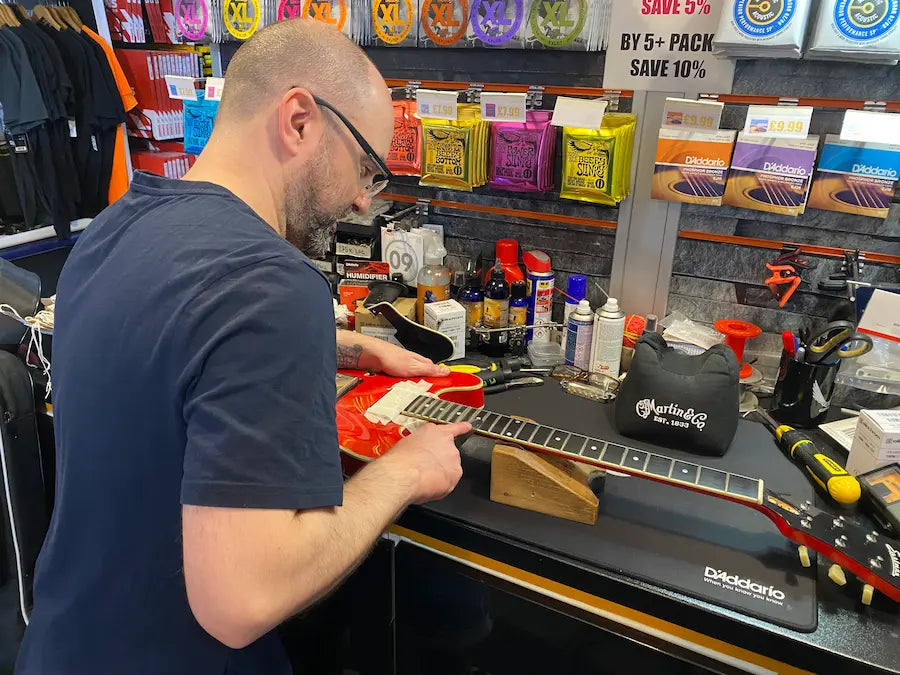
Twice-yearly: setup and inspection
Beyond routine cleaning, a twice-yearly check-up saves you headaches and expensive repairs. Think of it like a service for your car. You wouldn’t skip an oil change and expect peak performance, and the same logic applies here.
Setups every six months prevent around 80% of common guitar issues, from tuning instability and buzzing frets to poor intonation and uncomfortable action. Here’s what a proper twice-yearly setup covers:
- Truss rod adjustment: The neck should have a slight, controlled forward relief. Too much bow causes high action and slow response. Too little causes fret buzz, especially on lower frets.
- Nut inspection: Check nut slots for binding (causing tuning issues on bends) or excessive depth (causing fret buzz on open strings).
- Bridge and saddle check: On acoustics, inspect the saddle for wear and correct height. On electrics, check saddle intonation and adjust so that the 12th fret harmonic matches the fretted 12th fret note.
- Pickup height (electric guitars): Pickups set too close to the strings create a magnetic pull that affects sustain and intonation. The standard starting point is roughly 3mm from the strings at rest.
- Electronics: Spray contact cleaner into potentiometers (the volume and tone knobs) and the output jack to eliminate crackle and intermittent signal issues. This is one of the most overlooked steps in electric guitar care.
- Full visual inspection: Check for cracks at the headstock, heel joint, bridge plate, and top. Catching a small crack early means a £20 repair rather than a £200 one.
“A setup is not a luxury reserved for touring professionals. It’s a basic act of respect for your instrument, and it makes playing more enjoyable at every level.”
If you’re confident with tools, many of these adjustments are accessible to a careful DIY approach. The how to clean a guitar guide is a good starting point for understanding what you’re working with. However, truss rod adjustments in particular should be approached carefully and only a quarter turn at a time. If you’re uncertain, hand the guitar to a qualified technician. For guitar-specific maintenance context, the Yamaha Revstar maintenance tips article illustrates how manufacturer recommendations translate to real setup practice.
Pro Tip: Book your twice-yearly setup to align with the season changes in spring and autumn. These are precisely the moments when UK temperatures and humidity shift most dramatically, meaning the neck and body will have adjusted to new conditions and the setup can be dialled in accordingly.
Why most guitarists skip maintenance—and what actually works
Here’s the uncomfortable truth: most guitarists don’t neglect their instruments out of laziness. They skip maintenance because the technical language feels intimidating. Words like “truss rod relief,” “saddle intonation,” and “nut binding” create a mental barrier that makes the whole subject feel like it belongs to luthiers and technicians rather than everyday players. So the guitar gets wiped down occasionally and otherwise ignored until something goes wrong.
The problem with that approach is that guitar degradation is almost entirely silent until it’s significant. Strings corrode gradually. Frets wear slowly. Wood dries out over months, not days. By the time you notice tuning instability, dead frets, or cracking wood, you’re already dealing with cumulative damage that preventative habits would have avoided entirely.
The real insight is this: consistency beats intensity every single time. One minute after every session with a microfibre cloth does more good than a full cleaning session every six months. Small habits compound, and so does neglect. We’ve seen guitars come into our workshop that were playable and valuable a year prior but have deteriorated to the point where the repair bill approaches what the guitar is worth, all because of manageable environmental exposure and skipped string changes.
The players who keep their instruments in the best condition don’t necessarily know the most technical information. They have a simple kit, a clear routine, and they stick to it. Keep your must-have guitar accessories within arm’s reach of where you play, not buried in a cupboard. Accessibility is everything when it comes to building maintenance habits that actually last.
Find the right tools for your guitar care routine
Knowing what to do is only half the equation. Having the right tools within easy reach makes the difference between a maintenance routine that sticks and one that keeps getting postponed.

At MusicStreet, we stock everything you need to keep your guitar in peak condition, from quality microfibre cloths and fretboard oils to professional-grade humidifiers and full setup tool kits. Whether you’re building your first care kit or upgrading what you already have, our team in Huntingdon is happy to guide you through the right products for your specific guitar. Browse our full range of guitar care products online, or contact us directly for personalised recommendations. Getting the right kit now means your instrument rewards you with better tone, better feel, and a longer playing life.
Frequently asked questions
How often should I change my guitar strings?
Strings should be changed every 1-3 months or after approximately 100 hours of play, with regular players typically changing monthly for the best tone and tuning stability.
What is the ideal humidity level for storing my guitar?
Store your guitar at 40 to 60% relative humidity to prevent wood cracking in dry conditions or swelling in damp ones.
Is it safe to use lemon oil on all guitar fretboards?
Lemon oil is suitable for rosewood and ebony fretboards only. Never apply it to maple fretboards, which should be cleaned with a lightly damp cloth instead.
What does a guitar setup include?
A full setup covers truss rod adjustment, nut and saddle inspection, intonation, string height, pickup height on electrics, and a clean of all electronic contacts for reliable signal.
How do I clean my guitar’s body safely?
Wipe the body with a dry microfibre cloth after every session to remove sweat and oils, and use a dedicated guitar polish sparingly for a deeper clean without harming the finish.









Share:
Epiphone Les Paul vs Gibson Les Paul — Is the Upgrade Worth It?
Set up your pedalboard for better sound and performance