


- Proper tuning is essential for a guitar to sound its best during performance or practice.
- Using the right tuner type and following correct techniques ensures accurate and stable tuning.
- Regularly checking and maintaining your guitar’s tuning and setup improves sound quality and playing confidence.
There is nothing quite as deflating as playing a beautifully written chord and hearing it ring out sour and off-key. Whether you are performing on stage, recording at home, or simply practising in your bedroom, an out-of-tune guitar undermines everything. The good news is that mastering your tuner is one of the simplest and most rewarding skills you can develop as a guitarist. This guide walks you through everything from choosing the right tuner to building habits that keep your instrument sounding its absolute best, every single time you pick it up.
Table of Contents
- What you need before tuning your guitar
- Step-by-step: How to use your guitar tuner
- Common tuning mistakes and how to avoid them
- How to check your tuning and keep your guitar sounding great
- Our take: Why tuning precision is still underrated
- Where to find quality guitar tuners and accessories
- Frequently asked questions
Key Takeaways
| Point | Details |
|---|---|
| Know your reference | Always tune to EADGBE using A=440Hz for a consistent, professional sound. |
| Follow precise steps | Tuning from below pitch and double-checking all strings ensures stability and accuracy. |
| Avoid common mistakes | Rushing, skipping rechecks, or ignoring setup changes can lead to poor tuning and intonation. |
| Maintain regularly | Frequent checking, routine maintenance, and quality gear keep your guitar sounding its best. |
What you need before tuning your guitar
Before you pluck a single string, it helps to understand what you are working with. The right tools and a clear understanding of reference pitch will make the entire process faster, more accurate, and far less frustrating.
There are three main types of guitar tuners available to guitarists today, and each suits different situations. Clip-on tuners attach directly to the headstock and detect vibrations rather than sound, making them ideal for noisy environments like rehearsal rooms or backstage. Pedal tuners sit on your pedalboard and mute the signal while you tune, which is essential for live performance. Smartphone apps are convenient and free, but they rely on your phone’s microphone and can struggle with background noise. Knowing which tool fits your context is the first step toward accurate tuning.
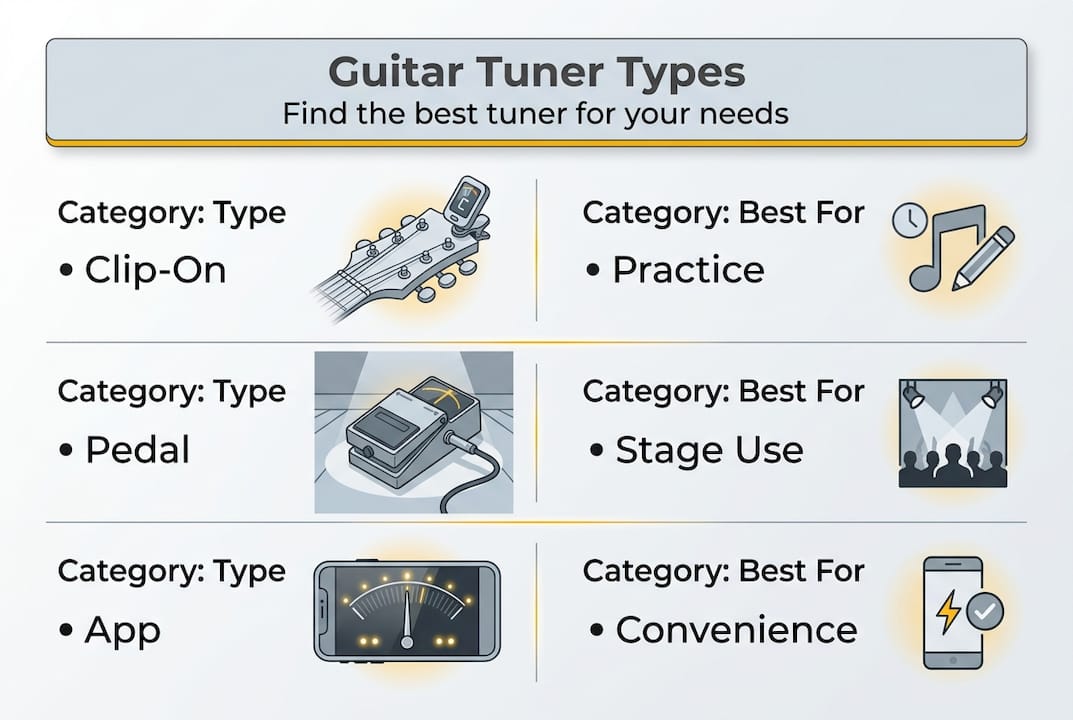
Equally important is understanding reference pitch. Standard guitar tuning is EADGBE from the thickest to the thinnest string, using A=440Hz as the universal reference pitch. This means your open A string should vibrate at exactly 440 cycles per second. Almost every tuner defaults to this standard, so unless you are intentionally dropping your tuning for a specific genre or song, leave the reference pitch at 440Hz.
Here is a quick summary of what you need before you begin:
- A tuner suited to your environment (clip-on, pedal, or app)
- Your guitar with reasonably fresh strings
- A quiet space, particularly if using a microphone-based tuner or app
- An understanding of the EADGBE string order
If you are unsure which tuner suits your playing style, choosing a guitar tuner comes down to a few practical factors: your budget, whether you gig regularly, and how much accuracy you need. A clip-on is perfect for most beginners and intermediate players, while professional performers often prefer the reliability of a pedal tuner.
| Tuner type | Best for | Accuracy level |
|---|---|---|
| Clip-on | Practice, acoustic, noisy rooms | Good |
| Pedal tuner | Live performance, electric guitar | Excellent |
| Smartphone app | Casual use, beginners | Moderate |
Having the right tuner in hand before you start means you spend less time fiddling and more time actually playing.
Step-by-step: How to use your guitar tuner
Now you have your tools and reference ready. Follow these exact steps for best results and you will find the whole process becomes second nature within a few sessions.
The step-by-step guitar tuning process is straightforward once you know the logic behind it. Here is how to do it properly:
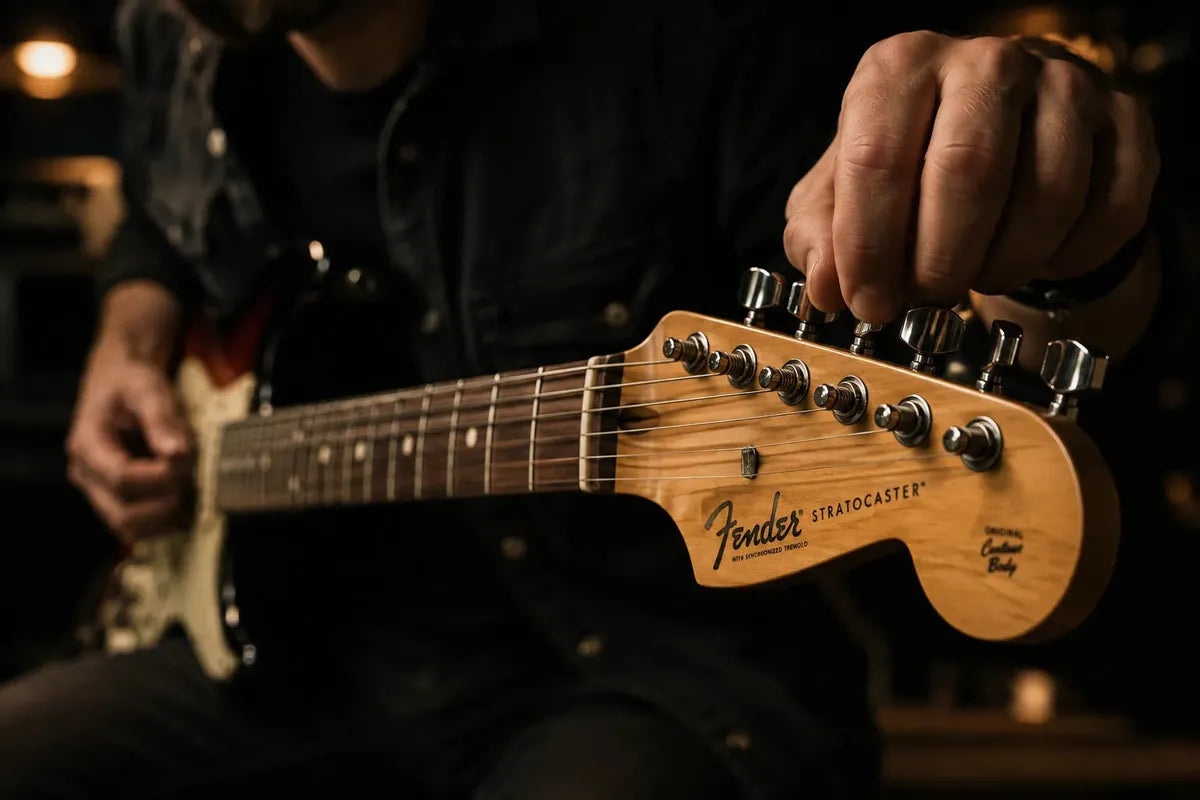
- Attach or connect your tuner. Clip it to the headstock, plug into a pedal tuner, or open your app and hold your guitar near the microphone.
- Start with the low E string (thickest). Pluck the open string firmly and watch the tuner display.
- Read the display. If the needle or indicator sits to the left, the string is flat (too low). If it sits to the right, the string is sharp (too high).
- Adjust the tuning peg slowly. To raise pitch, turn the peg to tighten the string. To lower pitch, loosen it gently.
- Always tune up from below. If the string is sharp, loosen it past the target pitch, then tighten back up to it. This approach, as confirmed by tuning from below, gives you far better stability because string tension settles more consistently when approached from underneath.
- Work through each string in order: E, A, D, G, B, E.
- Retune all strings once you reach the high E. Adjusting one string shifts tension across the entire neck, which pulls other strings slightly out of pitch. A second pass corrects this.
Pro Tip: After your first full pass, play a simple open chord like G or E major. If it sounds slightly off, do a second tuning pass. Neck tension redistributes after the initial tuning, so two passes are almost always better than one.
Here is a quick comparison of tuning approaches to help you choose wisely:
| Method | Speed | Accuracy | Best situation |
|---|---|---|---|
| Tune from above | Fast | Lower | Casual practice only |
| Tune from below | Slightly slower | Higher | Gigs, recording, all serious use |
For guitarists who struggle with tuning stability during heavy bends or vibrato, locking tuners for stability are worth considering. They clamp the string at the peg, significantly reducing slippage and keeping your tuning locked in far longer.

Common tuning mistakes and how to avoid them
Even with careful steps, there are pitfalls to watch out for. These are the most frequent causes of tuning trouble, and knowing them in advance will save you a great deal of frustration.
One of the biggest mistakes guitarists make is tuning too quickly and not rechecking. Many players pluck each string once, make a rough adjustment, and move on. The result is a guitar that sounds acceptable string by string but feels off when chords are played together. Always do at least two full passes.
Another common error is ignoring the relationship between your guitar’s setup and its tuning. Even a perfectly tuned open string can sound wrong when fretted if your intonation is off. Intonation refers to whether your guitar plays in tune all the way up the neck, not just on open strings. Poor neck relief or incorrect action height both affect this. After any guitar setup tips or adjustments, always re-check your intonation before playing.
Here are the most common tuning mistakes to avoid:
- Relying solely on your ear without a tuner
- Skipping the second tuning pass after initial adjustment
- Tuning in a noisy environment with a microphone-based tuner
- Neglecting to retune after changing strings or adjusting the truss rod
- Forgetting that temperature and humidity shifts affect pitch
Pro Tip: Never trust your ear alone for final tuning. Human ears detect pitch discrepancies of around 5 to 6 cents, while professional tuners can achieve accuracy to within ±0.02 cents. That gap is significant enough to make a chord sound slightly muddy even when you think it sounds fine.
“Always re-intonate after setup changes, as neck relief and action height directly impact how your guitar plays in tune up the neck.” This is why booking professional guitar setups periodically is one of the smartest investments any serious guitarist can make.
Think of tuning and setup as two sides of the same coin. A great tuner cannot compensate for a poorly adjusted instrument, and a perfect setup will not save a guitar that is chronically out of tune.
How to check your tuning and keep your guitar sounding great
Once you have tuned up and avoided the common errors, here is how to ensure your instrument stays pitch-perfect over time. Tuning is not a one-time task. It is an ongoing habit.
After your initial tuning session, use your tuner for a final verification pass. Pluck each open string again and confirm that every reading sits precisely in the centre of the tuner display. Pay particular attention to the G string, which is notoriously prone to going slightly sharp due to its thicker plain steel or wound construction depending on your string set.
Knowing when to retune is just as important as knowing how. Here are the key moments to reach for your tuner:
- Before every gig or recording session, without exception
- After moving your guitar between rooms with different temperatures
- Whenever you change strings, as new strings stretch and settle over the first few days
- After any period of intense play involving bends, vibrato, or heavy strumming
- When the guitar has been stored for more than a few days
For long-term tuning stability, routine maintenance plays a crucial role. Fresh strings hold tune far better than old, corroded ones. Most players benefit from changing strings every four to six weeks, or sooner if they play daily. Keeping your guitar in a stable environment away from direct sunlight and extreme humidity also reduces how often pitch drifts.
If you are auditioning guitars in store, always ask for the instrument to be tuned before you play it. A guitar that holds tune well during a brief session is a strong indicator of good neck stability and quality hardware. These are among the most practical guitar shopping tips you can apply before making a purchase decision.
Building a pre-play tuning ritual takes less than two minutes and makes an enormous difference to your sound, your confidence, and how seriously other musicians take you.
Our take: Why tuning precision is still underrated
Most guitarists treat tuning as a box to tick rather than a skill to refine. We think that is a missed opportunity. Precision tuning is one of the clearest dividing lines between players who sound amateur and those who sound genuinely professional, even when playing the exact same chords.
Here is what many players overlook: a guitar that is almost in tune creates subtle dissonance that listeners feel even if they cannot identify it. That slight muddiness in a chord, that sense that something is not quite right, often comes down to a few cents of drift that a casual ear would never consciously notice.
Modern tuners have become extraordinarily sensitive. The gap between a basic clip-on and a high-end strobe tuner is significant, and for serious players, that precision matters. Pairing a quality tuner with locking tuners on your headstock creates a system that actively resists pitch drift rather than just correcting it after the fact.
Every guitarist, regardless of skill level, deserves to hear their instrument at its best. Precise tuning is not a luxury reserved for professionals. It is the foundation everything else is built on.
Where to find quality guitar tuners and accessories
When you are ready to upgrade your toolkit, choosing the right source for your gear matters as much as the gear itself.

At MusicStreet, we stock a carefully selected range of guitar tuners and accessories suited to every playing style and budget, from reliable clip-ons for beginners to precision pedal tuners for gigging musicians. Our team understands that the right tuner is part of a broader setup, which is why we offer expert advice alongside every purchase. If you want to explore your options before buying, our guide to the best tuners in the UK breaks down the top choices in detail. Visit us online or in store in Huntingdon, Cambridgeshire, and let us help you find the perfect match for your instrument.
Frequently asked questions
What is the standard tuning for guitars?
Standard tuning is EADGBE from the thickest to the thinnest string, with A=440Hz as the universal reference pitch used by virtually every tuner by default.
How should I correct a string that is flat or sharp?
If the string is flat, tighten the tuning peg to raise the pitch; if it is sharp, loosen it past the target note and then tune up from below for the most stable result.
Why do strings sometimes go out of tune quickly?
New strings stretch as they settle, and temperature or humidity changes affect neck tension. Always recheck tuning after string changes, intense playing sessions, or moving between environments.
How accurate are human ears compared to professional tuners?
Human ears detect pitch differences of around 5 to 6 cents, whereas professional tuners can measure accuracy to within ±0.02 cents, making electronic tuners essential for truly precise intonation.





Share:
What Is a Guitar Capo and Which One Should You Buy?
The Ultimate Electric Guitar Buying Guide for All Levels