


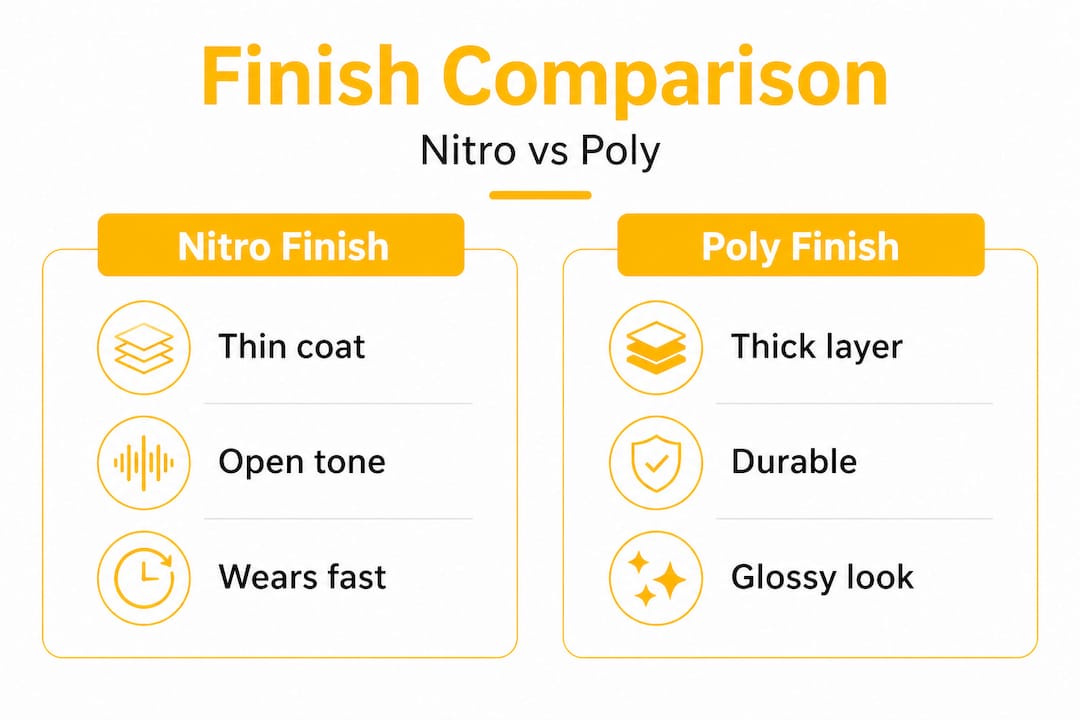
- Nitro finish is a thin, flexible lacquer that enhances wood resonance and natural feel.
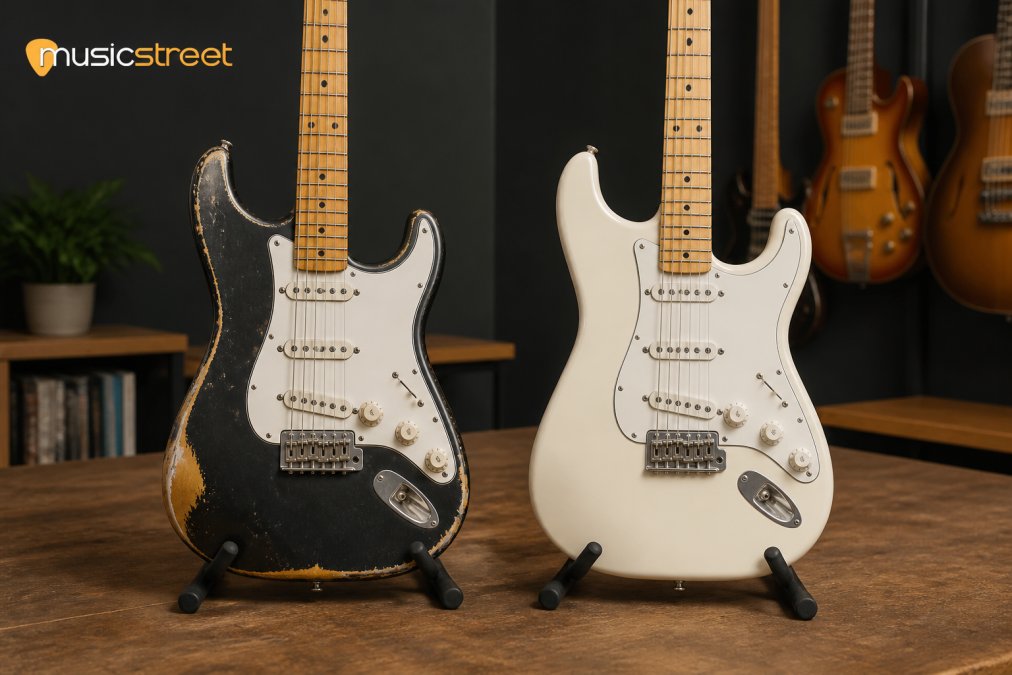
- It ages uniquely, developing wear, checking, and a vintage patina over time.
- Nitro finish is less durable, more sensitive to damage and environmental factors than poly.
Most guitarists spend hours obsessing over pickups, strings, and amp settings, yet barely give a second thought to what’s coating their instrument. That oversight can be surprisingly costly. A guitar’s finish isn’t just cosmetic. It directly influences how the wood resonates, how the neck feels under your hand, and how the instrument ages over decades. Nitro finish, short for nitrocellulose lacquer, is a thin, solvent-based coating that major manufacturers like Fender and Gibson built their reputations on, and it remains one of the most talked-about topics in lutherie today. This guide explains exactly what nitro finish is, how it affects your playing experience, and whether it’s the right choice for you.
Table of Contents
- What is nitro finish? Origins and basics explained
- How nitro finish affects guitar tone and playability
- Drawbacks of nitro finish: what every guitarist should know
- Nitro finish versus poly finish: a side-by-side comparison
- Tips for caring for nitro-finished guitars
- Why nitro finish isn’t for everyone, and why that’s fine
- Explore nitro-finished guitars and expert advice
- Frequently asked questions
Key Takeaways
| Point | Details |
|---|---|
| Nitro finish defined | Nitro finish is a thin, solvent-based lacquer that enhances guitar resonance and ages distinctively. |
| Tone and feel | Many players prefer nitro for its natural feel and the way it lets wood vibrate freely for a vintage sound. |
| Needs careful handling | Nitro finishes are less durable and require careful cleaning and environmental control to stay in good condition. |
| Personal preference matters | Choosing between nitro and other finishes depends on your priorities for tone, maintenance, and aesthetics. |
What is nitro finish? Origins and basics explained
Understanding nitro finish starts with the chemistry, but don’t worry, it’s simpler than it sounds. Nitro finish is nitrocellulose lacquer, a thin, solvent-based coating applied to a guitar’s body and neck in multiple fine layers. The term “nitro” is simply a shortened version of nitrocellulose, the primary compound in the lacquer formula. As each coat is sprayed on, the solvent evaporates and the layers bond together chemically rather than stacking up like paint. The result is a finish that feels genuinely connected to the wood beneath it.
Historically, nitrocellulose lacquer was the finish of choice throughout the 1950s and 1960s, precisely when Fender and Gibson were producing the instruments that would define rock and roll, blues, and country music. Manufacturers chose it not for romantic reasons but for practical ones. It was the most widely available and workable finish at the time, dried relatively quickly compared to older shellac methods, and buffed to a beautiful sheen. If you’ve ever held a vintage Les Paul or a pre-CBS Stratocaster, that silky, almost organic feel on the neck is nitro at its finest.
Here’s a quick overview of the core characteristics that define nitro finish application:
- Applied in multiple very thin coats using a spray gun
- Solvent-based: each layer chemically bonds to the previous one
- Air-dries rather than curing under UV lamps or heat
- Remains relatively soft and flexible even after full curing
- Can be re-coated at any time, as new layers melt into existing ones
“Nitro lacquer creates a finish that breathes with the wood, rather than sealing it under a thick plastic barrier.”
When you explore the types of guitar finishes available today, you’ll quickly notice that nitro contrasts sharply with polyurethane and polyester finishes, collectively called “poly finishes.” Poly finishes are sprayed or applied in thicker, more durable layers and often cure under UV light. They form a hard shell over the wood rather than integrating with it. Poly finishes dominate mass-market guitar production today because they’re faster to apply, cheaper, and far more resistant to damage. But there’s a meaningful trade-off, as we’ll explore next.
How nitro finish affects guitar tone and playability
Once you understand the origins and chemical realities of nitro finish, it’s time to explore why players insist it helps their guitar’s sound and feel. The core argument is straightforward: a thinner finish allows the wood to vibrate more freely. When a guitar top or body is coated in a thick layer of polyester, the finish itself dampens those natural vibrations. Nitro lacquer, being far thinner and more flexible, puts far less restriction on the wood. The acoustic result, particularly noticeable on hollowbody and semi-hollow instruments, is enhanced resonance and a livelier, more immediate response.
In tonal terms, nitro finish enhances resonance through its thinness and flexibility, contributing to an open midrange character and a slightly quicker note decay. That faster decay is not a flaw. For blues, jazz, and classic rock players, it’s a quality that makes notes feel more expressive and natural, less sustained and synthetic. Compare that to many modern poly-finished guitars, which often have a slightly longer, blossoming sustain that works brilliantly for certain styles but can feel less nuanced for others.
The tactile difference is equally striking. Nitro is softer under the hand. On the back of a neck, a thin nitro finish doesn’t feel like a slick plastic pipe. It feels more like worn wood, giving many players a more confident grip and a sense of connection with the instrument. This is one reason vintage-style guitars, particularly Fender’s American Vintage II series and Gibson’s Murphy Lab instruments, are so praised by players who grew up on older instruments.

| Feature | Nitro finish | Poly finish |
|---|---|---|
| Thickness | Very thin (0.1mm or less) | Thicker (0.3mm or more) |
| Wood resonance | Enhanced, wood vibrates freely | Slightly dampened |
| Neck feel | Soft, natural, less plastic | Slick, glassy |
| Tone character | Open mids, quicker decay | Full sustain, slightly warmer |
| Ageing | Checking, yellowing, patina | Stays glossy, resists ageing |
| Repairability | Easy, new coats blend in | Difficult to blend seamlessly |
Repairability deserves a mention here. Because nitro coats chemically bond together, you can apply a new layer directly over an old one and it will melt in, making localised touch-ups genuinely invisible. That’s a significant advantage for players who care about their instrument’s long-term appearance. Poly finishes, by contrast, sit on top of each other. Any touch-up tends to create a visible edge.
Pro Tip: If you play a nitro-finished guitar regularly, the wear you accumulate on the back of the body and the neck heel is completely natural. Many players consider this “honest relic-ing” and it’s actually one of the most admired qualities of a well-played vintage instrument. Don’t fight the ageing. Embrace it.
Explore the full picture of high end guitar finishes and understand the role of finish on tone to see exactly how these qualities translate across different instrument types and price points.
Drawbacks of nitro finish: what every guitarist should know
Every advantage comes with some caveats. Understanding nitro finish’s weaknesses is as important as knowing its strengths.
The most significant downside is durability. Nitro is genuinely soft and easily scratched, dinged, or worn. If you’re a gigging musician who throws your guitar into a gig bag and plays three nights a week, the finish will show every knock, every belt buckle scratch, and every knock against the mic stand. For players who care deeply about maintaining a pristine appearance, that can be genuinely frustrating. Nitro’s drawbacks include its lower durability, proneness to scratches and wear, high flammability during application, elevated VOC (volatile organic compound) levels, and longer cure times compared to poly options.
Let’s break down the specific concerns:
- Scratch and wear sensitivity: Even fingernails can leave marks on a soft nitro surface. Sweat from your arm can cause checking (fine cracks in the finish) over time.
- Flammability: Nitrocellulose lacquer is highly flammable during the spraying process, which makes it impractical for hobbyist application and requires strict safety controls in professional workshops.
- VOC emissions: Nitro lacquer releases high levels of volatile organic compounds during application and curing. This has led to tighter environmental regulations and is one reason many manufacturers moved away from it.
- Longer curing time: Full curing can take weeks or even months, meaning a freshly sprayed guitar needs careful handling. This increases production time and cost, which is why nitro finishes are predominantly found on premium instruments.
- Reactivity: Nitro finish is sensitive to UV light, oils from your skin, humidity changes, and even certain rubber or plastic compounds. Leaving a rubber strap end against a nitro body for an extended period can permanently damage the finish.
Pro Tip: Never store a nitro-finished guitar in a case with rubber-lined compartments for extended periods. The off-gassing from rubber can chemically react with the finish and cause irreversible clouding or softening. Use a quality cloth-lined case and a breathable guitar sock instead.
Proper cleaning a nitro-finished guitar requires some care. Many common household cleaners and even some guitar polishes contain silicones or solvents that will attack nitro. Always use products specifically formulated for nitrocellulose finishes.
Nitro finish versus poly finish: a side-by-side comparison
With advantages and drawbacks in hand, the crucial decision for guitarists is often: nitro or poly? The honest answer is that neither is universally superior. The right choice depends on what you value most in an instrument. As established, nitro is thinner and enhances resonance but falls short of poly’s toughness, while poly is more durable but prone to different compromises, particularly in the way it can make a neck feel synthetic under the hand.
Here’s how to decide based on your specific situation:
- Consider your playing environment. If you gig regularly in tight, busy venues, a poly-finished guitar will survive considerably better. Nitro’s softness is a real liability in rough-and-tumble conditions.
- Think about your tonal priorities. If you’re chasing vintage blues, jazz, or classic rock tones, nitro’s open midrange and livelier response may suit you. If you play heavy metal or modern country where sustain and clarity are paramount, poly has real advantages.
- Factor in your maintenance habits. Nitro requires more considered care. If you’re the kind of player who leaves guitars propped against the wall, doesn’t wipe down the strings, and grabs a guitar polish off the shelf without reading the label, nitro may cause unnecessary headaches.
- Assess your budget. Nitro-finished guitars nearly always cost more due to the labour-intensive application process and longer curing time. If budget is a primary concern, you may get more guitar for your money with a quality poly instrument.
- Decide whether ageing matters to you. If you love the idea of your guitar developing a unique patina over the years, checking, yellowing, and wearing in exactly the way you play it, nitro is deeply rewarding. If you want your guitar to look the same in 20 years as it does now, poly is your friend.
Explore the full compare poly vs nitro breakdown to see how these finishes perform across different body woods and playing contexts.
Tips for caring for nitro-finished guitars
Once you’ve chosen a nitro-finished guitar or have one already, proper care ensures its beauty and feel last for years. The finish is reactive to humidity, UV exposure, and skin oils, so a few thoughtful habits make a genuinely large difference to its long-term condition.
Follow these care steps consistently:
- Wipe down after every session. Use a soft, dry cotton cloth to remove sweat and skin oils from the body and neck. This is the single most effective habit you can build.
- Store away from direct sunlight. UV exposure yellows and weakens nitro over time. A quality hardshell case or a dark guitar stand position is ideal for daily storage.
- Maintain stable humidity. Aim for 45 to 55 per cent relative humidity in your storage space. Invest in a room humidifier or a small in-case humidifier to protect both the finish and the wood.
- Use only nitro-safe cleaning products. Many mainstream polish products contain silicones that will cloud or degrade nitro. Look for labels that specifically state compatibility with nitrocellulose finishes.
- Embrace natural wear. Playing wear on the arm rest area, the back of the neck, and the body edge is entirely normal. Attempting to stop it with heavy polishing regimes can do more harm than good.
Pro Tip: A small amount of pure carnauba wax polish, applied sparingly with a microfibre cloth, is one of the safest and most effective products for keeping nitro finishes looking their best without damaging the lacquer. Avoid any silicone-based products entirely.
Full guidance on keeping nitro finishes spotless and broader guitar maintenance tips will help you build a practical routine that protects your investment.
Why nitro finish isn’t for everyone, and why that’s fine
Here’s the perspective that most finish discussions skip past entirely: the obsession with nitro can become its own kind of trap. Online forums are full of players who genuinely believe nitro is categorically superior and that anything poly-finished is somehow lesser. That’s simply not true, and chasing a finish for the wrong reasons often leads to disappointment.
Poly finishes are extremely practical for working musicians. They resist sweat, knocks, and temperature changes with far greater resilience. For a touring guitarist who checks their instrument in flight cases and plays 200 nights a year, a poly-finished guitar isn’t a compromise. It’s the intelligent choice. Similarly, some players genuinely don’t want their guitar to age. They want it to look the same at a 40-year reunion as it did the day they bought it. There’s nothing wrong with that.
For custom builds, repairs, and high-end boutique instruments where the relationship between player and instrument develops over years, nitro’s repairability and unique patina earn their reputation. But no finish is universally perfect. The real truth is that a great player sounds great on any finish, and a mediocre guitar doesn’t become wonderful just because it’s coated in nitrocellulose lacquer.
If you’re genuinely curious about custom finishes for unique guitars, the best approach is to play instruments with both finishes back to back. Trust your hands. Trust your ears. Ignore the hype.
Explore nitro-finished guitars and expert advice
If reading about nitro finish has made you curious to experience it firsthand, there is no better substitute than picking up an instrument and playing it. At MusicStreet, we stock a carefully selected range of electric, acoustic, and bass guitars that span a variety of finishes, including premium nitro-finished models from the world’s most respected builders. Our team of experienced guitarists is on hand to discuss the nuances of finish, tone, and playability without the sales-pitch nonsense.

Whether you’d prefer to browse nitro-finished guitars from the comfort of your home or visit our physical store in Huntingdon, Cambridgeshire for a hands-on tryout, we’re here to help you find exactly the right instrument for your style and budget. Every guitar we sell is professionally set up and inspected before it reaches you. We also offer expert repair and finishing services, post-sale support, and genuine long-term advice.
Frequently asked questions
Is nitro finish better than poly for guitar sound?
Nitro finish enhances wood resonance due to its thinness and flexibility, but whether it sounds “better” depends entirely on your playing style and tonal preferences.
Do nitro finishes wear faster than other finishes?
Yes, nitro is less durable and will show scratches, checking, and yellowing much sooner than polyurethane or polyester finishes.
Are nitro finishes harder to maintain?
Nitro finishes do require more thoughtful care because the finish reacts to humidity, UV, and oils, so avoiding harsh products and direct sunlight is essential.
Does nitro finish change the value of a guitar?
Guitars with nitro finishes, particularly vintage and boutique models, are often valued more highly because their checking and yellowing develop an authentic, sought-after patina that appeals strongly to collectors and enthusiasts.
Recommended
- Role of Guitar Finish: Impact on Tone and Durability – MusicStreet
- Types of guitar finishes explained: pros, cons, best uses – MusicStreet
- How to improve guitar tone: essential tips for every player – MusicStreet
- ultimate guitar features: Defining the Perfect Instrument – MusicStreet
- Firearm Finishes: How Coatings Protect and Enhance Your Gun







Share:
Explore 10 guitar genres to expand your playing skills
Why guitar intonation matters for better sound