

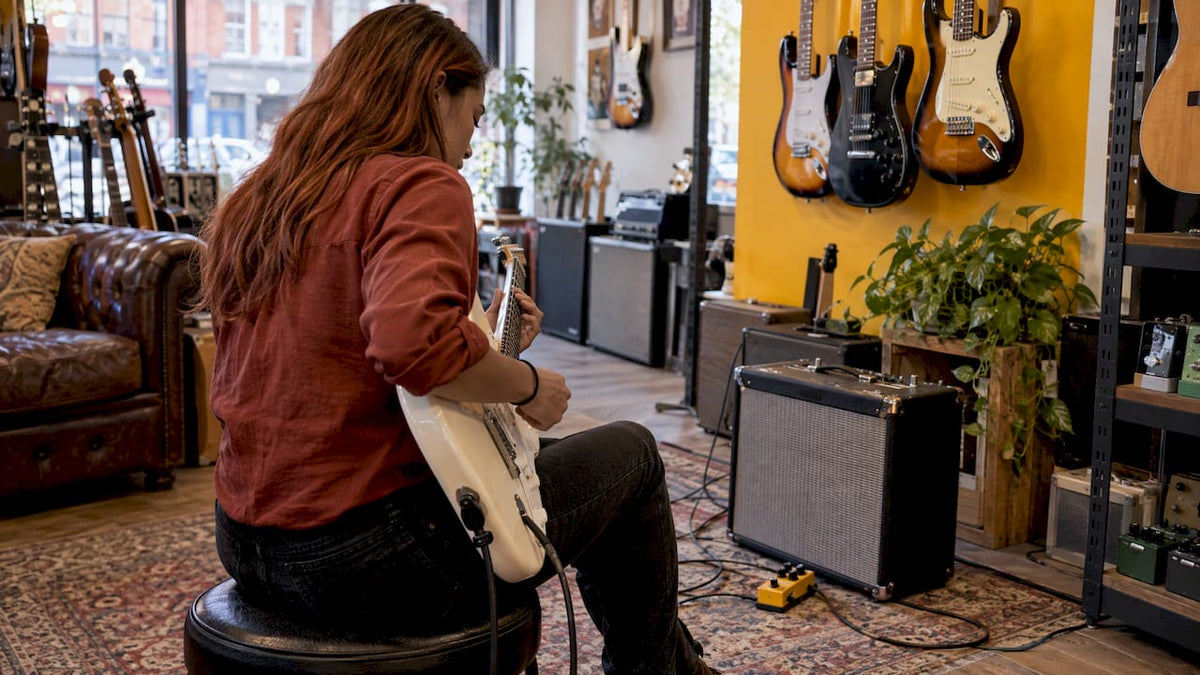
In guitar playing, overdrive is the warm, gritty break-up you get when an amplifier or pedal is pushed beyond what its circuit can reproduce cleanly. It is softer and more dynamic than distortion or fuzz, and it is the sound behind most blues, classic rock and country crunch. If you came here after a gearbox question, that is a different thing: in a car, overdrive is a high gear that lets the engine turn more slowly at cruising speed. Everything below is about the guitar kind.
Table of Contents
- What overdrive means for a guitarist
- How overdrive creates its sound
- Overdrive vs distortion vs fuzz
- Famous overdrive sounds and what they offer
- What the controls on an overdrive pedal do
- How to use overdrive with your amp
- Which styles use overdrive
- Our perspective
- Choosing an overdrive pedal
- Where to try and buy overdrive pedals
- Getting the best from overdrive: practical tips
- FAQ
- Sources
What overdrive means for a guitarist
Overdrive happens when you raise the gain of a guitar signal past what the circuitry can handle, so the signal starts to distort. MusicRadar’s guitar FX lesson describes it in exactly those terms. The important word is soft. In a valve amp, overdrive boosts the gain so that the valves are driven into clipping, and it uses soft clipping, which gives a smoother sound than the generally harsh hard clipping of distortion and fuzz.
The sound has a long history. From the 1950s, blues and rock players turned their amps up to maximum volume, overdriving the vacuum tubes and producing heavy saturation. Overdrive pedals later arrived to give players that cranked-amp character without needing the volume.
In practice, you notice three things when overdrive kicks in:
- Grit that responds to your hands. Dig in and the sound gets thicker and dirtier. Pick lightly or turn the guitar’s volume down and it cleans up.
- Sustain and warmth. Notes bloom and hold for longer, with a rounder edge.
- Retained clarity. Chords stay recognisable, rather than turning into a wall of noise.
How overdrive creates its sound
Every amplifier stage can only copy its input signal accurately up to a certain limit. Beyond that, the signal is forced into overdrive because the circuit cannot keep amplifying in a perfectly straight line. The peaks of the waveform get flattened, which is what we call clipping.
Clipping does more than make things dirty. It cuts extreme frequencies from the harmonic palette and emphasises the remaining ones, creating harmonic saturation. That emphasis is why a driven note sounds fuller and more “alive” than a clean one.
Soft clipping in pedals and amps
Tube amps clip when pushed into saturation. Overdrive pedals imitate this with soft clipping, usually using diodes in an op-amp feedback loop. The clipping curve rounds off gradually rather than chopping the wave sharply, so the result sits much closer to a valve amp at its limit than to a hard-edged distortion box.

Why a pedal can do what an amp does
A real valve amp needs to be loud to overdrive properly, which is rarely practical in a flat, a rehearsal room or a small pub gig. Overdrive pedals replicate the effect of a cranked tube amp at any volume, so you can reach tube-amp saturation at lower volumes.

Overdrive vs distortion vs fuzz
These three terms overlap, and even manufacturers admit the lines are fuzzy. Still, there is a useful working distinction. Overdrive mimics a tube amp at its limit, distortion pedals tend to be more intense, and fuzz is a distortion dominated by harmonics, often emphasising highs and cutting mids.
| Overdrive | Distortion | Fuzz | |
|---|---|---|---|
| Clipping | Soft | Hard | Heavily saturated, harmonic-rich |
| Gain level | Low to medium | Medium to high | Varies, often extreme |
| Feel | Smooth, dynamic, amp-like | Tight, aggressive, saturated | Woolly, buzzy, vintage |
| Reacts to picking and guitar volume | A lot | Somewhat | Often strongly, but with a very different texture |
| Typical styles | Blues, classic rock, country, indie | Hard rock, punk, metal | Psychedelic, garage, stoner |
The table is a guide, not a rulebook. MusicRadar notes that overdrive pedals use soft clipping and are relatively low-gain, while distortion pedals use hard clipping and generally produce a more saturated sound. Your ears are the final judge: if a pedal sounds like an amp turned up, most players will call it overdrive whatever the label says.
Famous overdrive sounds and what they offer
Different overdrives colour the sound in different ways. A few reference points help you understand what you are hearing.
- Ibanez Tube Screamer. Considered an archetypal overdrive, known for soft clipping and a pronounced midrange boost that helps push tube amps into saturation.
- Klon Centaur. Known for a transparent feel, with its circuit preserving the clean signal underneath the drive.
- Fulltone OCD. Can be run from 9 to 18 volts and delivers a less compressed sound at the higher voltage.
- BOSS SD-1. A warm, amp-like overdrive with a midrange boost, with bass and treble pulled back slightly. Its character is attributed to asymmetrical clipping, which imitates what a tube amp does to a signal.
The pattern is clear: some overdrives push the mids to help a guitar cut through, others try to disappear and simply add drive. Neither is better. It depends on your guitar, your amp and what you play.
What the controls on an overdrive pedal do
Most overdrive pedals share three knobs, and once you know them you can work out almost any model.
- Drive (or Gain): sets how much saturation you get. Low settings add a light edge, high settings give a thick, sustained crunch.
- Level (or Volume): sets the pedal’s output volume. Set it higher than your bypassed volume and the pedal also works as a boost.
- Tone: shapes the frequency response, usually moving from darker to brighter.
There is more to a good pedal than the knobs. Guitar.com’s feature on what makes a great overdrive argues that a powerful integrated EQ is vital to keep the tone clear, preserve note separation and place the guitar’s midrange properly within a band mix. When you try a pedal, play chords as well as single notes. If the chords stay distinct and respond to your picking, the pedal is doing its job.
How to use overdrive with your amp
The most common setup is a pedal in front of an amp, and there are a few classic ways to approach it.
As a boost for a nearly breaking-up amp
A guitarist may use an overdrive as a boost when they like their tube amp but want more saturation, a fatter tone or more perceived volume. Set the amp just on the edge of break-up, then tap the pedal for solos and heavier sections.
As an amp slammer
A widely used technique is to set the drive low and the level high, so the pedal slams the amp’s input and makes it break up naturally. The pedal adds little colour of its own. The amp does most of the work.
With a clean or slightly dirty amp
Adrian Thorpe MBE, writing in Guitar.com, argues that a good overdrive should retain guitar character, note separation and picking dynamics. His advice is to set the amp somewhere between clean and slightly dirty so the pedal integrates naturally. It is a good starting point if your amp has a clean channel and you want to add drive with a pedal.
Pedal or amp drive channel?
If your amp already has a drive channel, a pedal still earns its place. Pedals can augment an amp with different tonal characters and EQ, without the cost or hassle of carrying several amplifiers.
Which styles use overdrive
Overdrive is closely associated with blues. Low-gain boosts are used for folk or country, and overdrive can also be pushed into high-gain amps for modern metal, where it tightens the low end and adds punch before the amp’s own gain.
A rough guide:
- Blues and soul: low to medium drive, warm tone, lots of dynamic control from your picking hand.
- Rock and indie: medium drive, often with a mid-focused pedal to help a single guitar sit in a band.
- Country and folk: low drive, used as a gentle boost for solos.
- Metal: a pedal in front of a high-gain amp to firm up the attack.
Our perspective
We handle a lot of guitars and pedals every week, and the same thing keeps coming up: most players do not need more gain, they need the right kind of gain. Overdrive is the easiest place to start because it keeps your guitar and your hands in charge of the sound.
That is also why the guitar itself matters. Pickups, string condition and setup all change how an overdrive responds. A properly set-up instrument with fresh strings will drive more cleanly and with better note definition than one that has been neglected, which is why every instrument we sell is inspected and set up before it leaves us.
If you are choosing your first pedal, try it with your own guitar and amp if you can. Our in-store tryouts at Huntingdon exist for precisely that, and we would rather you left with a pedal you love than one that merely looked good online.
Music
Choosing an overdrive pedal
Start with what you want the pedal to do.
- A mid-focused, amp-like crunch: look at the classic Tube Screamer-style voicing, such as the BOSS SD-1W.
- A more dynamic, tube-like overdrive: the BOSS OD-1X and BOSS OD-3 are worth auditioning for their different takes on amp-style drive.
- A boutique, custom-voiced option: the Origin Effects RevivalDRIVE is a custom overdrive for players who want something beyond the standard pedalboard staples.
Before you buy, think about the amp you will pair it with. A pedal that sounds superb into a clean valve combo can behave very differently into an amp already running hot, and the right choice often depends on the amplifier more than the pedal.
Where to try and buy overdrive pedals
We stock overdrive and other effects alongside guitars, amps and accessories, and we can talk through which pedal suits your playing. If you are building a rig, take a look at our guitar amps and combos, then bring your own guitar to our Huntingdon shop to hear the combination for yourself.

For setup, servicing and repairs, including getting your guitar ready to work well with a new pedal, see what we offer on the Musicstreet homepage. Free UK delivery is available on orders over a minimum amount, and our pre-owned instruments are backed by insurance-supported warranties.
Getting the best from overdrive: practical tips
- Put it first in the chain. Overdrive normally sits near the start of your pedal chain, before modulation and delay, so the effects behind it are not distorted by it.
- Turn your guitar’s volume down. With the right pedal, rolling the volume back cleans up the sound without touching the pedal.
- Use fresh strings. Old strings sound dull, and drive exaggerates that. Our guitar strings range includes our in-store restring service.
- Set the level to taste. Matching the pedal’s bypassed volume lets you judge the tone honestly. Pushing the level higher turns it into a boost.
- Adjust the amp, not only the pedal. The same pedal sounds quite different with your amp on a clean, edge-of-breakup or crunch setting.
FAQ
Is overdrive the same as distortion?
Not quite. Distortion is a broad term for any dirty, non-clean signal, and overdrive is a specific, smoother form of it that imitates a tube amp pushed past its clean limit. Distortion pedals tend to be more intense and use hard clipping. In practice the terms overlap, and even manufacturers treat them as different gradations of the same idea.
Do I need a valve amp to use an overdrive pedal?
No. Overdrive pedals work with any amplifier, though they are often used with valve amps because pedals are designed to push a tube amp into saturation. With a solid-state amp the pedal does more of the work, and the result is a different character rather than a worse one.
Can an overdrive pedal work as a boost?
Yes. Set the drive low and the level high, and the pedal will push the front of your amp harder, creating natural break-up. It is also a handy way to lift a solo above the rest of a band.
What does overdrive mean in a car?
In a car, overdrive is a high gear that turns the driveshaft faster than the engine, so the engine runs at lower revs when cruising. It has nothing to do with the guitar effect, although both borrow the word for the idea of going beyond normal limits.
Sources
- Guitar tone explained: jargon-busting tone buzzwords, Guitar World
- Guitar 101: What Is the Difference Between Overdrive, Distortion and Fuzz, MasterClass
- Overdrive vs distortion: explore the sounds, MusicRadar
- Guitar FX basics: What is overdrive?, MusicRadar
- Amp FAQ: gain, overdrive and distortion, Guitar.com
- The FX files: Klon Centaur, MusicRadar
- The FX files: Fulltone OCD, MusicRadar
- Jargonbuster: Overdrive, Guitar.com
- Cause & Effects: what turns a good overdrive pedal into a great one, Guitar.com
- Why have drive pedals if your amp has a drive channel?, Guitar.com
- How to use an overdrive pedal as an amp boost, Guitar Gear
- Getting the Most Out of Your Overdrive Pedal, BOSS Articles

Share:
What Is a Capo? How It Works and Which Type to Choose