


Pick up two guitars with identical strings, the same scale length, and the same body shape. Play the same chord on both. The chances are they sound noticeably different. That difference is not down to luck or imagination. It comes from the wood. Tonewood is one of the most debated and least understood topics in the guitar world, and getting to grips with it can genuinely transform how you choose, play, and appreciate your instrument. This guide covers what tonewood actually is, the science behind it, how common woods compare, and how to make smarter buying decisions.
Table of Contents
- Defining tonewood: What it means for guitars
- The science behind tonewood: How wood affects guitar sound
- Comparing popular tonewoods: Sound differences in practice
- Beyond the hype: Myths, luthier insights, and what really matters
- Choosing the right tonewood for your guitar
- Find your perfect guitar with expert guidance
- Frequently asked questions
Key Takeaways
| Point | Details |
|---|---|
| Tonewood shapes sound | The type of wood used in your guitar greatly affects its unique sound characteristics. |
| Science versus myth | While properties like density and stiffness matter, not all claims about rare woods are backed by evidence. |
| Top matters most | For acoustics, the soundboard has the greatest influence on tone—more than back or sides. |
| Small differences in practice | Actual listening tests show tonewood changes can be subtle next to build and set-up quality. |
| Individual needs first | Make choices based on your playing style, budget, and the music you love, not just the type of wood. |
Defining tonewood: What it means for guitars
The word “tonewood” simply refers to any wood chosen specifically for its acoustic properties rather than just its strength or appearance. Not every timber makes the cut. Luthiers, the craftspeople who build guitars, select woods based on how they vibrate, how they project sound, and how they respond to the player’s touch. Understanding the role of guitar woods is the first step to understanding why your guitar sounds the way it does.
The guitar is essentially a collection of vibrating surfaces working together. The most important of these is the top, also called the soundboard. In acoustic guitars, the top vibrates most, acting like a speaker cone, and woods like spruce are favoured here because of their high stiffness-to-weight ratio, low density of around 400 to 450 kg/m³, high speed of sound of roughly 5,500 m/s, and low damping. These properties allow the soundboard to move freely and efficiently, converting string energy into audible sound.
The back and sides play a supporting role. They reflect and shape the sound produced by the top, adding colour and character without being the primary driver of volume or clarity. Here is a quick summary of what each part of the guitar contributes tonally:
- Top (soundboard): Controls volume, clarity, and dynamic response
- Back and sides: Influence warmth, depth, and tonal colour
- Neck wood: Affects sustain and feel, particularly on electric guitars
- Fingerboard: Contributes to attack and brightness
“The soundboard is to a guitar what a loudspeaker cone is to a hi-fi system. Get that right, and everything else falls into place.”
This hierarchy matters enormously when you are shopping. Spending more on a guitar with a solid spruce top will almost always yield a more noticeable sonic improvement than upgrading the back and sides.
The science behind tonewood: How wood affects guitar sound
Wood is not a uniform material. Every piece has a unique cellular structure, grain pattern, and moisture content, and these variables translate directly into acoustic behaviour. Three properties matter most: density, stiffness (expressed as the modulus of elasticity), and damping.
Density determines how much mass the wood has per unit of volume. A denser wood requires more energy to vibrate, which can extend sustain but may reduce sensitivity. Stiffness controls how quickly the wood returns to its resting position after being displaced, which influences resonance frequency and projection. Damping describes how quickly the wood absorbs vibrational energy, affecting how long notes ring out and how complex the overtone structure sounds.
The mechanics of wood acoustics show that density affects sustain, stiffness determines resonance frequency, and damping (measured as tanδ, approximately 0.0069 for spruce) controls decay and overtones. The anisotropic nature of wood, meaning its properties differ along different axes, is particularly important for guitar plates, where axial stiffness is critical.
| Property | What it affects | Spruce value |
|---|---|---|
| Density | Sensitivity, sustain | ~0.43 g/cm³ |
| Stiffness (E/ρ) | Resonance, projection | ~36 MPa m³/kg |
| Damping (tanδ) | Decay, overtone richness | ~0.0069 |
Here is where it gets genuinely interesting. Research into damping variations in guitars found that Q-factor differences ranging from 138 to 159 across different spruce samples had minimal perceptual impact on steel-string guitars in listening tests. In other words, two pieces of spruce that measure differently in the lab can sound remarkably similar to the human ear. This is a crucial insight: the science explains the framework, but it does not always predict what you will actually hear.
Pro Tip: When assessing a guitar in a shop, tap the soundboard lightly with your knuckle. A clear, resonant knock rather than a dull thud suggests the top is well-seasoned and responsive. This is a quick, practical way to gauge wood quality before you even play a note.
Think of it like this. Two cars may have engines with slightly different horsepower figures on paper, yet feel almost identical on a normal road. The numbers matter, but real-world experience is shaped by many interacting factors. The same logic applies to tonewoods. Understanding the ultimate guitar features that genuinely affect playability and sound helps you cut through the noise.
Comparing popular tonewoods: Sound differences in practice
Now for the practical part. Here is how the most common tonewoods actually behave, translated from lab data into playing experience.
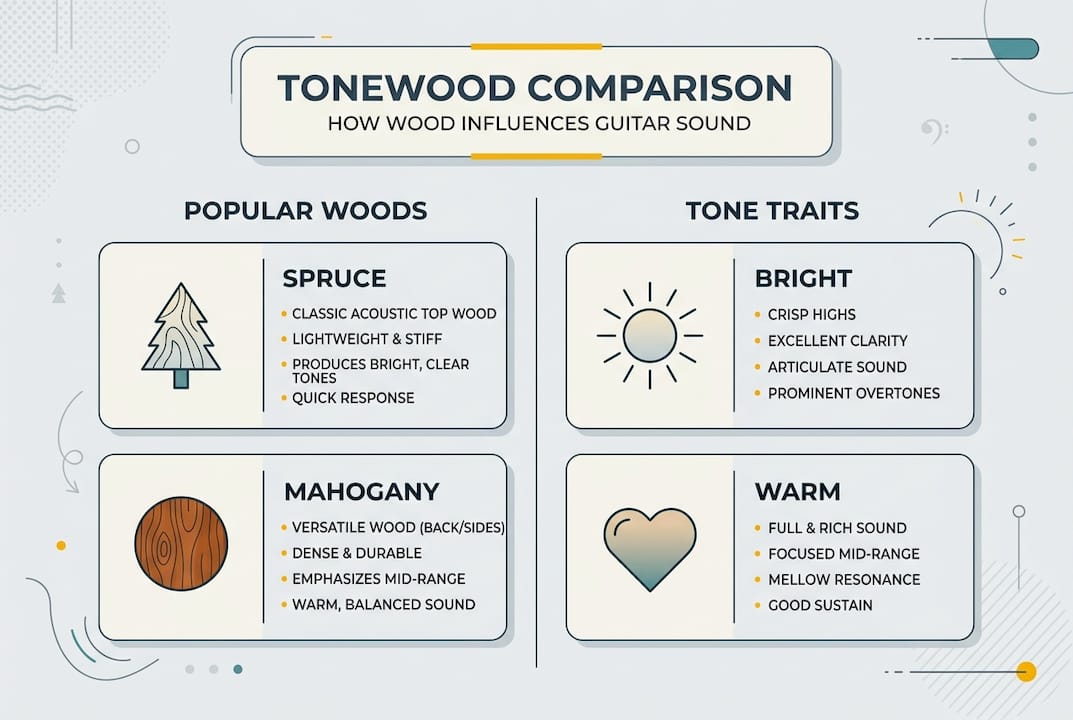
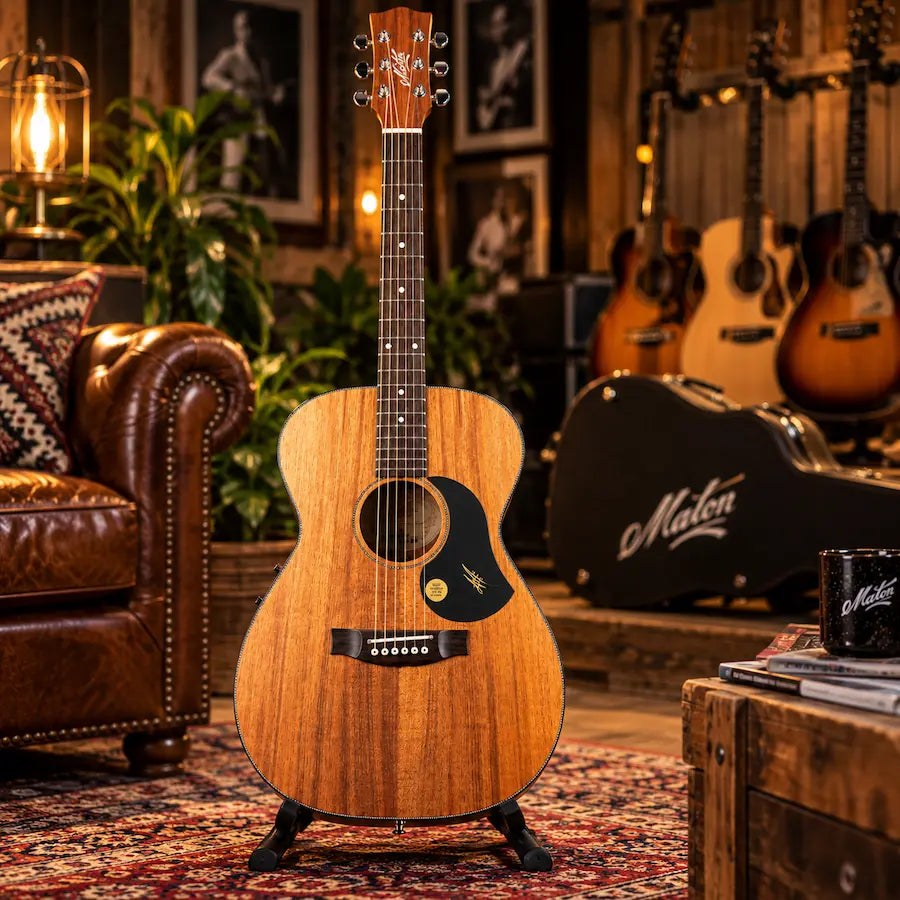
Spruce is the benchmark. With its low density of 0.43 g/cm³ and high stiffness-to-weight ratio, it delivers clarity, dynamic range, and excellent projection. It rewards players who vary their picking intensity, opening up as you play harder. Most acoustic guitars you encounter will have a spruce top for exactly this reason.

Mahogany is warmer and more focused. It has higher damping than spruce, which means it emphasises the fundamental note rather than complex overtones. Fingerpickers and blues players often prefer it for its smooth, woody midrange. It is also commonly used for backs, sides, and necks.
Rosewood is dense and rich. As a back and sides material, it adds depth and sustain, with a pronounced low end that complements a bright spruce top beautifully. Supply restrictions due to CITES regulations have made it less common in recent years, pushing builders towards alternatives.
Maple is bright and articulate. It has very low damping, which means notes cut through clearly with strong attack. It is a favourite for archtops, electric guitar bodies, and necks where clarity and sustain are priorities.
| Tonewood | Character | Best suited for |
|---|---|---|
| Spruce | Clear, dynamic, balanced | Strumming, fingerpicking, versatile use |
| Mahogany | Warm, focused, midrange | Blues, folk, fingerstyle |
| Rosewood | Rich, deep, sustaining | Back/sides pairing with spruce tops |
| Maple | Bright, articulate, punchy | Electric guitars, archtops, necks |
When choosing your first acoustic, the best acoustic guitar for beginners will almost always feature a spruce or cedar top, as these woods offer the broadest tonal range for developing players. Understanding guitar body types alongside tonewood choices gives you an even clearer picture of how your instrument will sound and feel.
It is also worth noting that sustainable alternatives are gaining serious ground. Bamboo versus traditional wood comparisons show that engineered and alternative materials can perform admirably, and many respected builders now use roasted maple, torrefied spruce, and other treated woods to achieve tonal qualities previously associated only with aged tonewoods.
- Torrefied spruce mimics the properties of decades-old wood through heat treatment
- Ovangkol and sapele are popular rosewood substitutes with similar tonal profiles
- Pau ferro is widely used as a fingerboard alternative to rosewood
Beyond the hype: Myths, luthier insights, and what really matters
Here is where we need to be honest with you. The guitar world is full of tonewood mythology, and some of it borders on folklore. The idea that a guitar “opens up” over decades of playing is real, but the mechanism is more nuanced than most people realise.
Luthier selection of resonance wood is empirical rather than mystical. Experienced builders tap, flex, and listen to individual pieces of wood before committing them to a build. Science explains the underlying properties, but perception tests consistently show limits to what players can reliably distinguish in blind listening conditions. The species name on a spec sheet tells you less than you might think.
What actually makes a meaningful difference? Here is a practical, prioritised list:
- Build quality and bracing pattern: How the wood is shaped and supported inside the guitar affects tone far more than species alone
- Setup and action: A poorly set-up guitar made from premium tonewood will sound worse than a well-set-up guitar made from modest materials
- Humidity and temperature control: Wood is hygroscopic, meaning it absorbs and releases moisture. Keeping your guitar at 45 to 55% relative humidity protects both tone and structural integrity
- Playing in: Regular playing does gradually loosen the cellular structure of the wood, improving resonance over time
- Finish type: A thick polyester finish can dampen vibration significantly. The role of guitar finish on tone is a genuinely underappreciated factor
“A guitar is only as good as its setup. The finest tonewood in the world cannot compensate for a nut that is too high or a neck that is poorly adjusted.”
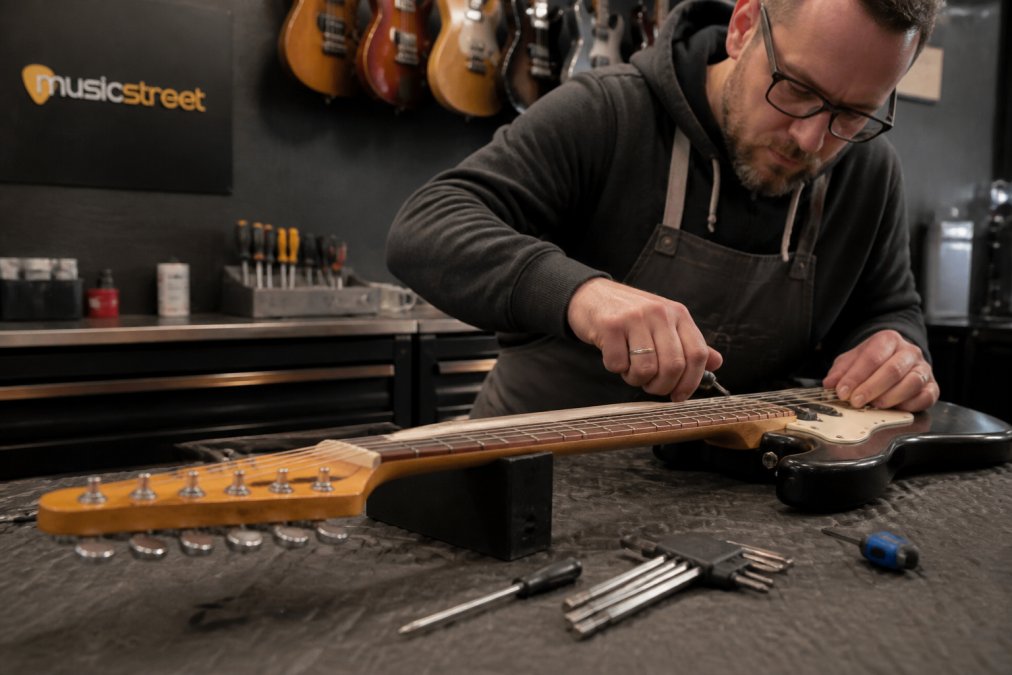
Pro Tip: Before attributing tonal issues to your guitar’s wood, have a professional setup done. Correcting action, intonation, and nut slot depth can transform the way an instrument sounds and plays, often more dramatically than swapping instruments entirely.
The practical takeaway is this: do not let tonewood species be the only factor in your decision. A beautifully built guitar with a modest spruce top will outperform a poorly constructed guitar with exotic tonewoods every single time.
Choosing the right tonewood for your guitar
So how do you actually make a decision? The good news is that once you understand the framework, the process becomes much more straightforward.
Luthier practice and empirical data consistently suggest that enhancement is better achieved through proper mechanics, such as playing regularly and controlling humidity, than through chasing mythologised wood species. That said, tonewood choices do matter, particularly for acoustic instruments, and here is how to approach them sensibly.
- Identify your primary playing style. Strummers benefit from spruce tops. Fingerpickers may prefer cedar or mahogany for their warmth and immediate response
- Set a realistic budget. Solid wood tops are worth prioritising over solid back and sides if you have to choose. A solid top with laminate back and sides is a smart compromise at mid-range prices
- Play before you buy whenever possible. No specification sheet replaces the experience of holding and playing an instrument. Trust your ears and your hands
- Ask about the build, not just the wood. Bracing style, finish thickness, and nut material all contribute to the final sound. The role of guitar woods is significant, but it works in concert with every other element of the build
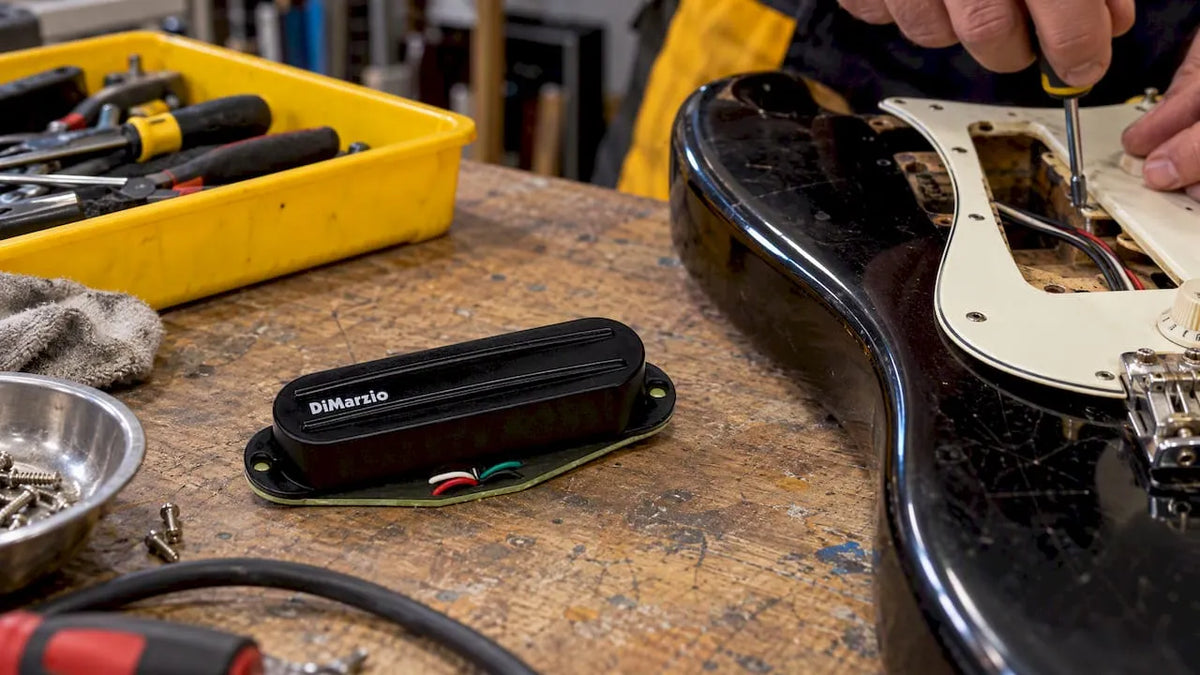
- Think long term. If you are considering upgrading to a higher quality electric guitar, remember that on electrics, pickups and electronics will shape your sound far more than body wood alone
For acoustic players, the soundboard is your single most important tonewood decision. For electric players, focus your attention on construction quality, hardware, and electronics. Tonewood still matters on electrics, but it sits further down the priority list.
Find your perfect guitar with expert guidance
Understanding tonewood is genuinely useful knowledge, but nothing replaces the experience of playing an instrument in person and getting advice from someone who knows their stock inside out. At MusicStreet, we stock a carefully chosen range of acoustic, electric, and bass guitars across all price points, and our team genuinely loves talking through the details with players at every level.

Whether you are weighing up a spruce-topped acoustic for fingerpicking or looking for a solid mahogany body for warm blues tones, we can help you find the right match for your playing style and budget. Browse the full range at the MusicStreet store, or visit us in Huntingdon, Cambridgeshire for a hands-on try-out. Our guitars are professionally inspected and set up before they reach you, so you can buy with confidence.
Frequently asked questions
Does tonewood really matter for electric guitars?
Electronics and pickups have a far greater influence on electric guitar sound than tonewood does. While body wood contributes subtly to resonance and sustain, damping variations have minimal perceptual impact in listening tests, making it a secondary consideration for most electric players.
Is solid wood better than laminate for tone?
Solid wood generally produces richer, more complex tone because the soundboard vibrates freely as a single piece rather than compressed layers. High-quality laminates can still sound excellent and offer greater resistance to humidity changes, making them a practical choice for beginners.
What is the best tonewood for beginners?
A spruce top paired with mahogany or laminate back and sides is the most widely recommended combination for new players. Spruce offers balance, versatility, and value, with its low density and high stiffness making it responsive across a wide range of playing styles.
Can you really hear the difference between tonewoods?
Trained listeners can detect subtle differences in controlled conditions, but Q-factor studies show that damping variations between wood samples often have minimal perceptual impact. Build quality, setup, and playability tend to make a more immediately noticeable difference for most musicians.





Share:
What is a P90 pickup? Tone, history and features
USA guitars: quality, value, and playability explained