


- Sustain refers to the duration a note remains audible after being played, shaping tone and emotion.
- It operates differently on piano through damper pedals and on guitar via string vibration decay.
- Effective control of sustain depends on technique, instrument setup, and musical context rather than solely gear.
Sustain is one of those musical concepts that almost every musician uses but surprisingly few fully understand. Ask ten guitarists what sustain means and you’ll likely get ten different answers. Ask a pianist and you might get a completely different answer altogether. The truth is, sustain isn’t simply about how long a note rings out. It shapes tone, musical expression, genre suitability, and even the emotional impact of a performance. This guide breaks down exactly what sustain is, how it works across piano and guitar, when you want more of it (and when you really don’t), and how to take control of it in your own playing.
Table of Contents
- Defining sustain: More than just a long note
- How sustain works on piano and guitar
- Context matters: When is long sustain good (and when is it not)?
- Ways to control and enhance sustain
- Why most musicians overcomplicate sustain (and what actually matters)
- Find your perfect sustain with MusicStreet
- Frequently asked questions
Key Takeaways
| Point | Details |
|---|---|
| Sustain defined | Sustain is how long a note lasts after it’s played, shaped by both instrument and technique. |
| Instrument matters | Pianos and guitars achieve sustain differently; pedals and pickups have a big impact. |
| Expressive use | Long sustain suits solos, while short sustain keeps rhythm clear and precise. |
| Control steps | Technique, gear, and maintenance all let you shape and improve your instrument’s sustain. |
Defining sustain: More than just a long note
When musicians talk about sustain, the most common assumption is simple: a note that lasts longer has better sustain. Full stop. But that’s only part of the picture, and if you build your playing decisions around that assumption alone, you’ll find yourself chasing the wrong things.
In music, sustain refers to the duration a note remains audible after it has been played. It covers the period between when the initial attack fades and when the note becomes inaudible. But the way that sustain behaves varies dramatically between instruments, and this is where many musicians get confused.
For a guitarist, guitar sustain explained is fundamentally about how slowly a string’s vibration decays. The longer the vibration continues, the more sustain you hear. For a pianist, sustain is more closely tied to the mechanics of the damper system and how pedalling interacts with resonating strings. These are genuinely different phenomena, even though musicians use the same word for both.
Common misconceptions about sustain:
- Longer sustain always means better tone
- Sustain only matters to guitarists playing lead
- The piano’s sustain pedal is just for holding notes when your hands move
- Sustain and reverb are essentially the same effect
- Only expensive instruments have good sustain
The reality is more nuanced. Expert guidance notes that on guitar, sustain is best understood as a slow decay rather than a held plateau, while on piano, professional pedalling technique requires syncopation and half-pedal control to maintain clarity. These are not simple concepts, but understanding them changes how you approach your instrument.
Sustain isn’t a feature you simply switch on for better music. Used without thought, it blurs articulation and muddies your sound. Used with intention, it transforms a passage from ordinary to extraordinary.
The reason sustain matters so much is its direct link to musical expressiveness. A well-sustained note can carry emotion across a phrase without needing additional notes to fill the space. A cleanly articulated, short note tells a completely different musical story. Neither is superior; both are essential tools.
How sustain works on piano and guitar
With a firm definition in hand, it’s essential to see exactly how sustain operates differently depending on your instrument.
On a piano, sustain is primarily controlled by the right sustain pedal, also called the damper pedal. When you press a key, a felt damper lifts away from the string, allowing it to vibrate and produce sound. When you release the key, the damper falls back onto the string and stops the vibration. The sustain pedal lifts all dampers simultaneously, allowing the strings to continue resonating freely even after the keys are released. This creates legato phrasing, richness, and harmonic depth.

What many pianists don’t realise early on is the importance of syncopated pedalling. This technique involves pressing the pedal down fractionally after a new chord is struck, not before. The benefit is enormous: you capture the new chord’s tone without carrying the harmonic mud of the previous chord into it.
On a guitar, sustain works through an entirely different mechanism. When you pluck or pick a string, it vibrates at a frequency determined by its length, gauge, and tension. That vibration transfers energy to the bridge, body, and neck of the instrument, and the rate at which that energy dissipates determines the sustain. Guitar sustain is essentially slow decay, not an extended plateau as with electronic synthesis.
| Factor | Piano sustain | Guitar sustain |
|---|---|---|
| Primary mechanism | Damper pedal lifts dampers | String vibration and energy transfer |
| Player control | Right foot pedal | Fretting hand pressure, picking technique |
| Key influencing factor | Pedal timing and damper condition | Wood density, string gauge, pickups |
| Decay characteristics | Smooth, gradual fade | Depends on amp, pickups, body resonance |
| Enhancement options | Half-pedal, syncopated pedalling | Compressor pedals, heavier strings |
Key factors affecting sustain for guitar and piano:
- Wood type and density (guitar body construction affects how long vibration resonates)
- String gauge and condition (heavier or fresher strings often sustain longer)
- Electronics and pickups (active pickups can maintain signal longer; amplification changes perceived sustain significantly)
- Playing technique (attack, finger pressure, pick angle, and note release all play a role)
- Pedal and effects usage (compressors, delay pedals and sustain effects can artificially extend note duration)
- Instrument condition and setup (worn frets, loose hardware, or poorly adjusted action all reduce sustain)
Pro Tip: On piano, practise half-pedalling by pressing the sustain pedal only halfway down. This partially lifts the dampers and gives you a softer, shorter sustain with far more harmonic clarity than full pedal use. It’s a technique used extensively in professional performance to maintain transparency across complex chord changes.
Context matters: When is long sustain good (and when is it not)?
Now that we understand the mechanics, let’s examine why different musical settings call for varying amounts of sustain, because this is where so many musicians go wrong in their choices.
When long sustain works brilliantly:
- Guitar solos and lead lines, where each note needs to carry across a phrase without dying out
- Piano ballads, where long, resonant chords create emotional depth and a singing quality
- Ambient music, where notes blending together is the entire aesthetic point
- Legato passages, where smooth, connected phrasing is essential to the musical line
- Blues guitar, where bent notes need to sustain long enough to carry the expressive character
When short sustain is the right choice:
- Funk and rhythm guitar, where staccato, chopped notes are the rhythmic engine of the music
- Complex piano passages with rapid harmonic changes, where mud quickly destroys clarity
- Jazz comping, where brief, defined chords leave rhythmic and harmonic breathing space
- Fingerpicking acoustic guitar, where distinct, separated notes are part of the texture
- Punk and pop-punk, where tight, punchy articulation drives the energy forward
Research into how listeners actually perceive sustain offers a fascinating insight. Soundboard damping perception studies have found that soundboard damping contributes far less to the perceived difference in sustain than many musicians assume. In controlled tests, listeners frequently struggled to identify meaningful perceptual differences between instruments with varying levels of soundboard damping. This suggests that the physical factors players obsess over may have less real-world impact than playing technique and musical context.
| Use case | Ideal sustain length | Reason |
|---|---|---|
| Guitar lead solo | Long | Expressive phrasing, note connection |
| Rhythm guitar | Short to medium | Rhythmic clarity and definition |
| Piano ballad | Long with controlled pedal | Emotional depth and smooth flow |
| Jazz piano comping | Short | Harmonic space and rhythmic precision |
| Ambient guitar | Very long | Notes blending is the intended texture |
| Funk rhythm | Very short | Tight, staccato groove drives the feel |
What this tells us is that guitar tone and sustain decisions should always be driven by musical context first. Your genre, your role in the band, and the emotional arc of the piece should all inform whether you want more sustain or less. There’s no universal setting that makes every piece of music sound better.
Ways to control and enhance sustain
Knowing the desired type of sustain, here’s how you can actively shape and enhance it as a musician, whether you’re working on piano or guitar.
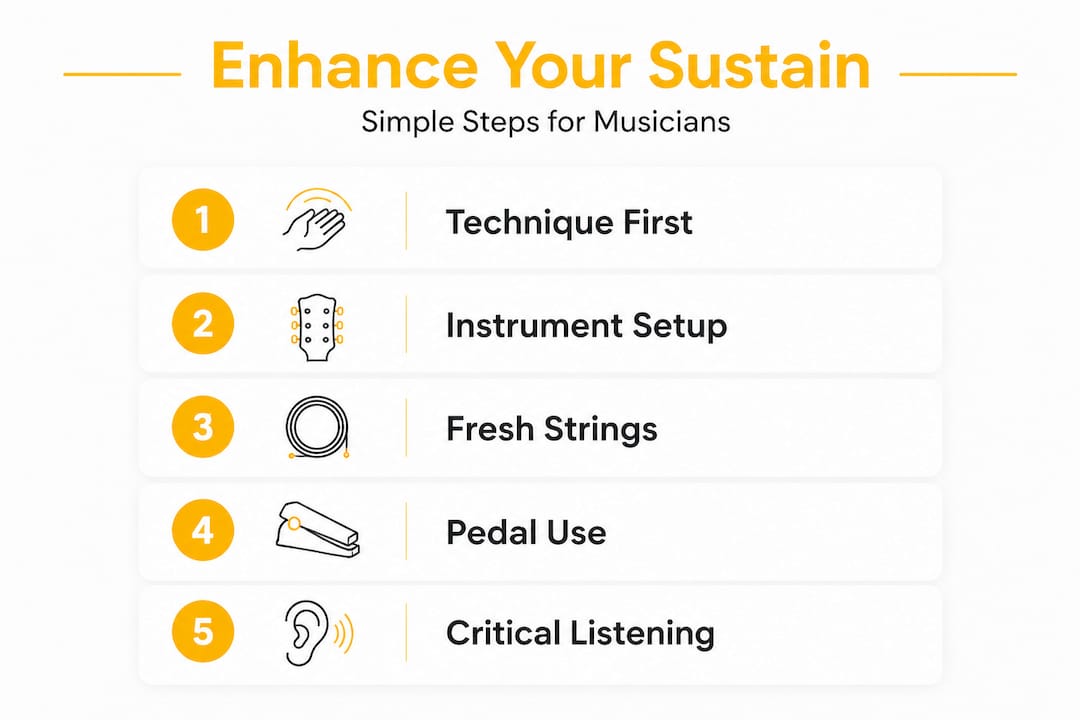
Performance technique comes first. On guitar, how hard you fret notes, the angle and pressure of your pick, and even how you release a note all affect sustain noticeably. Fretting closer to the fret rather than behind it reduces unwanted buzz and keeps notes ringing longer. On piano, syncopated pedal technique is the single biggest technique upgrade most intermediate players can make for cleaner sustain.
Accessories that shape sustain:
Learning how to choose the right guitar accessories for sustain can have a surprisingly large impact on your tone. Compressor pedals are among the most effective for guitarists, as they even out the volume envelope and artificially extend the decay phase of a note. Sustain pedals for guitar rigs, ebow devices, and even certain slide techniques all push sustain in different directions.
Step-by-step guide to improving your sustain:
- Assess your current sustain by playing a clean note without effects and counting how long it rings clearly
- Check your setup for any loose hardware, worn frets, or poorly seated nut slots that may be killing vibration
- Experiment with string gauge — moving from light to medium gauge can noticeably increase sustain on electric and acoustic guitars
- Try a compressor pedal and adjust the sustain and attack settings to hear exactly how it changes your note length
- Review your pedalling technique if you play piano, recording yourself to identify whether muddy patches coincide with pedal changes
- Test amplifier settings as guitar sustain is heavily shaped by your amp’s gain, volume, and tone stack
Good instrument maintenance for sustain is non-negotiable if you want consistent results. Dirty or oxidised strings lose sustain quickly. A piano with worn damper felts will have inconsistent pedal response. Loose tuning machines on a guitar bleed energy from the string before it can sustain.
Pro Tip: Before investing in new gear to improve sustain, try a fresh set of strings. It’s the cheapest and most immediate upgrade available to guitarists, and the difference between dead strings and new ones in terms of sustain is often more dramatic than changing pickups or adding effects.
Why most musicians overcomplicate sustain (and what actually matters)
Here’s an opinion that might challenge your current thinking: the pursuit of more sustain is often a distraction from more fundamental musical priorities.
We see this constantly in the guitar world. Players spend hours researching tonewoods, upgrading hardware, testing pickups, and comparing different instruments, all in the hope of unlocking that extra fraction of sustain. Meanwhile, their fretting technique, string setup, and playing context are doing far more to determine what the listener actually hears.
The research on soundboard damping perception reinforces this point powerfully. Factors that seem significant in isolation often fail to produce meaningful perceptual differences in real listening situations. What does make a difference is whether the musician is using the right amount of sustain for the musical moment.
Think about it this way. A beautifully sustained note played in the wrong rhythmic context doesn’t sound expressive; it sounds messy. A perfectly short, tight note played exactly where the groove demands it sounds absolutely authoritative. The emotional power of sustain comes from contrast and context, not from raw duration.
We’d also argue that many musicians conflate sustain with quality when assessing instruments. A guitar that sustains for ten seconds isn’t automatically better than one that sustains for five. The relationship between guitar finish and tone is a good example: players chase certain finishes believing they’ll unlock sustain, when the real variable is often something far more practical like string condition or setup.
Great music needs both presence and clarity, not just endless resonance. The musician who masters when to sustain and when to stop will always outperform one who simply chases more.
The most effective approach is to develop your ear for sustain in context. Listen critically to recordings you admire and notice how sustain is being used not as a constant feature but as a variable tool. Then practise controlling it deliberately in your own playing before reaching for a new piece of gear.
Find your perfect sustain with MusicStreet
Whether you’re a guitarist hunting for the right setup to nail expressive lead lines or a pianist looking to explore instruments with better damper response, getting hands-on with quality gear makes all the difference.

At MusicStreet, we stock a carefully chosen range of electric guitars, acoustic guitars, and accessories that cater to players at every level. Our team in Huntingdon, Cambridgeshire genuinely understands sustain as a practical concern, not just a spec on a product page. Whether you want to try instruments in person, get personalised advice on pedals and string gauges, or explore our pre-loved guitars for outstanding tone at great value, we’re here to help you find what actually works for your playing. Visit us online or in store and let’s find your sound together.
Frequently asked questions
What does ‘sustain’ mean in music performance?
Sustain is the duration that a note remains audible after it is played, influenced by playing technique and instrument design. On guitar it manifests as slow string decay rate, while on piano it is primarily managed through the damper pedal.
Why do soloists want long sustain, while rhythm players may not?
Long sustain adds expression and colour to solos, but short sustain keeps rhythm parts clear and distinct. Research confirms that the ideal sustain length is always determined by musical context and role rather than a universal preference.
Does the piano’s sustain pedal always make a song sound better?
Not always. Overusing the sustain pedal causes harmonic mud, particularly during chord changes. Using syncopated or half-pedalling techniques maintains clarity while still capturing the richness of sustained resonance.
Is there a way to increase sustain on my instrument?
Yes. Technique improvements, fresh strings, compressor pedals, and proper instrument maintenance can all enhance sustain on both guitar and piano. Starting with a professional setup and good-quality strings is often the most cost-effective first step before exploring effects or hardware upgrades.





Share:
Top 5 Common Electric Guitar Problems Every Musician Should Know About and Fix
Explore 10 guitar genres to expand your playing skills